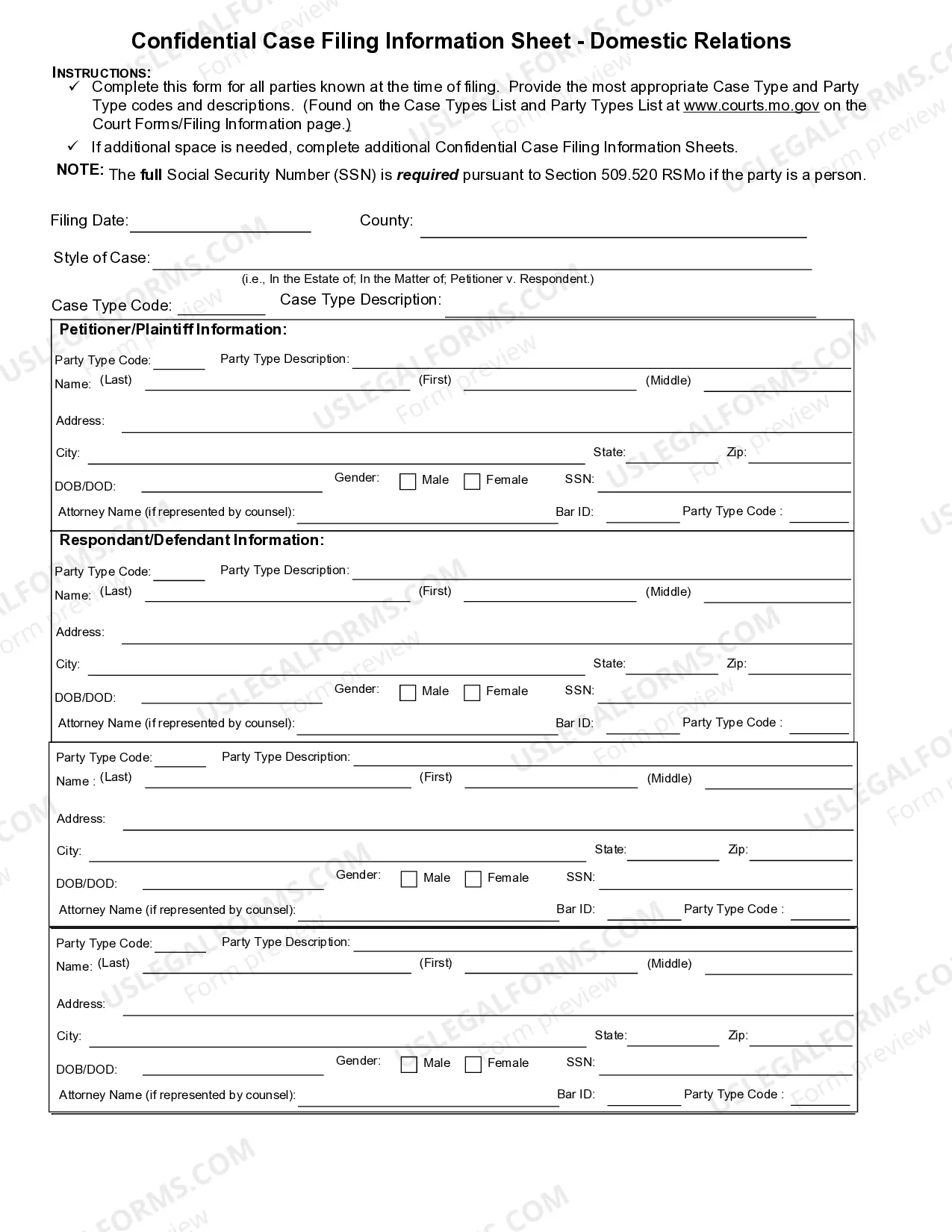
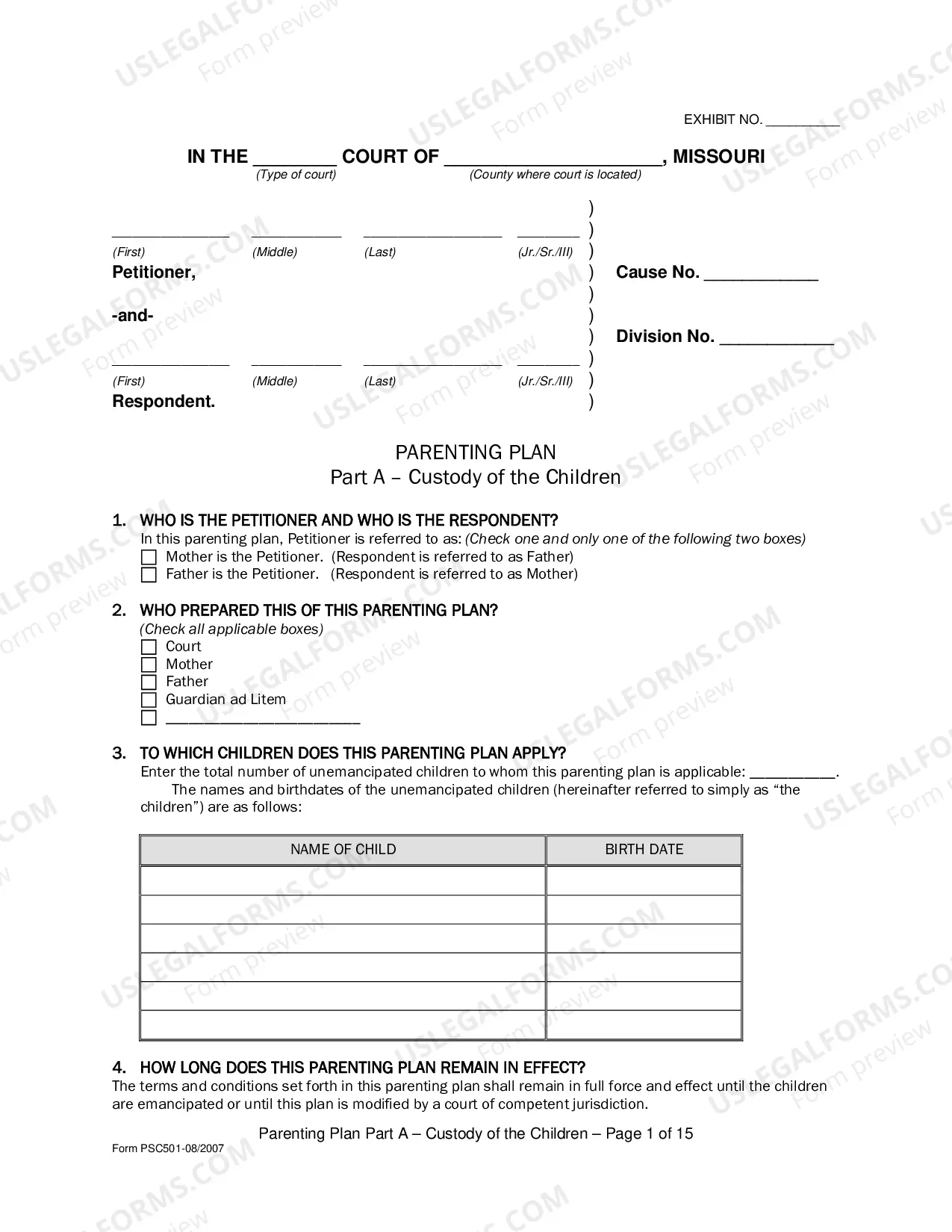
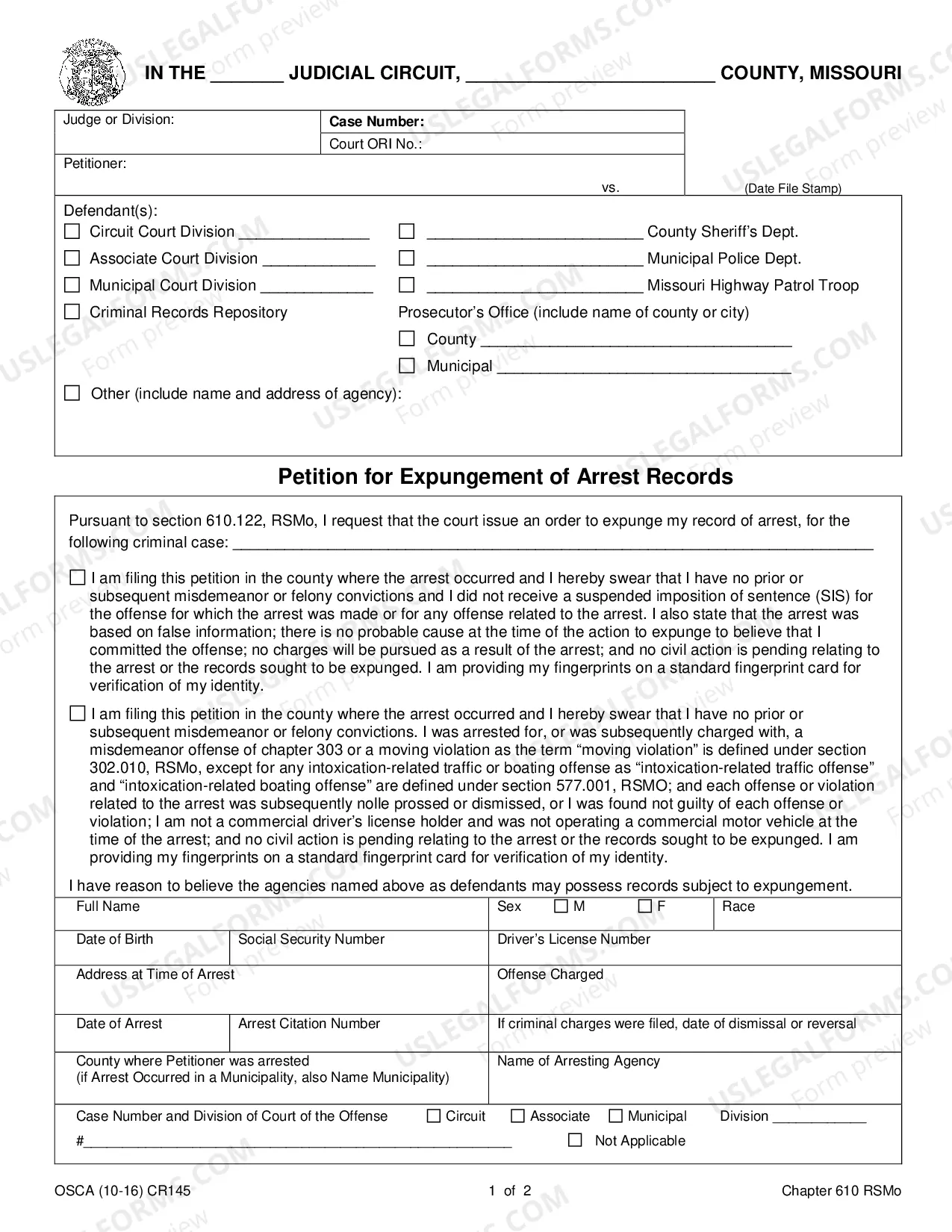
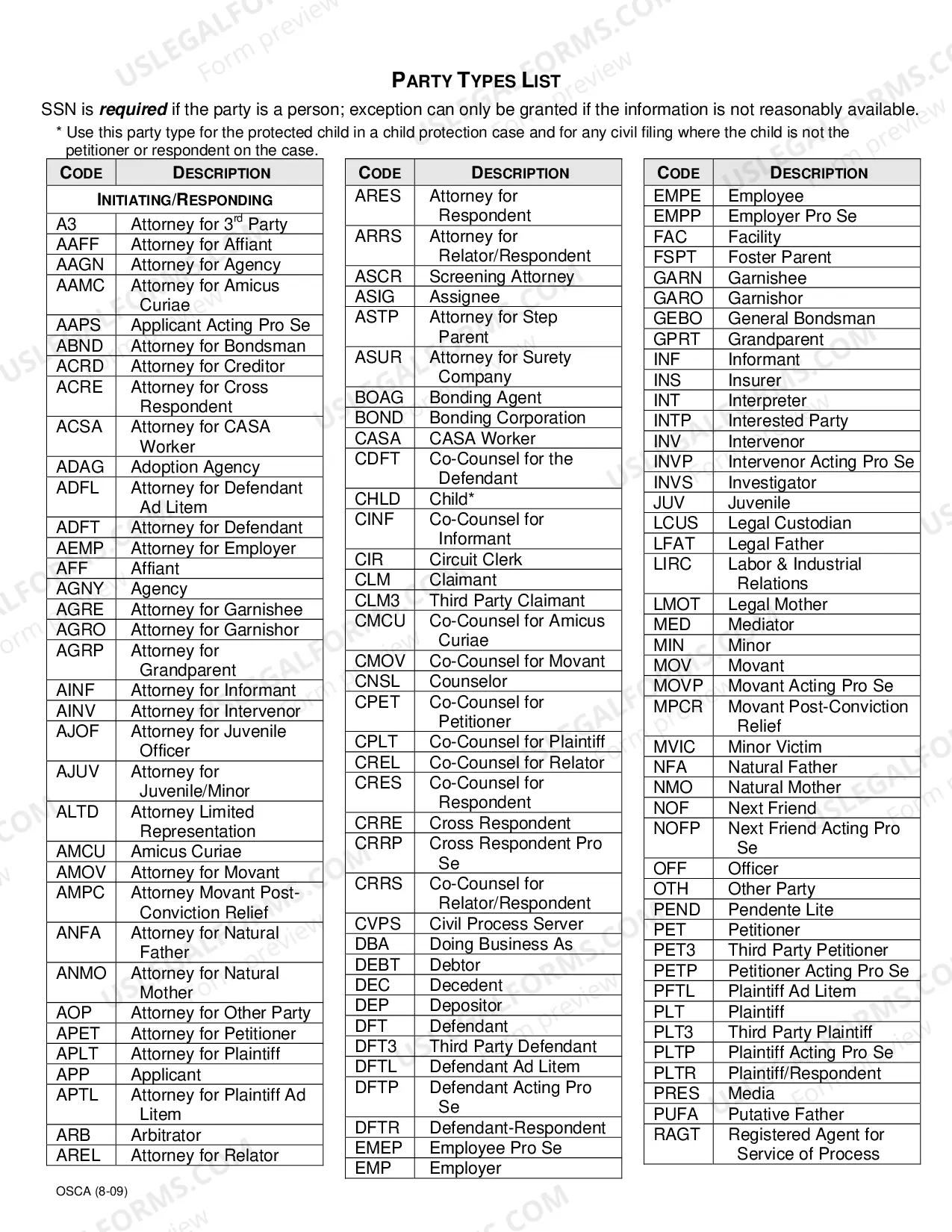
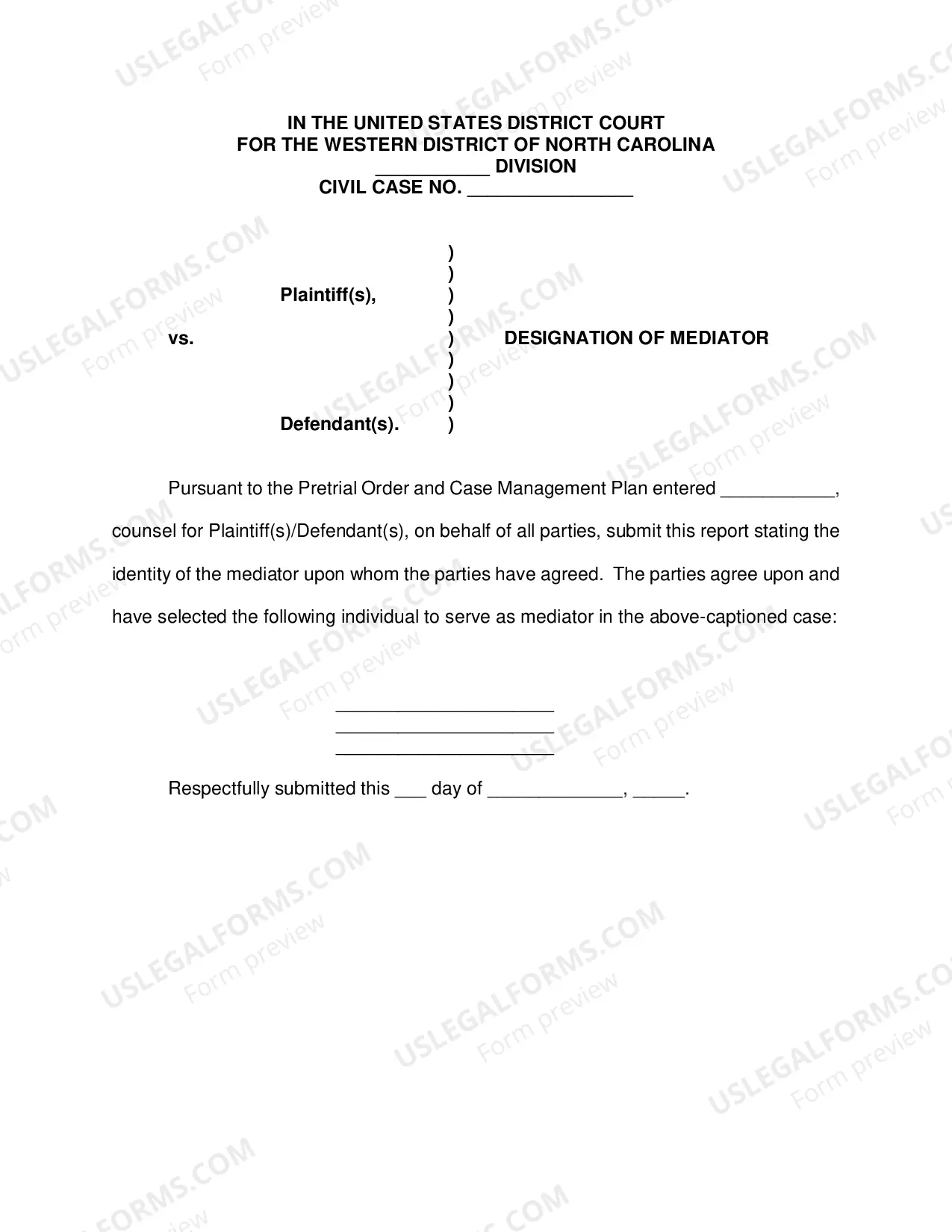
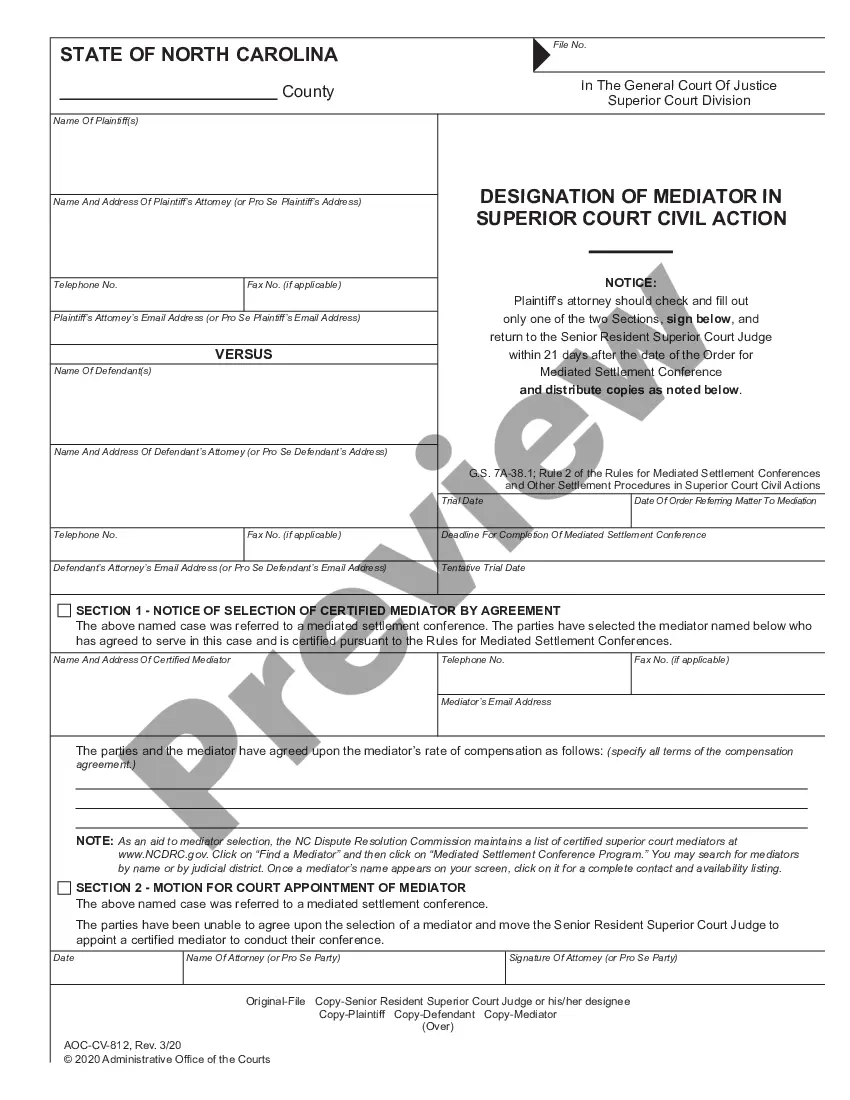
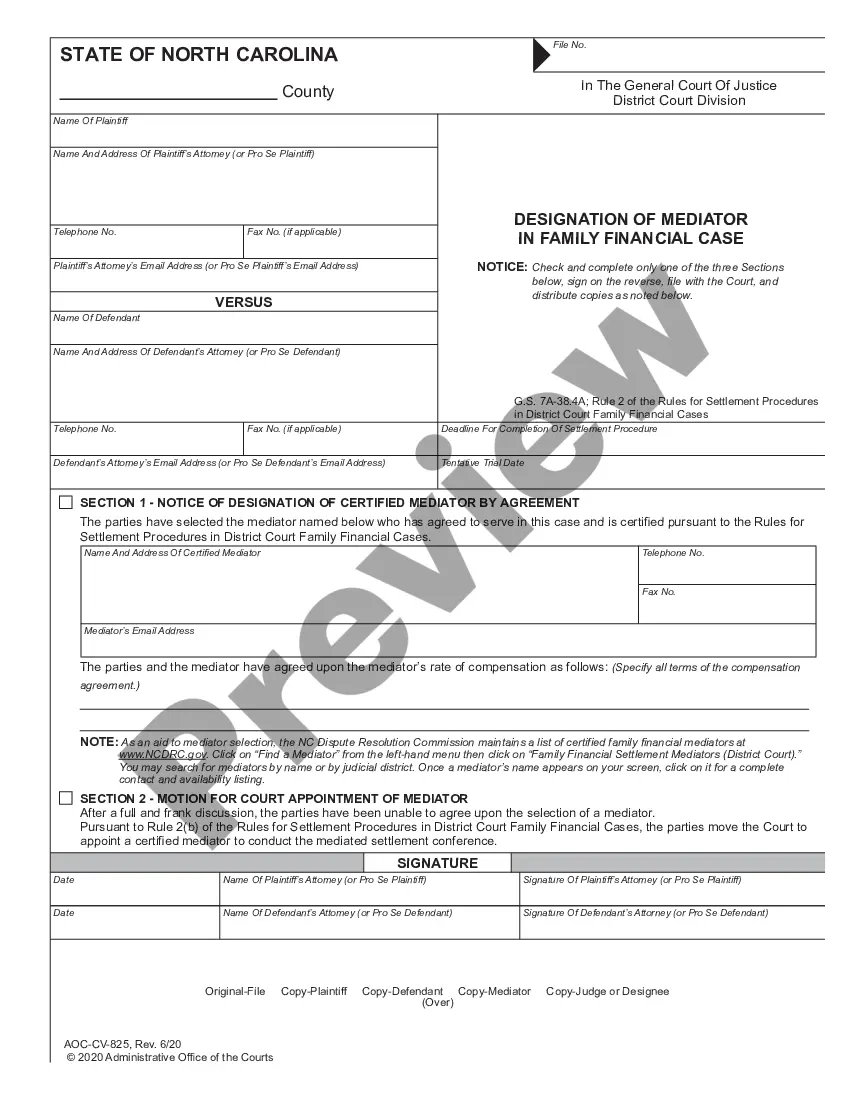
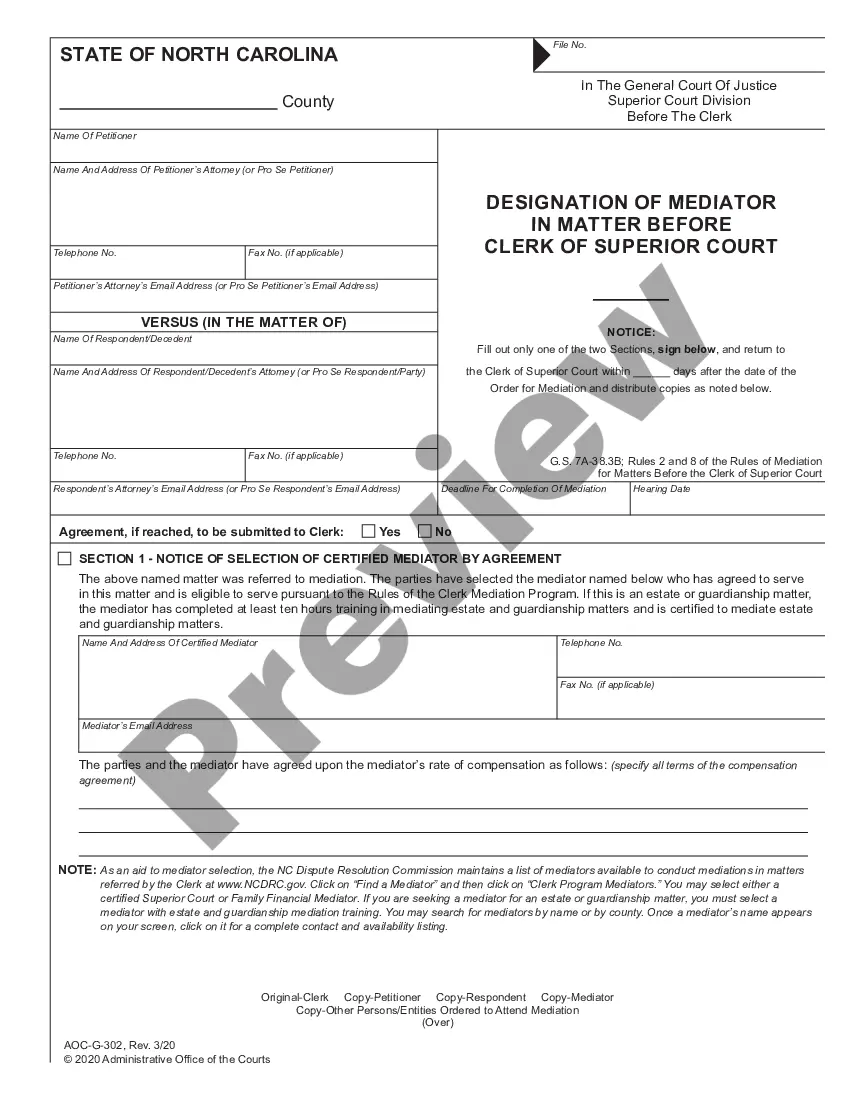
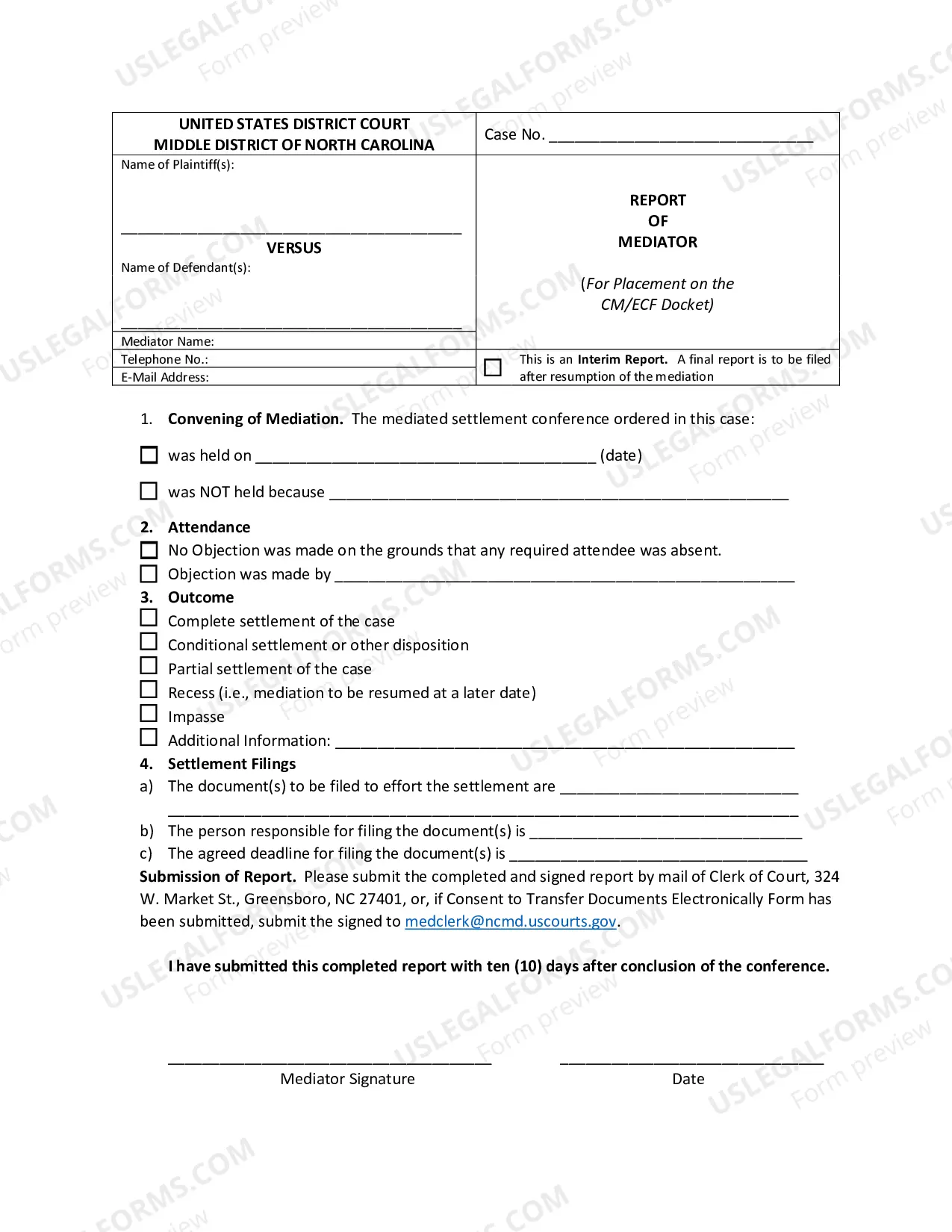
North Carolina Designation of Mediator is a process that enables a mediator to be appointed by a court of law, with the approval of both parties involved in a dispute. The mediator is responsible for helping the parties reach a settlement agreement through facilitated negotiation. The North Carolina Designation of Mediator process is commonly used to resolve disputes in divorce cases, family law matters, employment disputes, and civil litigation. There are two types of North Carolina Designation of Mediator: General Mediators and Specialized Mediators. General Mediators are appointed by the court when a dispute requires the attention of a neutral third-party. Specialized Mediators are appointed when the parties involved agree that the dispute requires the services of an expert in a specific area such as real estate, business transactions, or tax law. The mediator is required to adhere to the North Carolina Rules of Professional Conduct, which sets out the ethical standards for all mediators.
North Carolina Designation of Mediator
Description
Get your form ready online
Our built-in tools help you complete, sign, share, and store your documents in one place.
Make edits, fill in missing information, and update formatting in US Legal Forms—just like you would in MS Word.
Download a copy, print it, send it by email, or mail it via USPS—whatever works best for your next step.
Sign and collect signatures with our SignNow integration. Send to multiple recipients, set reminders, and more. Go Premium to unlock E-Sign.
If this form requires notarization, complete it online through a secure video call—no need to meet a notary in person or wait for an appointment.
We protect your documents and personal data by following strict security and privacy standards.

Make edits, fill in missing information, and update formatting in US Legal Forms—just like you would in MS Word.

Download a copy, print it, send it by email, or mail it via USPS—whatever works best for your next step.

Sign and collect signatures with our SignNow integration. Send to multiple recipients, set reminders, and more. Go Premium to unlock E-Sign.

If this form requires notarization, complete it online through a secure video call—no need to meet a notary in person or wait for an appointment.

We protect your documents and personal data by following strict security and privacy standards.
Looking for another form?
How to fill out North Carolina Designation Of Mediator?
Creating official documents can be quite a hassle if you lack accessible fillable templates. With the US Legal Forms online repository of formal paperwork, you can trust the forms you acquire, as all of them adhere to federal and state laws and are reviewed by our experts.
Obtaining your North Carolina Designation of Mediator from our platform is straightforward. Previously registered users with an active subscription just need to Log In and hit the Download button once they locate the correct template. Later, if necessary, users can access the same document from the My documents section of their account. However, even if you are a newcomer to our service, signing up for a valid subscription will only take a few minutes. Here’s a quick guide for you.
Haven’t you utilized US Legal Forms yet? Subscribe to our service now to acquire any formal document swiftly and effortlessly whenever you need it, and maintain your paperwork organized!
- Document compliance verification. You should carefully examine the contents of the form you wish for and ensure it meets your requirements and complies with your state laws. Previewing your document and checking its overall description will assist you in doing so.
- Alternative search (optional). If there are any discrepancies, navigate the library using the Search tab at the top of the page until you discover a suitable template, and click Buy Now when you identify the one you require.
- Account creation and form acquisition. Register for an account with US Legal Forms. After account confirmation, Log In and select your desired subscription plan. Make a payment to continue (PayPal and credit card options are offered).
- Template retrieval and subsequent usage. Select the file format for your North Carolina Designation of Mediator and click Download to store it on your device. Print it to fill out your documents manually, or utilize a feature-rich online editor to prepare an electronic copy more quickly and efficiently.
Form popularity
FAQ
Don't raise your voice or say swear words during the process. Instead, work on regulating your own emotions. It's okay to express your emotions constructively, but too much anger during mediation can certainly get you in trouble.
Complete a 4-year college degree from an accredited university or college, Take a 6-Hour Introduction to NC Courts course, Take a 40-hour Civil Superior Court Mediation Training with a DRC-approved trainer, Observe five mediations from start to finish as outlined in Rule 8,
To be certified as an attorney mediator an applicant must: Be a member in good standing of the N.C. State Bar or a member similarly in good standing of the Bar of another state; Have completed a minimum of 40 hours in a Trial Court Mediation Training Program certified by the N.C. Dispute Resolution Commission;
A mediator does not have decision-making power. You and your spouse make the decisions in your divorce while the mediator provides the information and guidance needed to facilitate successful negotiations. Being in control of your own divorce may seem risky.
You must hire a private mediator in order to attempt to settle equitable distribution before you will be entitled to have a trial in front of a judge. Mediation in this context is mandatory and failure to participate can lead to sanctions by the court.
Mediation is a way of sorting any differences between you and your ex-partner, with the help of a third person who won't take sides. The third person is called a mediator. They can help you reach an agreement about issues with money, property or children.
The mediator assists and guides the parties toward their own resolution. The mediator does not decide the outcome, but helps the parties understand and focus on the important issues needed to reach a resolution.
The mediator assists and guides the parties toward their own resolution. The mediator does not decide the outcome, but helps the parties understand and focus on the important issues needed to reach a resolution.