Tenant Removal Clauses: Contract for Real Property
About this form
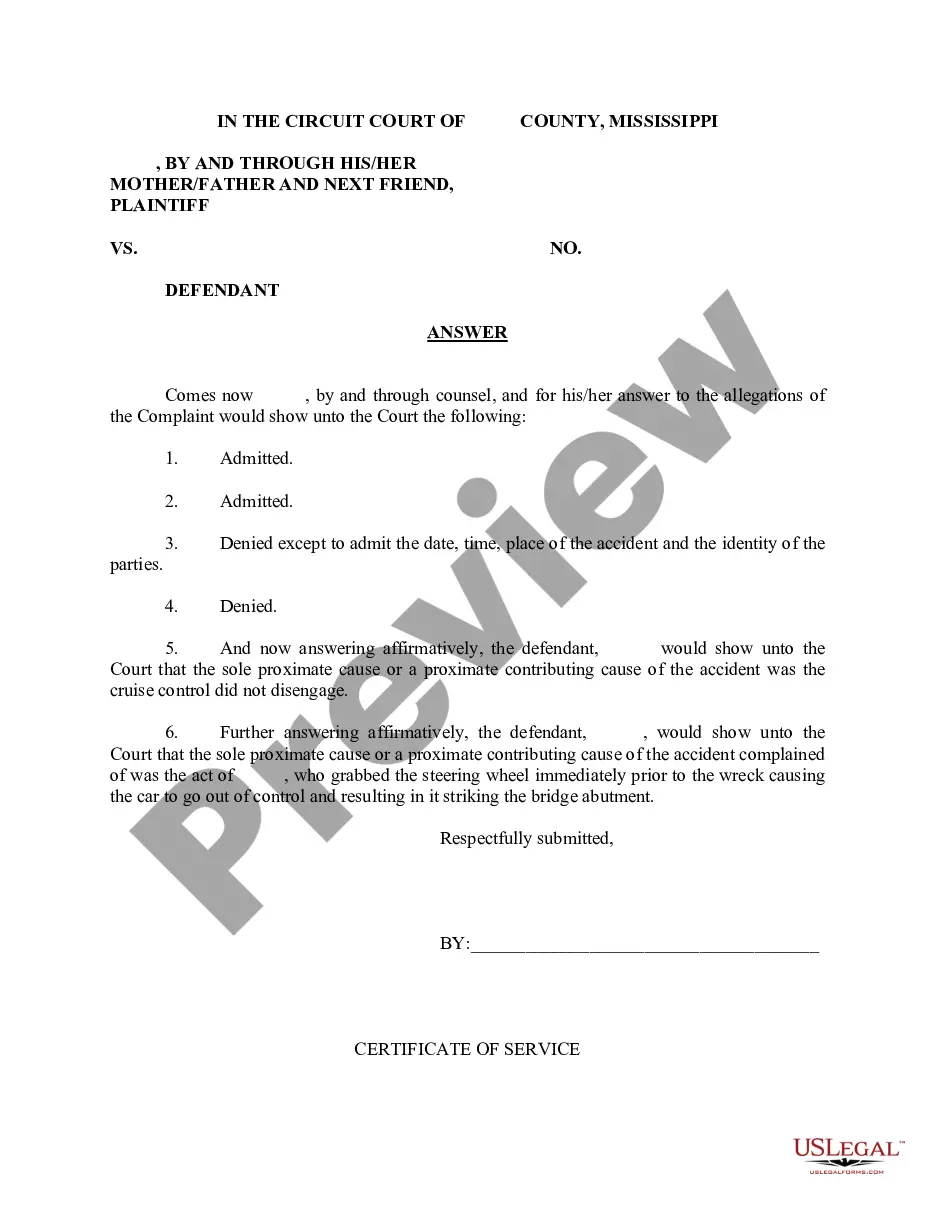
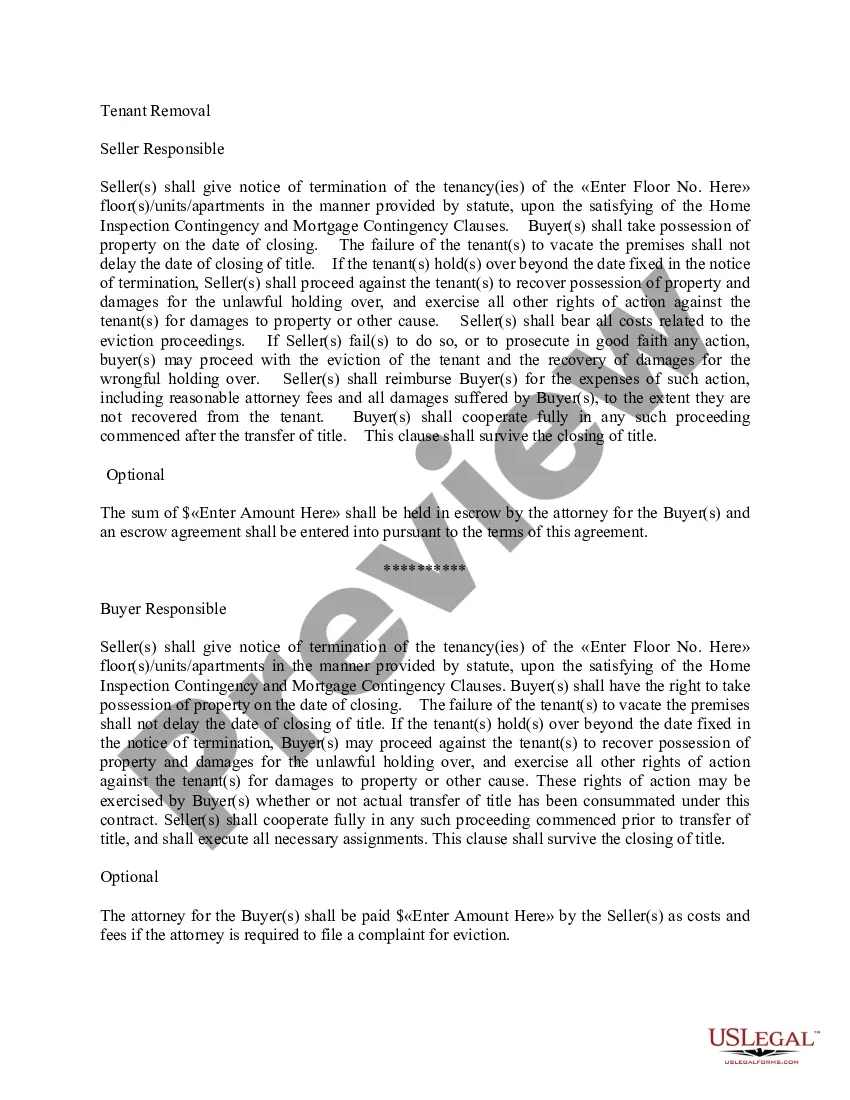
The Tenant Removal Clauses: Contract for Real Property is a legal document that outlines the responsibilities of sellers and buyers regarding tenants who remain on the property after a sale. This form provides two versions: one where the seller is responsible for notifying tenants to vacate, and another where the buyer assumes that responsibility. This form is essential for ensuring a clear understanding of the eviction process in real estate transactions involving occupied properties.
What’s included in this form
- Notice of termination requirements for tenants
- Provisions regarding the responsibilities of sellers and buyers
- Clauses addressing the handling of tenant holdover situations
- Escrow provisions for security deposits if applicable
- Assignment and cooperation clauses for eviction proceedings


Situations where this form applies
This form is needed when a property is sold and tenants are still residing in the units. It applies in situations where a seller must inform tenants of their eviction or when a buyer wishes to assume responsibilities related to tenant removal. This form safeguards both parties by clarifying the expectations and procedures connected to tenant holdover after the closing of a real estate transaction.
Who can use this document
- Property sellers who need to handle tenant evictions.
- Property buyers who wish to ensure they have rights over tenants.
- Real estate agents involved in transactions with existing tenants.
- Landlords seeking to understand the implications of tenant holdover during a sale.
Completing this form step by step
- Identify the parties involved, including the seller, buyer, and tenants.
- Specify the property address and relevant floor numbers or units.
- Enter the appropriate notice and termination clauses, indicating responsibilities.
- Include any escrow amounts as necessary for deposits or attorney fees.
- Ensure all parties sign and date the form where required.
Is notarization required?
This form does not typically require notarization unless specified by local law. However, it is advisable to confirm any notarization requirements that may apply in your jurisdiction to ensure the legal efficacy of the document.
Get your form ready online
Our built-in tools help you complete, sign, share, and store your documents in one place.
Make edits, fill in missing information, and update formatting in US Legal Forms—just like you would in MS Word.
Download a copy, print it, send it by email, or mail it via USPS—whatever works best for your next step.
Sign and collect signatures with our SignNow integration. Send to multiple recipients, set reminders, and more. Go Premium to unlock E-Sign.
If this form requires notarization, complete it online through a secure video call—no need to meet a notary in person or wait for an appointment.
We protect your documents and personal data by following strict security and privacy standards.

Make edits, fill in missing information, and update formatting in US Legal Forms—just like you would in MS Word.

Download a copy, print it, send it by email, or mail it via USPS—whatever works best for your next step.

Sign and collect signatures with our SignNow integration. Send to multiple recipients, set reminders, and more. Go Premium to unlock E-Sign.

If this form requires notarization, complete it online through a secure video call—no need to meet a notary in person or wait for an appointment.

We protect your documents and personal data by following strict security and privacy standards.
Common mistakes to avoid
- Failing to provide adequate notice to tenants.
- Not specifying the correct responsibilities in buyer versus seller clauses.
- Ignoring state-specific legal requirements for eviction notices.
- Omitting signatures or dates from the document.
Why use this form online
- Convenience of easy access and download at any time.
- Editable templates to fit individual property and transaction needs.
- Reliability from professionally drafted legal forms that comply with applicable laws.
- Quick turnaround for filling out and using the form appropriately.
Looking for another form?
Form popularity
FAQ
Tenant Rights and Responsibilities ing to California landlord-tenant laws, tenants have the right to live in safe, habitable rental units, as well as sue the landlord for retaliation, withhold rent for failure to provide essential services, recover attorney's fees, and more.
The traditional transfer clause is tied to your occupation. While the exact terms of the transfer clause vary, they usually allow you to break your lease if you have to relocate a certain distance for a new job. The clause typically requires you to give 30-day notice and pay a month's rent or forfeit a month's deposit.
Even without a written and signed lease agreement between a landlord and a tenant, California law considers this tenancy to have a ?verbal agreement.? This type of agreement defaults to a month-to-month agreement and both landlord and tenants are subject to California Civil Code.
For example, consider a farm owner who gives a fellow farmer an easement to use a path on their property so that the sheep can get to a watering hole. The shepherd later sells their flock and moves out of the state, with no intention of returning.
The landlord can include you in an eviction (unlawful detainer) court case even if your name is not on the lease or rental agreement.
Abandonment is defined as the absence of the Tenants from the Property for at least consecutive days without notice to Landlord.
Your rights as a tenant in California include: Refundable security deposits. The right to information (about mold, utilities, etc.) The right to make claims in small claims court. Rent control.
Even if you don't have a lease, a California landlord can't kick you to a curb without warning. If the landlord wants you gone, he's required to give you at least 30 days' notice on a month-to-month tenancy. There are exceptions, though -- circumstances in which the landlord can give you just three days to get out.