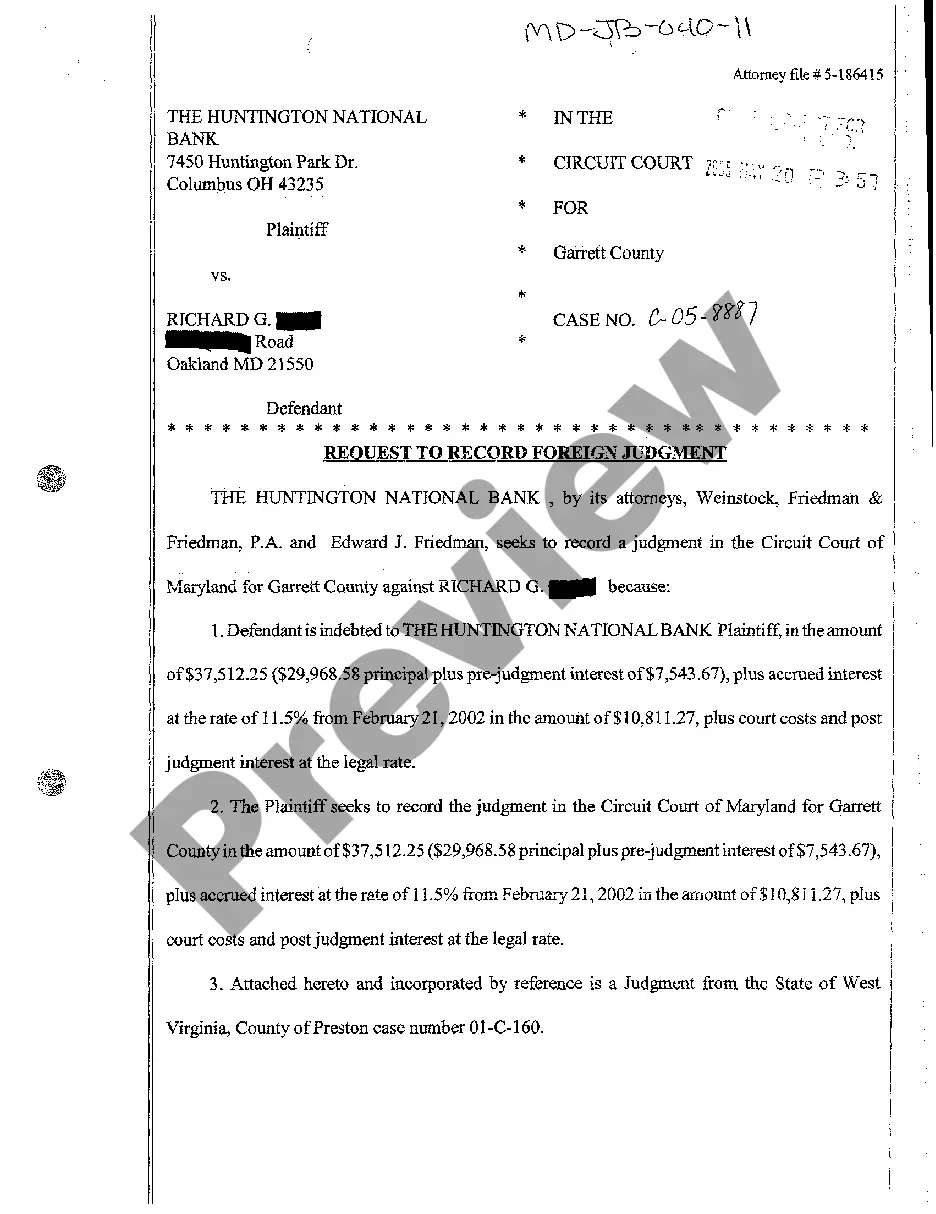
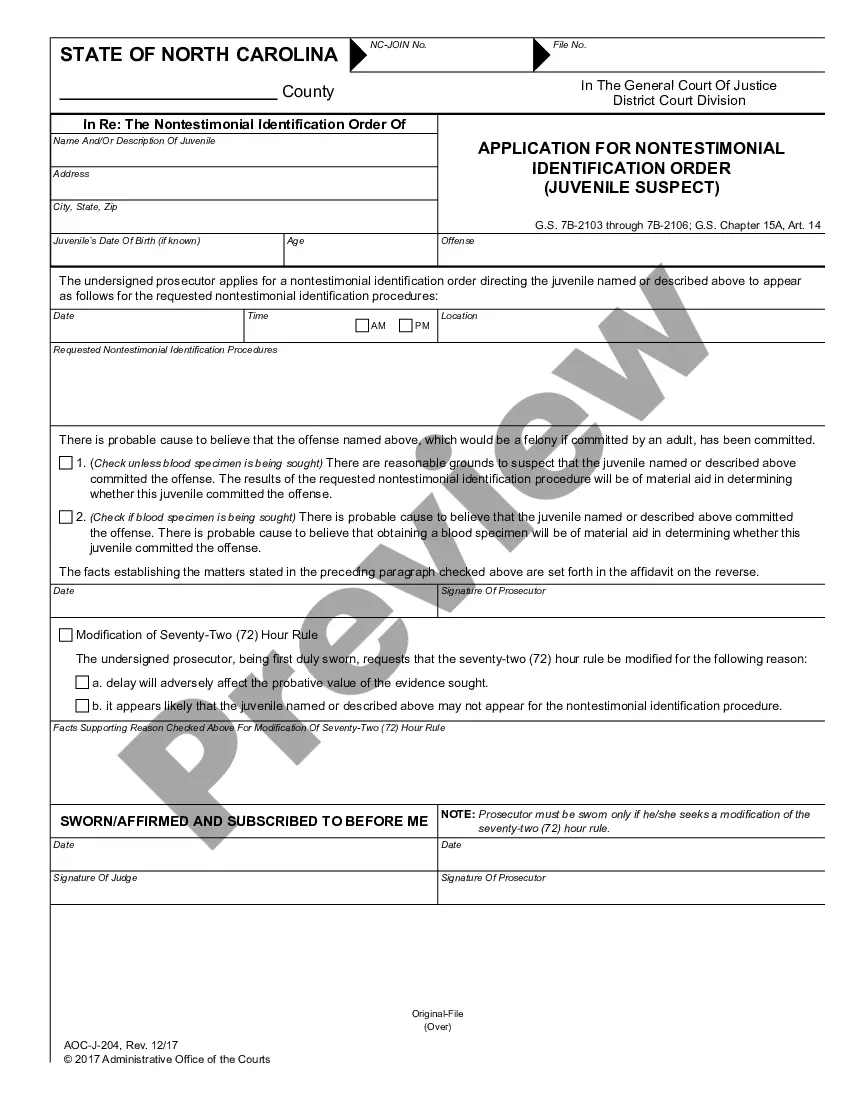
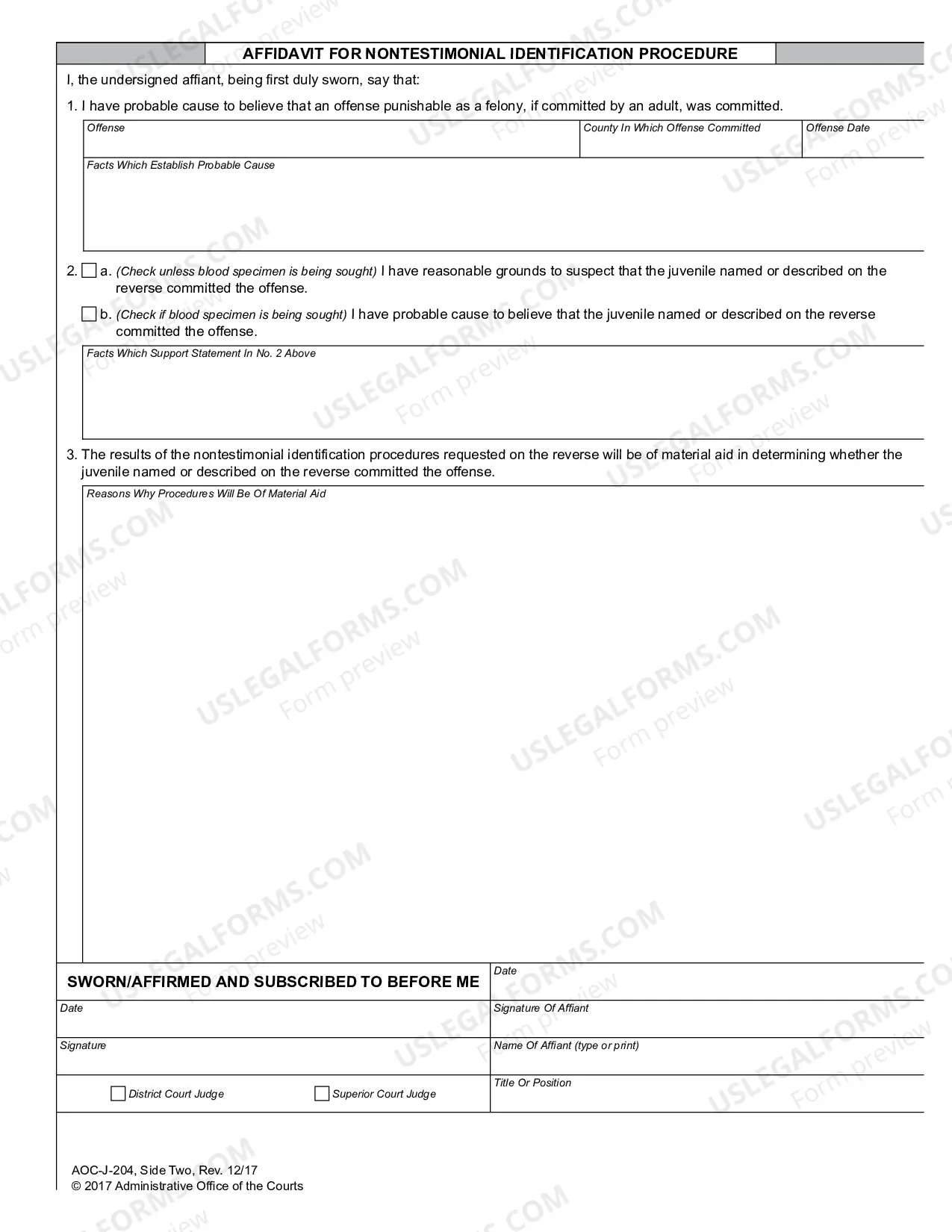
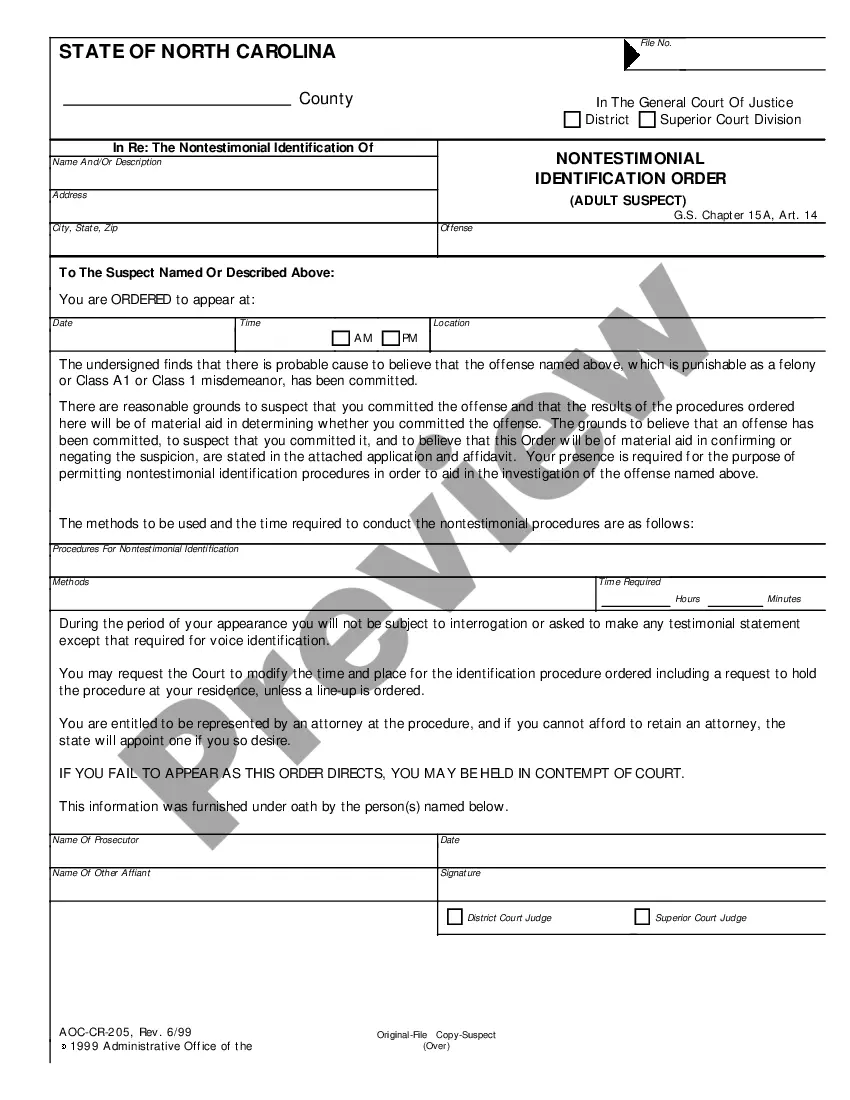
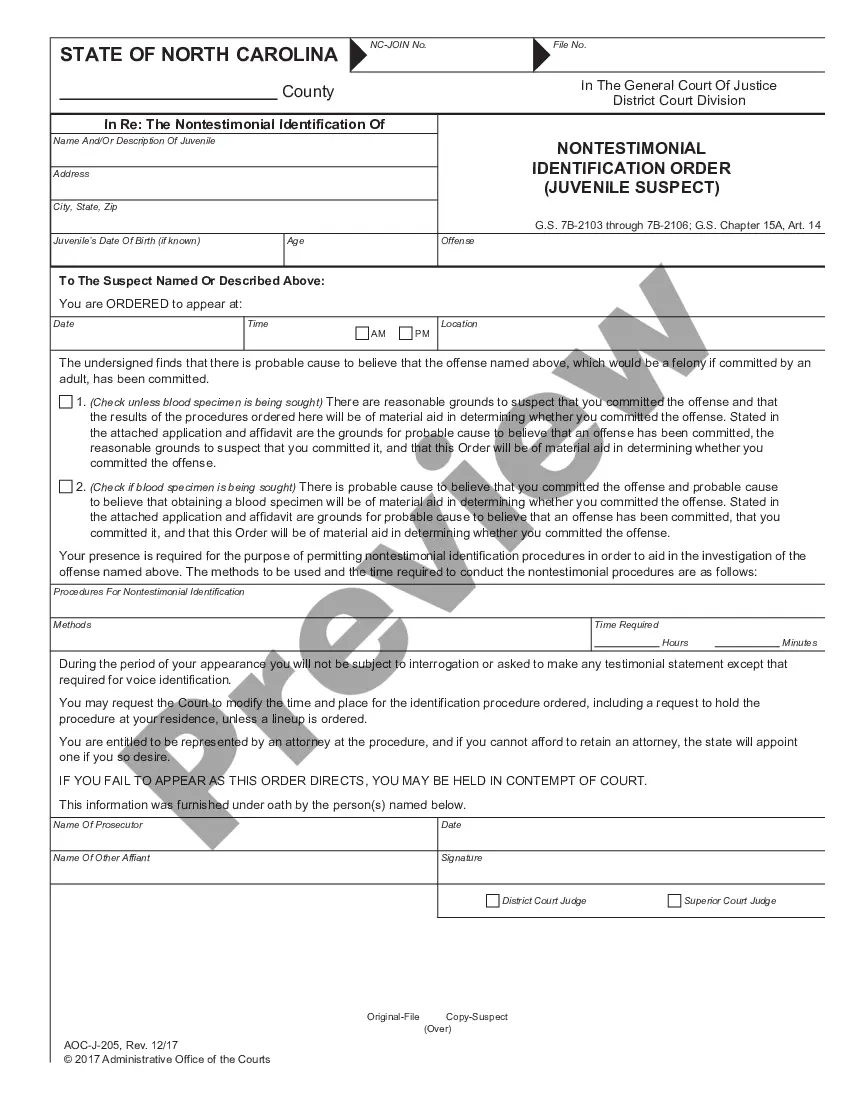
This is an Application for Nontestimonial Identification Order (Juvenile Suspect). This is an official form from the North Carolina Administration of the Courts (AOC), which complies with all applicable laws and statutes. USLF amends and updates the forms as is required by North Carolina statutes and law.
North Carolina Application for Nontestimonial Identification Order - Juvenile Suspect
Instant download
This website is not affiliated with any governmental entity
Public form
Description
Free preview
Get your form ready online
Our built-in tools help you complete, sign, share, and store your documents in one place.
Built-in online Word editor
Make edits, fill in missing information, and update formatting in US Legal Forms—just like you would in MS Word.
Export easily
Download a copy, print it, send it by email, or mail it via USPS—whatever works best for your next step.
E-sign your document
Sign and collect signatures with our SignNow integration. Send to multiple recipients, set reminders, and more. Go Premium to unlock E-Sign.
Notarize online 24/7
If this form requires notarization, complete it online through a secure video call—no need to meet a notary in person or wait for an appointment.
Store your document securely
We protect your documents and personal data by following strict security and privacy standards.

Make edits, fill in missing information, and update formatting in US Legal Forms—just like you would in MS Word.

Download a copy, print it, send it by email, or mail it via USPS—whatever works best for your next step.

Sign and collect signatures with our SignNow integration. Send to multiple recipients, set reminders, and more. Go Premium to unlock E-Sign.

If this form requires notarization, complete it online through a secure video call—no need to meet a notary in person or wait for an appointment.

We protect your documents and personal data by following strict security and privacy standards.
Looking for another form?

How to fill out North Carolina Application For Nontestimonial Identification Order - Juvenile Suspect?
Steer clear of expensive lawyers and locate the North Carolina Application for Nontestimonial Identification Order - Juvenile Suspect you require at a fair price on the US Legal Forms website. Utilize our straightforward groups feature to search for and download legal and tax documents. Review their descriptions and inspect them thoroughly before downloading. Additionally, US Legal Forms offers users with detailed instructions on how to acquire and fill out each template.
US Legal Forms users only need to Log In and download the exact form they require to their My documents section. Those who have yet to purchase a subscription should adhere to the following guidelines.
After downloading, you can complete the North Carolina Application for Nontestimonial Identification Order - Juvenile Suspect by hand or using editing software. Print it out and reuse the template multiple times. Achieve more for less with US Legal Forms!
- Ensure the North Carolina Application for Nontestimonial Identification Order - Juvenile Suspect is permissible for use in your area.
- If possible, read the description and utilize the Preview function before downloading the document.
- If you are confident the template is suitable for you, click Buy Now.
- If the template is incorrect, employ the search tool to find the appropriate one.
- Next, establish your account and select a subscription plan.
- Make payment via card or PayPal.
- Choose to download the document in PDF or DOCX format.
- Simply click Download and locate your template in the My documents section. Feel free to save the document to your device or print it out.
Form popularity
FAQ
(Sentencing) The final stage in the processing of adjudicated juveniles in which a decision is made on the form of treatment or penalty that should be imposed on the child.
Legal Definition of Juvenile In the eyes of the law, a juvenile or a minor is any person under the legal adult age. This age varies from state to state, but in most states the legal age of majority is 18.
Police officers generally bring in or summon young offenders to the police department's juvenile division and question, fingerprint, book and, if necessary, detain them. At the time of an arrest, officers decide whether to refer young offenders to juvenile court or to route these cases out of the justice system.
There is no minimum age to be sent to juvenile court if you are charged with a crime. Children as young as 6 years old have been sent to juvenile court and accused of being a delinquent.
The juvenile justice process involves nine major decision points: (1) arrest, (2) referral to court, (3) diversion, (4) secure detention, (5) judicial waiver to adult criminal court, (6) case petitioning, (7) delinquency finding/adjudication, (8) probation, and (9) residential placement, including confinement in a
The juvenile justice system underwent a process that has been described as the four Ds: (1) Decriminalization, that is, taking status offenders out from delinquency definitions and constraining court authority with these youths; (2) Diversion from the court of lesser offenders, including status offenders; (3) Due
Intake: The process used for every youth referred to juvenile court. Intake involves screening each youth to determine the appropriateness for release or referral to a diversionary program or agency for nonofficial or nonjudicial handling.
New Laws under Senate Bill 439 SB 439 states that California's juvenile court has jurisdiction over a minor when: The minor is between 12 and 17 years of age; and, The minor violates any law of California, or the United States, or a municipal ordinance.
The Juvenile Assessment and Intervention System2122 (JAIS) is a supervision model that builds rapport between a young person and a worker while bringing valuable information to the surface.The gender-specific risk assessment used in JAIS is research-based and has been employed and validated widely.