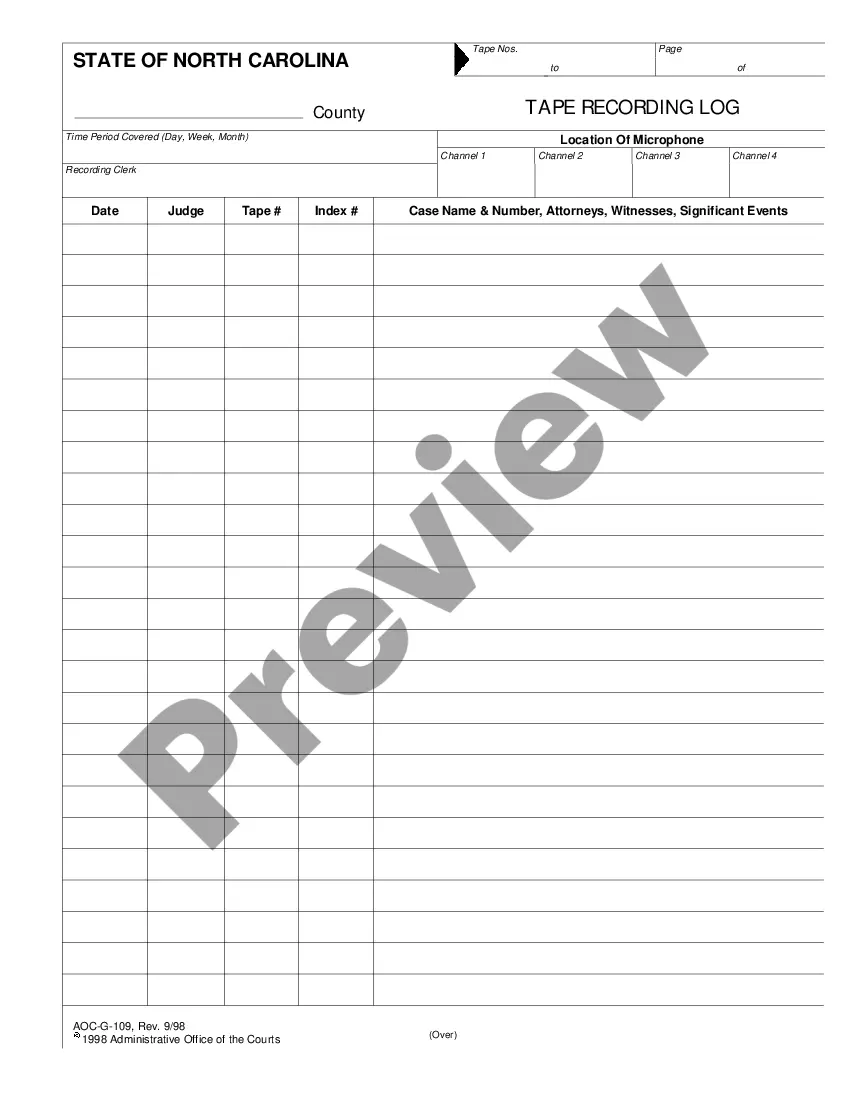
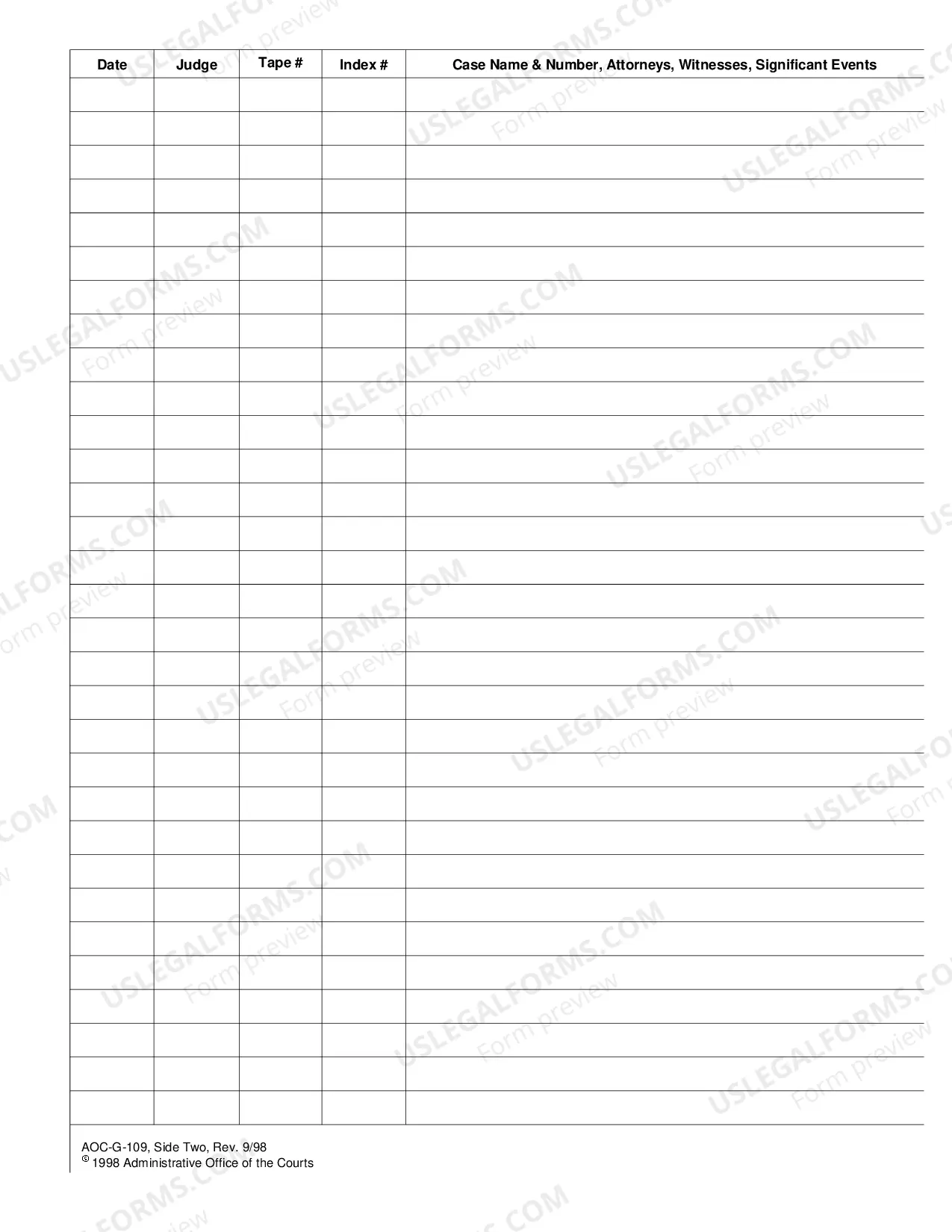
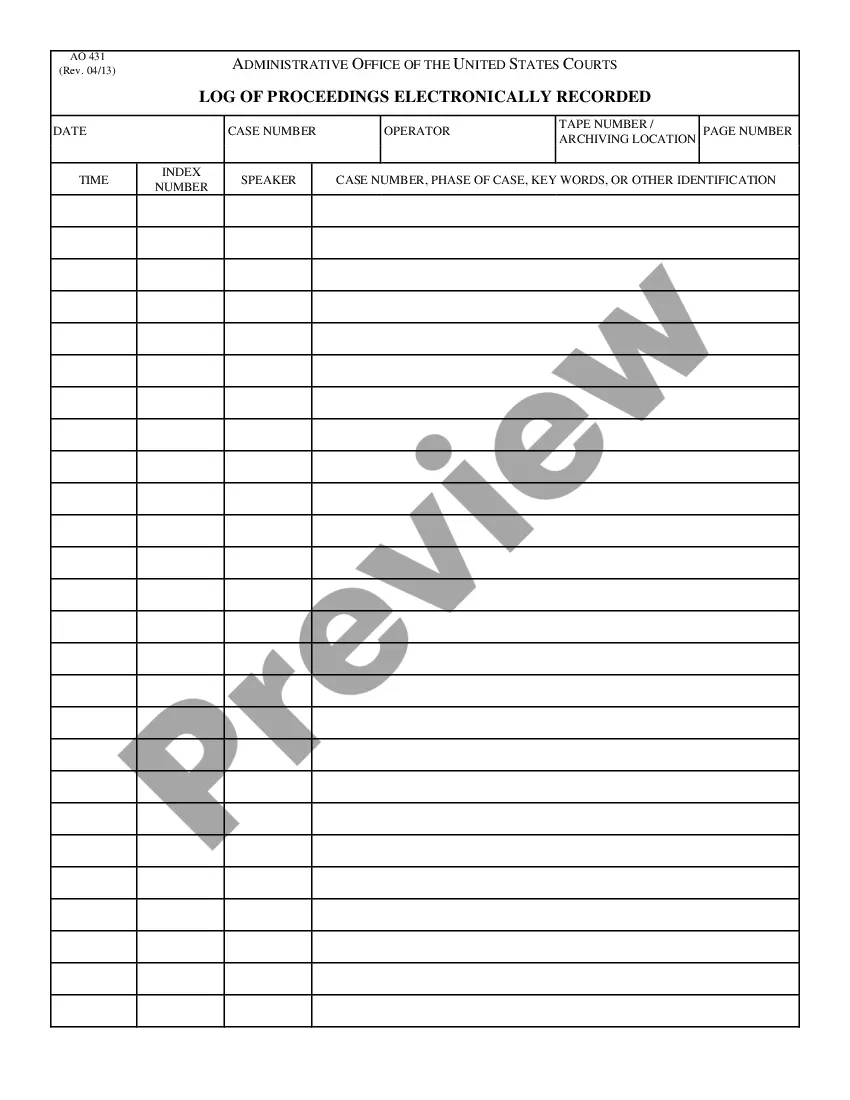
Tape Recording Log: This is an official form from the North Carolina Administration of the Courts (AOC), which complies with all applicable laws and statutes. USLF amends and updates the forms as is required by North Carolina statutes and law.
North Carolina Tape Recording Log
Instant download
This website is not affiliated with any governmental entity
Public form
Description
Free preview

Get your form ready online
Our built-in tools help you complete, sign, share, and store your documents in one place.
Built-in online Word editor
Make edits, fill in missing information, and update formatting in US Legal Forms—just like you would in MS Word.
Export easily
Download a copy, print it, send it by email, or mail it via USPS—whatever works best for your next step.
E-sign your document
Sign and collect signatures with our SignNow integration. Send to multiple recipients, set reminders, and more. Go Premium to unlock E-Sign.
Notarize online 24/7
If this form requires notarization, complete it online through a secure video call—no need to meet a notary in person or wait for an appointment.
Store your document securely
We protect your documents and personal data by following strict security and privacy standards.

Make edits, fill in missing information, and update formatting in US Legal Forms—just like you would in MS Word.

Download a copy, print it, send it by email, or mail it via USPS—whatever works best for your next step.

Sign and collect signatures with our SignNow integration. Send to multiple recipients, set reminders, and more. Go Premium to unlock E-Sign.

If this form requires notarization, complete it online through a secure video call—no need to meet a notary in person or wait for an appointment.

We protect your documents and personal data by following strict security and privacy standards.
Looking for another form?
How to fill out North Carolina Tape Recording Log?
Steer clear of expensive attorneys and locate the North Carolina Tape Recording Log you require at a reasonable cost on the US Legal Forms site.
Utilize our straightforward categories feature to search for and download legal and tax documents. Review their descriptions and preview them thoroughly before downloading.
Choose to download the document in PDF or DOCX format. Just click Download and locate your form in the My documents section. Feel free to save the template to your device or print it out. After downloading, you can complete the North Carolina Tape Recording Log manually or with editing software. Print it out and reuse the form multiple times. Achieve more for less with US Legal Forms!
- Additionally, US Legal Forms offers users detailed instructions on how to acquire and complete each template.
- Subscribers to US Legal Forms simply need to Log In and download the specific document they require to their My documents section.
- Those who have not subscribed yet should adhere to the guidelines below.
- Verify that the North Carolina Tape Recording Log is suitable for use in your location.
- If accessible, examine the description and utilize the Preview option thoroughly before downloading the templates.
- If you are confident that the document meets your needs, click Buy Now.
- If the template is incorrect, use the search tool to find the appropriate one.
- Next, set up your account and select a subscription plan.
- Make payment via card or PayPal.
Form popularity
FAQ
California's wiretapping law is a "two-party consent" law. California makes it a crime to record or eavesdrop on any confidential communication, including a private conversation or telephone call, without the consent of all parties to the conversation. See Cal. Penal Code § 632.
North Carolina recording law stipulates that it is a one-party consent state. In North Carolina, it is a criminal offense to use any device to record or share communications, whether they are wire, oral or electronic, without the consent of at least one person taking part in the communication.
An individual could be ordered to pay damages in a civil lawsuit against them or might even face jail time or a hefty fine. So, if someone recorded you without your consent, it is considered a gross infringement on your privacy, and you can initiate a lawsuit against them.
In 12 statesCalifornia, Connecticut, Florida, Illinois, Maryland, Massachusetts, Michigan, Montana, Nevada, New Hampshire, Pennsylvania, and Washingtonall parties involved need to consent before one of them can record the conversation.
South Carolina law provides that it is a felony to record an in-person or telephone conversation without the consent of at least one party. Illegal recording can also give rise to civil liability.
North Carolina's wiretapping law is a "one-party consent" law. North Carolina makes it a crime to intercept or record any "wire, oral, or electronic communication" unless one party to the conversation consents.
California's wiretapping law is a "two-party consent" law. California makes it a crime to record or eavesdrop on any confidential communication, including a private conversation or telephone call, without the consent of all parties to the conversation.
North Carolina Wiretapping LawNorth Carolina's wiretapping law is a "one-party consent" law. North Carolina makes it a crime to intercept or record any "wire, oral, or electronic communication" unless one party to the conversation consents.
It's not against North Carolina law, but it may be subject to civil action depending on the circumstances. North Carolina is a one-party consent state, said Lt.Eleven states in the union require the consent of every party to a recording in order to make it lawful; North Carolina is not one of those.