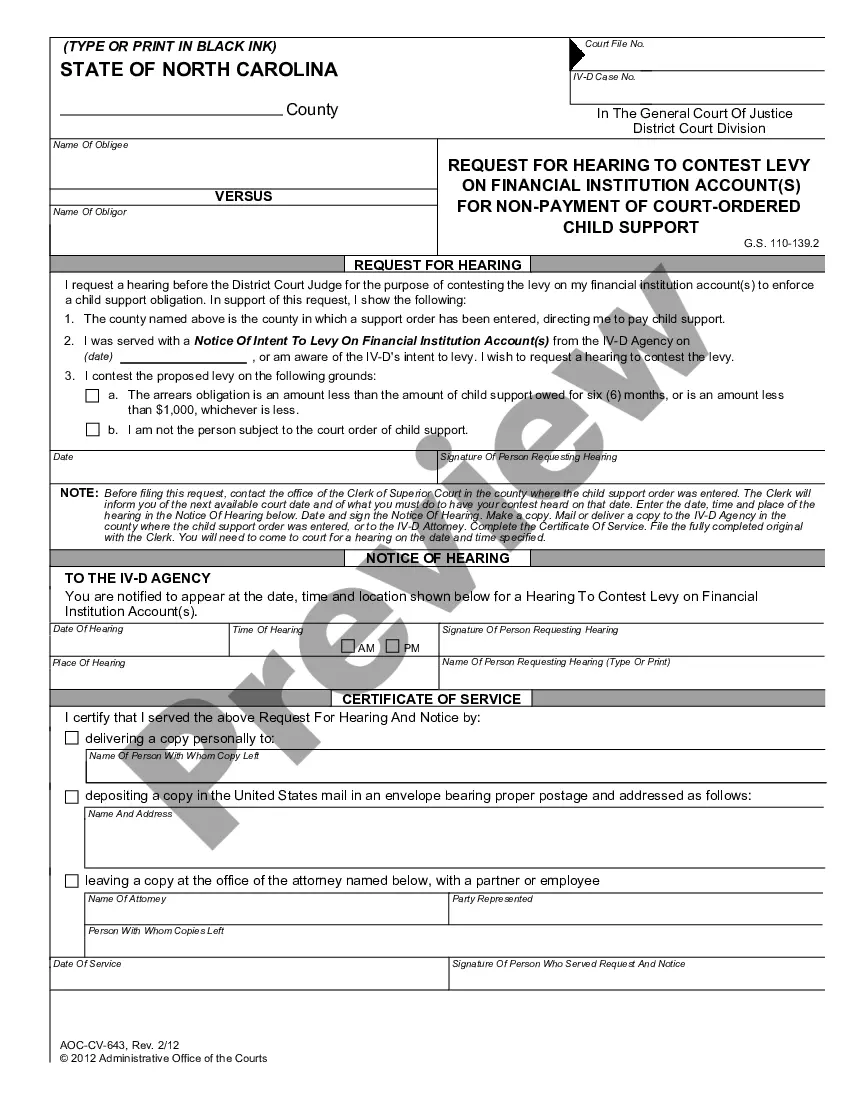
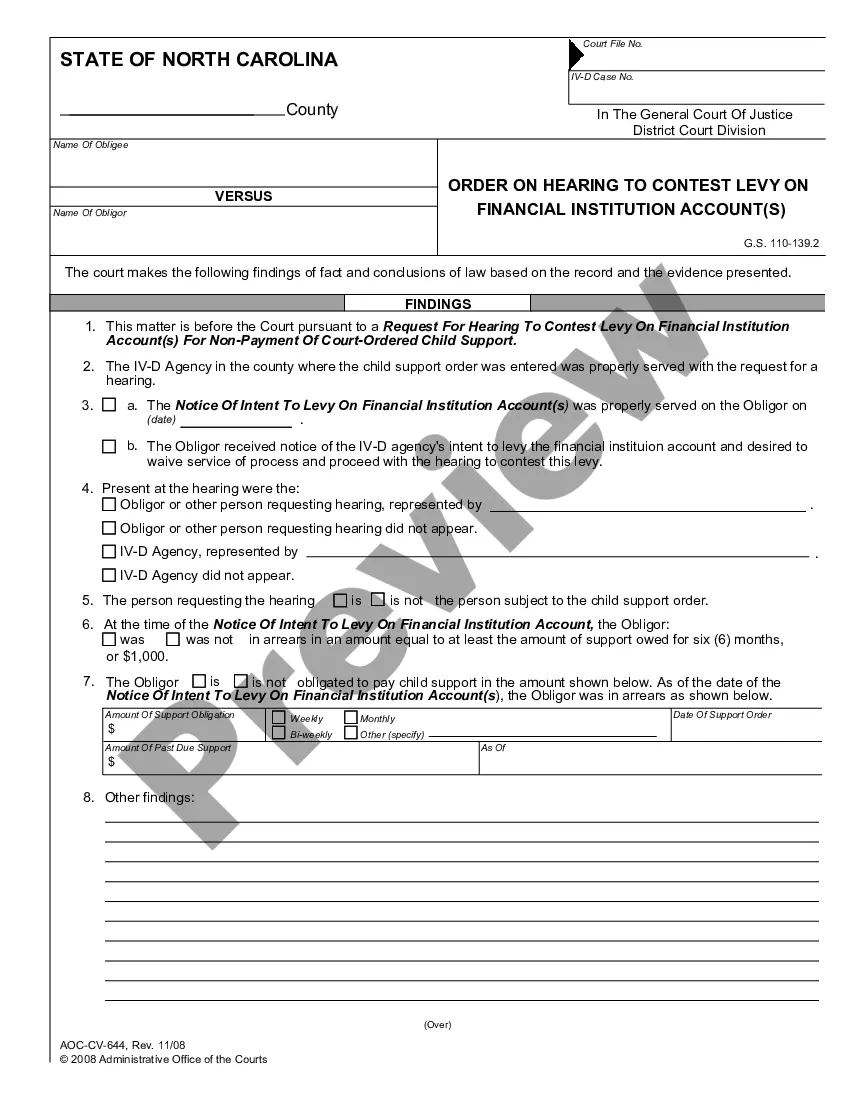
Request for Hearing to Contest Levy on Financial Institution Account(s) for Non-Payment of Court-Ordered Child Support: This is an official form from the North Carolina Administration of the Courts - AOC, which complies with all applicable laws and statutes. USLF amends and updates the forms as is required by North Carolina statutes and law.
North Carolina Request for Hearing to Contest Levy on Financial Institution Accounts for Nonpayment of Court-Ordered Child Support
State:
North Carolina
Category:
Control #:
NC-CV-643
Format:
PDF
Instant download
This website is not affiliated with any governmental entity
Public form
Description
Get your form ready online
Our built-in tools help you complete, sign, share, and store your documents in one place.
Built-in online Word editor
Make edits, fill in missing information, and update formatting in US Legal Forms—just like you would in MS Word.
Export easily
Download a copy, print it, send it by email, or mail it via USPS—whatever works best for your next step.
E-sign your document
Sign and collect signatures with our SignNow integration. Send to multiple recipients, set reminders, and more. Go Premium to unlock E-Sign.
Notarize online 24/7
If this form requires notarization, complete it online through a secure video call—no need to meet a notary in person or wait for an appointment.
Store your document securely
We protect your documents and personal data by following strict security and privacy standards.

Make edits, fill in missing information, and update formatting in US Legal Forms—just like you would in MS Word.

Download a copy, print it, send it by email, or mail it via USPS—whatever works best for your next step.

Sign and collect signatures with our SignNow integration. Send to multiple recipients, set reminders, and more. Go Premium to unlock E-Sign.

If this form requires notarization, complete it online through a secure video call—no need to meet a notary in person or wait for an appointment.

We protect your documents and personal data by following strict security and privacy standards.
Looking for another form?
How to fill out North Carolina Request For Hearing To Contest Levy On Financial Institution Accounts For Nonpayment Of Court-Ordered Child Support?
Steer clear of expensive lawyers and locate the North Carolina Request for Hearing to Challenge Levy on Financial Institution Accounts for Failure to Pay Court-Ordered Child Support you desire at an affordable price on the US Legal Forms website.
Utilize our straightforward categories feature to browse for and obtain legal and tax documents. Review their descriptions and view them prior to downloading.
Select to download the document in PDF or DOCX format. Simply click Download and locate your template in the My documents section. You may save the form to your device or print it out. After downloading, you can complete the North Carolina Request for Hearing to Challenge Levy on Financial Institution Accounts for Failure to Pay Court-Ordered Child Support either manually or using editing software. Print it out and reuse the template multiple times. Achieve more for less with US Legal Forms!
- Additionally, US Legal Forms provides users with detailed instructions on how to download and fill out each form.
- US Legal Forms members simply need to sign in and access the specific form they require in their My documents section.
- Those who have not yet acquired a subscription should adhere to the following guidelines.
- Confirm that the North Carolina Request for Hearing to Challenge Levy on Financial Institution Accounts for Failure to Pay Court-Ordered Child Support is valid for use in your state.
- If possible, review the description and utilize the Preview option before downloading the templates.
- If you are certain the document suits your needs, click on Buy Now.
- If the form is not accurate, use the search bar to find the correct one.
- Next, set up your account and select a subscription option.
- Make payment via credit card or PayPal.
Form popularity
FAQ
North Carolina's statute of limitations on most debts is 3 years. North Carolina does not permit wage garnishment for commercial debts, though the IRS or State can garnish wages. Bank accounts are not exempt from attachment by judgment creditors.
The garnishment amount is limited to 25% of your disposable earnings for that week (what's left after mandatory deductions) or the amount by which your disposable earnings for that week exceed 30 times the federal minimum hourly wage, whichever is less.
For most types of debt such as credit cards and medical bills, the creditor can't immediately garnish your wages if you stop paying your bill. The creditor must first sue you, obtain a judgment, and get a court order. Example.The court awarded the credit card company a money judgment for the amount owed.
Pay the full total tax liability. The taxpayer can pay the amount shown due on the taxpayer's notice now to avoid accruing additional interest. Set up an Installment Payment Agreement. Leave the garnishment in effect.
In North Carolina, the statute of limitations for automobile loans, installment loans, credit cards and promissory notes is three years from the date of the last payment or charge. What this means is that every payment made on a delinquent account resets the clock and restarts the statute of limitations.
In North Carolina, a judgment is valid for ten years from the date it was awarded by the Court. The judgment can be renewed for another ten years, giving a judgment creditor additional time to try to collect the money owed.
How Long Can a Debt Collector Pursue an Old Debt? Each state has a law referred to as a statute of limitations that spells out the time period during which a creditor or collector may sue borrowers to collect debts. In most states, they run between four and six years after the last payment was made on the debt.
Most creditors can't garnish your wages as soon as you fall behind on a credit card payment or medical bill.The only debts that North Carolina allows a creditor to collect using a wage garnishment are as follows: unpaid income taxes. alimony.
Debtor's prisons, as they were called, have since been abolished. Therefore, you cannot go to jail if you default on your debts.A creditor can in fact file a lawsuit against you for the debt that you owe them. If you do not respond or go to any hearings that are set, they will most likely get a judgment against you.