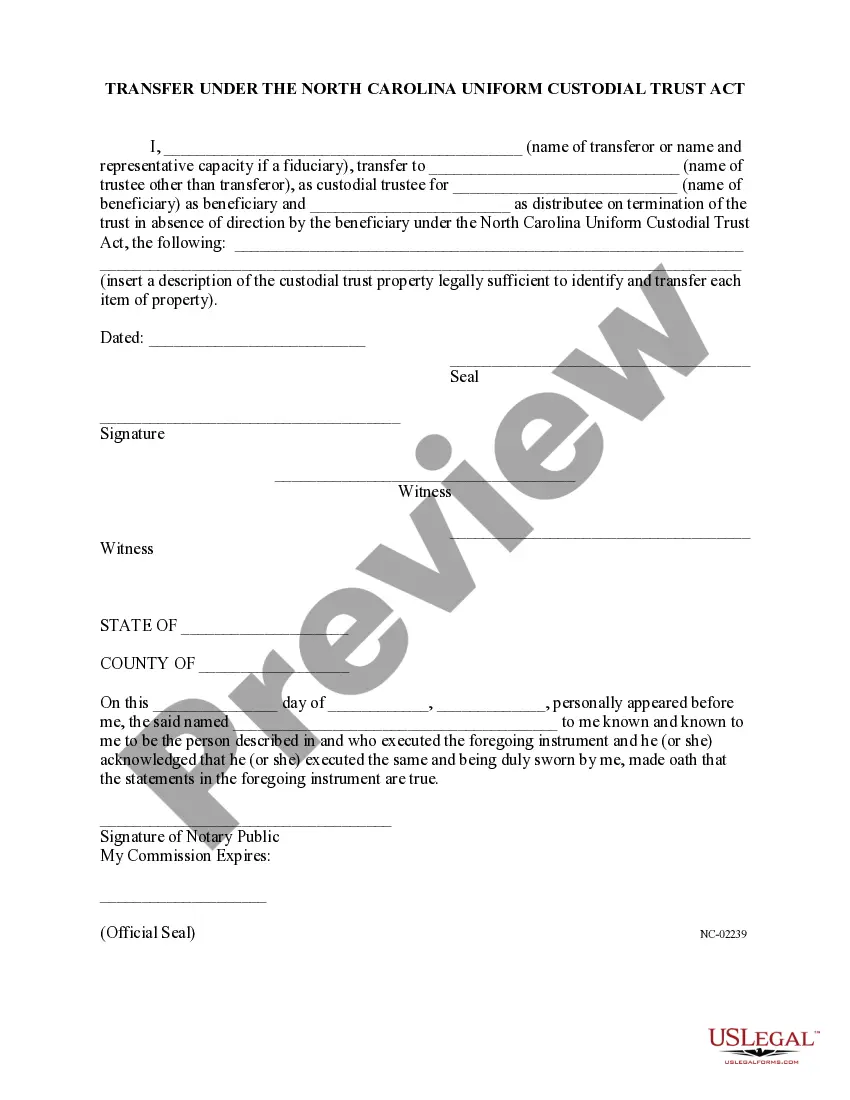
Transfer Under The North Carolina Uniform Custodial Trust Act
About this form
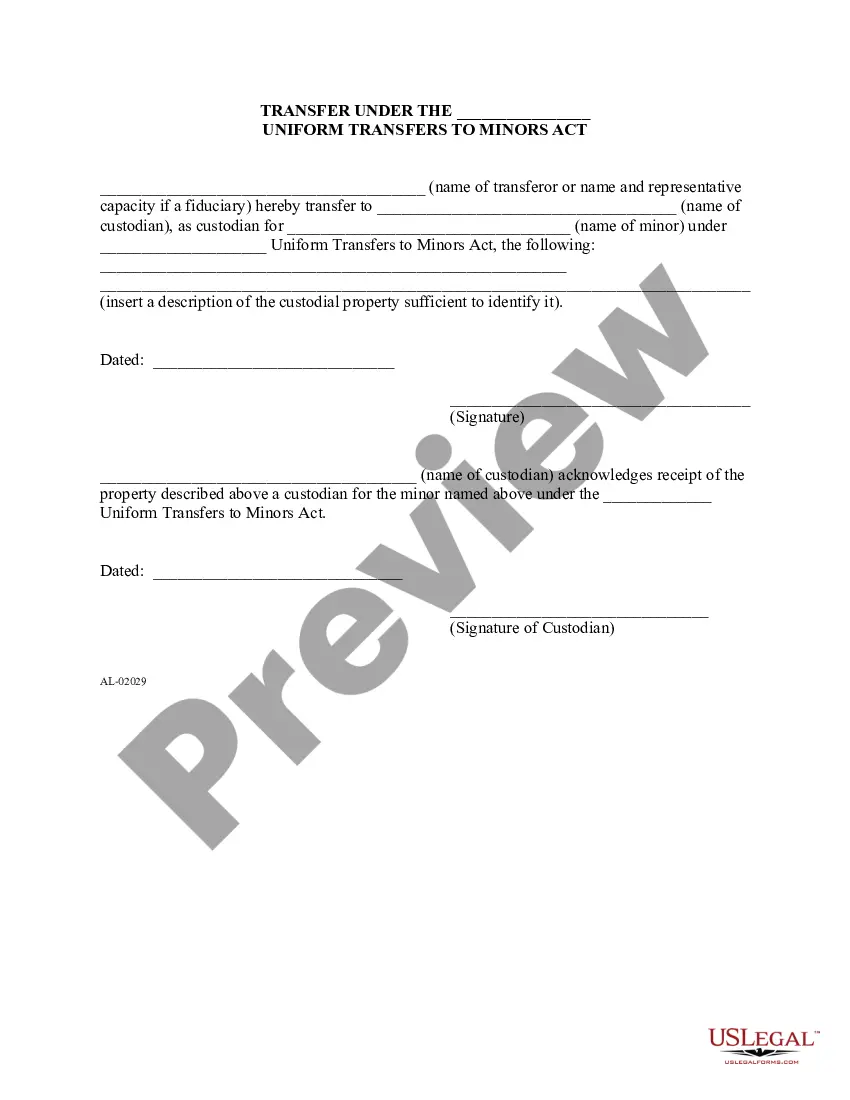
The Transfer Under The North Carolina Uniform Custodial Trust Act is a legal document used to transfer ownership of property to a custodial trustee. This form is unique as it specifically complies with North Carolina law regarding custodial trusts, ensuring that the assets are managed for the benefit of a designated beneficiary until a specified event occurs. Unlike general property transfer forms, this document is tailored to meet specific statutory requirements unique to custodial trusts in North Carolina.
Form components explained
- Name of transferor or representative capacity if a fiduciary
- Name of the trustee (custodial trustee)
- Name of the beneficiary
- Distributee on termination of the trust
- Detailed description of the property being transferred
- Dates and signatures for legal validation
Common use cases
This form should be used when an individual or fiduciary wishes to transfer specific assets into a custodial trust in North Carolina. It is appropriate in situations such as planning for a minor's inheritance, managing assets for beneficiaries who may not be ready to handle property directly, or ensuring that the property is safeguarded until the beneficiary is legally able to manage it.
Who needs this form
- Individuals looking to establish a custodial trust for a minor or incapacitated beneficiary
- Fiduciaries responsible for managing assets on behalf of another
- Legal representatives handling estate planning or asset transfers
Instructions for completing this form
- Identify and enter the name of the transferor.
- Specify the name of the trustee who will manage the property.
- Detail the name of the beneficiary who will receive the benefits from the trust.
- Provide a thorough description of the assets being transferred.
- Enter the date of the transfer and obtain necessary signatures for validation.
Is notarization required?
To make this form legally binding, it must be notarized. Our online notarization service, powered by Notarize, lets you verify and sign documents remotely through an encrypted video session.
Get your form ready online
Our built-in tools help you complete, sign, share, and store your documents in one place.
Make edits, fill in missing information, and update formatting in US Legal Forms—just like you would in MS Word.
Download a copy, print it, send it by email, or mail it via USPS—whatever works best for your next step.
Sign and collect signatures with our SignNow integration. Send to multiple recipients, set reminders, and more. Go Premium to unlock E-Sign.
If this form requires notarization, complete it online through a secure video call—no need to meet a notary in person or wait for an appointment.
We protect your documents and personal data by following strict security and privacy standards.

Make edits, fill in missing information, and update formatting in US Legal Forms—just like you would in MS Word.

Download a copy, print it, send it by email, or mail it via USPS—whatever works best for your next step.

Sign and collect signatures with our SignNow integration. Send to multiple recipients, set reminders, and more. Go Premium to unlock E-Sign.

If this form requires notarization, complete it online through a secure video call—no need to meet a notary in person or wait for an appointment.

We protect your documents and personal data by following strict security and privacy standards.
Mistakes to watch out for
- Failing to clearly describe the property being transferred.
- Not including the name of the distributee who will receive the assets upon trust termination.
- Omitting signatures or dates, which may invalidate the form.
Advantages of online completion
- Easy access to download and fill out the form at your convenience.
- Editable formats available for personalized adjustments.
- Reliable and legally vetted forms drafted by licensed attorneys.
Looking for another form?
Form popularity
FAQ
In North Carolina, any person 18-years of age and older can make a will or living trust, and that will or trust will be recognized by law. Whatever debts you owe upon your death, whether it is a car loan or fees owed for personal services, this will come from the assets of your estate.
In this article: A living trust is a type of estate planning tool that allows you to transfer ownership of your assets to a separate fund while you're still alive.In some circumstances, you can use a living trust to protect money you owe to creditors.
It is true that in some states (such as California) probate administration can be lengthy and expensive. North Carolina is not one of those states. The maximum court cost that can be saved in North Carolina by using a funded living trust is $3,000, and those costs are generally much less in most estates.
Using a revocable living trust instead of a will means assets owned by your trust will bypass probate and flow to your heirs as you've outlined in the trust documents. A trust lets investors have control over their assets long after they pass away.
Figure out the type of trust you'll need. Are you single? Take inventory of everything you own. Pick your trustee. Draw up the trust document, either by yourself or with a lawyer. Sign the trust document in front of a notary. Fund the trust this means putting your property into the trust.
It is generally considered more difficult to challenge a living trust than to contest a will.To successfully contest a will, a person must prove that the testator, the person creating the will, either lacked the capacity to have the will drafted or they were subject to undue influence by a beneficiary.
It is true that in some states (such as California) probate administration can be lengthy and expensive. North Carolina is not one of those states. The maximum court cost that can be saved in North Carolina by using a funded living trust is $3,000, and those costs are generally much less in most estates.
Wills and Trusts FAQs Deciding between a will or a trust is a personal choice, and some experts recommend having both. A will is typically less expensive and easier to set up than a trust, an expensive and often complex legal document.