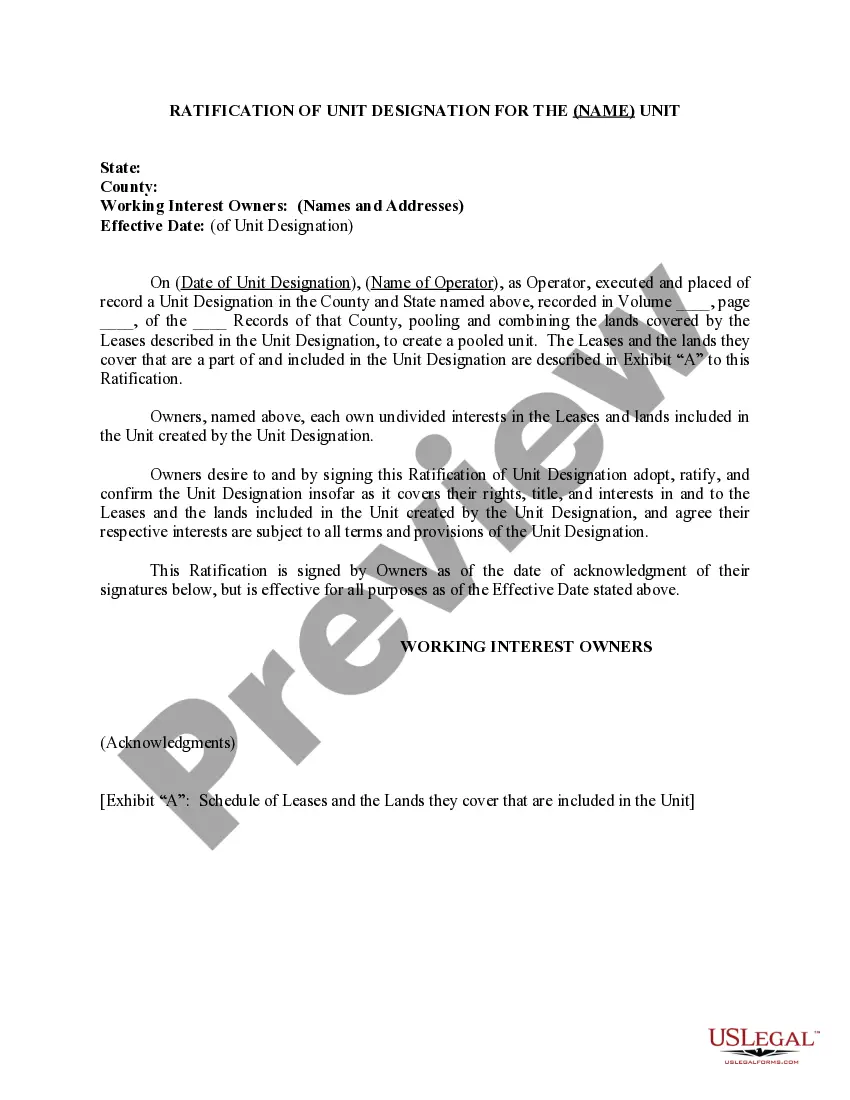
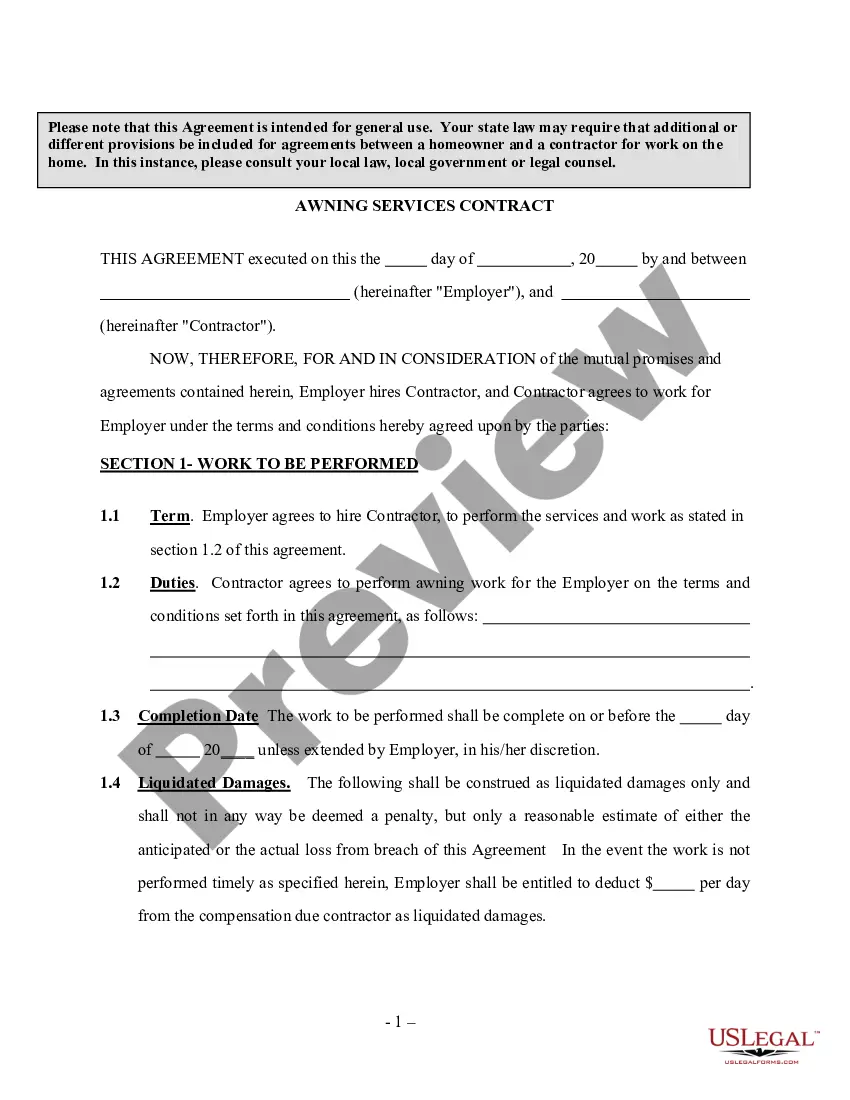
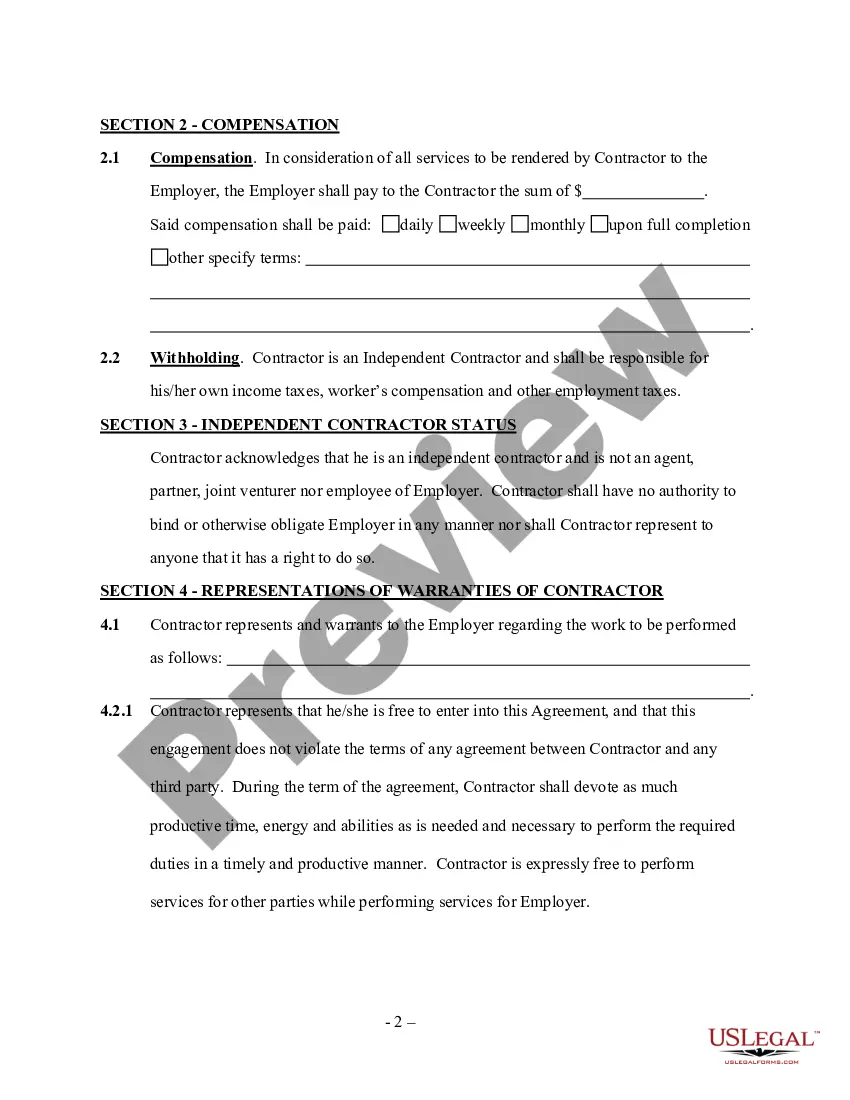
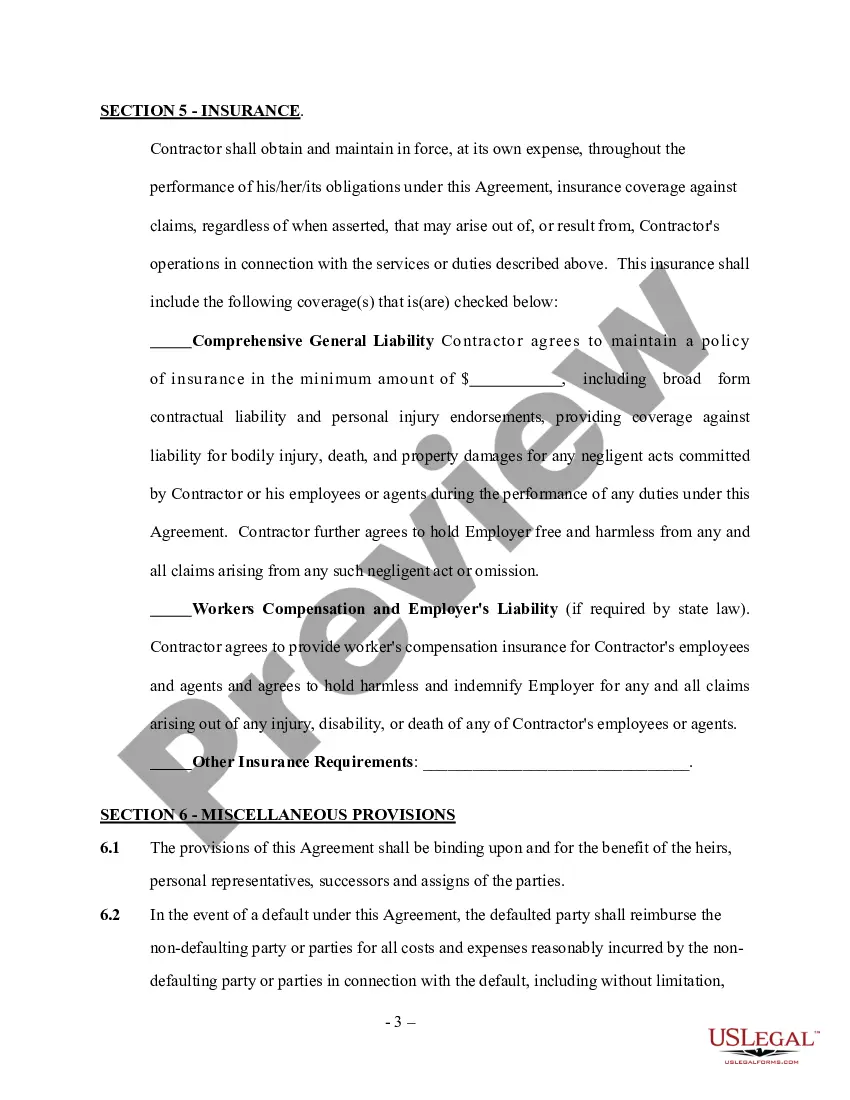
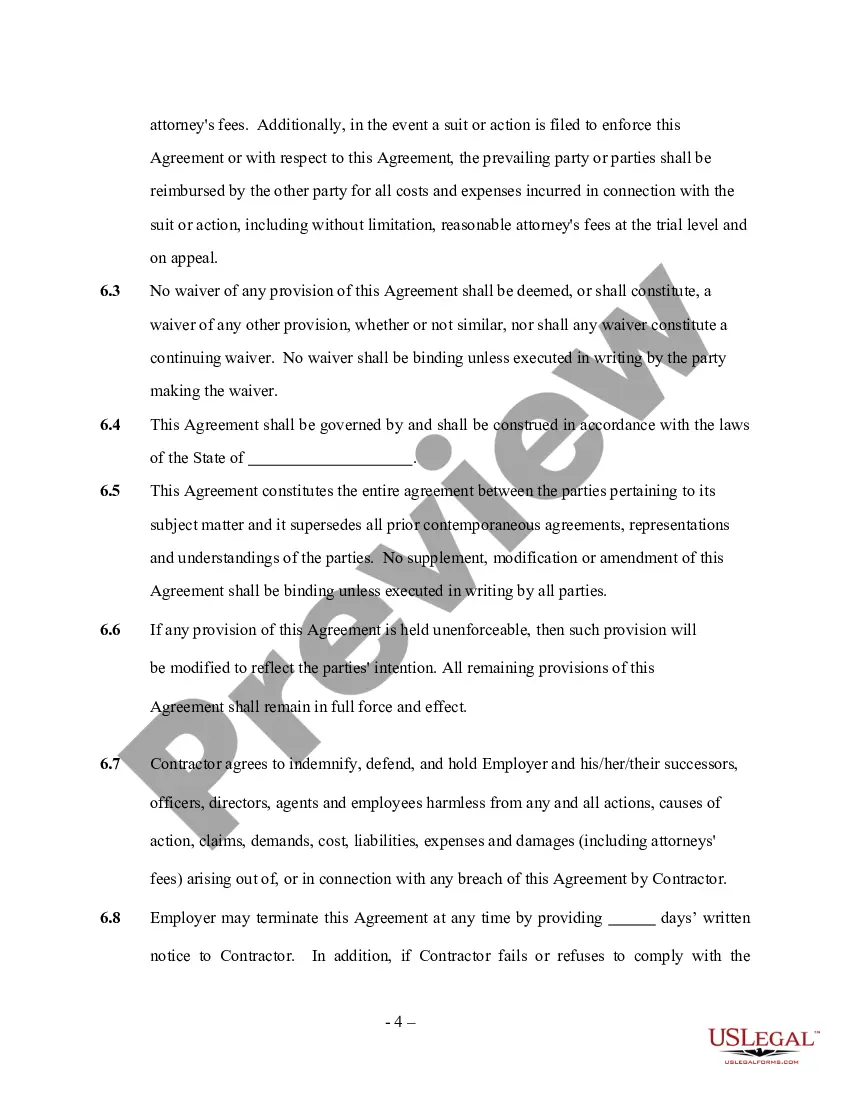
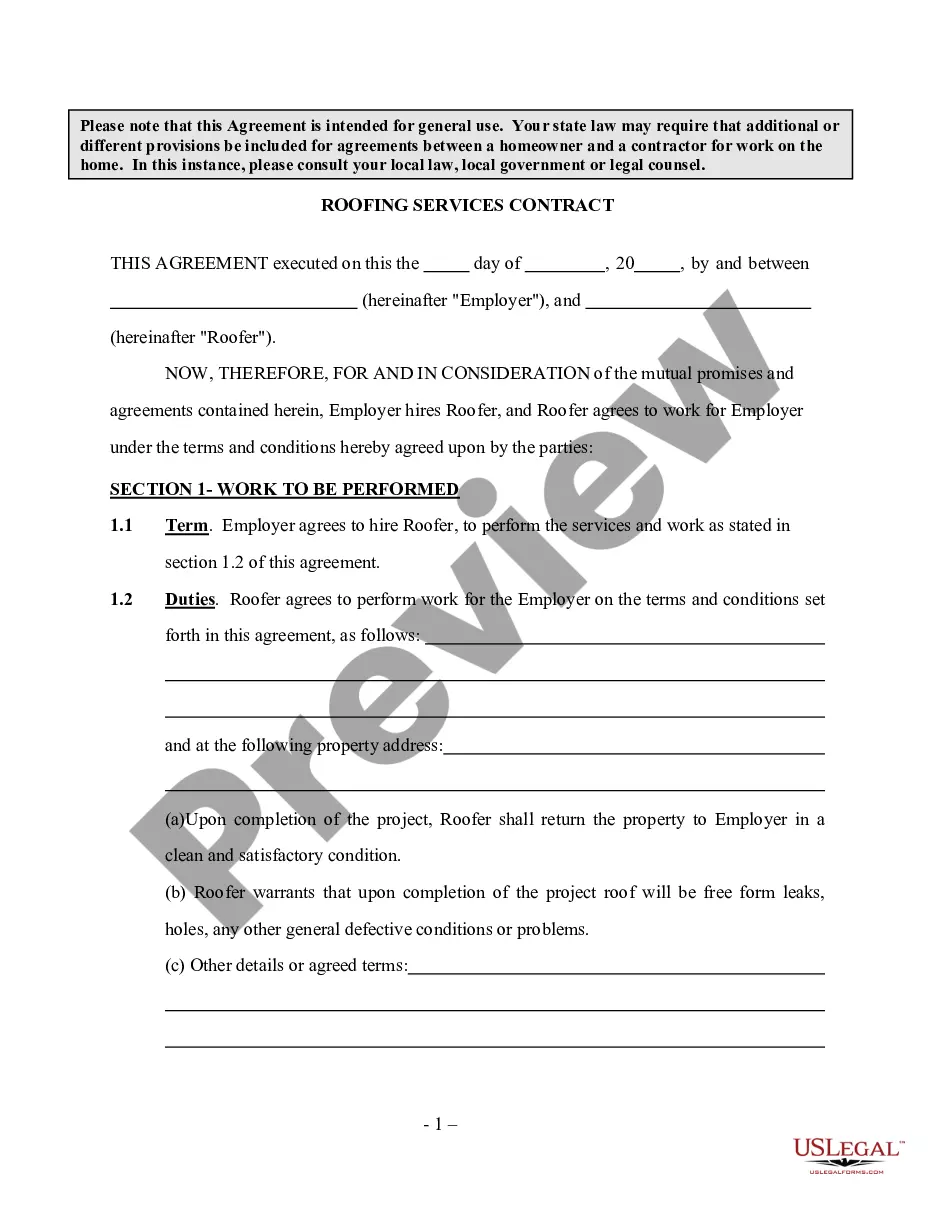
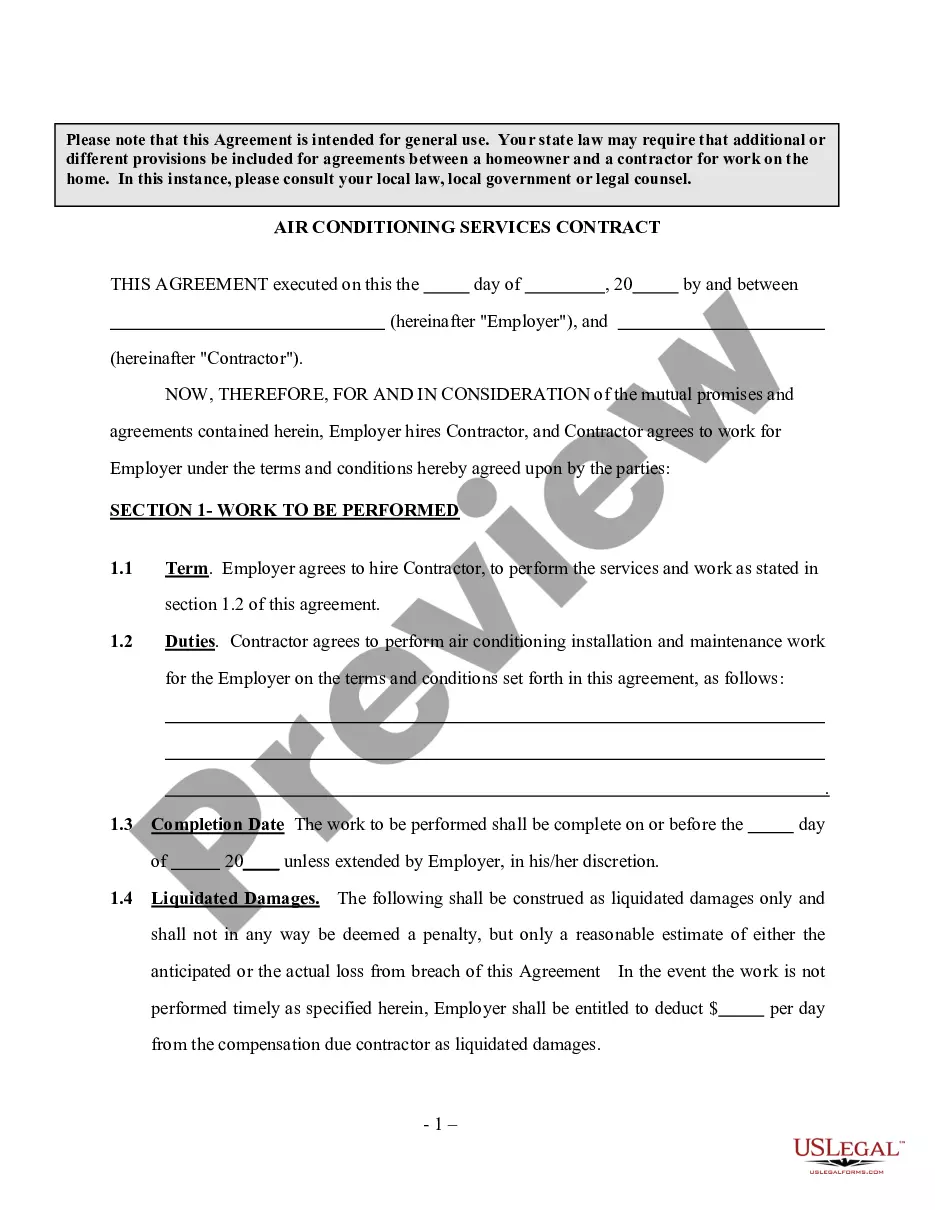
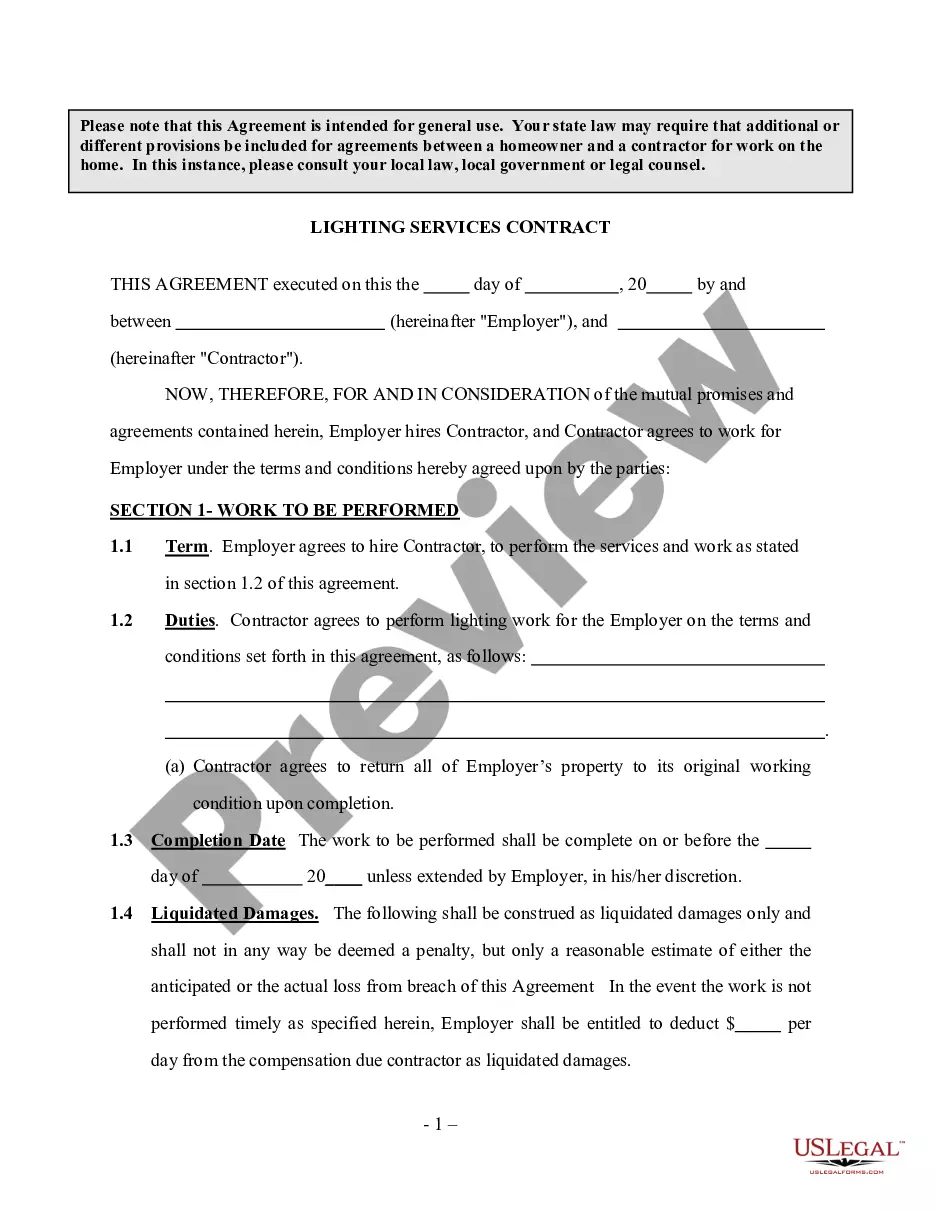
Employer contracts with an independent contractor to install, maintain, and/or service all awnings as specified and agreed upon in the contract. Please note that this Agreement is intended for general use. Your state law may require that additional or different provisions be included for agreements between a homeowner and a contractor for work on the home. In this instance, please consult your local law, local government or legal counsel.
Montana Self-Employed Awning Services Contract
State:
Multi-State
Control #:
US-INDC-88
Format:
Word;
Rich Text
Instant download
Description
Free preview
Get your form ready online
Our built-in tools help you complete, sign, share, and store your documents in one place.
Built-in online Word editor
Make edits, fill in missing information, and update formatting in US Legal Forms—just like you would in MS Word.
Export easily
Download a copy, print it, send it by email, or mail it via USPS—whatever works best for your next step.
E-sign your document
Sign and collect signatures with our SignNow integration. Send to multiple recipients, set reminders, and more. Go Premium to unlock E-Sign.
Notarize online 24/7
If this form requires notarization, complete it online through a secure video call—no need to meet a notary in person or wait for an appointment.
Store your document securely
We protect your documents and personal data by following strict security and privacy standards.

Make edits, fill in missing information, and update formatting in US Legal Forms—just like you would in MS Word.

Download a copy, print it, send it by email, or mail it via USPS—whatever works best for your next step.

Sign and collect signatures with our SignNow integration. Send to multiple recipients, set reminders, and more. Go Premium to unlock E-Sign.

If this form requires notarization, complete it online through a secure video call—no need to meet a notary in person or wait for an appointment.

We protect your documents and personal data by following strict security and privacy standards.
Looking for another form?

How to fill out Self-Employed Awning Services Contract?
Are you currently in a situation where you require documents for either business or personal purposes regularly.
There are numerous legal document templates available online, but finding reliable ones is challenging.
US Legal Forms provides a vast collection of form templates, including the Montana Self-Employed Awning Services Contract, designed to meet federal and state requirements.
Utilize US Legal Forms, which offers one of the most extensive selections of legal forms, to save time and avoid mistakes.
The service provides professionally crafted legal document templates that you can use for various purposes. Create an account on US Legal Forms and start making your life a bit easier.
- If you are already familiar with the US Legal Forms site and have an account, simply Log In.
- After that, you can download the Montana Self-Employed Awning Services Contract template.
- If you do not have an account and wish to start using US Legal Forms, follow these steps.
- Find the form you need and ensure it is for the correct city/state.
- Utilize the Preview button to review the form.
- Read the description to confirm you have selected the correct form.
- If the form is not what you are looking for, use the Search field to find the form that meets your needs.
- Once you locate the correct form, click Get now.
- Choose the pricing plan you want, enter the required information to create your account, and pay for the order using your PayPal or Visa or Mastercard.
- Select a convenient file format and download your copy.
- Access all the document templates you have purchased in the My documents menu. You can download another copy of the Montana Self-Employed Awning Services Contract at any time if needed. Click the desired form to download or print the document template.
Form popularity
FAQ
To become an independent contractor in Montana, you need to register your business and obtain any necessary licenses. You should also draft a Montana Self-Employed Awning Services Contract to formalize your agreement with clients. Lastly, consider setting up a system for tracking your income and expenses, as this will help you maintain financial records and fulfill tax obligations efficiently.
Yes, Montana requires certain independent contractors to obtain a contractor license, especially for construction-related work. If you plan to provide awning services, you may need to apply for a license, depending on the scope of your projects. It’s essential to check local regulations and ensure compliance to operate legally under your Montana Self-Employed Awning Services Contract.
Independent contractors in Montana are entitled to payment for services rendered as outlined in their Montana Self-Employed Awning Services Contract. Unlike employees, they do not receive benefits such as health insurance or retirement plans from clients. However, they can deduct business expenses and have more flexibility in their work schedule, allowing them to manage multiple clients and projects.
To qualify as an independent contractor in Montana, you must demonstrate that you operate your own business and control your work. You should provide your services to clients under a Montana Self-Employed Awning Services Contract, which outlines your responsibilities and the terms of your work. Additionally, you should meet the IRS criteria, which includes being in business for yourself and not being subject to the control of another party regarding how your work is performed.
Becoming an independent contractor in Montana involves several steps. Start by researching the specific requirements and regulations for your industry. After that, register your business and obtain any necessary permits. Finally, create a solid contract, like a Montana Self-Employed Awning Services Contract, to clearly outline your services and agreements with clients, ensuring a professional approach to your new venture.
To become an independent contractor, you must meet certain legal requirements. You need to have a valid business license and possibly specific permits related to your services in Montana. It's also essential to maintain proper records for tax purposes and ensure compliance with local regulations. Utilizing a Montana Self-Employed Awning Services Contract can help you define your responsibilities and protect your interests.
What Is an Independent Contractor? An independent contractor is a self-employed person or entity contracted to perform work foror provide services toanother entity as a nonemployee. As a result, independent contractors must pay their own Social Security and Medicare taxes.
The three types of self-employed individuals include:Independent contractors. Independent contractors are individuals hired to perform specific jobs for clients, meaning that they are only paid for their jobs.Sole proprietors.Partnerships.
Becoming an independent contractor is one of the many ways to be classified as self-employed. By definition, an independent contractor provides work or services on a contractual basis, whereas, self-employment is simply the act of earning money without operating within an employee-employer relationship.
A 1099 employee is a US self-employed worker that reports their income to the IRS on a 1099 tax form. Freelancers, gig workers, and independent contractors are all considered 1099 employees.