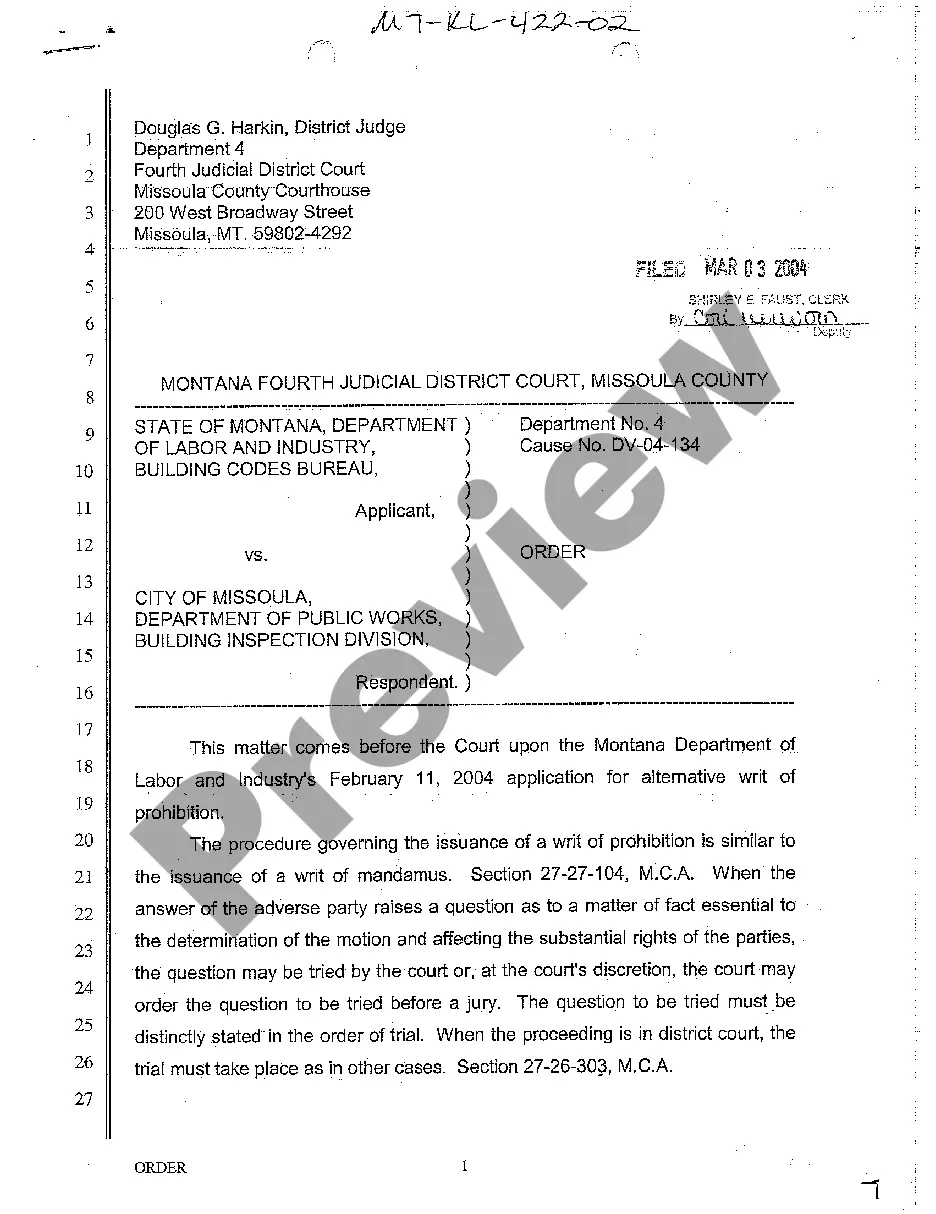
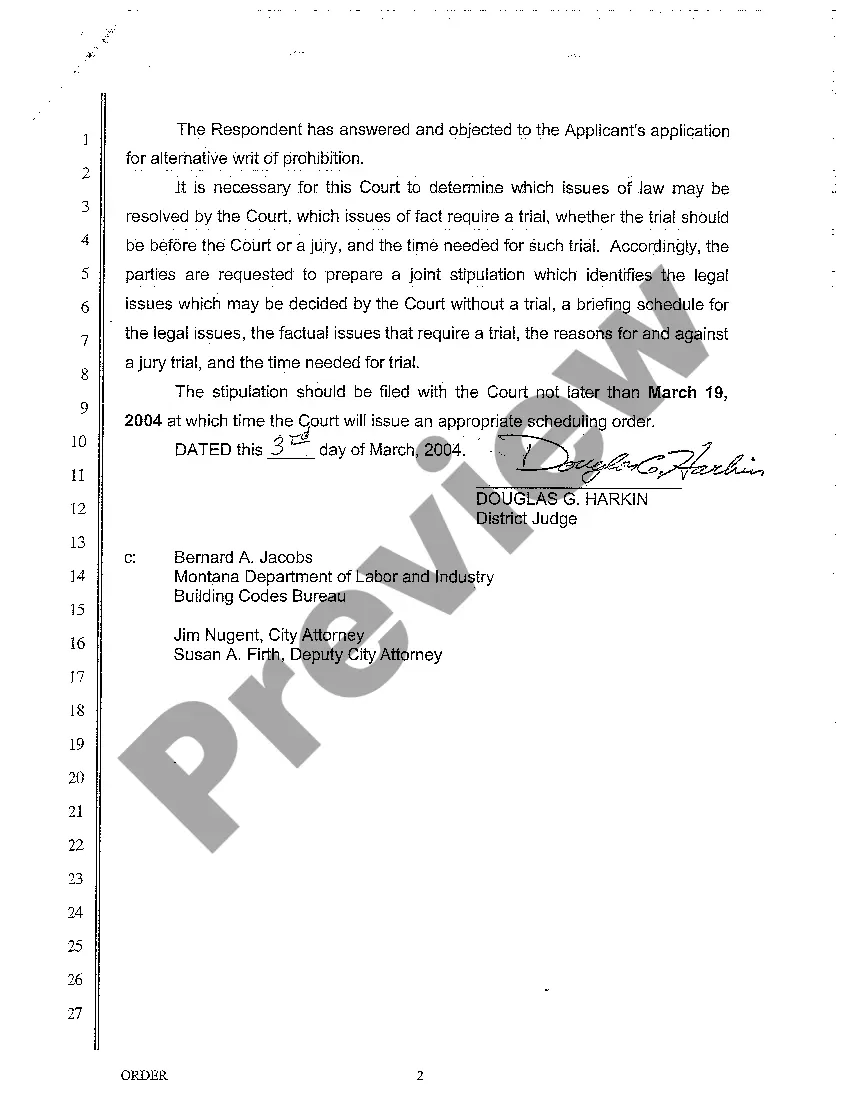
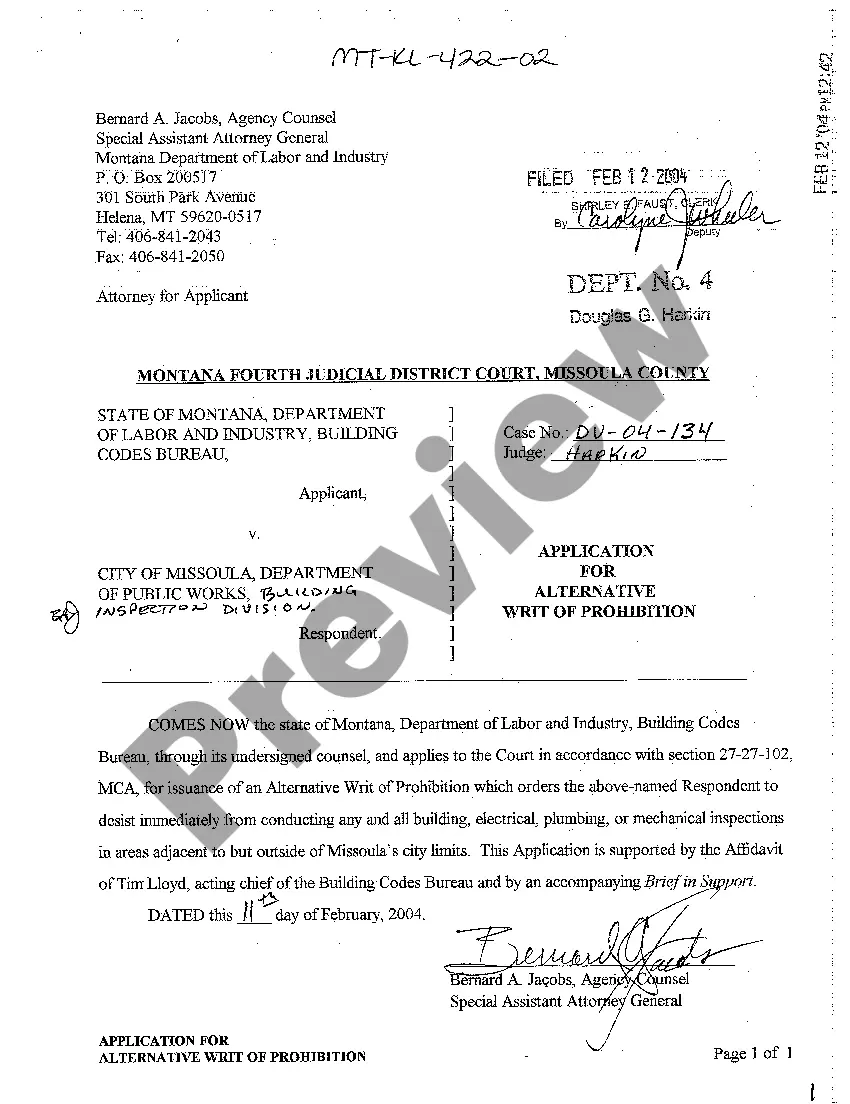
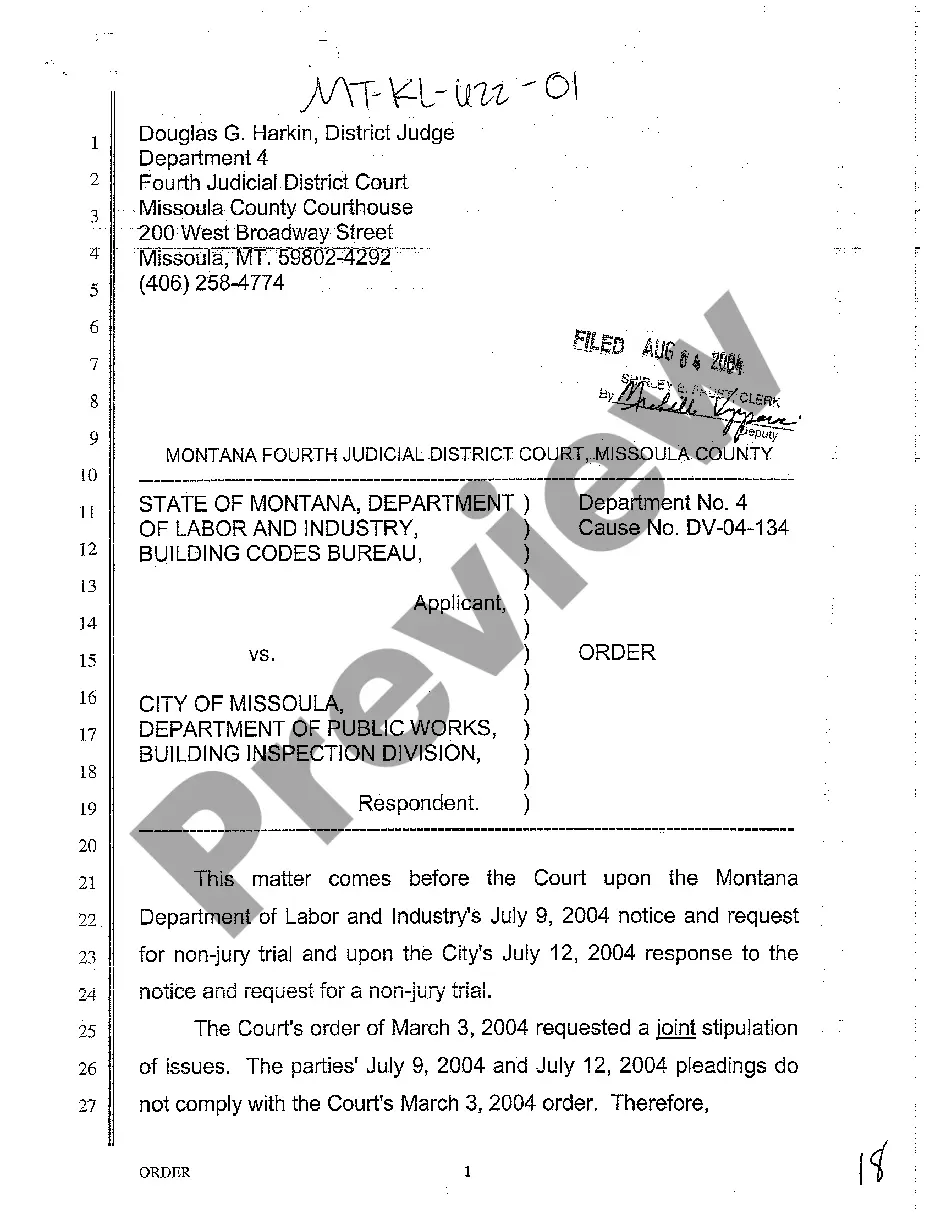
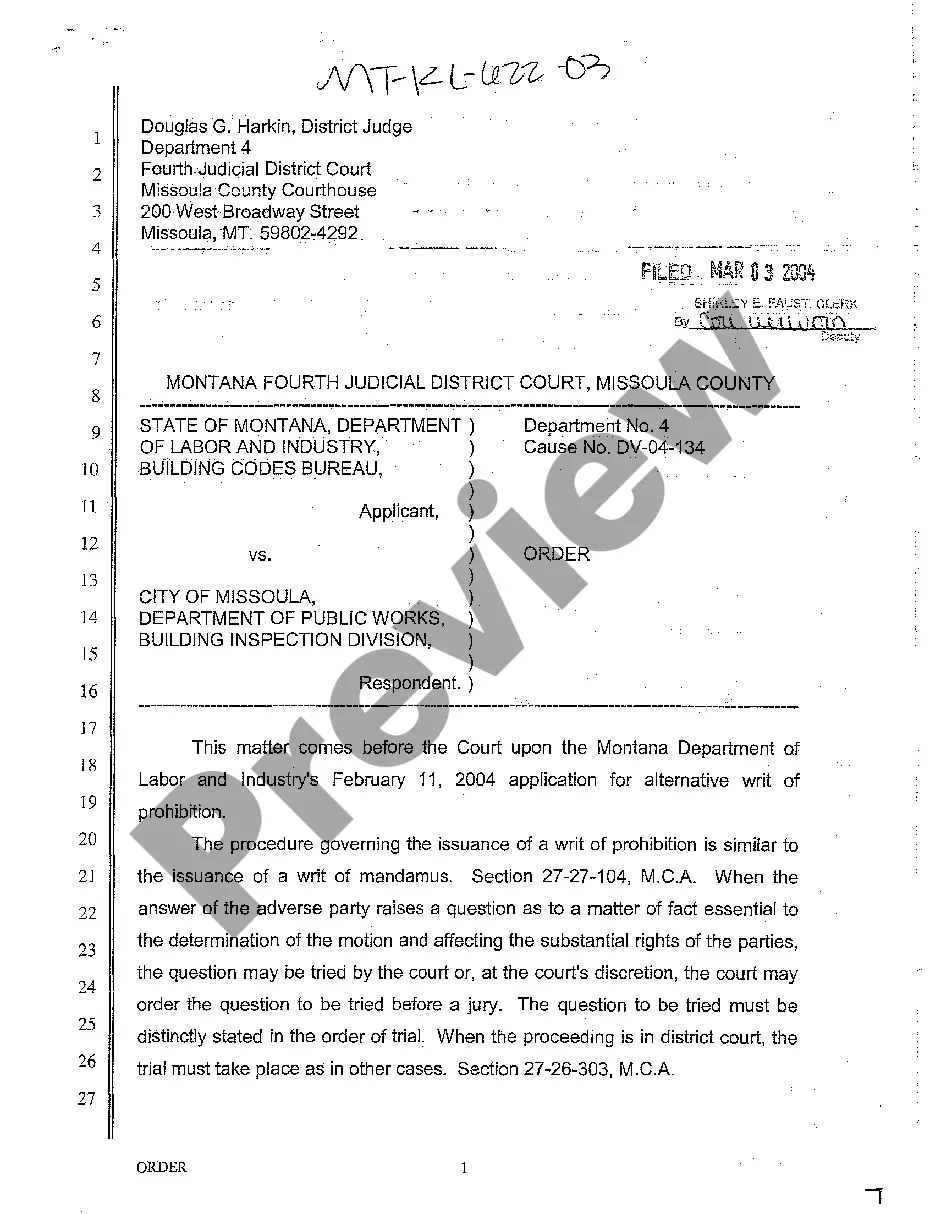
Montana Order Asking Parties to Prepare a Joint Stipulation Identifying Legal Issues Surrounding Writ of Prohibition
Description
How to fill out Montana Order Asking Parties To Prepare A Joint Stipulation Identifying Legal Issues Surrounding Writ Of Prohibition?
Obtain a printable Montana Order Requesting Parties to Create a Joint Agreement Identifying Legal Matters Related to Writ of Prohibition with just a few clicks from the most comprehensive collection of legal electronic documents.
Discover, retrieve, and print professionally crafted and validated examples on the US Legal Forms site. US Legal Forms has been the leading provider of affordable legal and tax documents for US citizens and residents online since 1997.
After you have downloaded your Montana Order Requesting Parties to Create a Joint Agreement Identifying Legal Matters Related to Writ of Prohibition, you may complete it in any online editor or print it out and fill it in manually. Utilize US Legal Forms to gain access to 85,000 professionally drafted, state-specific documents.
- Individuals who already possess a subscription must sign in to their US Legal Forms account, download the Montana Order Requesting Parties to Create a Joint Agreement Identifying Legal Matters Related to Writ of Prohibition, and view it stored in the My documents section.
- Individuals without a subscription should adhere to the following steps.
- Ensure your template complies with your state's regulations.
- If available, examine the form's description for further information.
- If accessible, preview the document to see additional details.
- Once you are confident the form is suitable for you, simply click Buy Now.
- Establish a personal account.
- Select a plan.
- Make payment via PayPal or credit card.
- Download the document in Word or PDF format.
Form popularity
FAQ
Sample Format of Affidavit for Writ of Mandamus in High Court under Article 226 of Constitution is as under. I, __________________ , S/o Shri _______________, Aged about ___ years, R/o ___ ________________ _______________ the Petitioner do hereby solemnly state and affirm as under: 1.
A case cannot, as a matter of right, be appealed to the U.S. Supreme Court. As such, a party seeking to appeal to the Supreme Court from a lower court decision must file a writ of certiorari. In the Supreme Court, if four Justices agree to review the case, then the Court will hear the case.
A (writ of) mandamus is an order from a court to an inferior government official ordering the government official to properly fulfill their official duties or correct an abuse of discretion. (See, e.g. Cheney v. United States Dist.
(1) A party petitioning for a writ of mandamus or prohibition directed to a court must file a petition with the circuit clerk and serve it on all parties to the proceeding in the trial court. The party must also provide a copy to the trial-court judge.
The Constitution of India empowers the Supreme Court and the High Courts to issue Writs for the enforcement of the fundamental rights conferred by the Part-III of the Indian Constitution under Article 32 and Article 226. There are five types of Writs- Habeas Corpus, Mandamus, Certiorari, Prohibition and Quo- Warranto.
A lower court or a body receives a writ of prohibition, also known as a 'stay order', to stop acting beyond its powers. The court issues a writ of mandamus for any illegal activity. Whereas, it issues the writ of prohibition against the lower courts to condemn their inactivity in the concerned matter.
Writs of Certiorari Parties who are not satisfied with the decision of a lower court must petition the U.S. Supreme Court to hear their case. The primary means to petition the court for review is to ask it to grant a writ of certiorari.
Any person whose fundamental rights are violated can move the High Court (under article 226 of Indian constitution) or the Supreme Court (under article 32) and the court can issue direction or orders or writs.
Fundamentally, a writ is a formal written order issued by anybody, executive or judicial, authorised to do so. In modern times, this body is generally judicial. Therefore, a writ can be understood as a formal written order issued by a Court having authority to issue such an order.