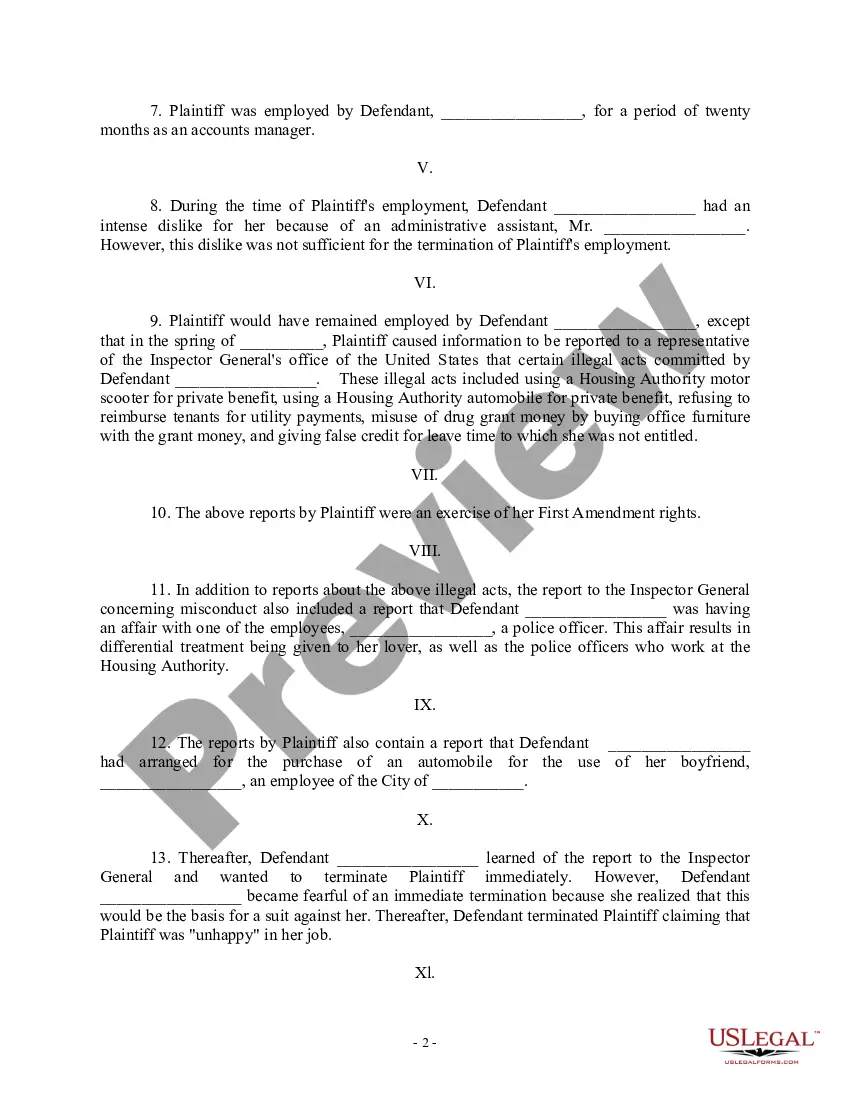
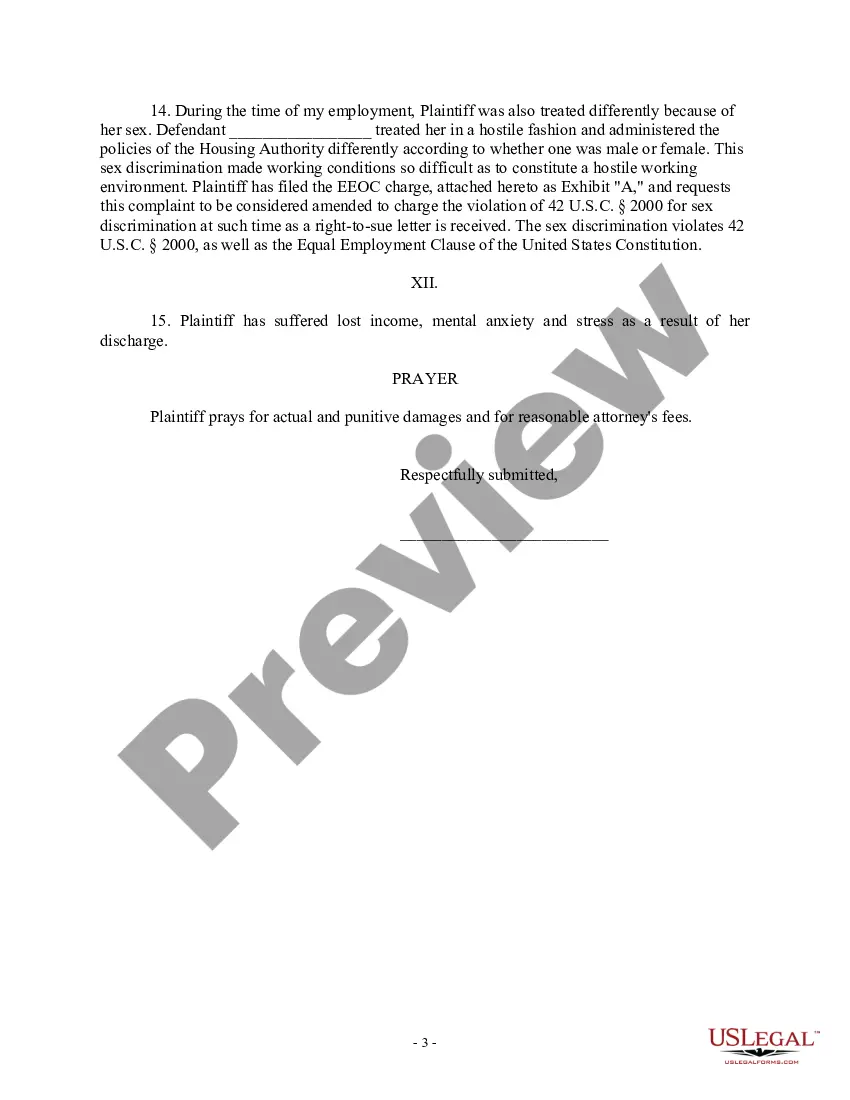
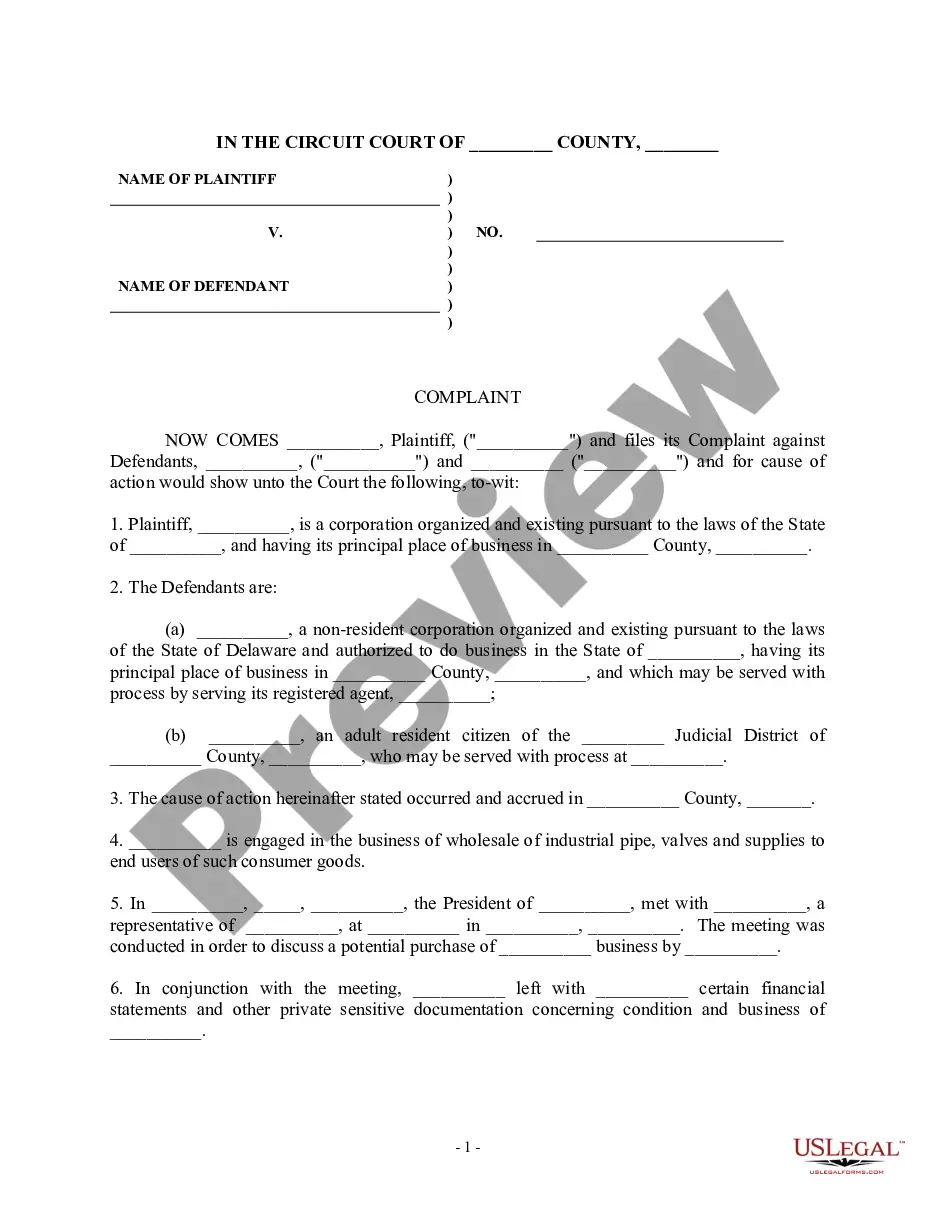
Plaintiff seeks to recover damages for violation of the First Amendment of the United States Constitution. Plaintiff states that she was unlawfully terminated and treated differently because of her gender.
Mississippi Complaint for Violation of Civil Rights and for Wrongful Discharge for Reporting Illegal Acts - 1st, 14th Amendments, US Constitution - Jury Trial Demand
Category:
State:
Multi-State
Control #:
US-000284
Format:
Word;
Rich Text
Instant download
Description
Free preview






How to fill out Complaint For Violation Of Civil Rights And For Wrongful Discharge For Reporting Illegal Acts - 1st, 14th Amendments, US Constitution - Jury Trial Demand?
US Legal Forms - one of the largest collections of legal documents in the United States - provides a wide range of legal document templates that you can download or print. By using the site, you can access thousands of forms for business and personal use, organized by categories, states, or keywords.
You can find the latest versions of forms such as the Mississippi Complaint for Violation of Civil Rights and for Wrongful Discharge for Reporting Illegal Acts - 1st, 14th Amendments, US Constitution - Jury Trial Demand in just a few minutes. If you already have an account, Log In to download the Mississippi Complaint for Violation of Civil Rights and for Wrongful Discharge for Reporting Illegal Acts - 1st, 14th Amendments, US Constitution - Jury Trial Demand from your US Legal Forms library. The Obtain button will be visible on every form you view. You can access all previously downloaded forms within the My documents tab of your account.
If you want to use US Legal Forms for the first time, here are simple steps to get started: Ensure you have chosen the correct form for your city/state. Click the Review button to check the form's content. Review the form details to confirm you have selected the right form. If the form does not meet your requirements, use the Search field at the top of the screen to find one that does. If you are satisfied with the form, confirm your choice by clicking the Buy now button. Then, choose the payment plan you prefer and provide your information to create an account. Complete the transaction. Use your credit card or PayPal account to finalize the transaction. Select the format and download the form to your device. Make adjustments. Fill out, edit, print, and sign the downloaded Mississippi Complaint for Violation of Civil Rights and for Wrongful Discharge for Reporting Illegal Acts - 1st, 14th Amendments, US Constitution - Jury Trial Demand. Each template you add to your account does not expire and is yours permanently. So, if you wish to download or print another copy, simply go to the My documents section and click on the form you need. Access the Mississippi Complaint for Violation of Civil Rights and for Wrongful Discharge for Reporting Illegal Acts - 1st, 14th Amendments, US Constitution - Jury Trial Demand with US Legal Forms, the most extensive library of legal document templates. Utilize a vast array of professional and state-specific templates that fulfill your business or personal needs and requirements.
Form popularity
FAQ
A federal law violation of civil rights occurs when individuals are denied their rights as guaranteed by the Constitution. These violations can include discrimination, unlawful termination, or retaliation for reporting illegal activities. Filing a Mississippi Complaint for Violation of Civil Rights and for Wrongful Discharge for Reporting Illegal Acts - 1st, 14th Amendments, US Constitution - Jury Trial Demand allows affected individuals to pursue legal action. Utilizing platforms like uslegalforms can simplify the process of drafting and submitting your complaint.
When due process is violated, individuals may experience significant legal repercussions. This includes the potential for wrongful termination or denial of rights, as protected under the 1st and 14th Amendments of the US Constitution. A Mississippi Complaint for Violation of Civil Rights and for Wrongful Discharge for Reporting Illegal Acts - 1st, 14th Amendments, US Constitution - Jury Trial Demand can be filed to seek justice and hold responsible parties accountable. It's crucial to understand your rights and seek legal guidance to navigate this complex process.
Rule 81 requires use of a special summons which commands that the defendant appear and defend at a specific time and place set by order of the court and informs him or her that no answer is necessary.
(the Due Process Clause requires the prosecution to prove beyond a reasonable doubt all of the elements included in the definition of the offense of which the defendant is charged; thus, when all of the elements are not included in the definition of the offense of which the defendant is charged, then the accused's due ...
Violations of these rights include excessive force by police, being passed over for a promotion because of a personal identity, denying housing to an individual because of personal identity, or efforts to impede your right to peacefully protest.
United States law allows an individual who believes that his or her constitutional rights have been violated to bring a civil action against the government to recover the damages sustained as a result of that violation.
Due process of law involves two types of processes: (a) procedural due process ? Is the process fair? and (b) substantive due process - Does the government have the right to bring the action in the first place? In performing the LHO duties and responsibilities, you must be concerned with whether the process is fair.
The Fourth Amendment right against unlawful search and seizure, the right to a trial by jury, the right to an attorney, and freedom from self-incrimination are all examples of provisions central to procedural due process.
Governmental actors violate due process when they frustrate the fairness of proceedings, such as when a prosecutor fails to disclose evidence to a criminal defendant that suggests they may be innocent of the crime, or when a judge is biased against a criminal defendant or a party in a civil action.
Examples of procedural due process include: The right to call witnesses and present evidence in defense of the charges. Right to receive exculpatory evidence from the prosecution. Right to appeal a judge's or jury's decision.
