Mississippi Order Denying Petition for Domestic Abuse Protective Order and Assessing Costs to Petitioner
About this form
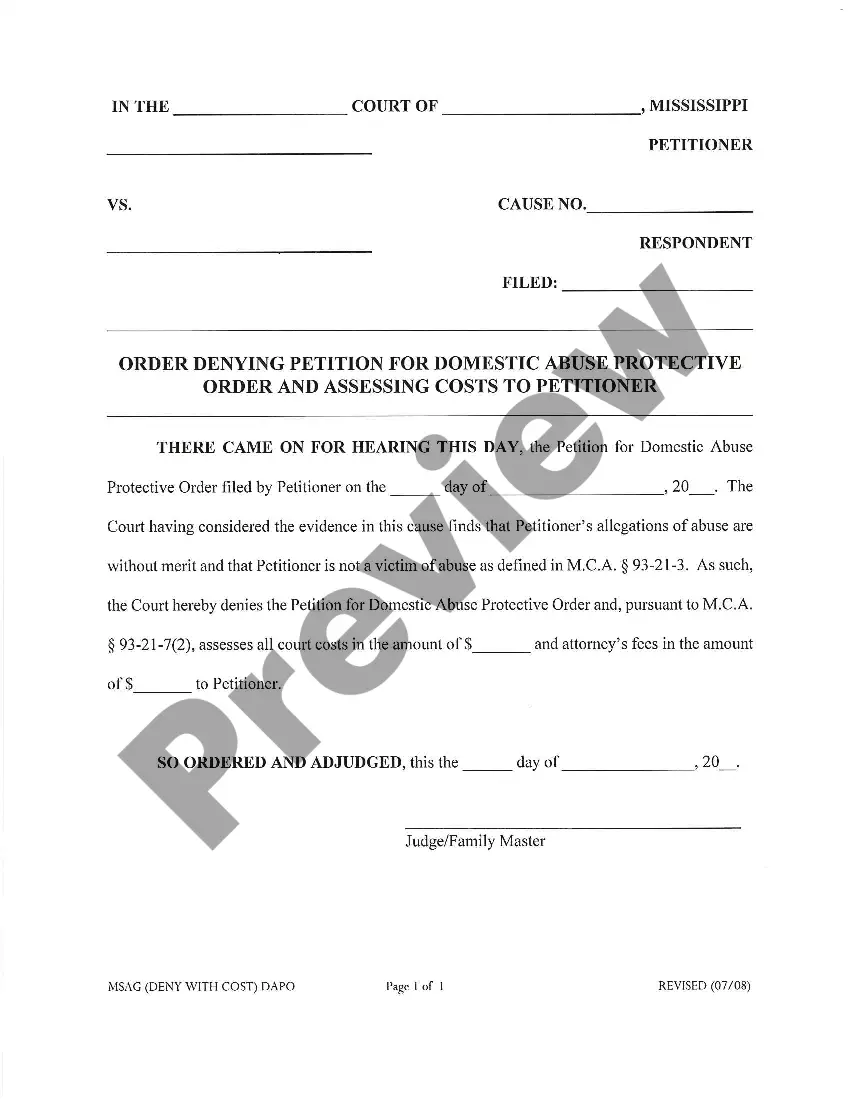
This form, titled Order Denying Petition for Domestic Abuse Protective Order and Assessing Costs to Petitioner, is used after a court hearing where the judge determines that a domestic abuse petition lacks merit. It formally denies the petition and may impose court costs on the petitioner. This form is crucial for cases where the court finds that the individual seeking the order is not a victim of domestic abuse, differentiating it from protective orders that grant relief to victims.
What’s included in this form
- Identification of parties involved in the case.
- Statement of the court's findings regarding the petition's merit.
- Assessment of court costs to be imposed on the petitioner.
- Signature lines for the judge and relevant court officials.

When this form is needed
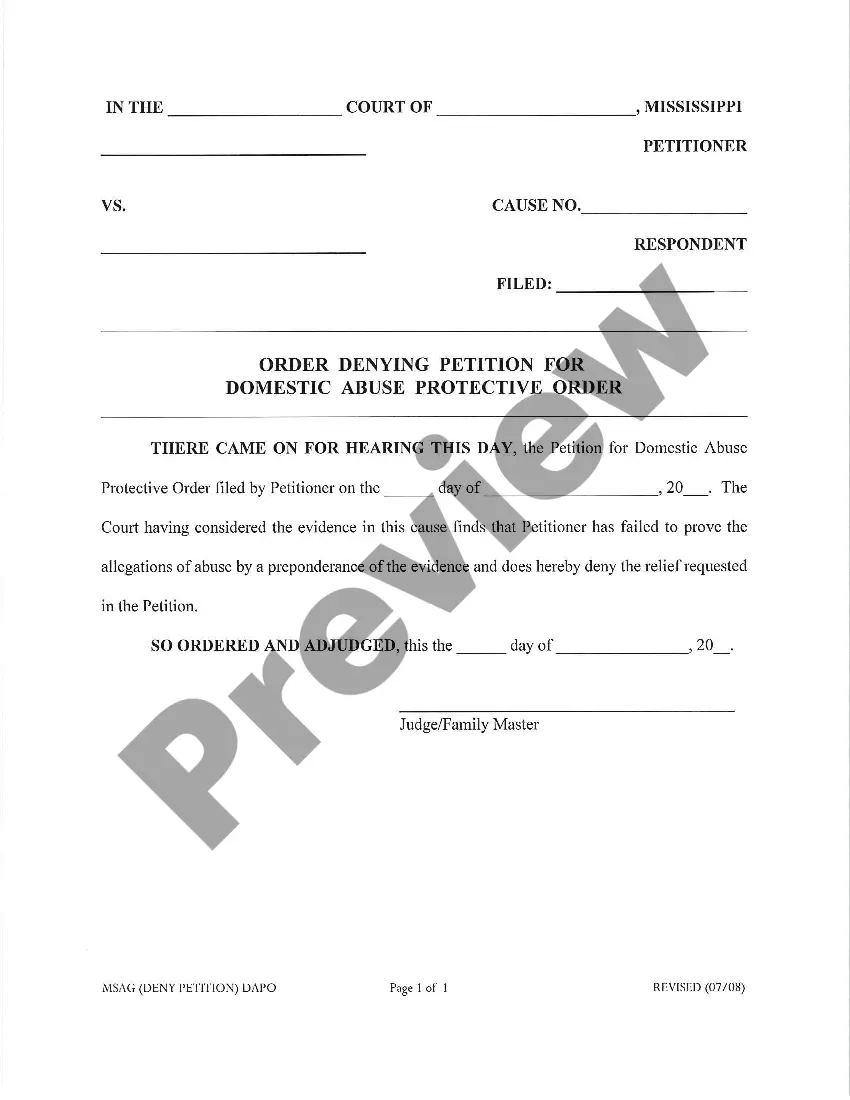
This form is necessary when a petitioner has filed for a domestic abuse protective order but the court determines that the evidence presented does not warrant such an order. It's used to officially close the case against the petitioner and impose any applicable costs. You should use this form after a court hearing concludes with findings that support denying the protective order request.
Who needs this form
- Individuals who have filed a domestic abuse petition that the court has deemed meritless.
- Petitioners seeking clarification on court costs associated with their dismissed case.
- Legal representatives assisting clients involved in domestic abuse hearings.
Completing this form step by step
- Identify the parties involved, including the petitioner and respondent.
- Enter the court's findings regarding the merits of the petition.
- Include any court costs assessed against the petitioner.
- Ensure the signature fields are completed by the judge and authorized officials.
- File the completed form with the court as per local rules.
Does this document require notarization?
Notarization is generally not required for this form. However, certain states or situations might demand it. You can complete notarization online through US Legal Forms, powered by Notarize, using a verified video call available anytime.
Get your form ready online
Our built-in tools help you complete, sign, share, and store your documents in one place.
Make edits, fill in missing information, and update formatting in US Legal Forms—just like you would in MS Word.
Download a copy, print it, send it by email, or mail it via USPS—whatever works best for your next step.
Sign and collect signatures with our SignNow integration. Send to multiple recipients, set reminders, and more. Go Premium to unlock E-Sign.
If this form requires notarization, complete it online through a secure video call—no need to meet a notary in person or wait for an appointment.
We protect your documents and personal data by following strict security and privacy standards.

Make edits, fill in missing information, and update formatting in US Legal Forms—just like you would in MS Word.

Download a copy, print it, send it by email, or mail it via USPS—whatever works best for your next step.

Sign and collect signatures with our SignNow integration. Send to multiple recipients, set reminders, and more. Go Premium to unlock E-Sign.

If this form requires notarization, complete it online through a secure video call—no need to meet a notary in person or wait for an appointment.

We protect your documents and personal data by following strict security and privacy standards.
Typical mistakes to avoid
- Failing to accurately identify all parties involved.
- Leaving out the statement of findings from the court hearing.
- Not including the proper information regarding cost assessments.
- Omitting signatures or dates, which can invalidate the document.
Why complete this form online
- Convenient access to legally vetted forms at any time.
- Easy to download and fill out at your own pace.
- Reliable templates designed by licensed attorneys to ensure compliance.
Looking for another form?

Form popularity
FAQ
Be punctual. Make sure your witnesses are present and prepared. Ensure your evidence is ready. If witnesses or documents that have been subpoenaed and are not in the court, let the judge know. Dress in a manner similar to that as you would for a job interview.
Under section 93-21-7(2) of the Mississippi Code, there is no cost to file for a protection order. . temporary restraining order. the clerk will fill out the information for you.
If you think you need to obtain a restraining order, or have been served with a temporary restraining order, you should reach out to a criminal attorney or family law attorney. You should have legal representation at the hearing where the court will decide whether or not to issue a permanent restraining order.
Decide the evidence you want to use.Evidence is what you present in court to prove that the Respondent has harmed or may harm you (and/or your child). Evidence can be your testimony, the testimony of witnesses, documents, photos, or objects such as torn clothing or a weapon.
If the judge is satisfied, he or she will issue a temporary protective order that will last ten days, but which can be extended upon request, up to the maximum length of one year, but can only last 30 days where the victim has minor children with the abuser.
It does not cost anything to file for an order of protection. Many orders of protection cases are handled without a lawyer however it can often be helpful to have one represent you in court.If you are going to be in court without a lawyer, our Preparing for Court By Yourself section may be useful to you.
Ask the court to change the order. The court can drop the "no contact" part of the order but keep the "no abuse" part of the order. Get the 209A protective order "terminated." This will end the order completely.
1Reconciliation. Strangers do not perpetrate DV, someone they love does. When someone you love is the perpetrator, leaving for good is the hardest part.2Children. Kids miss their parents, and parents miss their kids. There is a constant pressure for a parent to return to being a "family."
If you believe the protection order was granted improperly or that it is no longer needed, you can file a motion asking the court to dissolve (terminate or cancel) the protection order.If the court schedules a hearing and grants the motion, the protection order will become immediately void and unenforceable.