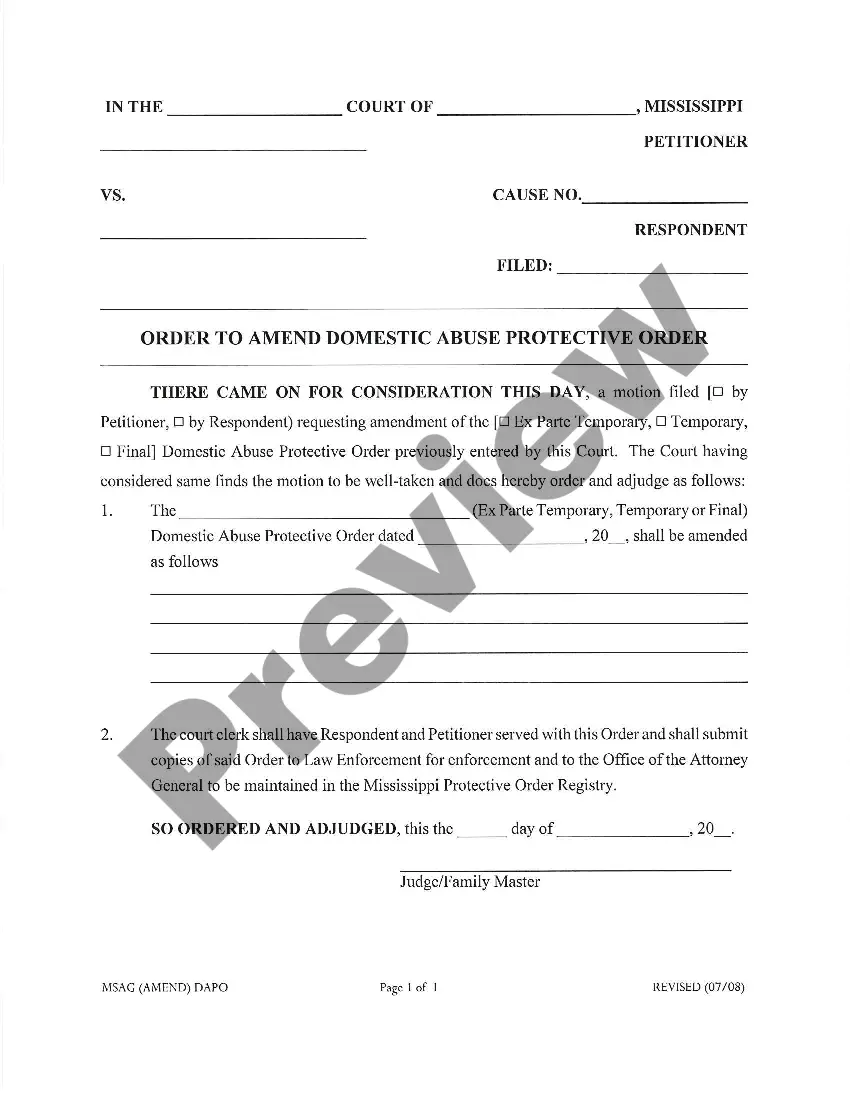
Mississippi Order to Amend Domestic Abuse Protective Order
What this document covers
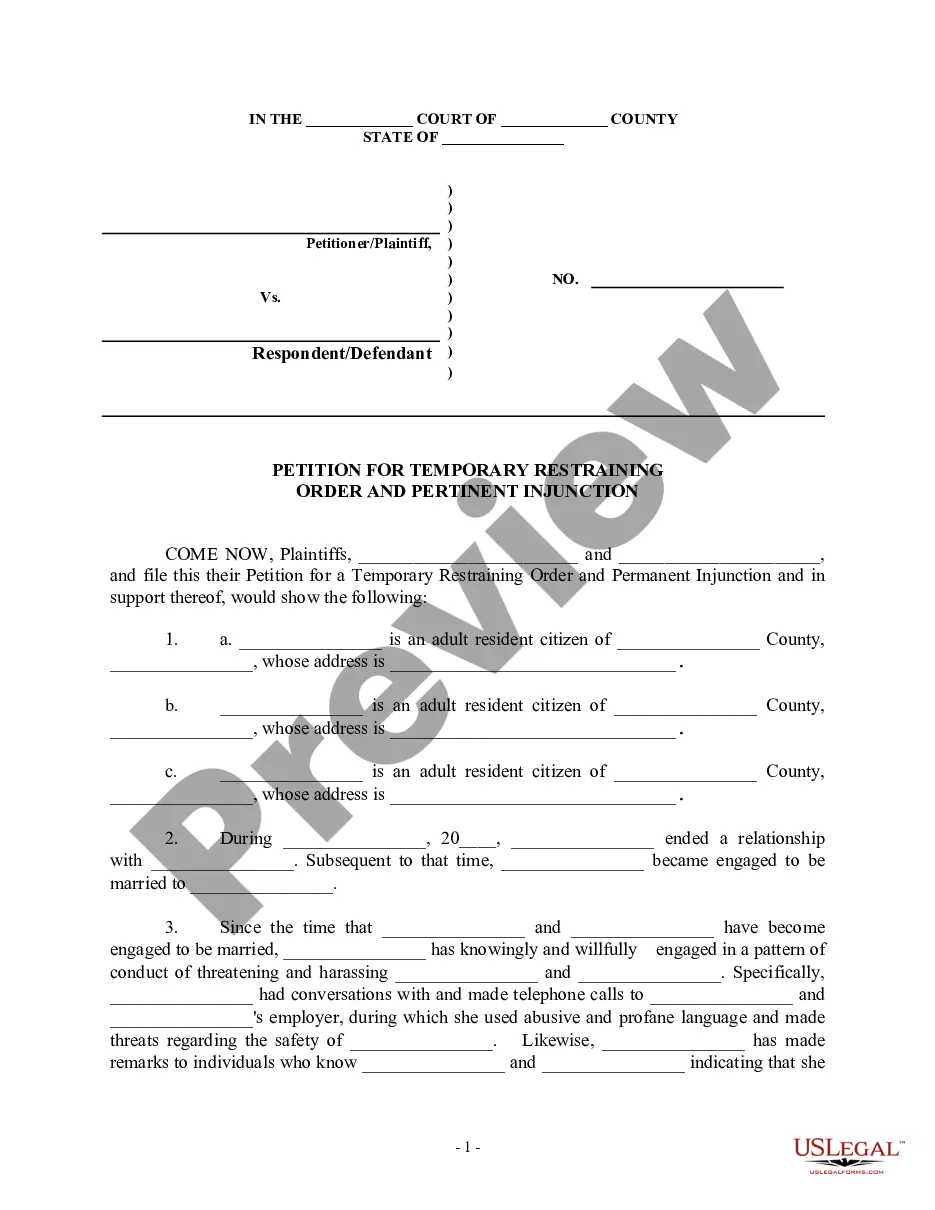
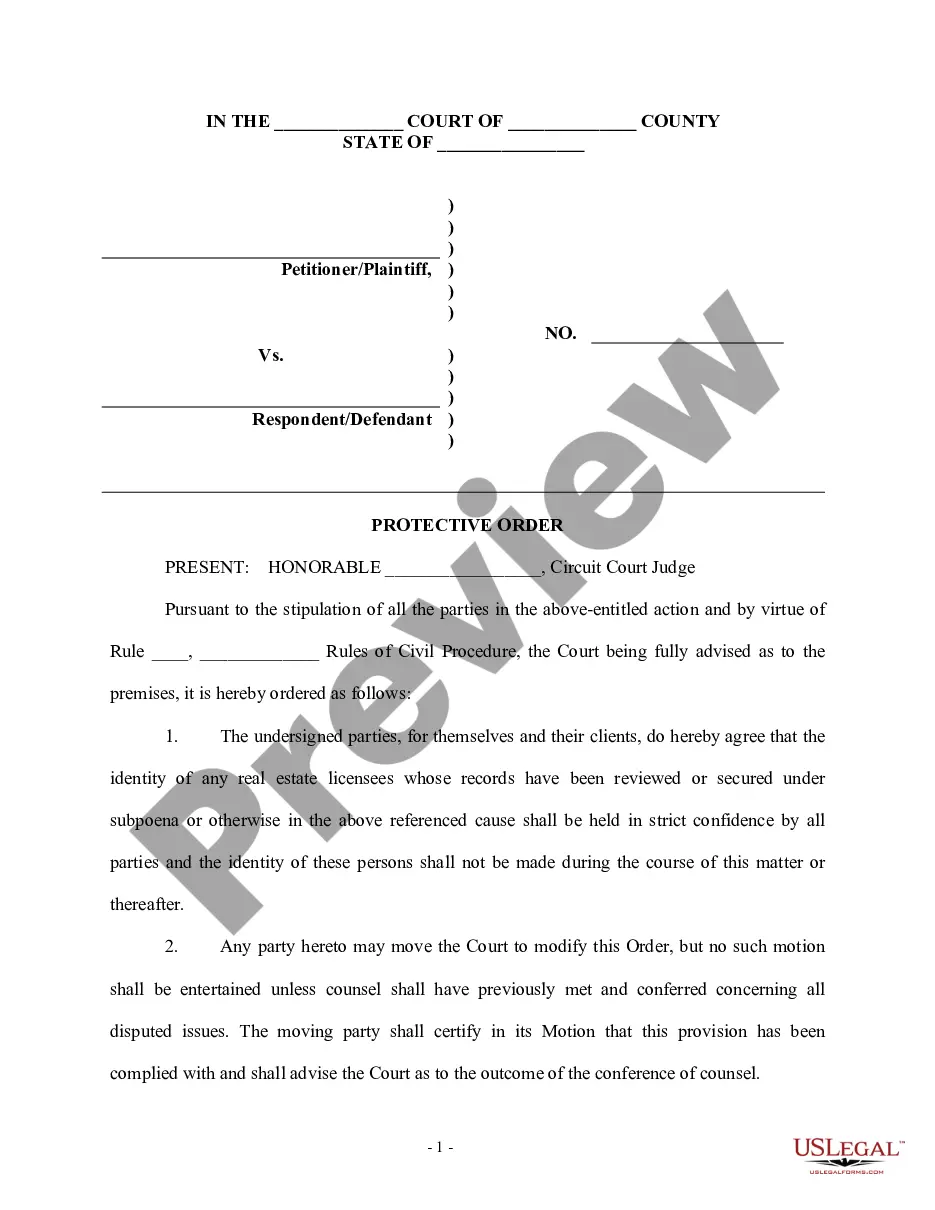
The Order to Amend Domestic Abuse Protective Order is a legal document used when a party wishes to modify or change the terms of an existing protective order. This form is essential for individuals seeking adjustments to the provisions set forth in the original order, which may involve altering restrictions or requirements to better reflect their current circumstances. Unlike a new protective order, this form focuses specifically on amendments to an existing order.
Key parts of this document
- Identification of the parties involved, including the petitioner and the respondent.
- Details of the original protective order, highlighting the terms to be amended.
- Specific changes requested to the protective order terms.
- Explanation or justification for the requested amendments.
- Signature lines for involved parties to authenticate the request.
Situations where this form applies
This form should be used when either party involved in the domestic abuse protective order wishes to request a change in its terms. Situations may include a need to modify contact restrictions, changes in living arrangements, or adjustments related to custody arrangements. It is crucial to file this request promptly if circumstances change significantly.
Who should use this form
The following individuals should consider using this form:
- Individuals who are currently protected by an existing domestic abuse protective order.
- Respondents who wish to appeal for a modification of the protective order terms.
- Attorneys representing either party in this legal matter.
Completing this form step by step
To complete the Order to Amend Domestic Abuse Protective Order, follow these steps:
- Identify all parties by entering their full names and contact information.
- Reference the original protective order by including its case number and relevant details.
- Clearly specify the changes you are requesting in the protective order.
- Provide a detailed explanation for each requested amendment.
- Both parties must sign and date the form, ensuring all signatures are authentic and correctly dated.
Is notarization required?
No, this form does not typically require notarization unless specified by local law. However, it is recommended to verify with local regulations regarding any specific requirements for filing.
Get your form ready online
Our built-in tools help you complete, sign, share, and store your documents in one place.
Make edits, fill in missing information, and update formatting in US Legal Forms—just like you would in MS Word.
Download a copy, print it, send it by email, or mail it via USPS—whatever works best for your next step.
Sign and collect signatures with our SignNow integration. Send to multiple recipients, set reminders, and more. Go Premium to unlock E-Sign.
If this form requires notarization, complete it online through a secure video call—no need to meet a notary in person or wait for an appointment.
We protect your documents and personal data by following strict security and privacy standards.

Make edits, fill in missing information, and update formatting in US Legal Forms—just like you would in MS Word.

Download a copy, print it, send it by email, or mail it via USPS—whatever works best for your next step.

Sign and collect signatures with our SignNow integration. Send to multiple recipients, set reminders, and more. Go Premium to unlock E-Sign.

If this form requires notarization, complete it online through a secure video call—no need to meet a notary in person or wait for an appointment.

We protect your documents and personal data by following strict security and privacy standards.
Typical mistakes to avoid
- Failing to provide complete and accurate information about the original protective order.
- Not specifying the exact changes sought, leading to confusion or rejection of the request.
- Neglecting to sign the document, invalidating the request.
Benefits of using this form online
- Convenience of accessing the form online at any time.
- Easily editable to fit specific needs of the individual situation.
- Access to legal validity through templates crafted by licensed attorneys.
Main things to remember
- The Order to Amend Domestic Abuse Protective Order is crucial for requesting changes to an existing order.
- Clear documentation and justification for changes are necessary to ensure a smooth process.
- Ensure all parties sign the form to validate the request.
Looking for another form?
Form popularity
FAQ
A protection order may be varied, withdrawn or set aside if the complainant makes an application for variation or rescission, but only if the court is satisfied that the application is being made freely and voluntarily.The court may refuse to withdraw if it believes that you or your children require protection.
You can fill out and file a Response to Request for Civil Harassment Restraining Orders (Form CH-120. ) where you tell the judge your side of the story about what happened. Even if you do not file a Response, GO TO YOUR HEARING!
There are no costs involved in applying for a protection order, unless an attorney is used.Once a protection order is granted, it is valid until the victim withdraws it. If the perpetrator lodges an appeal, the order will continue to operate until it is cancelled by the appeal court.
Modifications: After the court has granted either the ex parte temporary protective order or long term protective order, if you want to change part of the order, you can file your request with the court. Only the judge has the power to modify the order.It is not valid unless it is written in a court order.
The court is looking for a description of your relationship to the respondent, when, where, what happened, and who did what to whom. Using the facts of the incident only, keep your statement brief and to the point. Briefly describe the most recent incident of abuse and/or threats of abuse or other behaviors.
If you believe the protection order was granted improperly or that it is no longer needed, you can file a motion asking the court to dissolve (terminate or cancel) the protection order. After you file the motion, the court will decide whether or not to schedule a hearing.
Consult with a family law attorney experienced in defending people against false restraining orders. You must go to court for the final restraining order hearing and present your evidence proving why the accusations against you are false. The evidence can be police reports, witnesses, text messages and or emails.
If you're the person who asked for the no contact order, you can ask the judge in your case to drop it. While there's no guarantee that the judge will do so, if you can show that you're not being forced or coerced into doing it, you'll have a better chance of getting it dropped.