Mississippi Final Judgment
What is this form?
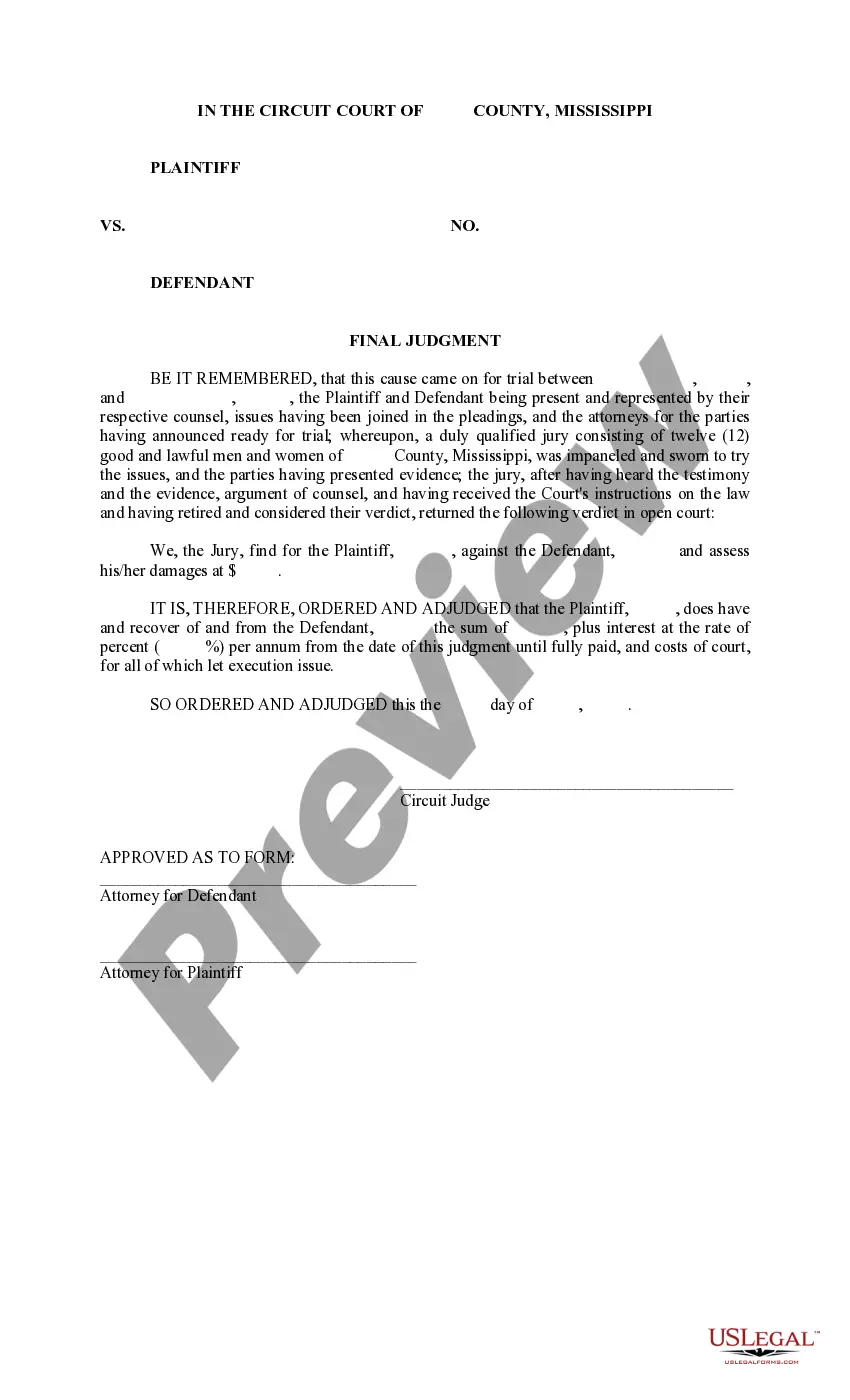
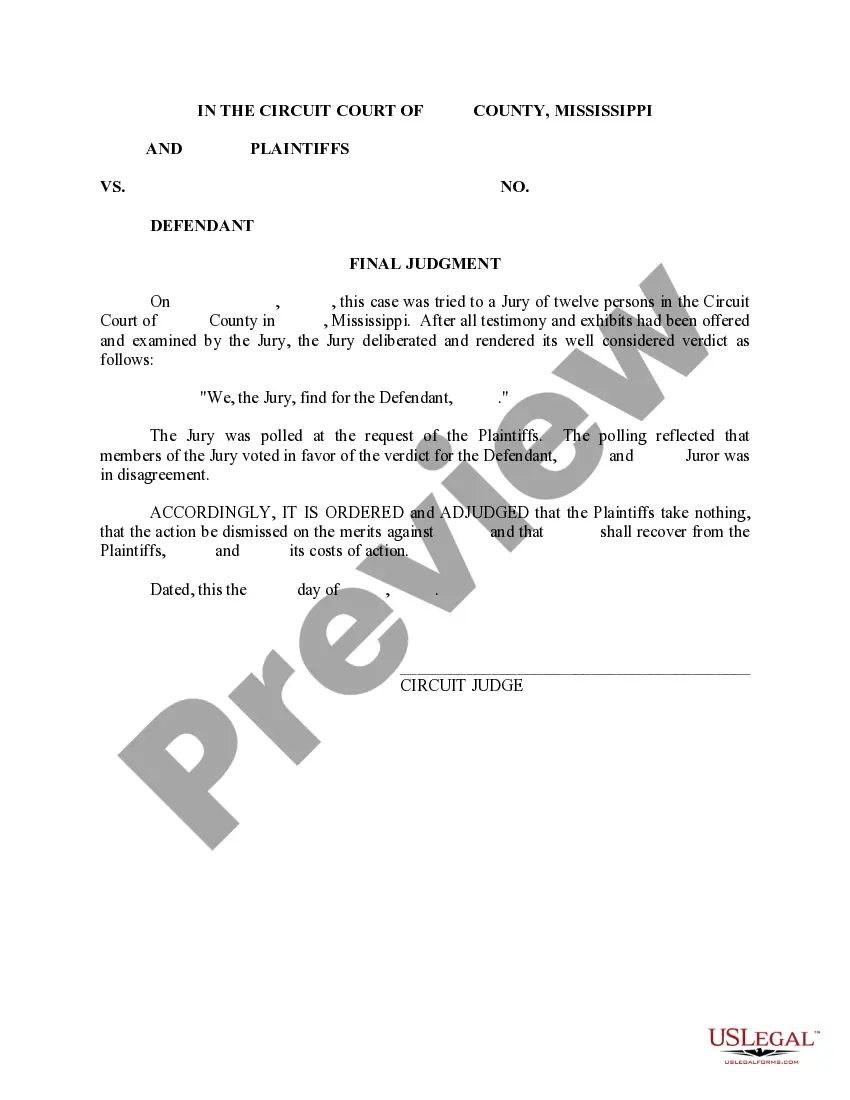
The Final Judgment is a legal document that outlines the outcome of a lawsuit, detailing the verdict reached by a jury or judge. Unlike other legal forms that may pertain to motions or requests, the Final Judgment formally concludes the case and establishes the rights and obligations of the parties involved. This form is essential for maintaining a clear record of the court's decision and serves as proof of the final outcomes decided during litigation.
Key parts of this document
- Case title and caption, identifying the parties involved in the lawsuit.
- Details of the verdict, summarizing the findings and rulings made by the court.
- Signature line for the judge, which authenticates the document.
- Date of judgment, marking when the decision was rendered.
- Instructions for any further actions required by the parties post-judgment.
When to use this form
This form should be used after the conclusion of a trial where a verdict has been reached, either through a jury or a bench trial. It is particularly necessary when parties need formal documentation of the court's decision, which may be required for enforcement, appeals, or record-keeping purposes.
Who needs this form
- Plaintiffs seeking a formal record of their case's outcome.
- Defendants wishing to understand their obligations following a verdict.
- Attorneys representing clients who need to file final judgments in court.
- Parties involved in litigation requiring documentation for appeal or further legal proceedings.
How to complete this form
- Identify the parties involved in the case and include their names in the case title.
- Summarize the verdict given by the jury or judge, including any specific rulings made.
- Ensure the judge signs and dates the form to affirm its legitimacy.
- Review any additional instructions related to the implementation of the judgment.
- File the completed form with the appropriate court for official recordkeeping.
Does this document require notarization?
This form does not typically require notarization unless specified by local law. It is important to verify your jurisdiction's requirements to ensure compliance.
Get your form ready online
Our built-in tools help you complete, sign, share, and store your documents in one place.
Make edits, fill in missing information, and update formatting in US Legal Forms—just like you would in MS Word.
Download a copy, print it, send it by email, or mail it via USPS—whatever works best for your next step.
Sign and collect signatures with our SignNow integration. Send to multiple recipients, set reminders, and more. Go Premium to unlock E-Sign.
If this form requires notarization, complete it online through a secure video call—no need to meet a notary in person or wait for an appointment.
We protect your documents and personal data by following strict security and privacy standards.

Make edits, fill in missing information, and update formatting in US Legal Forms—just like you would in MS Word.

Download a copy, print it, send it by email, or mail it via USPS—whatever works best for your next step.

Sign and collect signatures with our SignNow integration. Send to multiple recipients, set reminders, and more. Go Premium to unlock E-Sign.

If this form requires notarization, complete it online through a secure video call—no need to meet a notary in person or wait for an appointment.

We protect your documents and personal data by following strict security and privacy standards.
Mistakes to watch out for
- Failing to include the full names of all parties involved in the case.
- Omitting the signature and date from the judge, which can invalidate the form.
- Using unclear language when summarizing the verdict, leading to confusion.
- Not filing the form with the court in a timely manner after the verdict.
Why complete this form online
- Convenience of accessing and downloading the form instantly.
- Editability allows users to customize the form to fit their specific case.
- Reliability of forms drafted by licensed attorneys, ensuring legal compliance.
Legal use & context
- The Final Judgment serves as a decisive record in the court system.
- It is enforceable and can be used in future legal proceedings related to the case.
- Documentation must adhere to applicable laws to ensure its validity and recognition.
Quick recap
- The Final Judgment is crucial for formalizing court decisions in lawsuits.
- Accurate completion of this form is essential for legal clarity and compliance.
- This form can be customized and used across various states, depending on specific legal nuances.
Looking for another form?

Form popularity
FAQ
The court may, upon any terms as may be just, relieve a party or his or her legal representative from a judgment, dismissal, order, or other proceeding taken against him or her through his or her mistake, inadvertence, surprise, or excusable neglect. (Code Civ.
United States, a final judgment is a decision by the. district court that ends the litigation on the merits and leaves nothing for the court to do but. execute the judgment.
The grant of summary judgment usually results in a final judgment only if the grant resolves all issues as to all parties. An order for summary judgment is interlocutory if it does not entirely end the proceedings before the trial court.
There are basically 3 stages to a civil appeal in Mississippi. First, you file your notice of appeal and other preliminary documents. Critically, you MUST file your notice of appeal within 30 days of the trial court's final judgment. In some cases, you should file a post-trial motion within 10 days of the judgment.