Mississippi Motion for Recusal and Change of Venue
Overview of this form
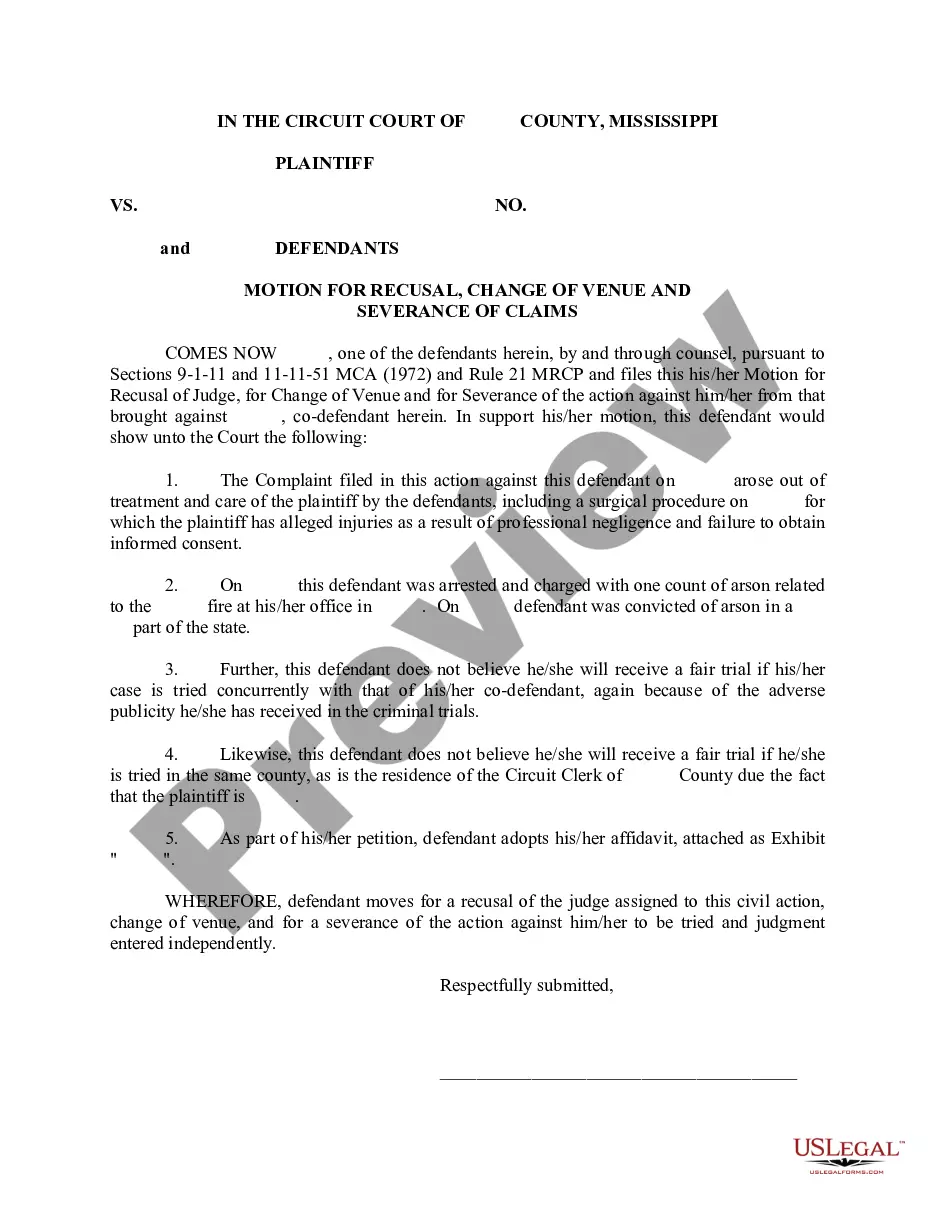
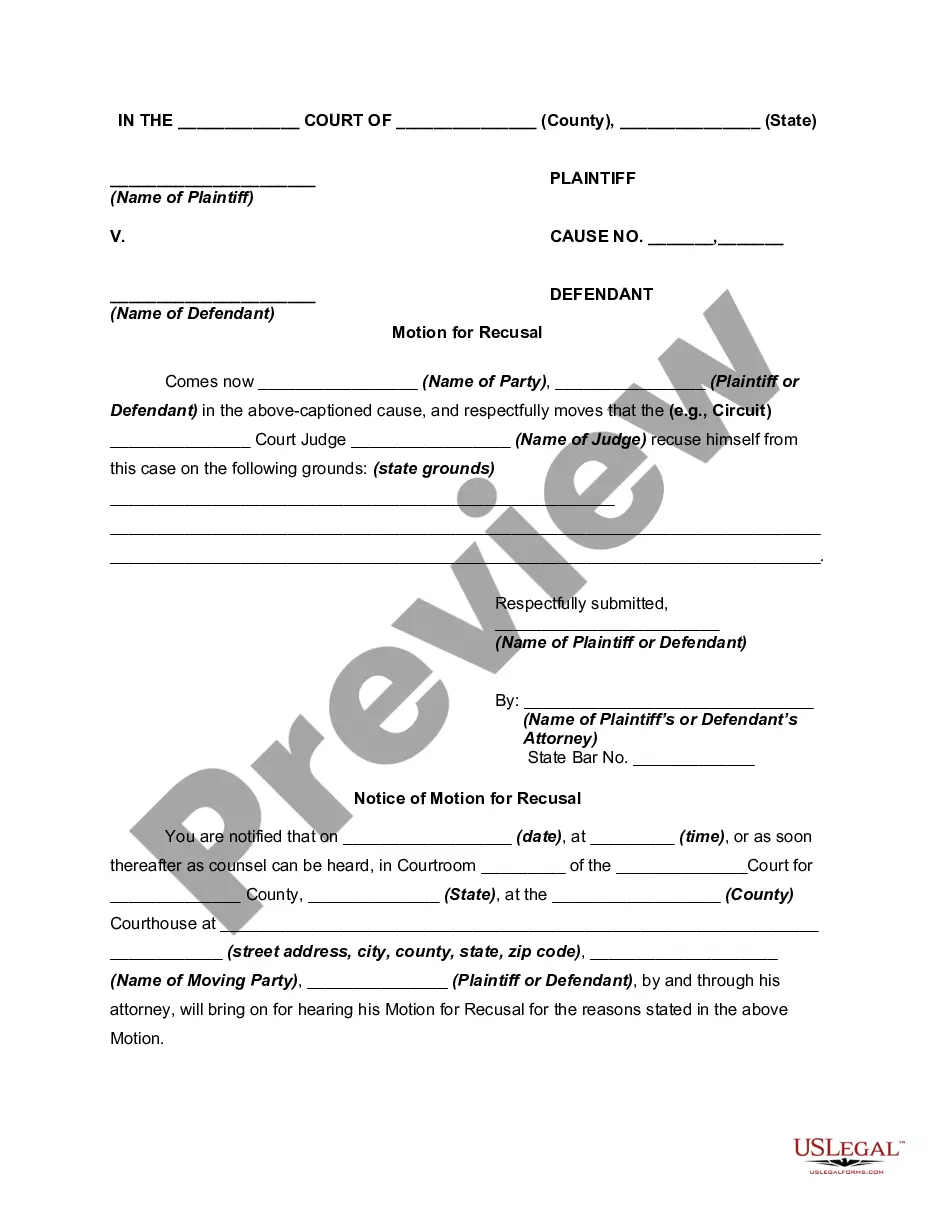
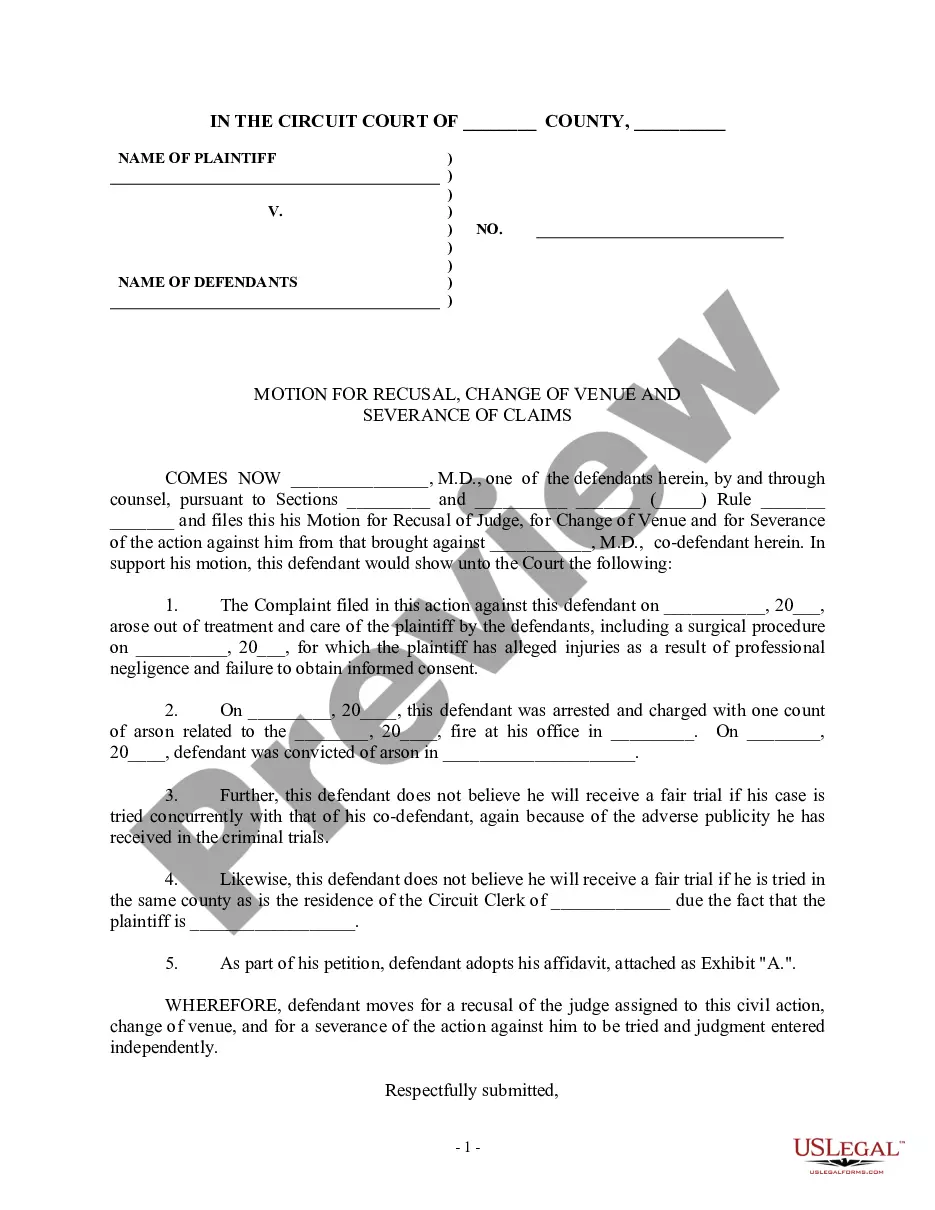
A Motion for Recusal and Change of Venue is a formal written request submitted to the court asking for a judge to disqualify themselves from a case and for the case to be moved to a different location. This document differs from other motions as it specifically addresses issues of bias or conflict of interest concerning the presiding judge, as well as the logistical aspects of venue change. This form is designed for adaptability to fit your specific circumstances while maintaining compliance with court rules.
Main sections of this form
- Header that indicates the filing party, case number, and court name.
- Statement of the grounds for recusal, detailing any perceived bias or conflict of interest.
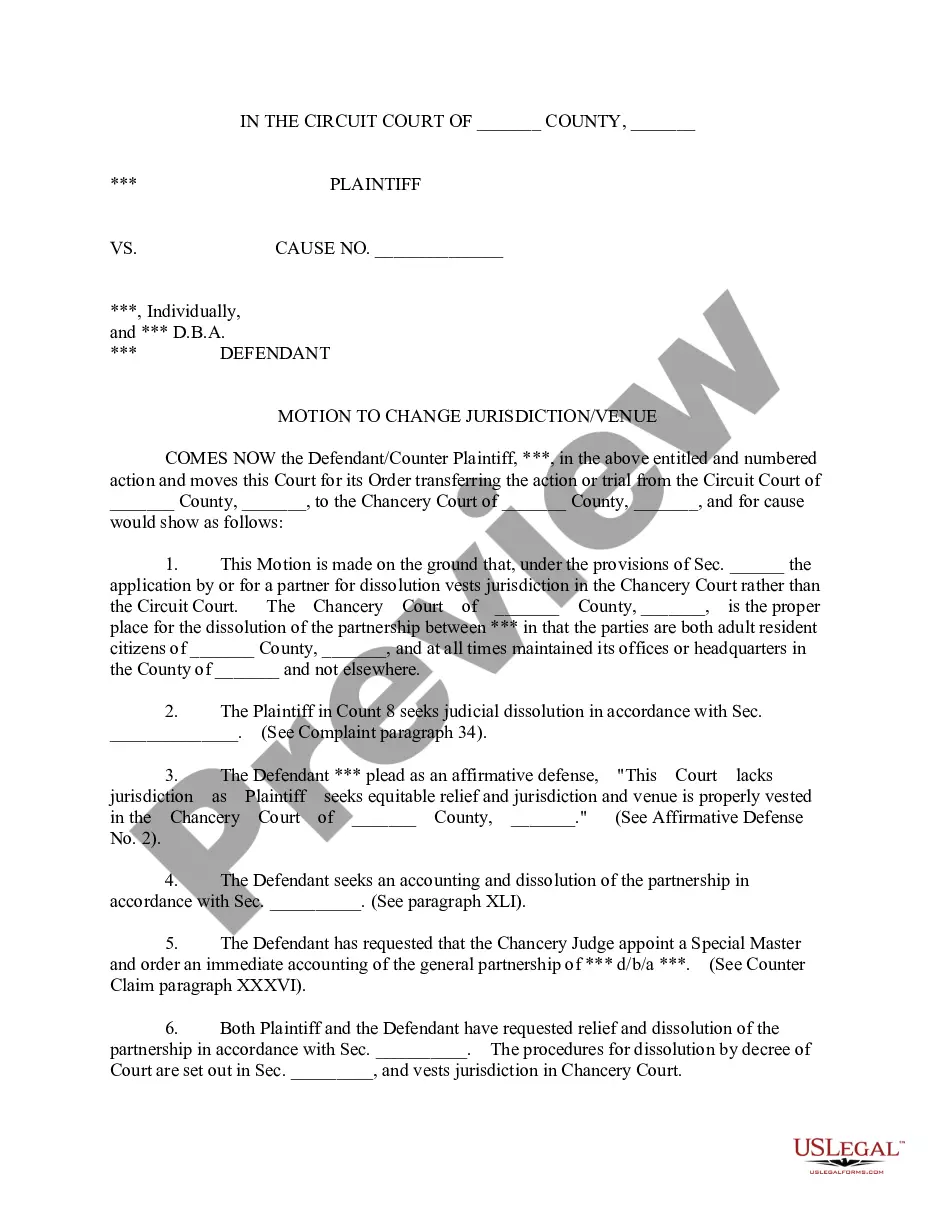
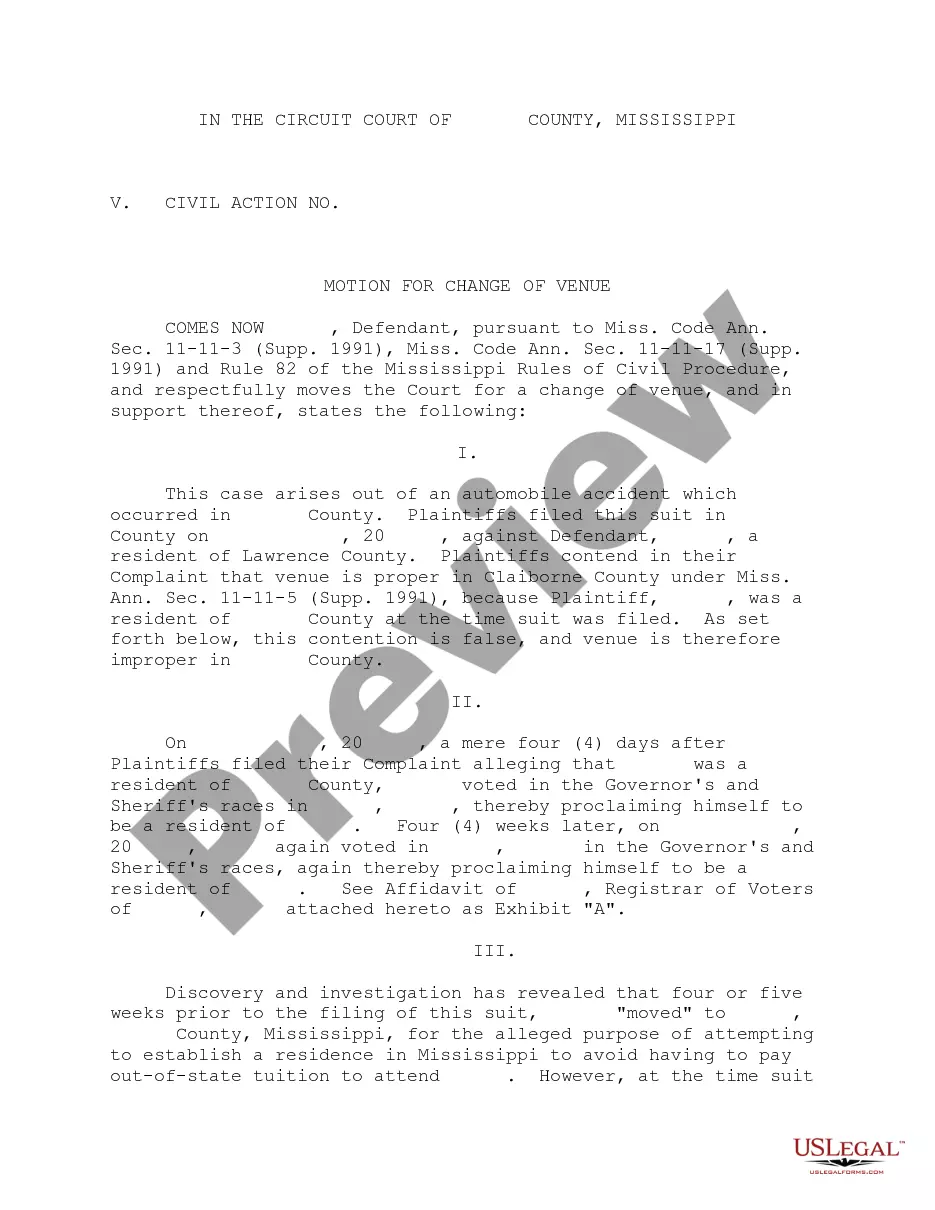
- Request for a change of venue, including reasons justifying the move.
- Supporting evidence and references to applicable laws or court rules.
- Signature block for the moving party or their attorney.
Common use cases
This form is commonly used when a party involved in a legal proceeding believes that the judge cannot provide a fair trial due to perceived bias or conflict of interest. Additionally, it is applicable when logistical factors, such as the convenience of witnesses or the location's relevance to the case, warrant a change of venue. Situations may include cases involving local media attention that could affect a judge's impartiality or instances where the current court lacks jurisdiction over the matter.
Intended users of this form
- Individuals or parties involved in legal proceedings who feel that a judge is biased.
- Attorneys representing clients seeking a more favorable court environment.
- Any party needing to relocate their case to a different jurisdiction for impartiality or convenience.
Completing this form step by step
- Identify the parties involved and fill in the header with the case number and court details.
- Clearly state your reasons for requesting the recusal of the judge, referencing specific instances of bias or conflict.
- Make your case for why the venue should be changed, including any supporting evidence.
- Review applicable laws or court rules that support your motion, and include these references in your filing.
- Sign the document and date it to finalize your request to the court.
Is notarization required?
Notarization is not commonly needed for this form. However, certain documents or local rules may make it necessary. Our notarization service, powered by Notarize, allows you to finalize it securely online anytime, day or night.
Get your form ready online
Our built-in tools help you complete, sign, share, and store your documents in one place.
Make edits, fill in missing information, and update formatting in US Legal Forms—just like you would in MS Word.
Download a copy, print it, send it by email, or mail it via USPS—whatever works best for your next step.
Sign and collect signatures with our SignNow integration. Send to multiple recipients, set reminders, and more. Go Premium to unlock E-Sign.
If this form requires notarization, complete it online through a secure video call—no need to meet a notary in person or wait for an appointment.
We protect your documents and personal data by following strict security and privacy standards.

Make edits, fill in missing information, and update formatting in US Legal Forms—just like you would in MS Word.

Download a copy, print it, send it by email, or mail it via USPS—whatever works best for your next step.

Sign and collect signatures with our SignNow integration. Send to multiple recipients, set reminders, and more. Go Premium to unlock E-Sign.

If this form requires notarization, complete it online through a secure video call—no need to meet a notary in person or wait for an appointment.

We protect your documents and personal data by following strict security and privacy standards.
Avoid these common issues
- Failing to provide sufficient evidence supporting claims of bias.
- Not referencing specific legal statutes or court rules that apply to the case.
- Omitting signatures or dates from the motion, rendering it invalid.
- Filing the motion in an incorrect jurisdiction or court.
Benefits of using this form online
- Accessibility to legal resources 24/7 allows for immediate use when needed.
- Easy customization of the form ensures it meets individual legal needs.
- Reliable templates drafted by licensed attorneys enhance the quality of submissions.
Looking for another form?


Form popularity
FAQ
The change of venue form asks for the judge to move your court from the city where you were detained to a city closer to where you currently live. The blue form tells the judge and immigration your new address so they can send you important documents like notice of your court date.
A motion for change of venue ensures that a case is heard in the best location. There are two basic requirements that must be met before a court can hear a case. The first is jurisdiction, which means that the court has the authority to decide the legal issues which affect the rights of the parties in the case.
Venue is the location where a civil or criminal case is decided. In state courts, venue is decided by where the plaintiff or defendant lives or does business. It can also be decided based on the location of witnesses or even the court.In real estate law, venue is decided by the location of the property at issue.
Reasons for changes of venue include pretrial publicity, bias, political atmosphere, and any other circumstance that the parties believe would prevent them from obtaining a fair trial in the county in which the case was originally filed.
A change of venue is the legal term for moving a trial to a new location.A change of venue request because venue is improper means that the removing defendant believes that the case may not be in that venue because it is improper under procedural rules.
Change of venue is the transfer of a legal action from one county to another county for trial. In criminal cases a change of venue is permitted if, for example, the court believes the defendant cannot receive a fair trial in a given county.
To achieve a change of venue, defendants typically have to show a reasonable likelihood that they can't receive a fair trial.Other reasons for a change of venue include: a judge who is prejudiced against the defendant, and. in capital cases, a jury pool that's predisposed for or against the death penalty.
When an attorney requests a change of venue, the attorney is asking: the Court of Appeals for the District of Columbia.
To achieve a change of venue, defendants typically have to show a reasonable likelihood that they can't receive a fair trial.Other reasons for a change of venue include: a judge who is prejudiced against the defendant, and. in capital cases, a jury pool that's predisposed for or against the death penalty.
A change of venue may be ordered by the Supreme Court where it is shown that the accused might be liquidated by his enemies in the place where the trial was originally scheduled to be held.