Mississippi Jury Instruction - For Plaintiff - No Punitive Damages
Understanding this form
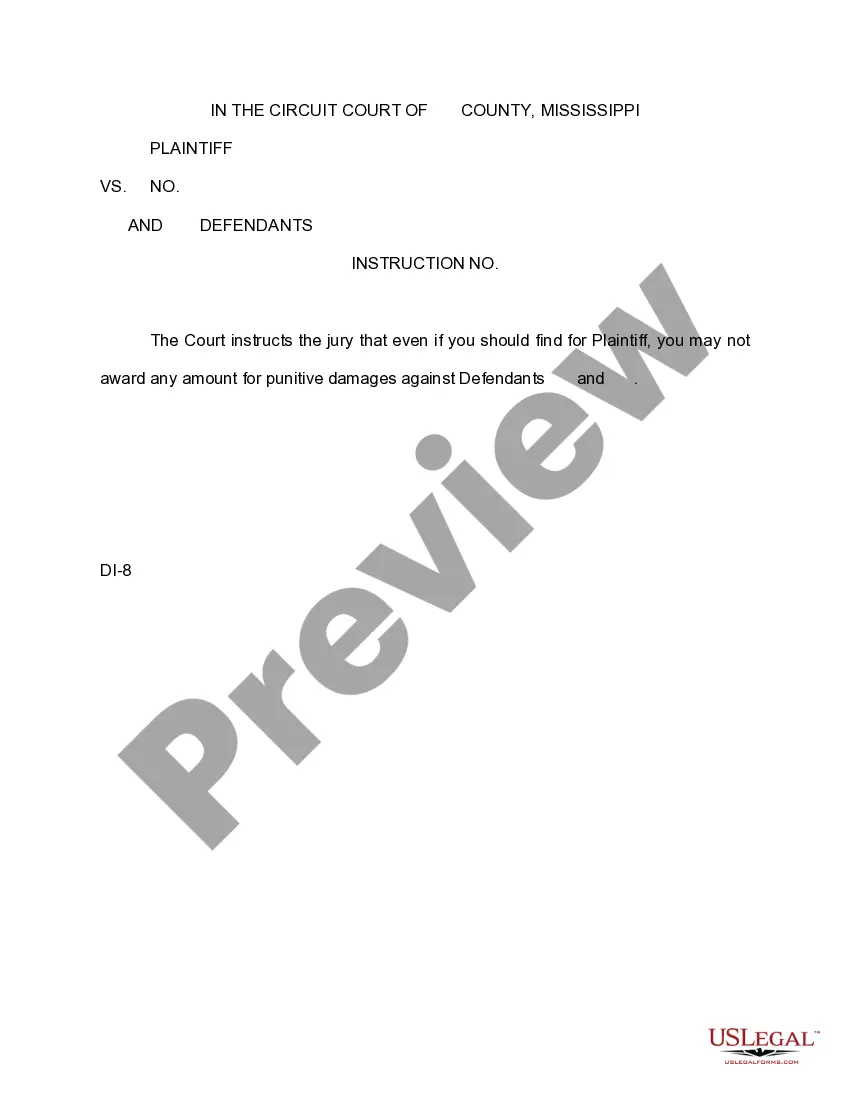
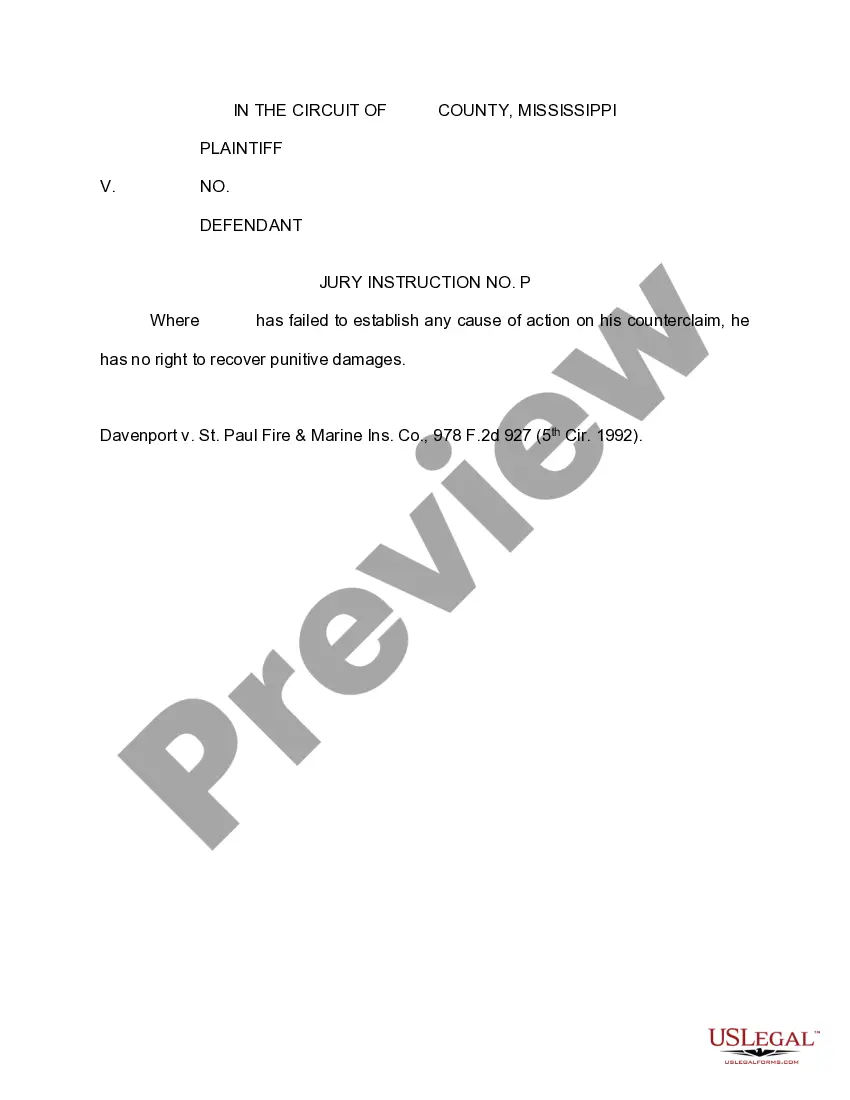
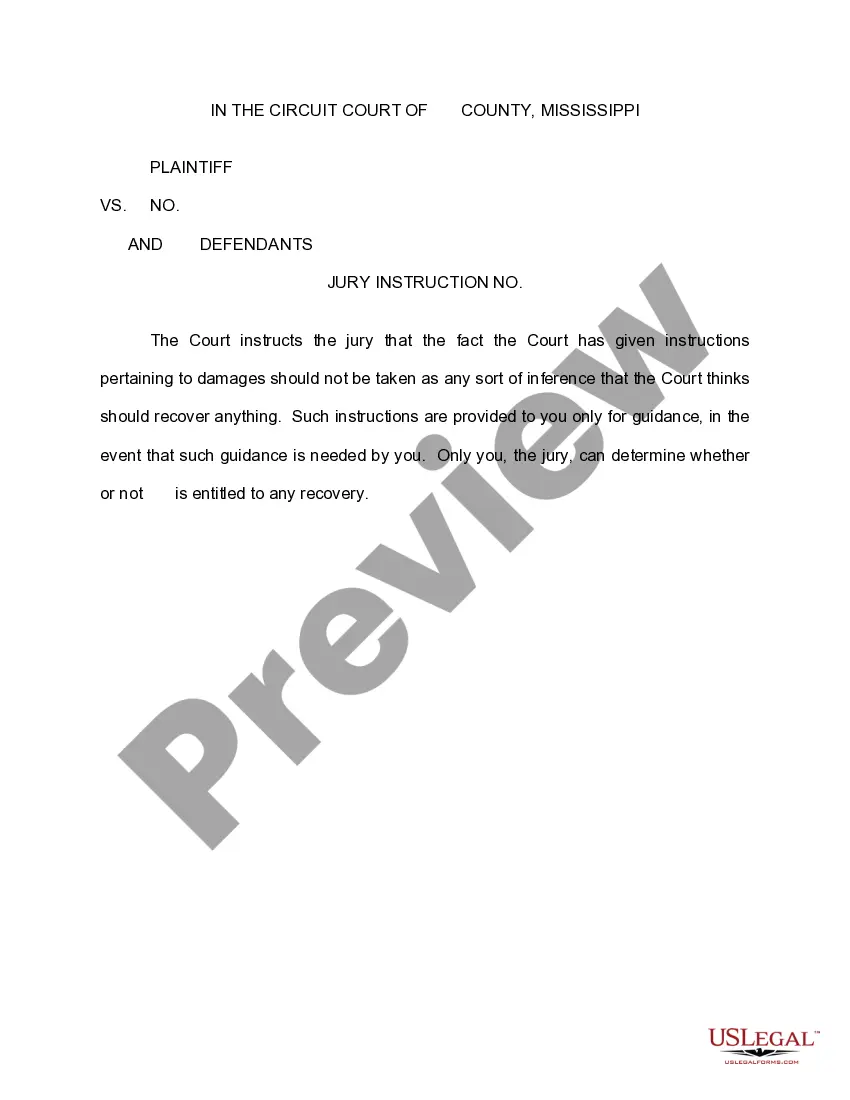
The "Jury Instruction - For Plaintiff - No Punitive Damages" form is a legal document specifically designed for use in Mississippi court cases. Its primary purpose is to instruct the jury that, even if they find in favor of the plaintiff, they are not permitted to award punitive damages against the defendants. This form is important for ensuring that jurors understand the limits established by law regarding damage awards in certain cases.
Key components of this form
- Identification of parties involved in the lawsuit.
- Instruction to the jury regarding the prohibition of punitive damages.
- Space for the court to provide specific details about the trial's context.
- Official designation of the jury instruction number.
Situations where this form applies
This form should be used in civil lawsuits in Mississippi where the plaintiff seeks compensatory damages but does not intend to claim punitive damages. It ensures that the jury is properly informed of this limitation, which can be crucial for accurately determining damages according to legal standards.
Who needs this form
- Lawyers and legal practitioners involved in Mississippi civil litigation.
- Plaintiffs seeking to file for damages without seeking punitive awards.
- Defendants needing to understand jury instructions relevant to their case.
Instructions for completing this form
- Begin by identifying the parties involved in the lawsuit at the top of the form.
- Insert the specific instruction number designated by the court.
- Clearly state that the jury may not award punitive damages to the plaintiff.
- Ensure all legal language aligns with current Mississippi law.
- Review the completed instruction for accuracy before submission to the court.
Is notarization required?
Notarization is generally not required for this form. However, certain states or situations might demand it. You can complete notarization online through US Legal Forms, powered by Notarize, using a verified video call available anytime.
Get your form ready online
Our built-in tools help you complete, sign, share, and store your documents in one place.
Make edits, fill in missing information, and update formatting in US Legal Forms—just like you would in MS Word.
Download a copy, print it, send it by email, or mail it via USPS—whatever works best for your next step.
Sign and collect signatures with our SignNow integration. Send to multiple recipients, set reminders, and more. Go Premium to unlock E-Sign.
If this form requires notarization, complete it online through a secure video call—no need to meet a notary in person or wait for an appointment.
We protect your documents and personal data by following strict security and privacy standards.

Make edits, fill in missing information, and update formatting in US Legal Forms—just like you would in MS Word.

Download a copy, print it, send it by email, or mail it via USPS—whatever works best for your next step.

Sign and collect signatures with our SignNow integration. Send to multiple recipients, set reminders, and more. Go Premium to unlock E-Sign.

If this form requires notarization, complete it online through a secure video call—no need to meet a notary in person or wait for an appointment.

We protect your documents and personal data by following strict security and privacy standards.
Typical mistakes to avoid
- Failing to correctly identify all parties involved in the case.
- Omitting necessary legal language or context from the instruction.
- Assuming that the form is valid without checking for compliance with current law.
Advantages of online completion
- Convenience of immediate access and download.
- Editability to tailor the instruction to specific case needs.
- Reliability of using professionally drafted legal language.
Looking for another form?


Form popularity
FAQ
We found that 98 percent of the large punitive damages awards were made by juries and only two percent by judges. The jury awards in these large cases were highly unpredictable and were weakly correlated with compensatory damages.
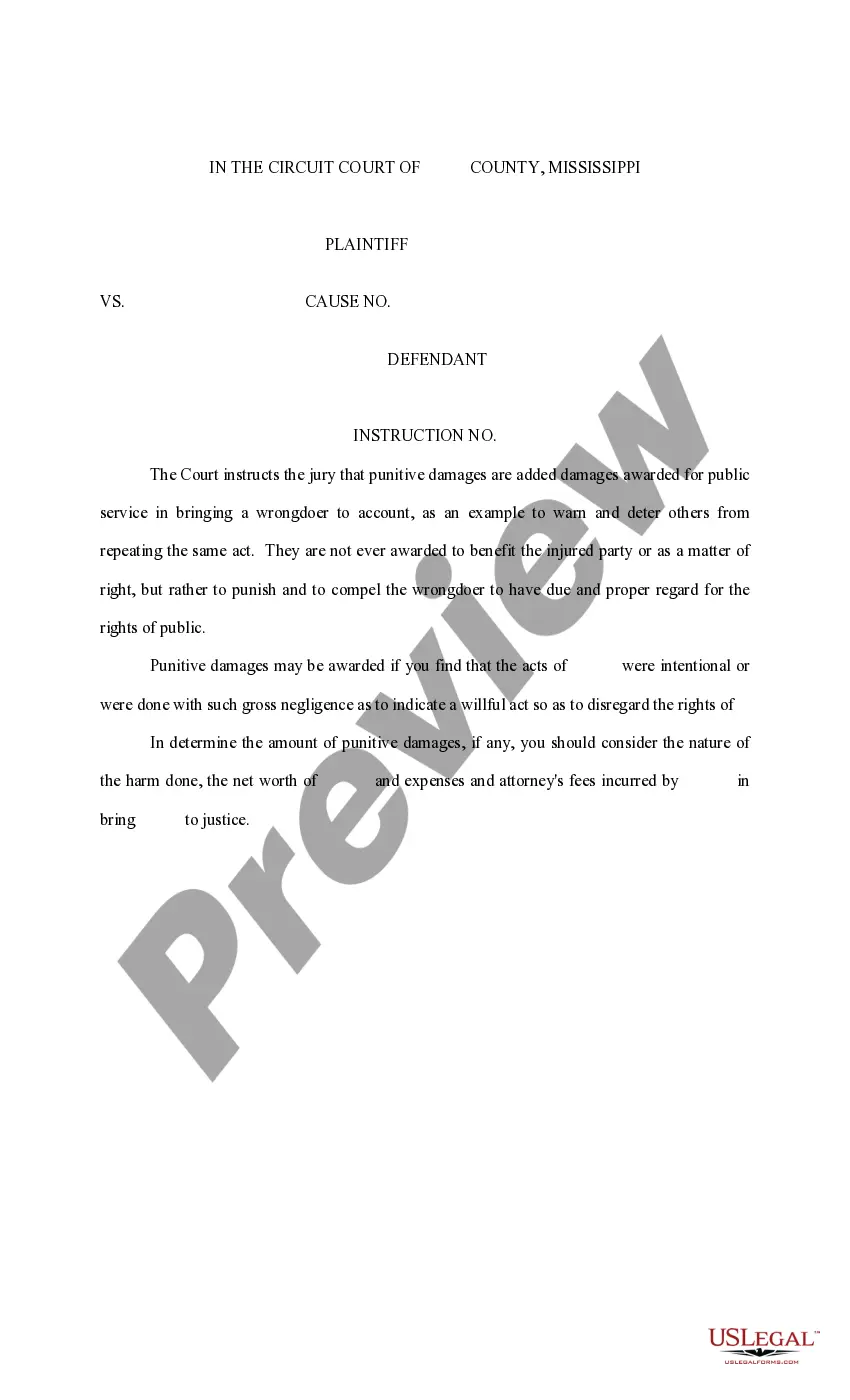
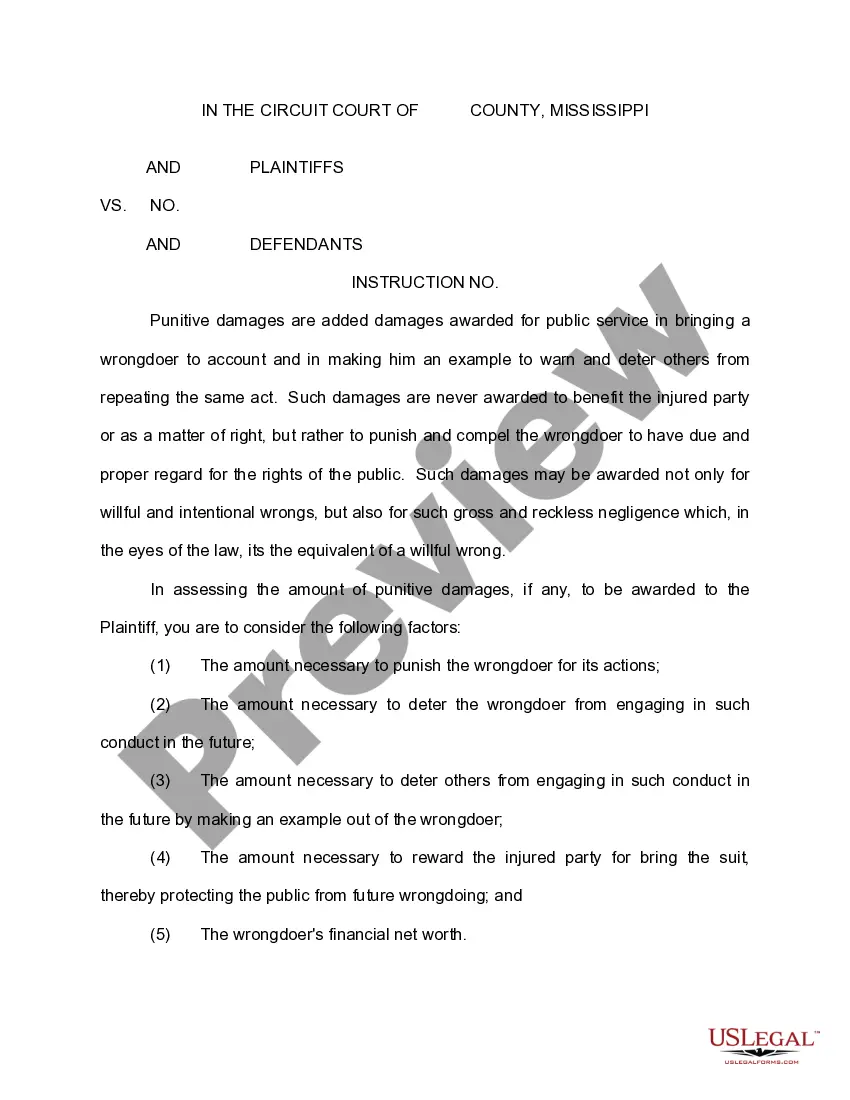
Punitive damages are legal recompense that a defendant found guilty of committing a wrong or offense is ordered to pay on top of compensatory damages. They are awarded by a court of law not to compensate injured plaintiffs but to punish defendants whose conduct is considered grossly negligent or intentional.
In short, the jurors determine the facts and reach a verdict, within the guidelines of the law as determined by the judge. Many states allow the lawyers to request that certain instructions be given, but the judge makes the final decisions about them.
As such, punitive damages are usually reserved for cases where the defendant's conduct is beyond merely negligent or intentional; the conduct must be reckless, malicious, fraudulent, wanton, outrageous, or otherwise more deserving of punishment in the eyes of the judge or jury.
In many states, including California and Texas, punitive damages are determined based on statute; elsewhere, they may be determined solely based on case law.They are rare, occurring in only 6% of civil cases that result in a monetary award.
Even though punitive damage awards are meant to punish the defendant and benefit society, not the plaintiff, punitive damage awards are paid to the plaintiff in a case.
When can I get "punitive damages"? California Civil Code 3294 allows plaintiffs to recover punitive damages when they can show that their injuries were caused by the defendant's malice, oppression or fraud, typically in cases of intentional harm or extreme recklessness.
Jurisdictions employ one of three standards of proof in decisions concerning punitive damages: (1) beyond a reasonable doubt, (2) by clear and convincing evidence, and (3) by a preponderance of evidence.
Generally, punitive damages are in excess of provable injuries. They are usually only awarded in cases brought under tort law, such as personal injury or medical malpractice cases, rather than those brought because of a contractual dispute.