Mississippi Order to Transport
What this document covers
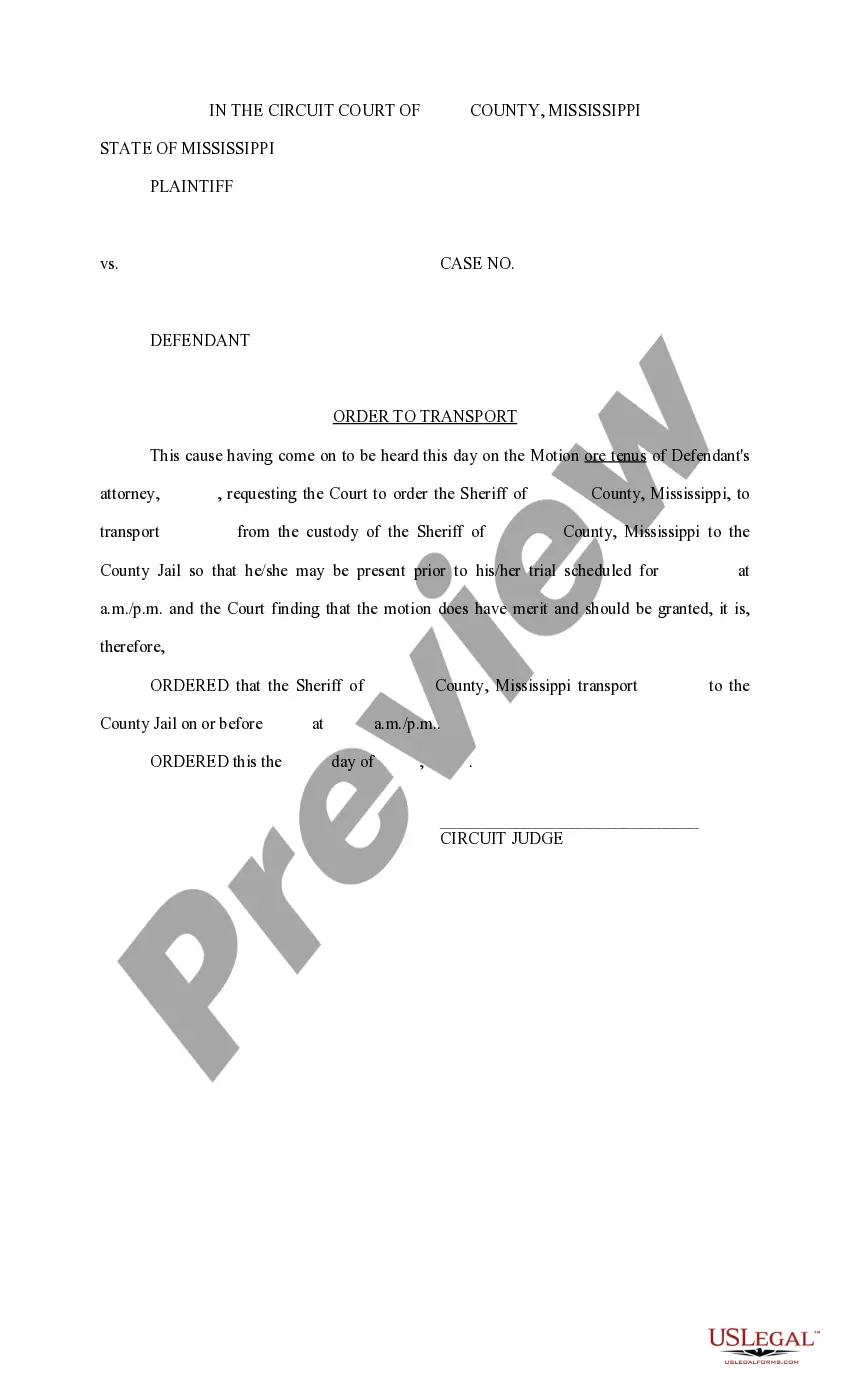
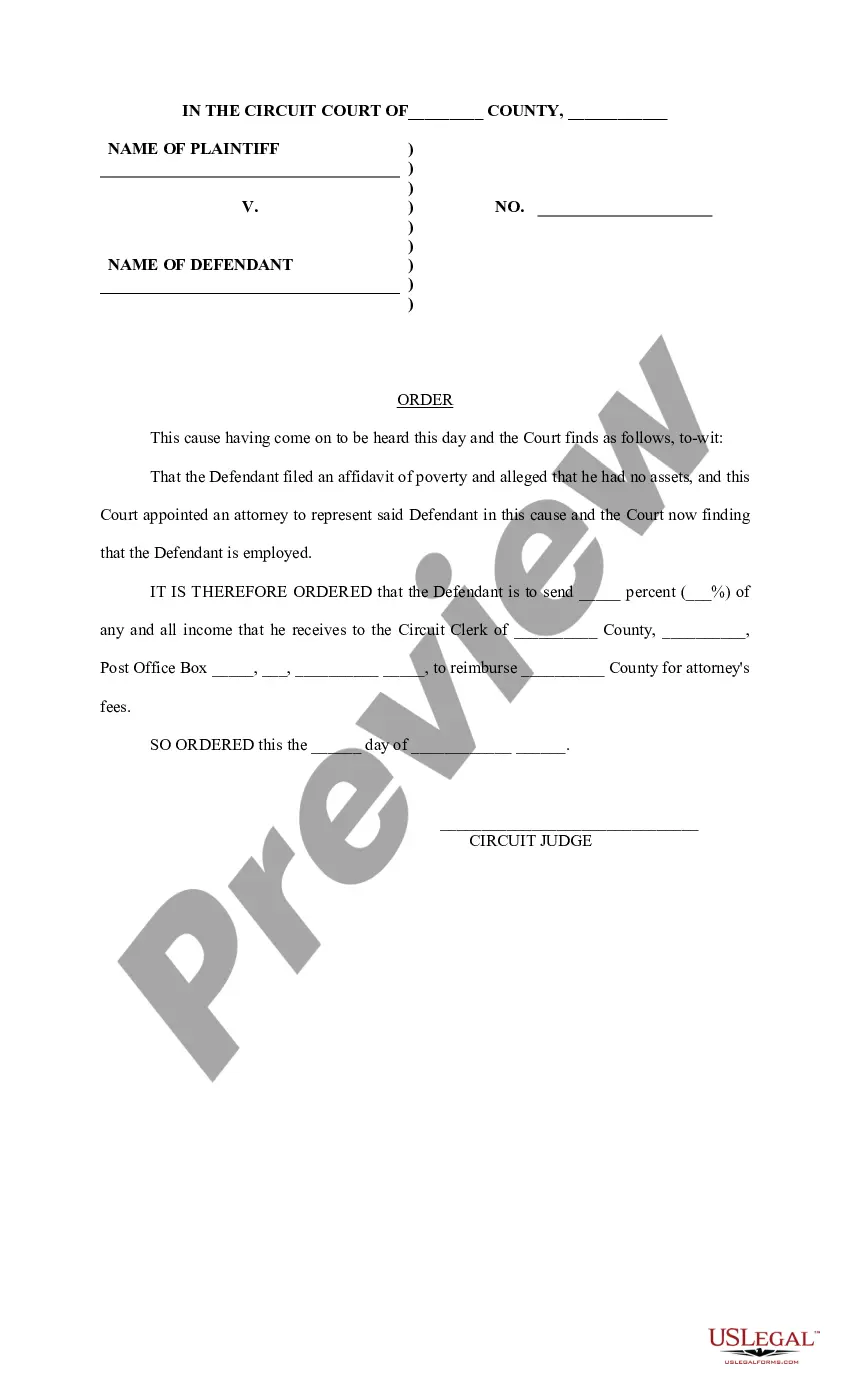
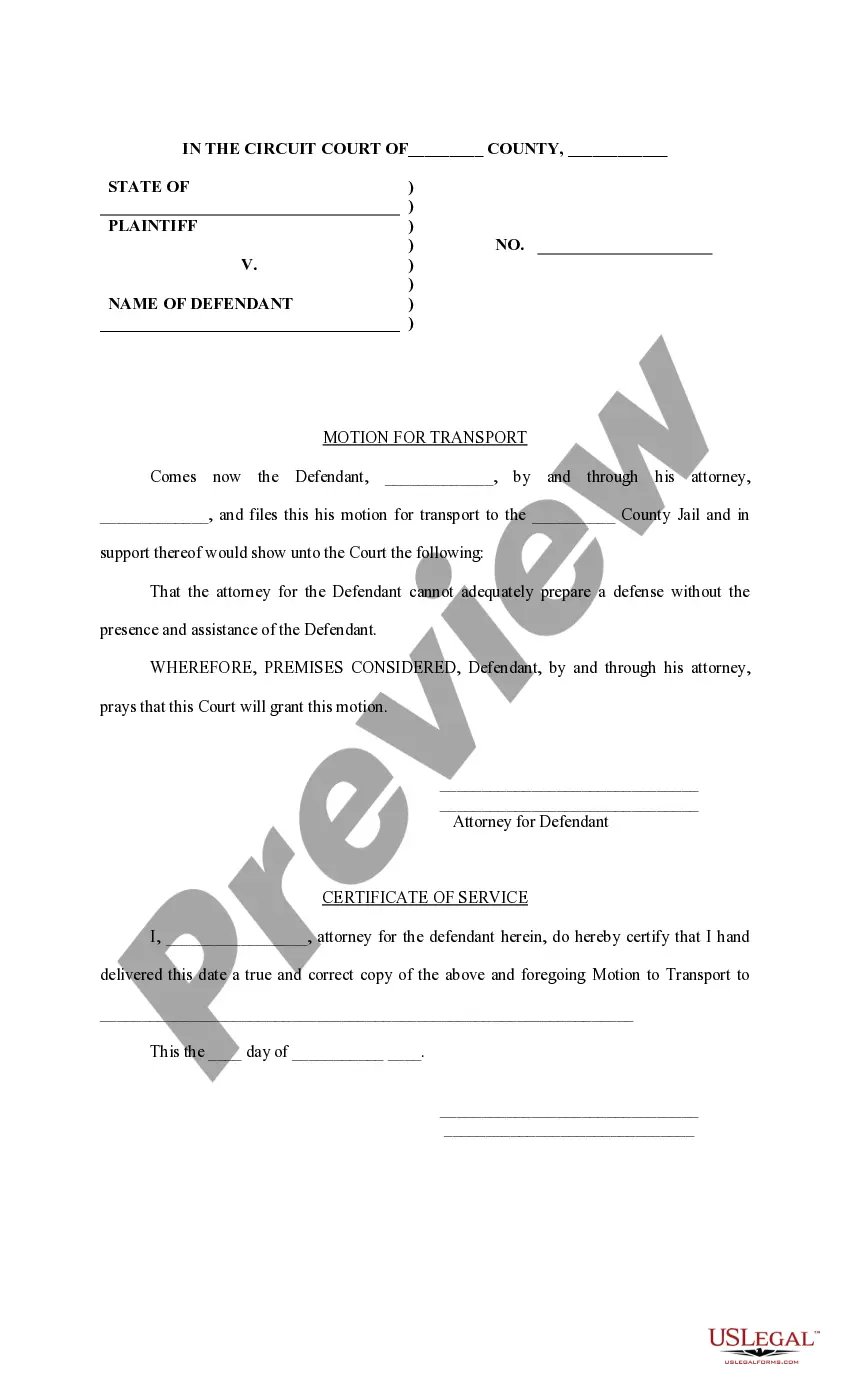
The Order to Transport is a legal document issued by the court, which commands specific actions such as the movement of a person or item. This form is signed by a judge and failure to comply can result in contempt charges. Unlike other court orders, this one is explicitly for transportation purposes and must be adapted to fit your specific case circumstances.
Key parts of this document
- Title of the order: clearly indicates the purpose.
- Case caption: includes names of parties involved and case number.
- Details of transport: specifies what or who is to be transported, along with dates and locations.
- Judge's signature: validates the order.
- Compliance instructions: outlines what actions are required of the involved parties.
Situations where this form applies
This form is typically used in situations where a court has directed the transport of an individual, such as during a custodial exchange or the transportation of a witness for a hearing. It may also be employed in criminal cases where a defendant needs to be transported to a different facility for trial or evaluation.
Who needs this form
- Attorneys representing a party in a case involving transport.
- Individuals seeking to comply with a court's request for transportation orders.
- Law enforcement officials who need to formalize the transport of a person.
- Court clerks who prepare orders based on judicial instructions.
How to prepare this document
- Identify the parties: enter the names of the individuals or entities involved in the order.
- Specify the transport details: indicate what or who is to be transported, including any special instructions.
- Enter the logistics: provide dates, times, and locations for the transport.
- Review compliance requirements: outline actions the involved parties must take to comply with the order.
- Obtain the judge's signature: ensure the order is signed to validate its authority.
Notarization guidance
This form does not typically require notarization unless specified by local law. However, always verify with your local court for any additional requirements.
Get your form ready online
Our built-in tools help you complete, sign, share, and store your documents in one place.
Make edits, fill in missing information, and update formatting in US Legal Forms—just like you would in MS Word.
Download a copy, print it, send it by email, or mail it via USPS—whatever works best for your next step.
Sign and collect signatures with our SignNow integration. Send to multiple recipients, set reminders, and more. Go Premium to unlock E-Sign.
If this form requires notarization, complete it online through a secure video call—no need to meet a notary in person or wait for an appointment.
We protect your documents and personal data by following strict security and privacy standards.

Make edits, fill in missing information, and update formatting in US Legal Forms—just like you would in MS Word.

Download a copy, print it, send it by email, or mail it via USPS—whatever works best for your next step.

Sign and collect signatures with our SignNow integration. Send to multiple recipients, set reminders, and more. Go Premium to unlock E-Sign.

If this form requires notarization, complete it online through a secure video call—no need to meet a notary in person or wait for an appointment.

We protect your documents and personal data by following strict security and privacy standards.
Common mistakes to avoid
- Failing to include all necessary details about the transport.
- Not obtaining the required signature from the judge.
- Leaving out compliance instructions, which can lead to confusion.
- Using outdated or incorrect wording that does not comply with current legal standards.
Benefits of using this form online
- Convenience: download from anywhere, at any time.
- Editability: easily modify the template to fit your unique circumstances.
- Reliability: forms are drafted by licensed attorneys to ensure legal compliance.
Legal use & context
- An Order to Transport is enforceable under state law as a directive from the court.
- Non-compliance may result in contempt charges, emphasizing the order's legal weight.
- This form is essential in various legal proceedings, ensuring compliance with court directives.
What to keep in mind
- The Order to Transport is a crucial document for court-ordered movements.
- Correct completion is vital for legal validity.
- This form can be adapted to different scenarios and states, ensuring wider applicability.
Looking for another form?
Form popularity
FAQ
Mississippi Department of Employment Security (MDES) announced today that Mississippi workers who are not able to work due to COVID-19 will be eligible to file for unemployment benefits.Based on guidance from the U.S. Department of Labor and Governor Tate Reeves, MDES is modifying existing unemployment compensation rules to allow workers to file a claim for unemployment benefits.
Due to COVID-19 concerns, ALL Mississippi child support offices will be closed to the public immediately. MDHS will continue processing payments as normal. If you have received a notice requesting you to visit the office, to attend court, or if you have other immediate concerns about your case, please contact the customer service center at 1-877-882-4916 or you may submit common requests or inquiries through Gen on the MDHS website at www.mdhs.ms.gov/child-support/.
Generally speaking, an employee engages in misconduct by willfully doing something that substantially injures the company's interests.Other common types of disqualifying misconduct include chronic tardiness, numerous unexcused absences, extreme insubordination, intoxication on the job, and dishonesty.
You will need your work history information for the past 18 months including employer names, addresses, phone numbers, the reason for separation, and dates of employment; your current contact information; your driver's license or state ID number and Social Security Card.
Misconduct generally exists only when an employee's work behavior shows a willful and substantial disregard for the employer's interests or expected standards of behavior.
Some U.S. courts have set a standard for when employees were denied COBRA benefits because they were fired for gross misconduct, by defining the term to mean this or close: intentional, wanton, willful, deliberate, reckless or in deliberate indifference to an employer's interest.
Mississippi is an "at will" state, which means an employer can fire an employee for any or no reason, as long as it is not discriminatory.
The Pandemic Unemployment Assistance (PUA) program is an emergency program activated in response to a crisis and designed to provide benefits to certain individuals who are ineligible for or who have exhausted entitlement to regular unemployment compensation or extended benefits.
You should file for benefits as you may be eligible for partial unemployment. Please note: when working and filing, all hours and gross earnings must be reported. A portion of your gross earnings will be deducted from your weekly benefit amount.