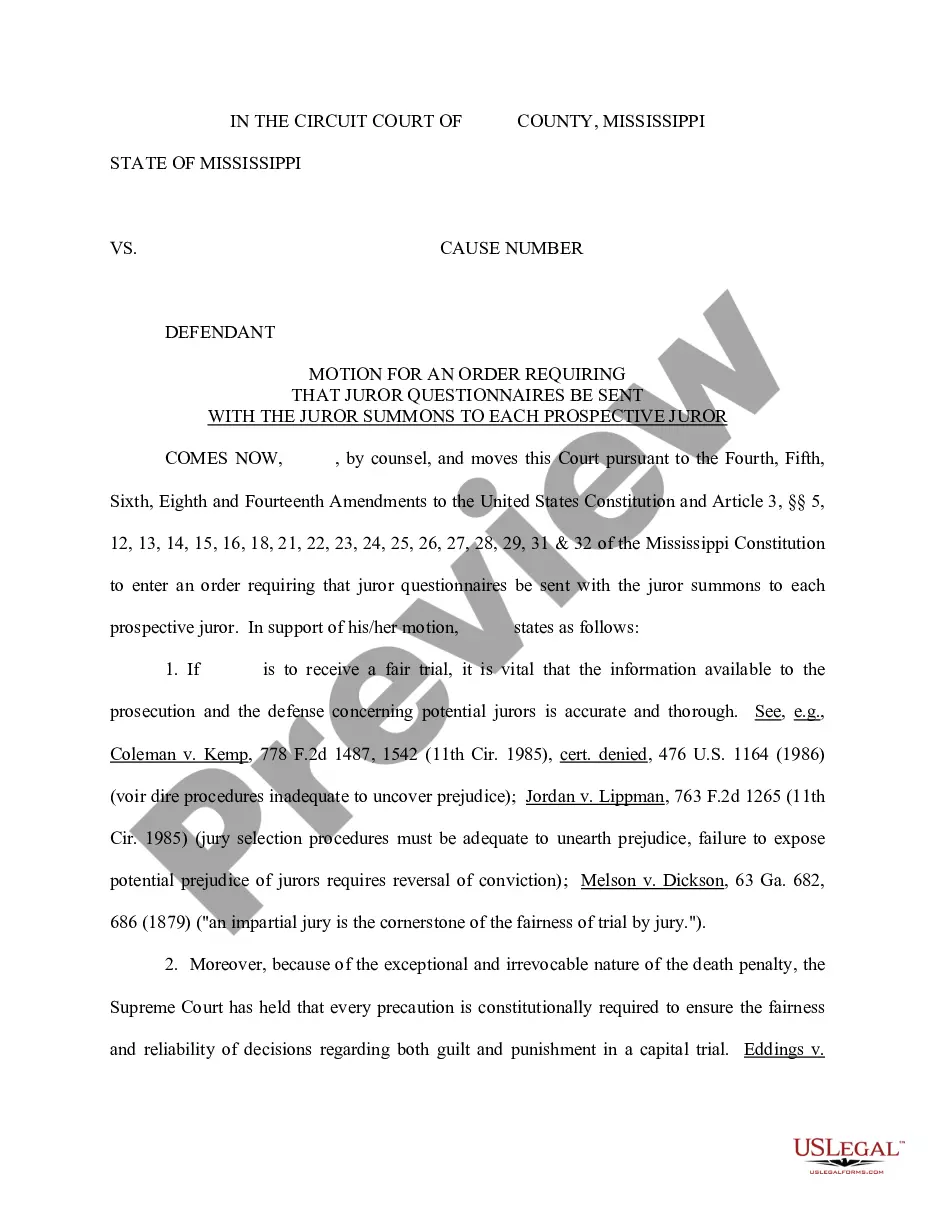
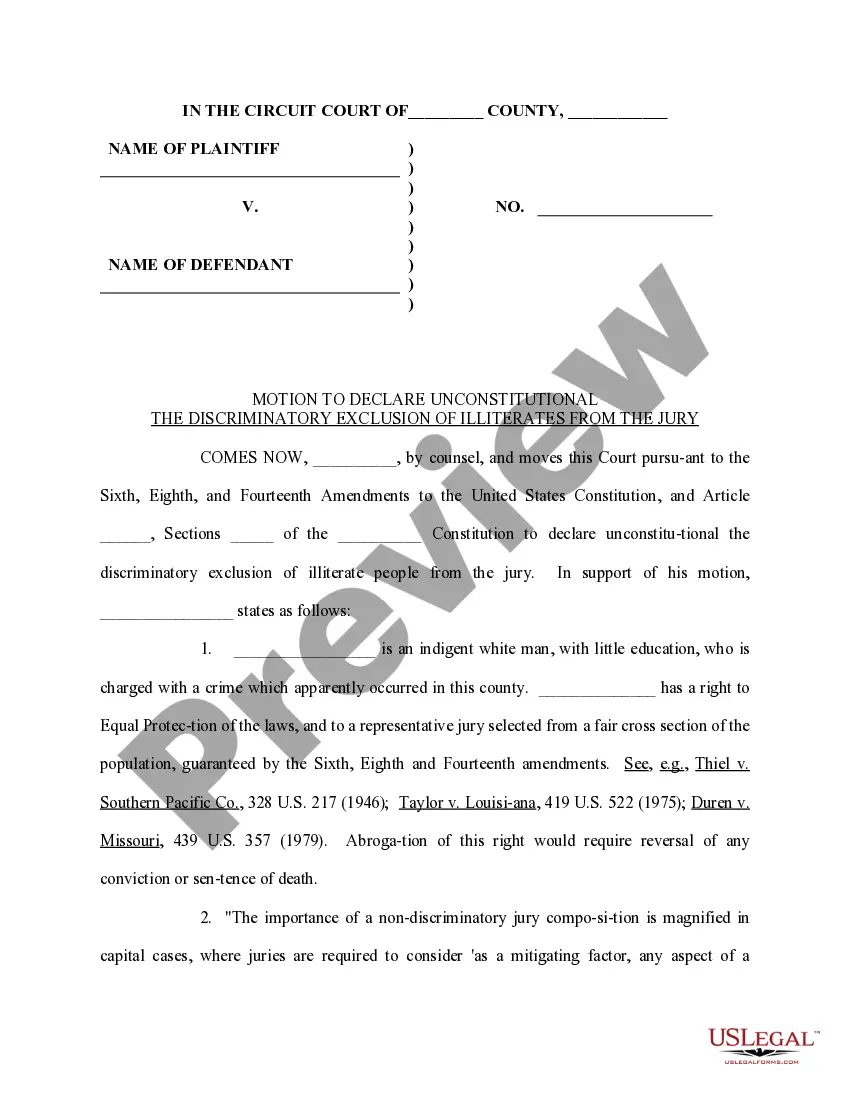
Mississippi Motion to Declare Unconstitutional the Discriminatory Exclusion of Illiterates from the Jury
Understanding this form
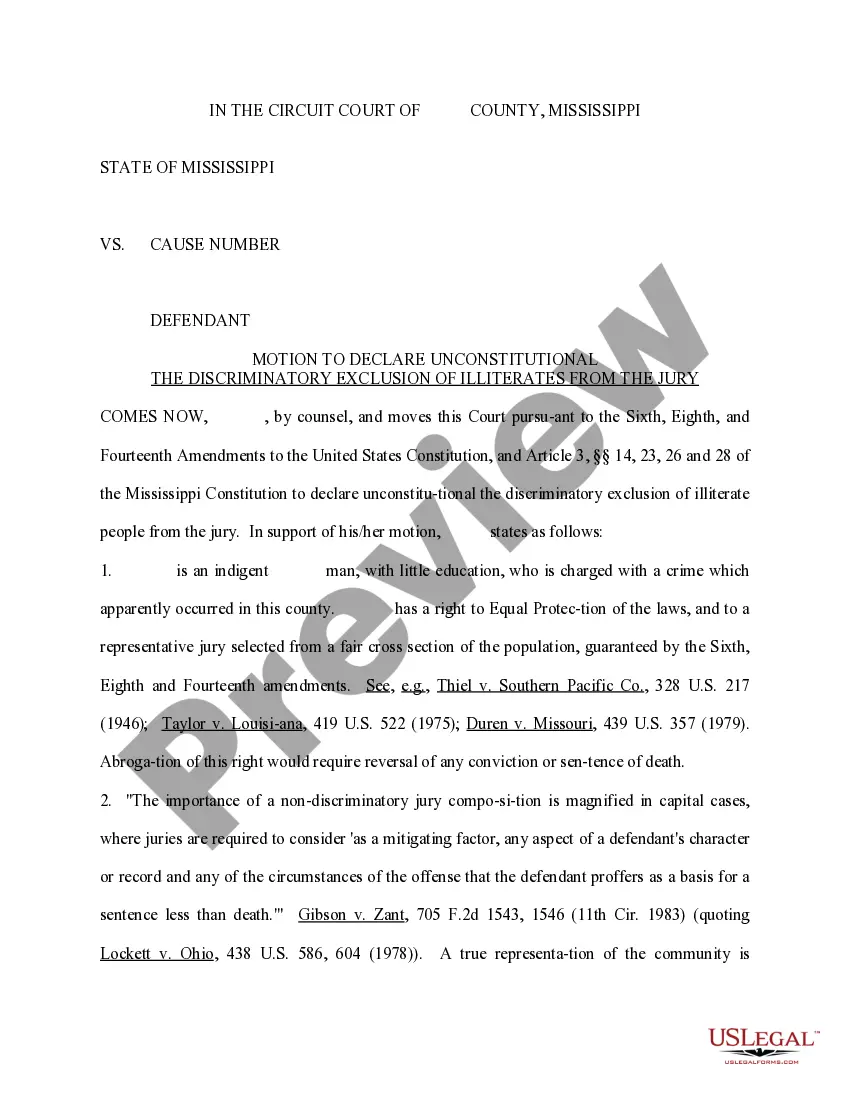
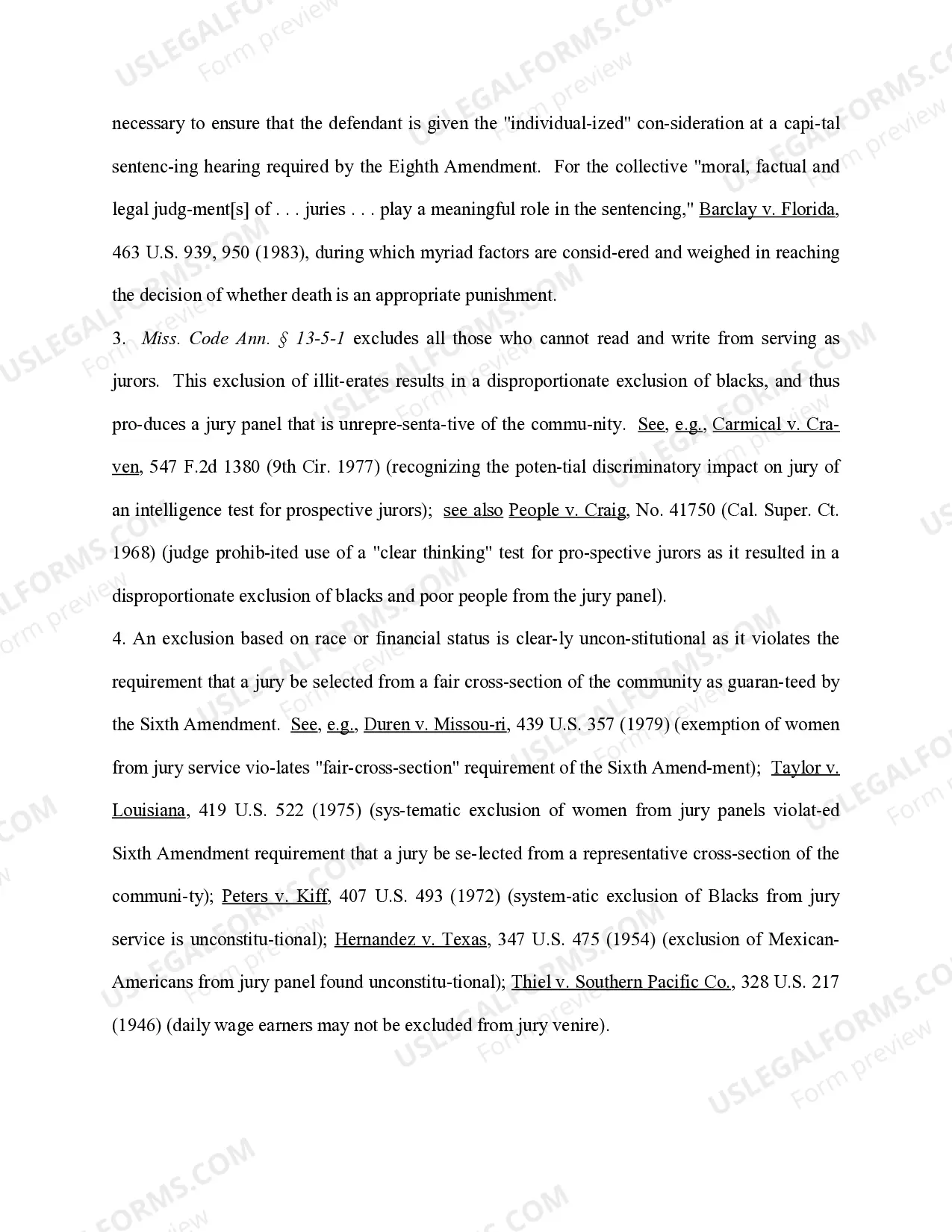
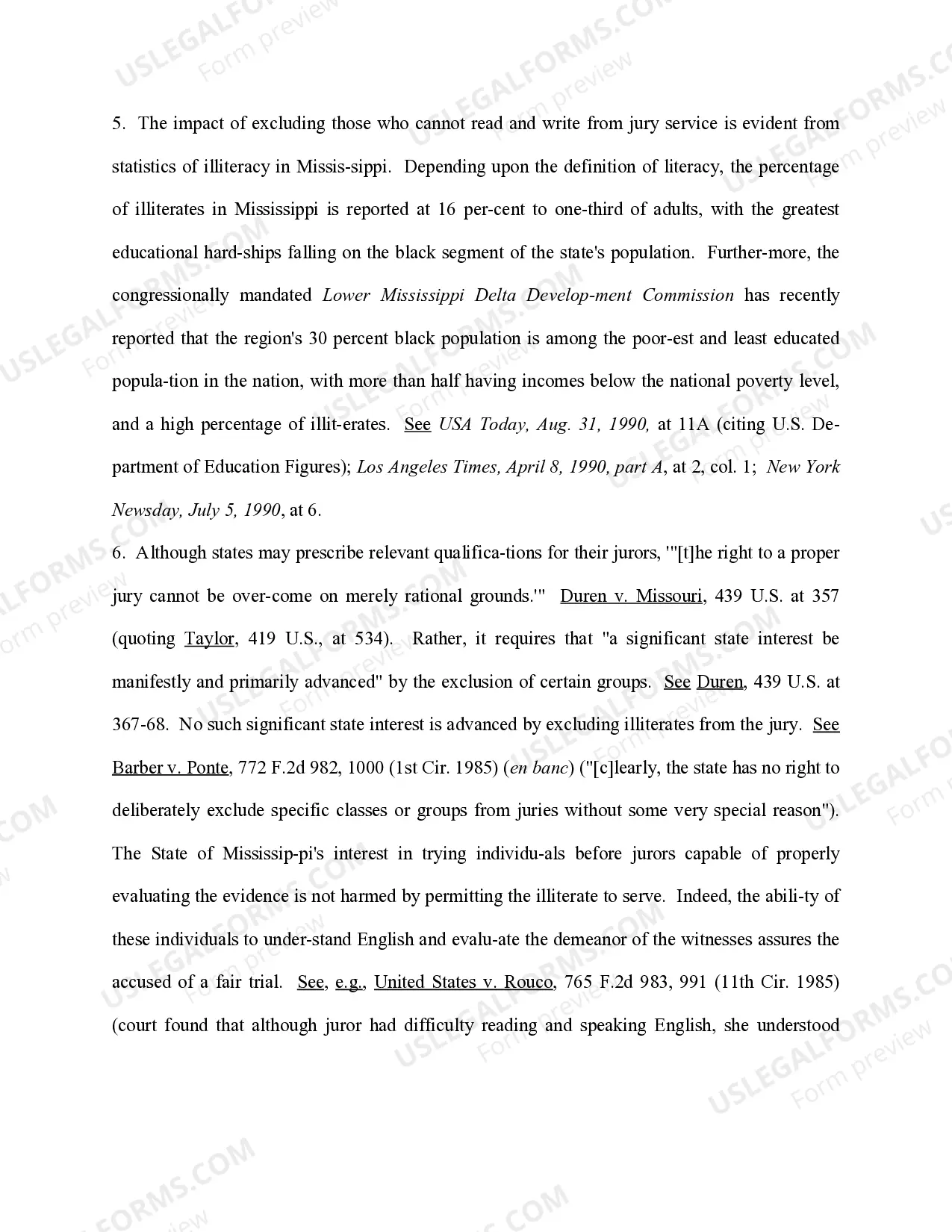
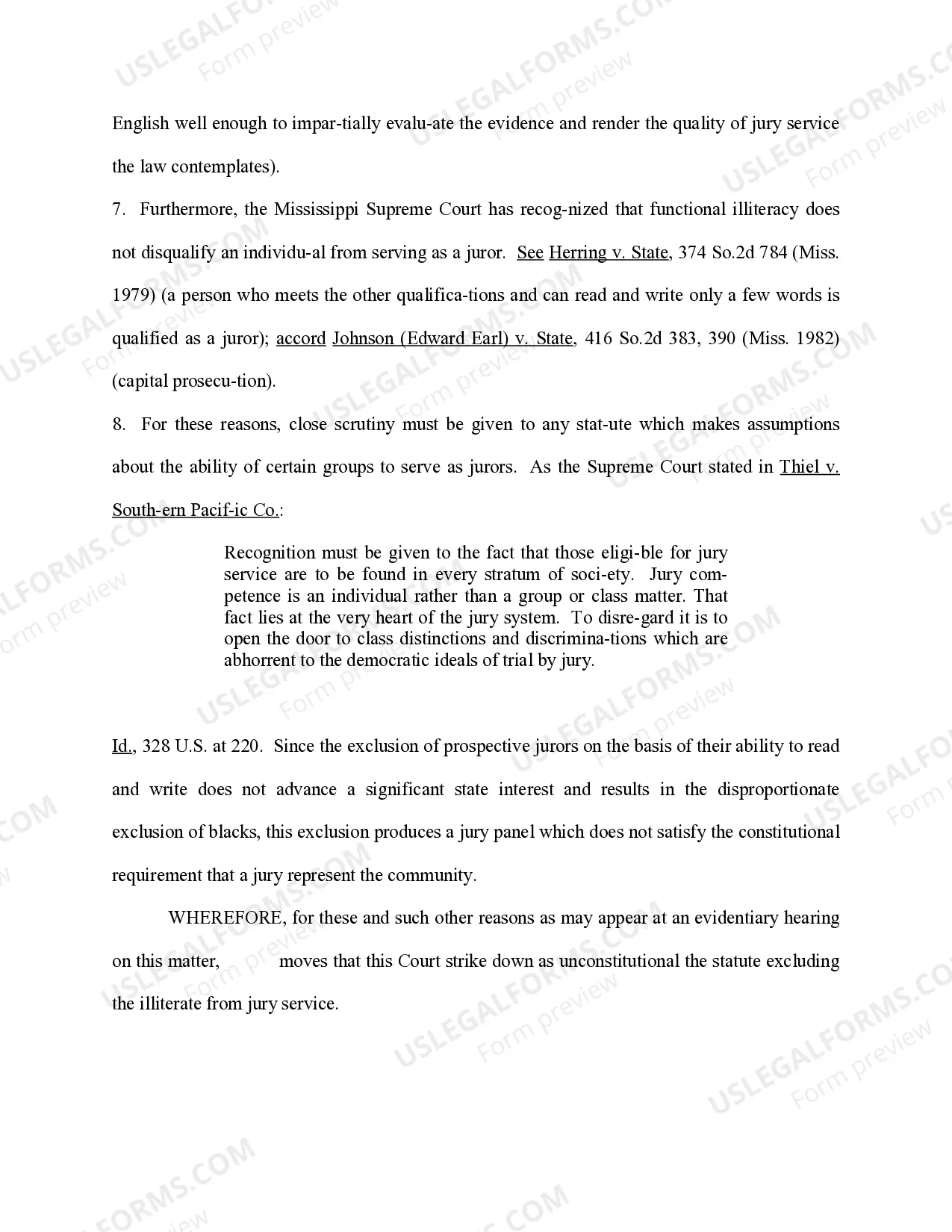
The Motion to Declare Unconstitutional the Discriminatory Exclusion of Illiterates from the Jury is a legal document used to request a court's review of laws or practices that exclude individuals unable to read or write from jury duty. This form is crucial for advocating against discrimination in jury selection, highlighting the need for a representative jury, particularly in capital cases. Unlike general motion forms, this document specifically addresses issues of literacy and discrimination within the legal system.
Key components of this form
- Identification of the jurisdiction and specific laws being challenged.
- Arguments detailing the negative impact of excluding illiterates from jury service.
- Citations of relevant legal precedents and constitutional rights.
- Request for the court to declare the exclusion unconstitutional.
- Signature and date fields for submission.

When this form is needed
This form is appropriate when an individual or attorney seeks to combat the exclusion of illiterate jurors from jury selection. It can be used in scenarios involving capital cases where a fair jury composition is critical for upholding the defendant's rights. Additionally, it may be necessary in cases where evidence suggests that local statutes disproportionately affect marginalized communities.
Who needs this form
- Attorneys representing defendants in capital cases.
- Advocates for civil rights and jury representation.
- Individuals seeking to challenge discriminatory practices in legal proceedings.
- Organizations focused on improving access to justice for underrepresented populations.
Instructions for completing this form
- Begin by entering the court name and case number at the top of the form.
- Clearly identify the statute or rule you seek to challenge regarding juror qualifications.
- Detail the arguments against the exclusion of illiterates, citing relevant case law.
- Include specific statistics or evidence showing the discriminatory impact of the exclusion.
- Sign and date the motion before submitting it to the court.
Notarization guidance
This form does not typically require notarization to be legally valid. However, some jurisdictions or document types may still require it. US Legal Forms provides secure online notarization powered by Notarize, available 24/7 for added convenience.
Get your form ready online
Our built-in tools help you complete, sign, share, and store your documents in one place.
Make edits, fill in missing information, and update formatting in US Legal Forms—just like you would in MS Word.
Download a copy, print it, send it by email, or mail it via USPS—whatever works best for your next step.
Sign and collect signatures with our SignNow integration. Send to multiple recipients, set reminders, and more. Go Premium to unlock E-Sign.
If this form requires notarization, complete it online through a secure video call—no need to meet a notary in person or wait for an appointment.
We protect your documents and personal data by following strict security and privacy standards.

Make edits, fill in missing information, and update formatting in US Legal Forms—just like you would in MS Word.

Download a copy, print it, send it by email, or mail it via USPS—whatever works best for your next step.

Sign and collect signatures with our SignNow integration. Send to multiple recipients, set reminders, and more. Go Premium to unlock E-Sign.

If this form requires notarization, complete it online through a secure video call—no need to meet a notary in person or wait for an appointment.

We protect your documents and personal data by following strict security and privacy standards.
Common mistakes
- Failing to properly cite relevant case law and statutes.
- Not providing enough evidence of the discriminatory effects of the exclusion.
- Leaving out the court and case information in the header.
- Missing signature or date which can invalidate the submission.
Why complete this form online
- Convenient access to legal templates drafted by licensed attorneys.
- Edit and customize the form quickly to fit specific cases and clients.
- Download and print the form immediately after completion for timely submission.
- Assured reliability of the legal language and structure in line with current laws.
Looking for another form?
Form popularity
FAQ
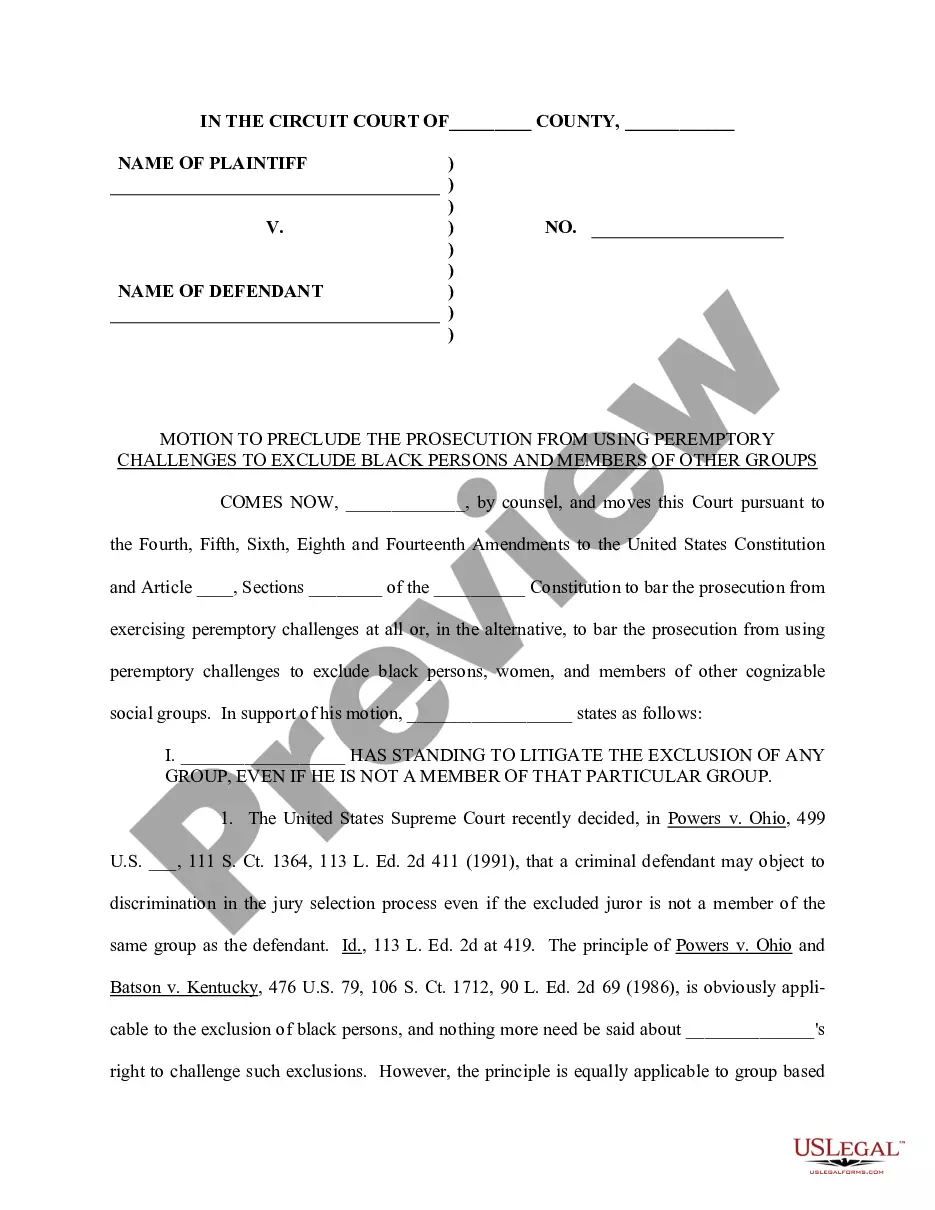
A Batson challenge is a challenge made by one party in a case to the other party's use of peremptory challenges to eliminate potential jurors from the jury on the basis of sex, race, ethnicity, or religion. A trial usually begins with jury selection.
If a juror has provided little or no case-specific information, a Batson challenge may very well prove successful.
Batson, a black man, was on trial charged with second-degree burglary and receipt of stolen goods. During the jury selection, the prosecutor used his peremptory challenges to strike the four black persons on the venire, resulting in a jury composed of all whites. Batson was convicted on both of the charges against him.
Decision. The U.S. Supreme Court unanimously rejected Williams' contention in a 9-0 vote, ruling that he had not shown that the administration of the Mississippi suffrage provision was discriminatory.
Since the landmark case Batson v.Yet in an ironic extension of Batson,3 reverse-Batson challenges put defendants at risk when a trial judge erroneously believes the defense counsel's use of peremptory challenges is racially motivated.
Kentucky, 476 U.S. 79 (1986), was a landmark decision of the US Supreme Court ruling that a prosecutor's use of a peremptory challenge in a criminal casethe dismissal of jurors without stating a valid cause for doing somay not be used to exclude jurors based solely on their race.
An objection to the validity of a peremptory challenge, on grounds that the other party used it to exclude a potential juror based on race, ethnicity, or sex. The result of a Batson challenge may be a new trial. The name comes from Batson v.
Selection procedures that purposefully exclude black persons from juries undermine public confidence in the fairness of our system of justice." A defendant in a criminal case can make an Equal Protection claim based on the discriminatory use of peremptory challenges at a defendant's trial.