Mississippi Order Setting Bond in a Criminal Case
What this document covers
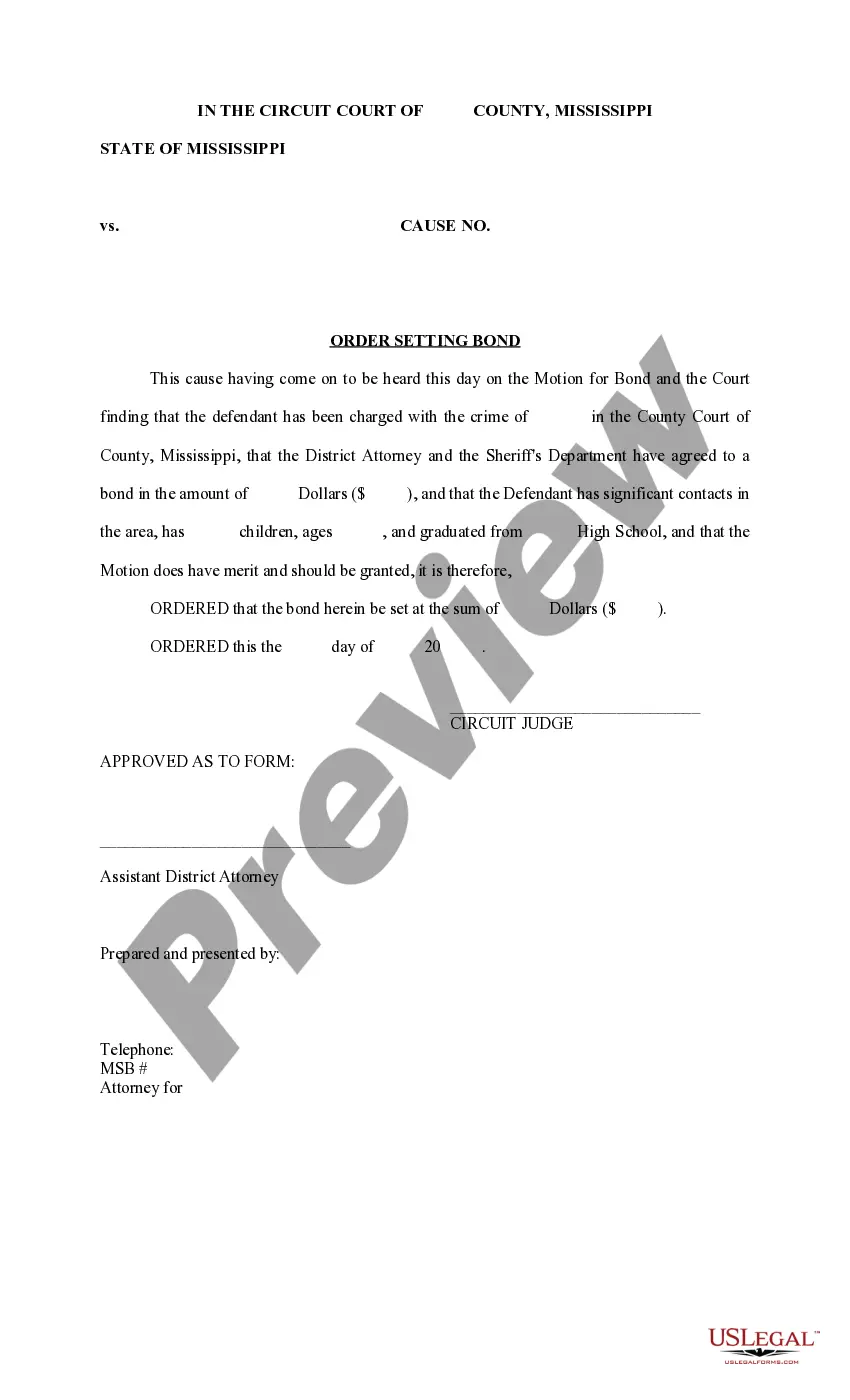
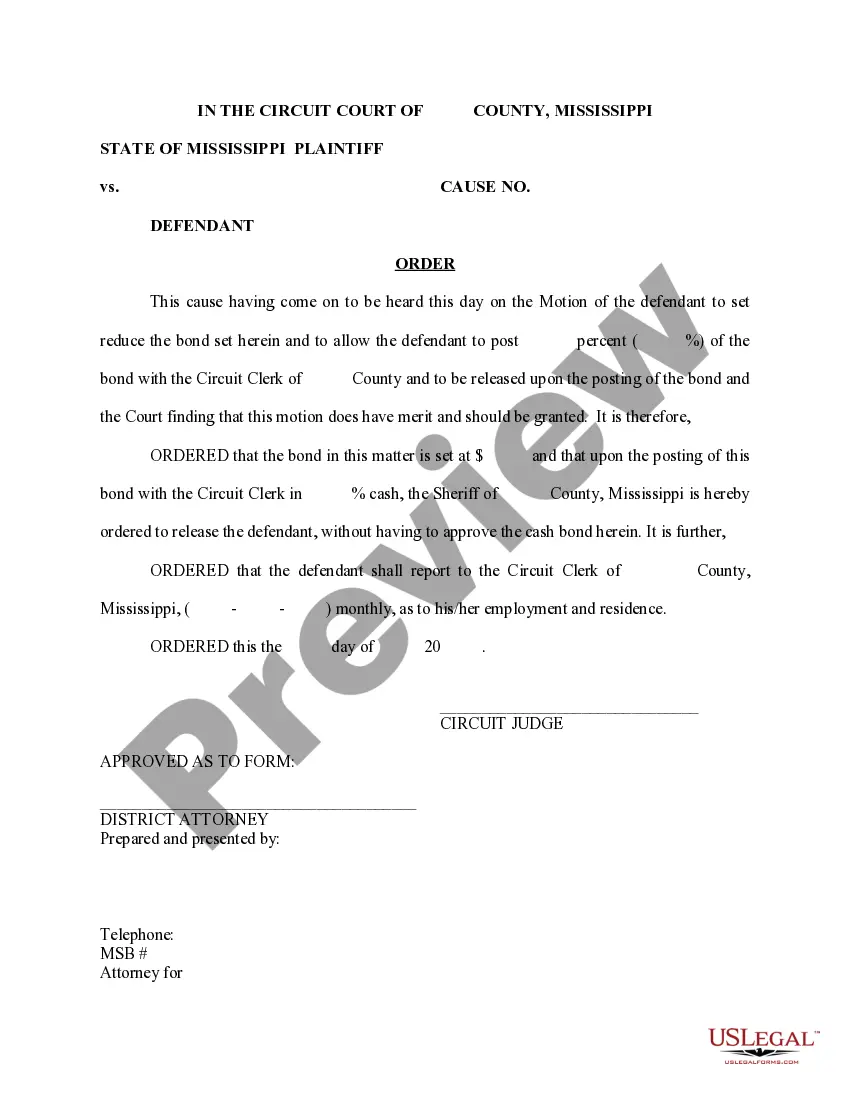
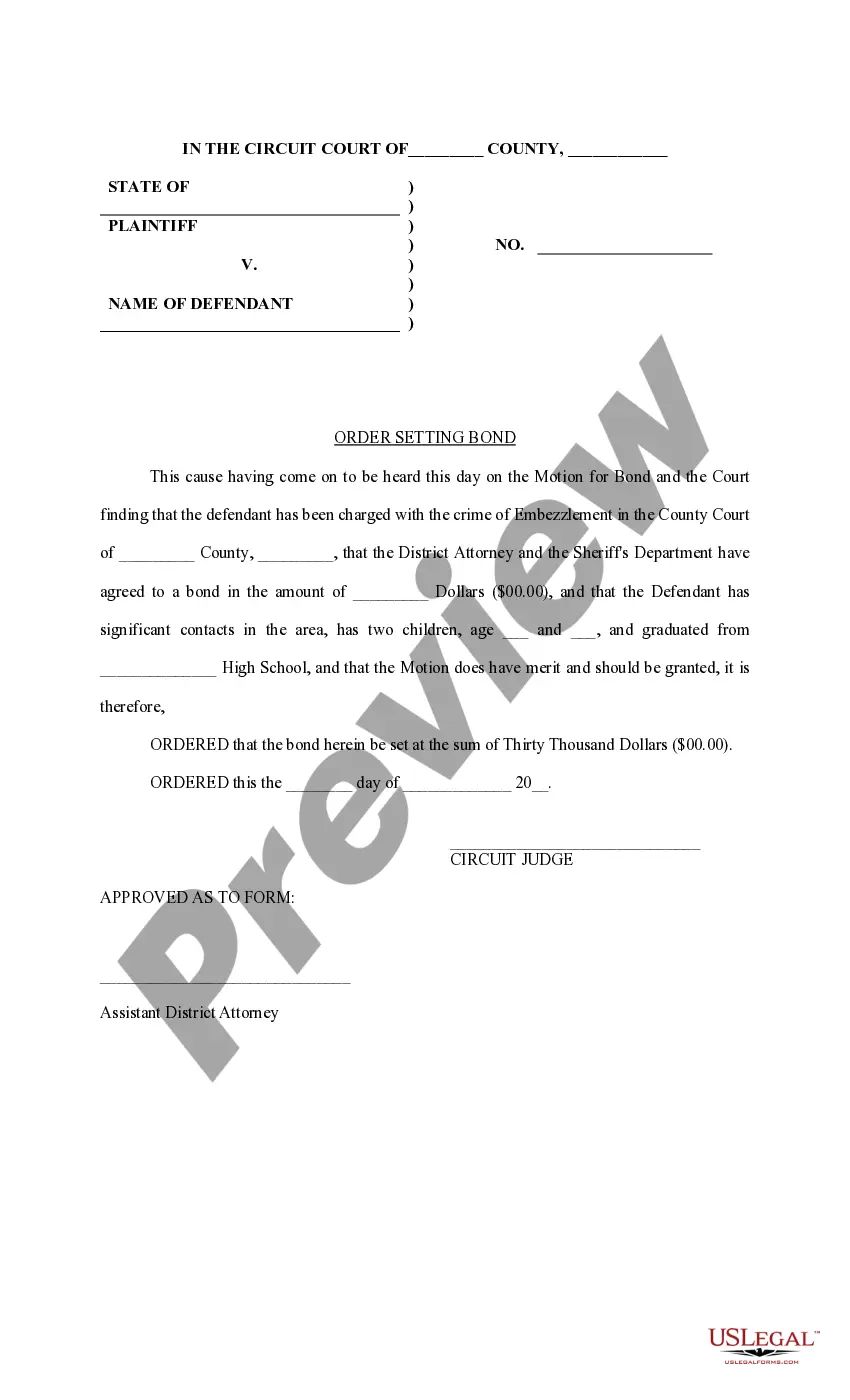
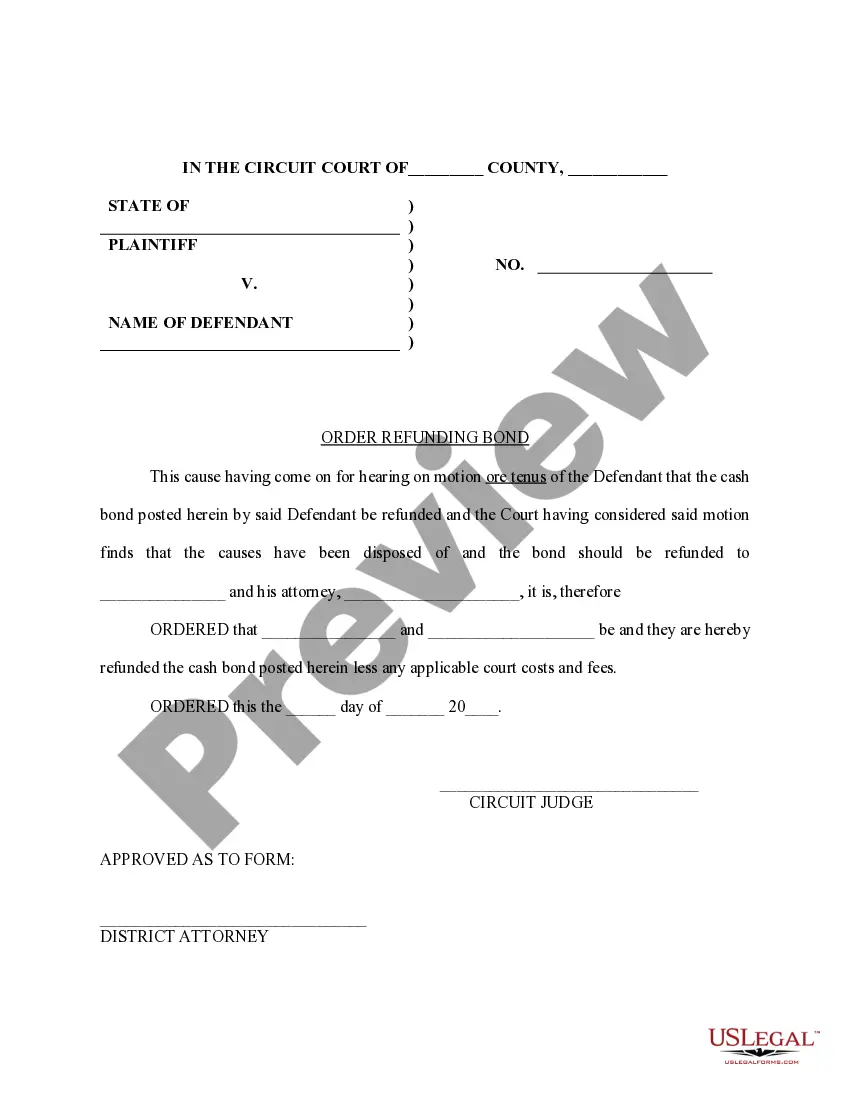
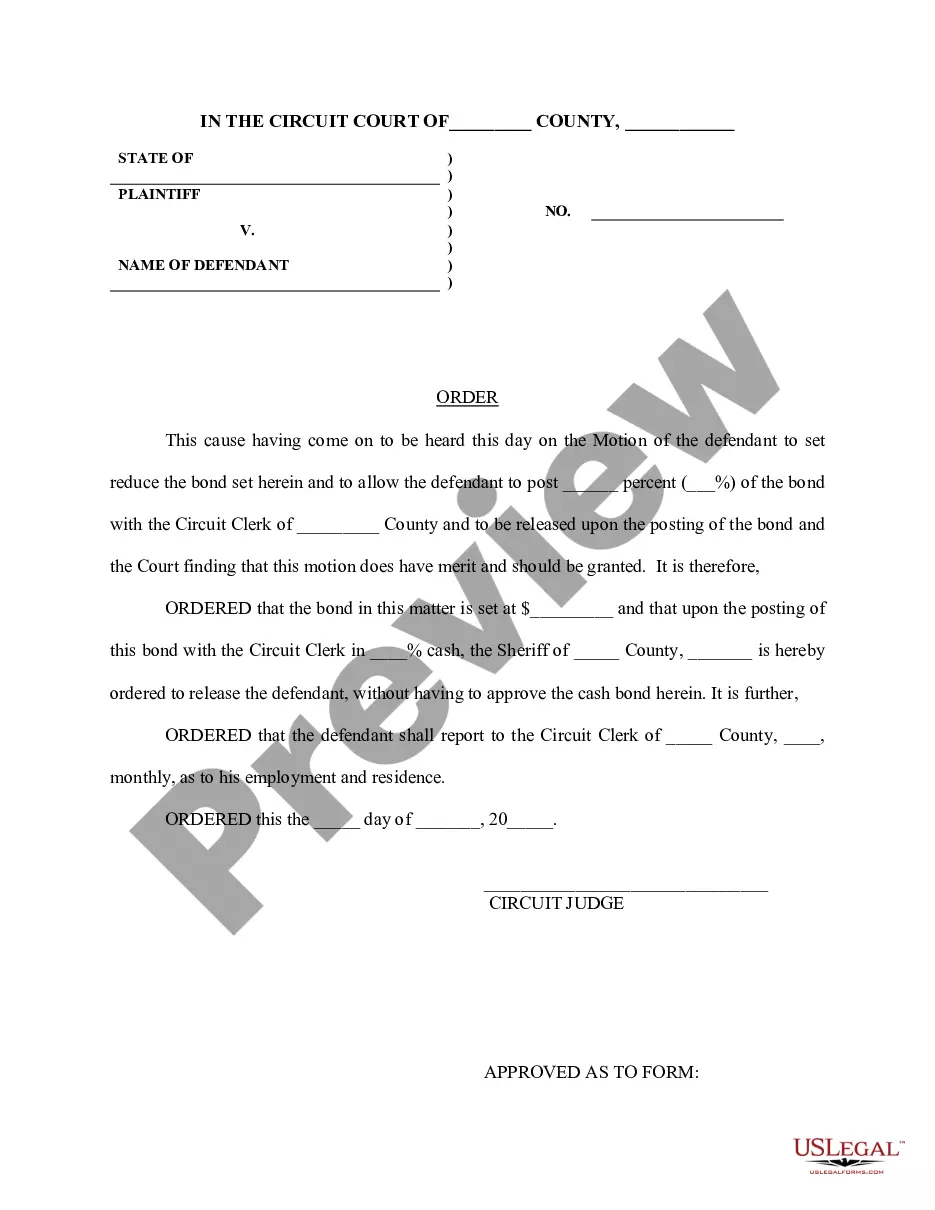
The Order Setting Bond in a Criminal Case is an official court document issued by a judge directing a specific action related to a defendant's bond in a criminal matter. This form differs from other court orders by focusing specifically on bond terms, ensuring the defendant meets certain conditions for release. It serves as a crucial tool in the criminal justice process, setting the foundation for managing a defendant's release while ensuring compliance with court conditions.
Key parts of this document
- Title of the court and case number.
- Name of the defendant and relevant parties.
- Specific bond amount set by the court.
- Conditions under which the bond is granted.
- Signatures of the judge and relevant court personnel.

When this form is needed
This form is used when a court needs to establish the terms of a bond for a defendant in a criminal case. It is typically employed after an arrest and can be crucial during bail hearings, ensuring the defendant understands the financial obligations and conditions attached to their release.
Intended users of this form
- Defendants facing criminal charges who require release on bond.
- Attorneys representing defendants in criminal cases.
- Court clerks involved in managing case documentation.
Steps to complete this form
- Identify the relevant court and enter the case number.
- List the names of the defendant and other involved parties.
- Specify the bond amount set by the judge.
- Include any conditions that the defendant must follow while on bond.
- Ensure all required signatures are obtained, including that of the judge.
Notarization requirements for this form
This form usually doesn’t need to be notarized. However, local laws or specific transactions may require it. Our online notarization service, powered by Notarize, lets you complete it remotely through a secure video session, available 24/7.
Get your form ready online
Our built-in tools help you complete, sign, share, and store your documents in one place.
Make edits, fill in missing information, and update formatting in US Legal Forms—just like you would in MS Word.
Download a copy, print it, send it by email, or mail it via USPS—whatever works best for your next step.
Sign and collect signatures with our SignNow integration. Send to multiple recipients, set reminders, and more. Go Premium to unlock E-Sign.
If this form requires notarization, complete it online through a secure video call—no need to meet a notary in person or wait for an appointment.
We protect your documents and personal data by following strict security and privacy standards.

Make edits, fill in missing information, and update formatting in US Legal Forms—just like you would in MS Word.

Download a copy, print it, send it by email, or mail it via USPS—whatever works best for your next step.

Sign and collect signatures with our SignNow integration. Send to multiple recipients, set reminders, and more. Go Premium to unlock E-Sign.

If this form requires notarization, complete it online through a secure video call—no need to meet a notary in person or wait for an appointment.

We protect your documents and personal data by following strict security and privacy standards.
Common mistakes to avoid
- Failing to enter the correct case number.
- Omitting essential details, such as the bond amount or conditions.
- Not obtaining all required signatures before submission.
Why complete this form online
- Convenience of downloading and filling the form at your own pace.
- Editability of the document to fit specific case details easily.
- Reliability of attorney-drafted templates based on legal standards.
Legal use & context
- This form is enforceable once properly completed and filed with the court.
- Failure to comply with the bond conditions may lead to revocation and further legal action.
Summary of main points
- The Order Setting Bond is essential for ensuring defendants comply with court conditions.
- Proper completion and submission of this form can facilitate the release process.
- Always check local regulations to adapt the form as needed for your state.
Looking for another form?
Form popularity
FAQ
Sixteen-year-old William Haymon has spent more than 500 days in an adult jail in rural Lexington, Mississippi. There are no state rules governing how long a person can be incarcerated without being formally charged with a crime.
Judges ordinarily set a bail amount at a suspect's first court appearance after an arrest, which may be either a bail hearing or an arraignment. Judges normally adhere to standard practices (for example, setting bail in the amount of $500 for nonviolent petty misdemeanors).
Investigation. Charging. Initial Hearing/Arraignment. Discovery. Plea Bargaining. Preliminary Hearing. Pre-Trial Motions. Trial.
The defendant pays the 10 percent premium established under Mississippi law and the bail bond agent agrees to guarantee the full amount of bail. As long as the defendant shows up for all court appearances, the defendant or co-signer is released from the bail agreement. The 10 percent premium is non-refundable.
In the California criminal justice system, bail is money that must be posted with the court in order for an inmate to be released from jail. It is a means of ensuring that the person will show up for future court appearances.
Step 1: Arrest. An arrest is the initial stage in the criminal process in which an individual accused of a crime is taken into custody. Step 2: Charges. Step 3: Arraignment. Step 4: Pretrial Proceedings. Step 5: Trial. Step 6: Verdict. Step 7: Sentencing. Step 8: Appeal.
The criminal statute of limitations requires prosecutors to file criminal charges against a suspect within two years for misdemeanors and within five years for certain felonies, but there is no time limit in Mississippi for charges of murder, kidnapping, rape, burglary, robbery, larceny, and several other serious
Bail is set in less than half of criminal cases. It depends upon factors such as the defendant's criminal history and whether they were doing something at the time of arrest that would indicate they would try to flee or demonstrate an act of violence.If violence is a factor, then bail will almost always be set.
The criminal statute of limitations requires prosecutors to file criminal charges against a suspect within two years for misdemeanors and within five years for certain felonies, but there is no time limit in Mississippi for charges of murder, kidnapping, rape, burglary, robbery, larceny, and several other serious