Mississippi Petition to Admit Will to Probate as Muniment of Title Only
What is this form?
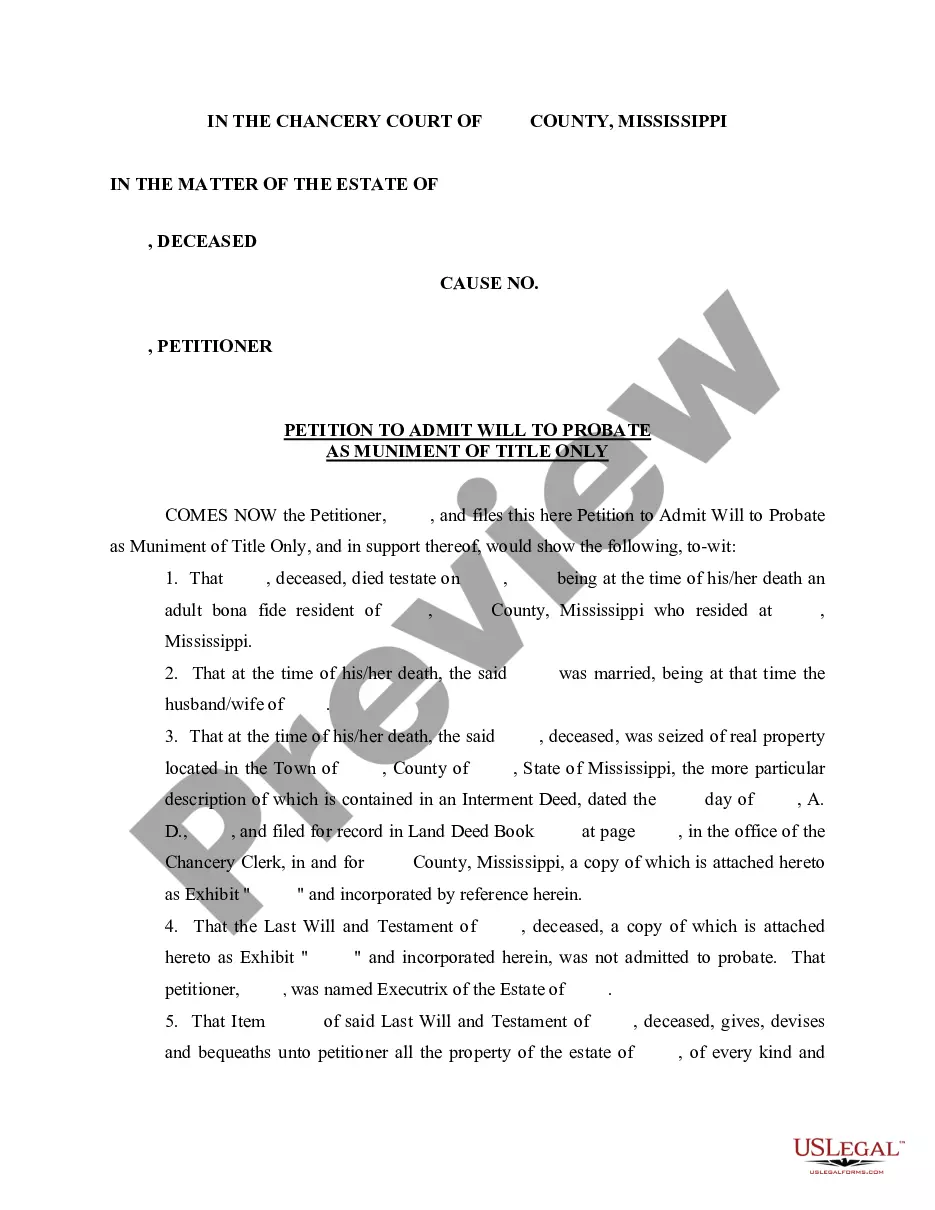
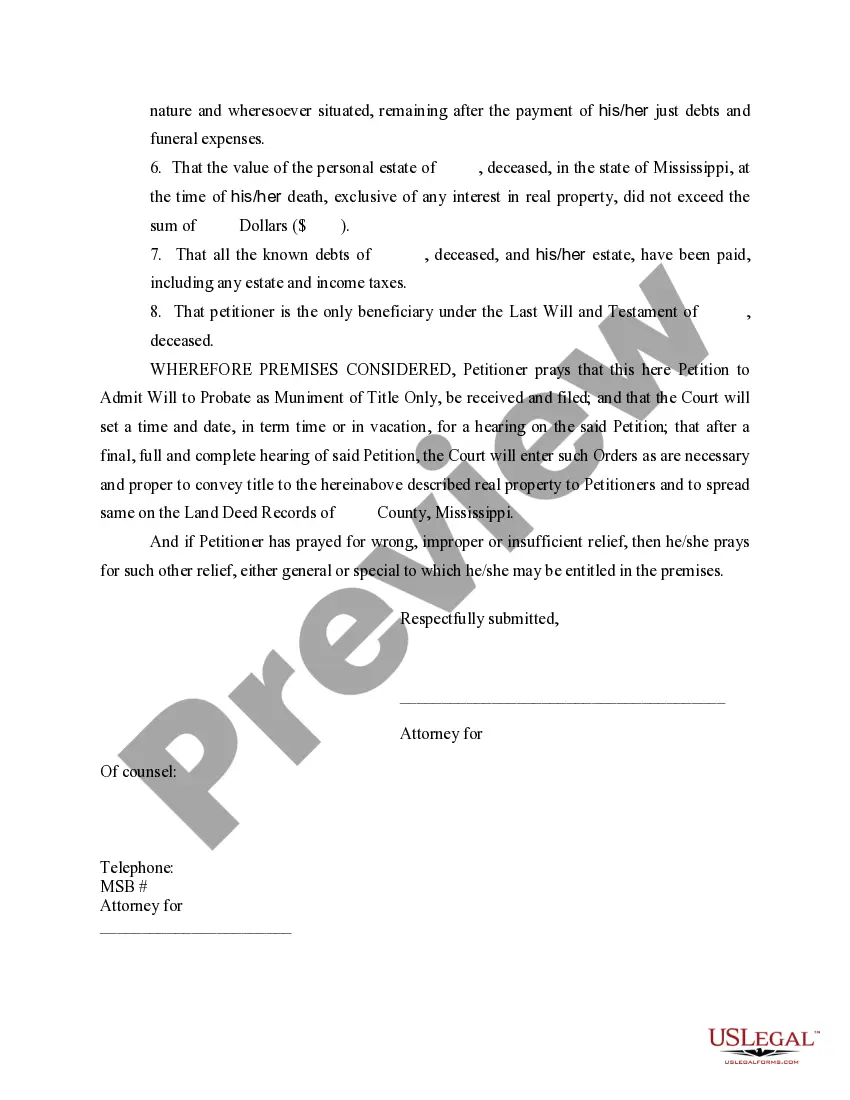
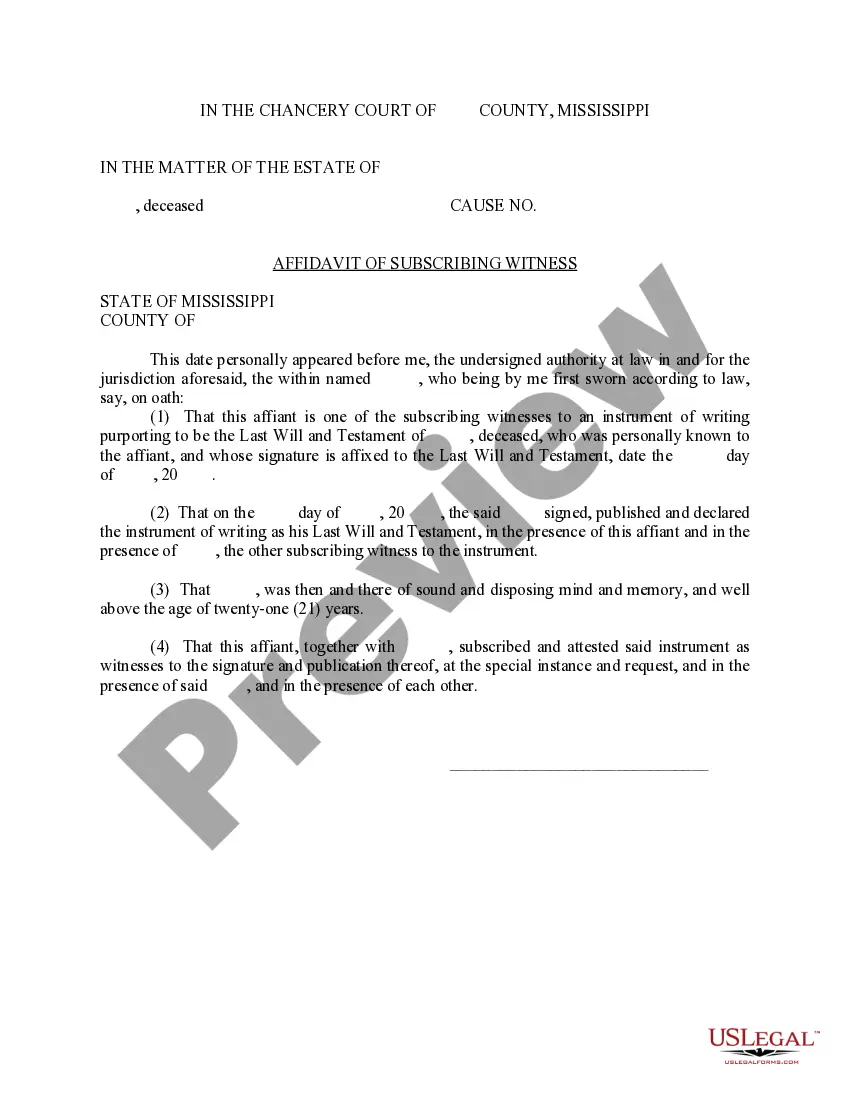
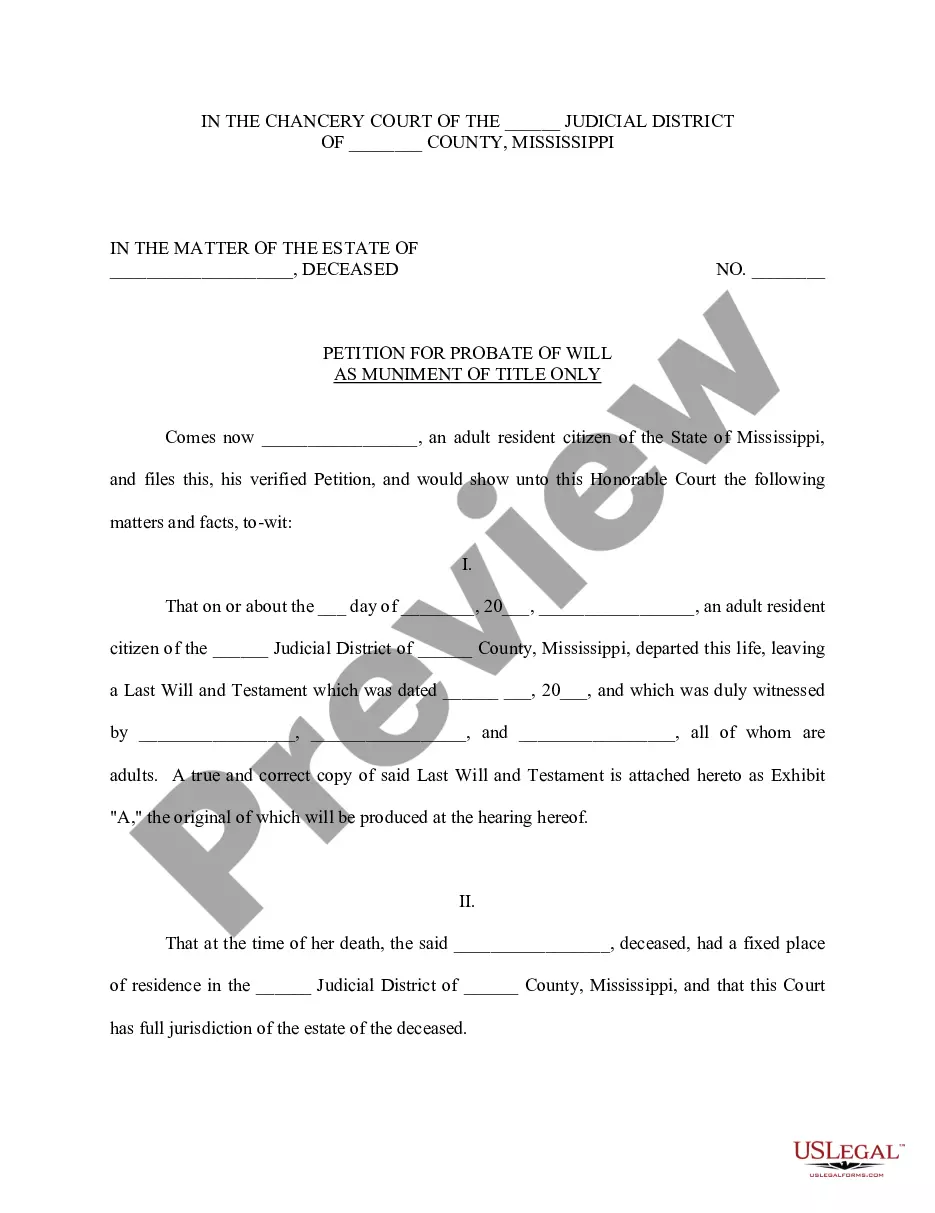
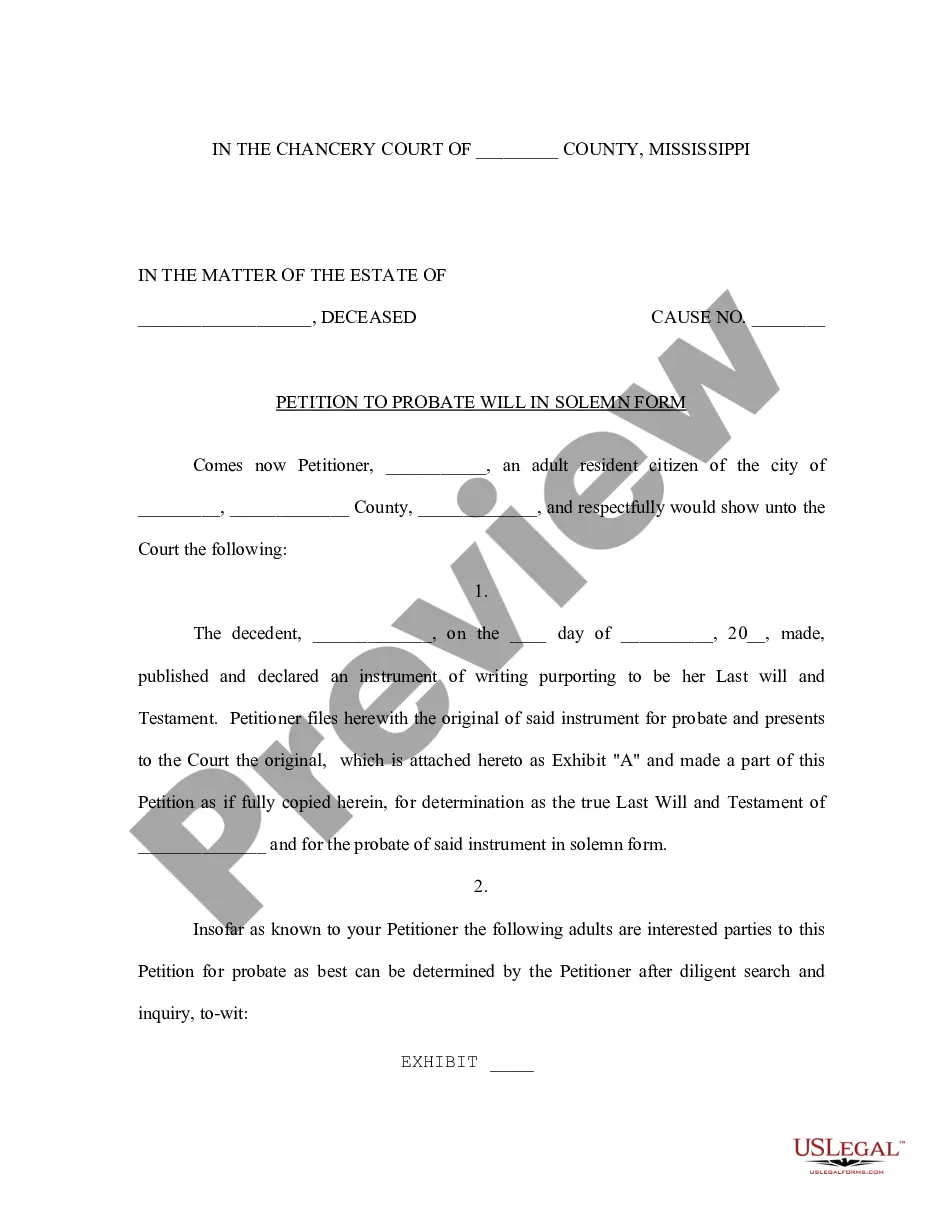
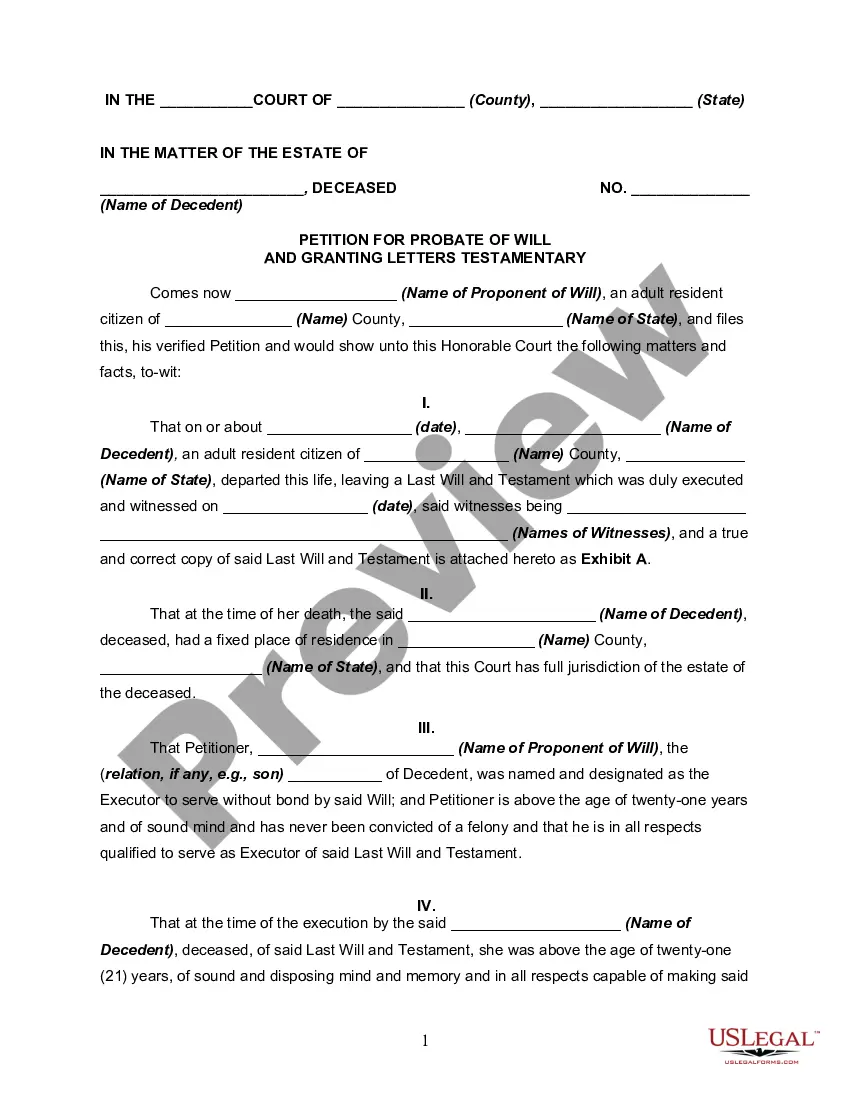
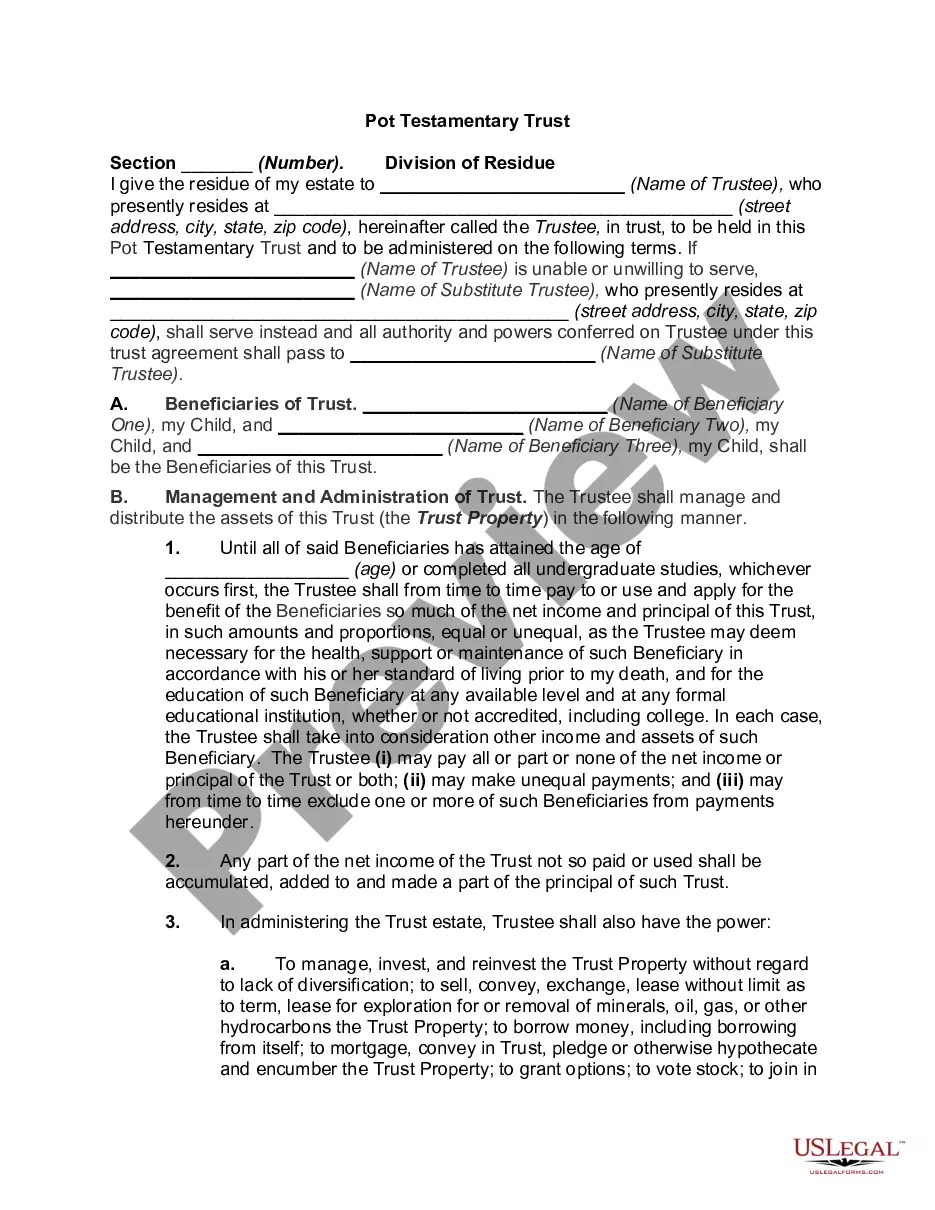
The Petition to Admit Will to Probate as Muniment of Title Only is a legal document used to request that a court recognize a will for the purpose of transferring title to property. Unlike full probate proceedings, this form allows for a simpler process when the only goal is to validate a will and transfer property ownership without distributing assets under traditional probate rules. This form is essential for individuals who wish to establish proof of ownership based solely on the will.
Main sections of this form
- Petitioner's information: Includes the name and address of the individual filing the petition.
- Decedent's details: Requires the name, date of death, and residence of the deceased.
- Will verification: Space to attach and validate the original will.
- Property description: Section to accurately describe the property covered by the will.
- Hearing request: Indicates if a court hearing is needed for the petition.
- Signature line: Area for the petitioner to sign and date the form.
Situations where this form applies
This form is used when a person has passed away, and their will needs to be admitted to probate to validate property ownership. Common scenarios include situations where the estate is small, where there are no contested claims, or when heirs simply seek to confirm ownership of property like real estate without embarking on lengthy probate procedures.
Who this form is for
- Heirs of a deceased person who possess a valid will.
- Individuals managing an estate with minimal financial complexities.
- Executors or personal representatives aiming to confirm property ownership swiftly.
- Anyone needing to settle property matters without going through full probate.
Steps to complete this form
- Identify the petitioner and provide contact information.
- Fill in the decedentâs name, date of death, and residence details.
- Attach a copy of the will and confirm its validity.
- Describe the property involved clearly.
- Indicate if a court hearing is necessary for the petition.
- Sign and date the petition in the appropriate section.
Notarization guidance
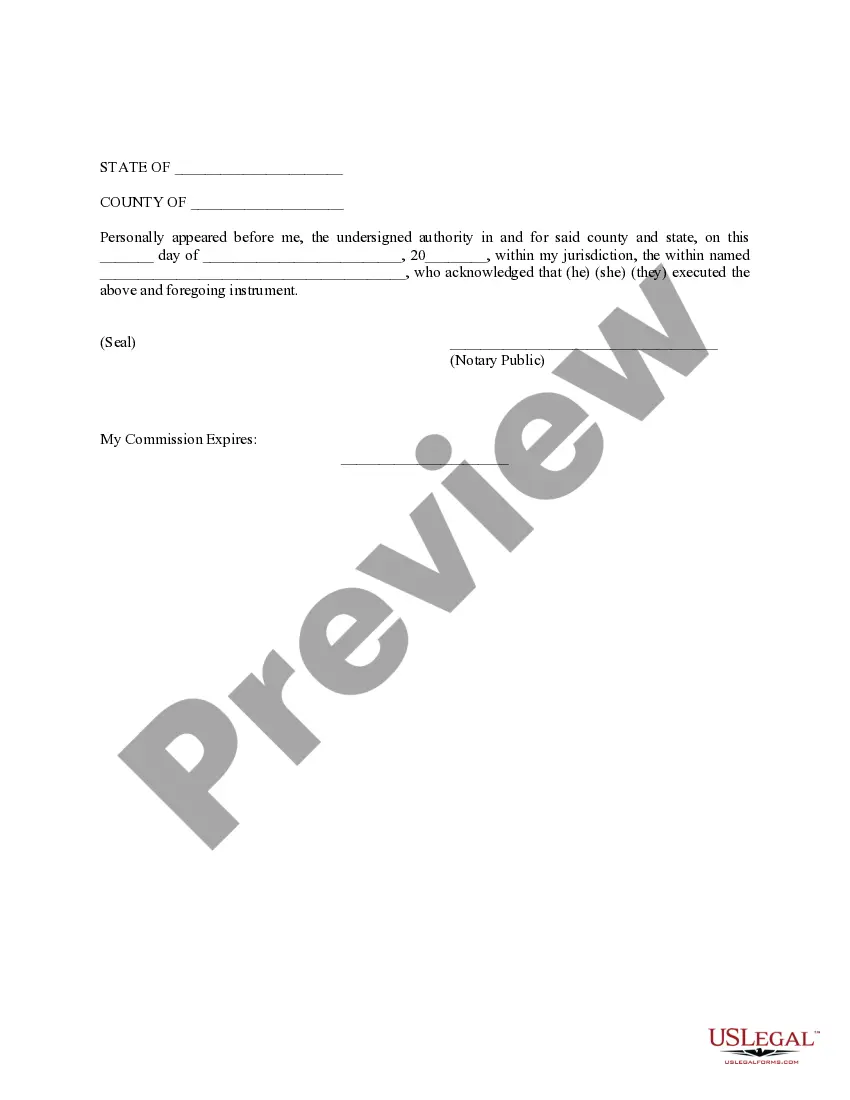
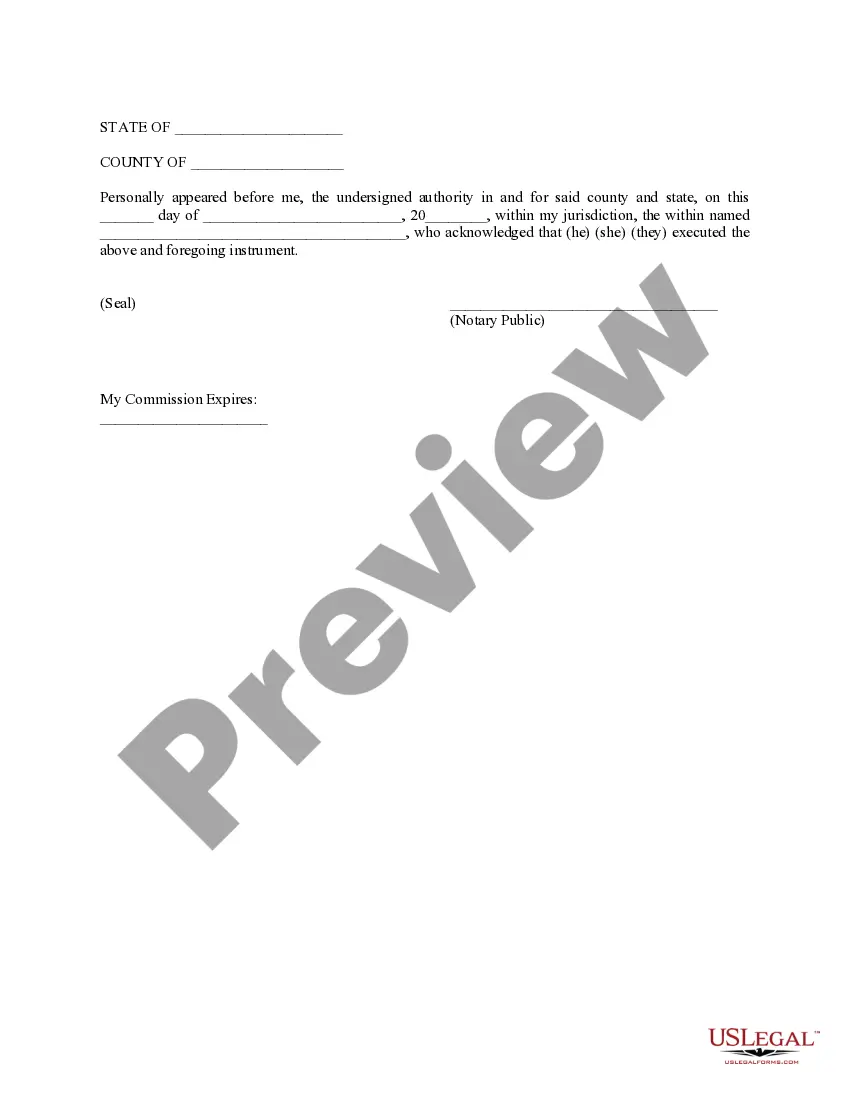
This form does not typically require notarization unless specified by local law. Ensure to follow your jurisdictionâs requirements to validate the document appropriately.
Get your form ready online
Our built-in tools help you complete, sign, share, and store your documents in one place.
Make edits, fill in missing information, and update formatting in US Legal Forms—just like you would in MS Word.
Download a copy, print it, send it by email, or mail it via USPS—whatever works best for your next step.
Sign and collect signatures with our SignNow integration. Send to multiple recipients, set reminders, and more. Go Premium to unlock E-Sign.
If this form requires notarization, complete it online through a secure video call—no need to meet a notary in person or wait for an appointment.
We protect your documents and personal data by following strict security and privacy standards.

Make edits, fill in missing information, and update formatting in US Legal Forms—just like you would in MS Word.

Download a copy, print it, send it by email, or mail it via USPS—whatever works best for your next step.

Sign and collect signatures with our SignNow integration. Send to multiple recipients, set reminders, and more. Go Premium to unlock E-Sign.

If this form requires notarization, complete it online through a secure video call—no need to meet a notary in person or wait for an appointment.

We protect your documents and personal data by following strict security and privacy standards.
Avoid these common issues
- Providing incomplete or incorrect personal information.
- Failing to attach the original will or the correct copy.
- Omitting important details about the decedent or the property.
- Not signing the document before submission.
- Neglecting to confirm local court requirements before filing.
Why use this form online
- Convenient download for immediate use without waiting for postal services.
- Editability allows you to customize the form to fit your specific needs.
- Access to templates drafted by licensed attorneys ensuring reliability.
- 24/7 availability for last-minute filings or urgent needs.
What to keep in mind
- The Petition to Admit Will to Probate as Muniment of Title Only is ideal for simple estates.
- Accurate completion is critical to avoid legal challenges.
- Consider local regulations before submitting the form to ensure proper processing.
Looking for another form?
Form popularity
FAQ
Under Mississippi statute, where as estate is valued at less than $50,000, an interested party may, thirty (30) days after the death of the decedent, issue a small estate affidavit to collect any debts owed to the decedent.
A Muniment of Title proceeding is when a court admits a will to probate solely to establish title to personal and real property. (This is the first in a series regarding probate procedures in Texas.)You can only qualify for a Muniment of Title if there is no need for an administration of the estate.
1 : the evidence (such as documents) that enables one to defend the title to an estate or a claim to rights and privileges usually used in plural.
The price to Probate a Will as a Muniment of Title is $1750. This price includes filing fees, attorneys fees for hearing attendance with the applicant and preparation of all required documents: Application to Probate of Will as a Muniment of Title.
In Mississippi, you can make a living trust to avoid probate for virtually any asset you ownreal estate, bank accounts, vehicles, and so on. You need to create a trust document (it's similar to a will), naming someone to take over as trustee after your death (called a successor trustee).
A Muniment or Muniment of Title is a legal term for a document, title deed or other evidence, that indicates ownership of an asset.Muniments of title are deeds, wills, and court judgments through which a particular land title passes and upon which its validity depends.
Mississippi probate is usually required if a deceased person died with Mississippi assets in his or her name and those assets do not pass automatically at the person's death.There are some alternatives to probate that may apply in limited circumstances.
A: Texas law states that a will can be probated after four years only if the executor "was not in default in failing to present the will for probate on or before the fourth anniversary of the testator's death." Fortunately, Texas courts are typically liberal in applying the "not in default" rule.