Mississippi Petition To Probate Will in Solemn Form
About this form
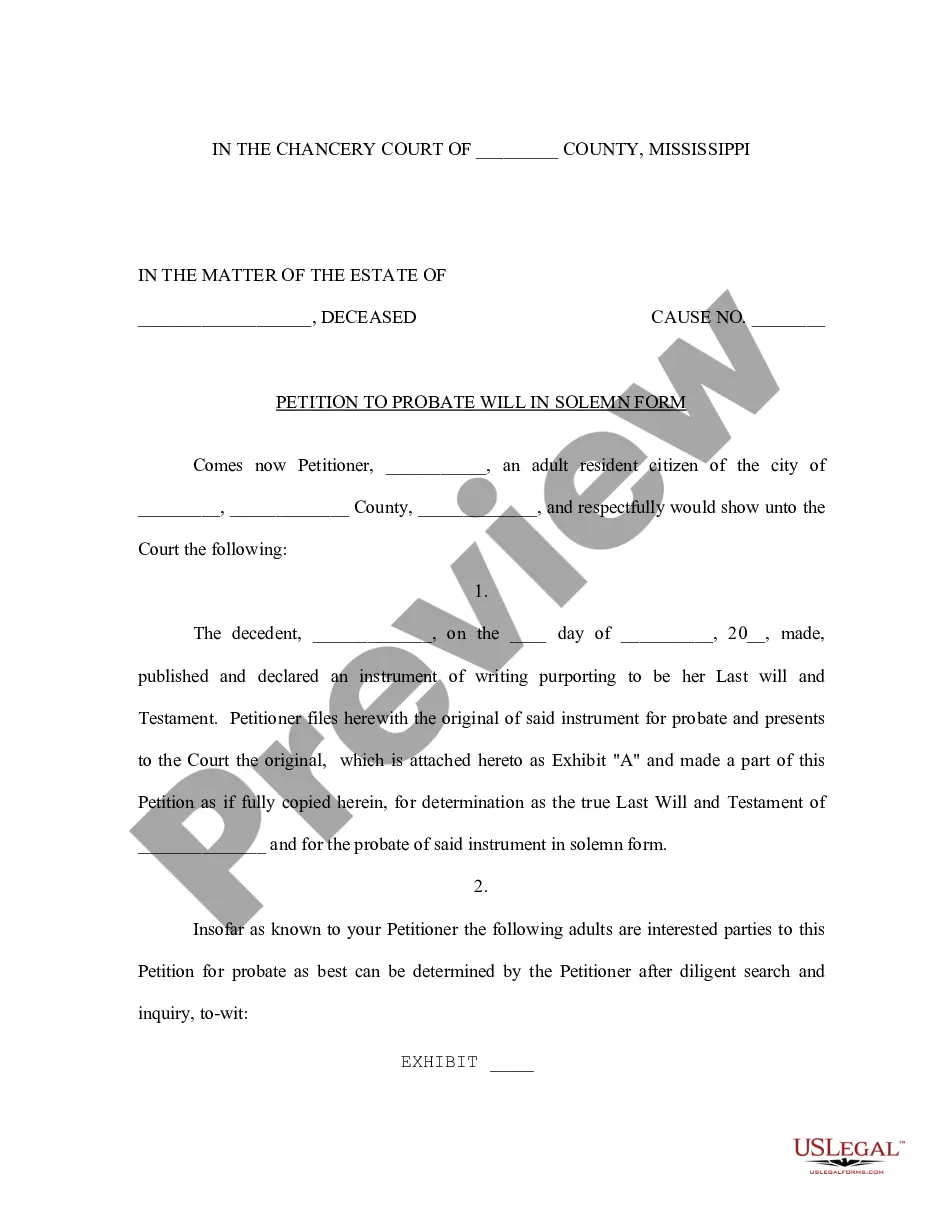
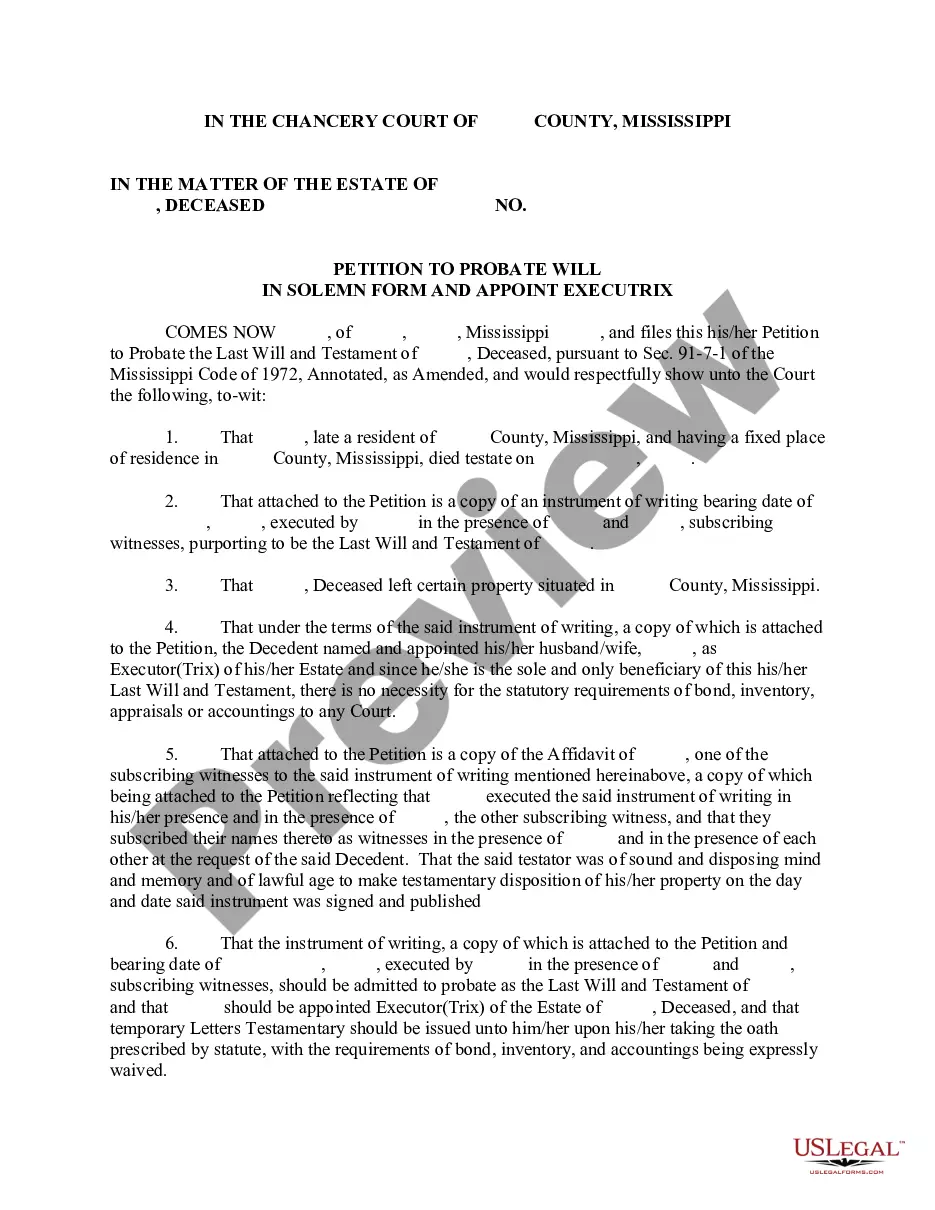
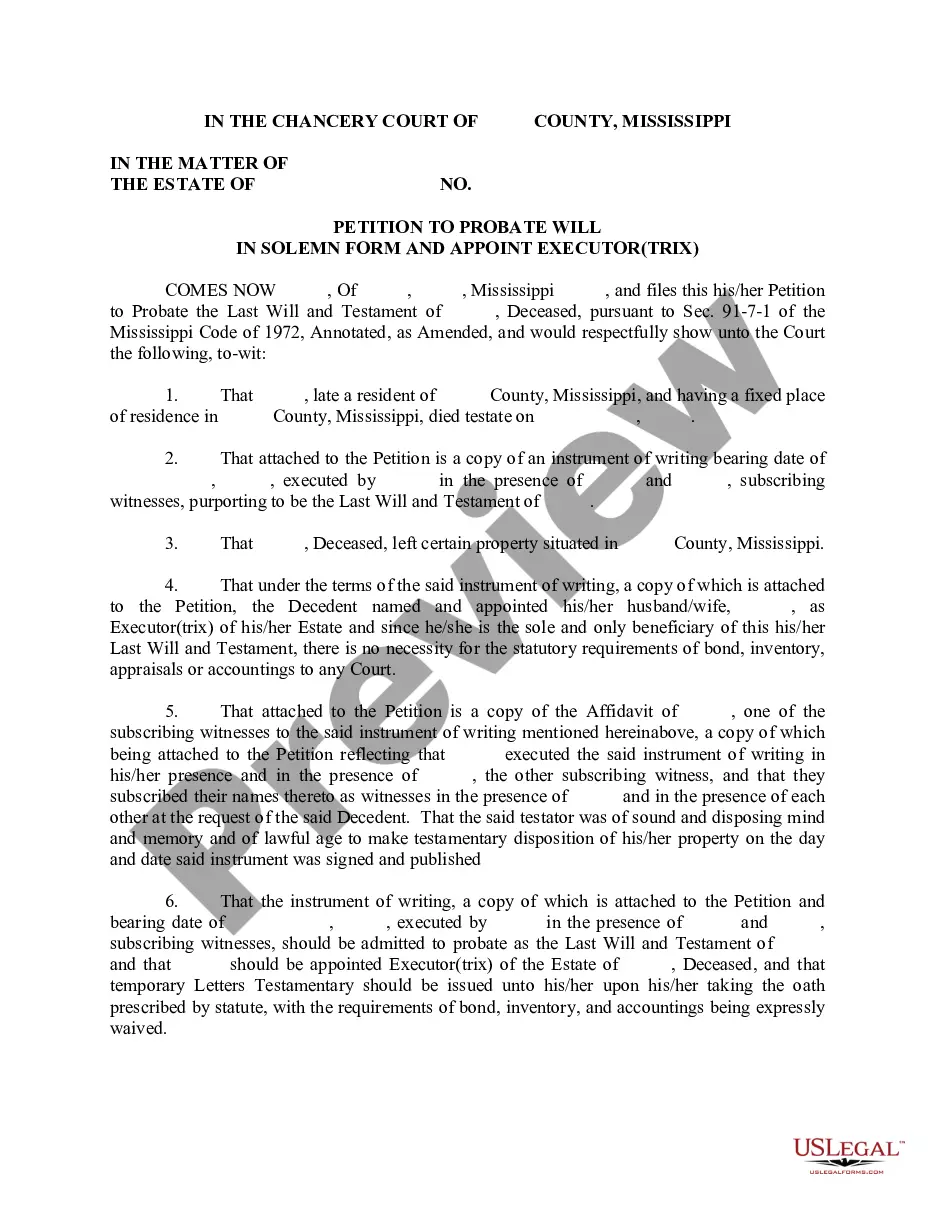
The Petition to Probate Will in Solemn Form is a legal document used by an executor or administrator to request the Probate Court to validate a deceased person's will. This form differs from other probate applications as it seeks a solemn form of probate, which involves a more formal hearing and allows interested parties to contest the will.
Key parts of this document
- The decedent's information: Details about the deceased person, including their name and date of death.
- Petitioner's information: The name and address of the person filing the petition.
- Original will attachment: The original will must be included as an exhibit with the petition.
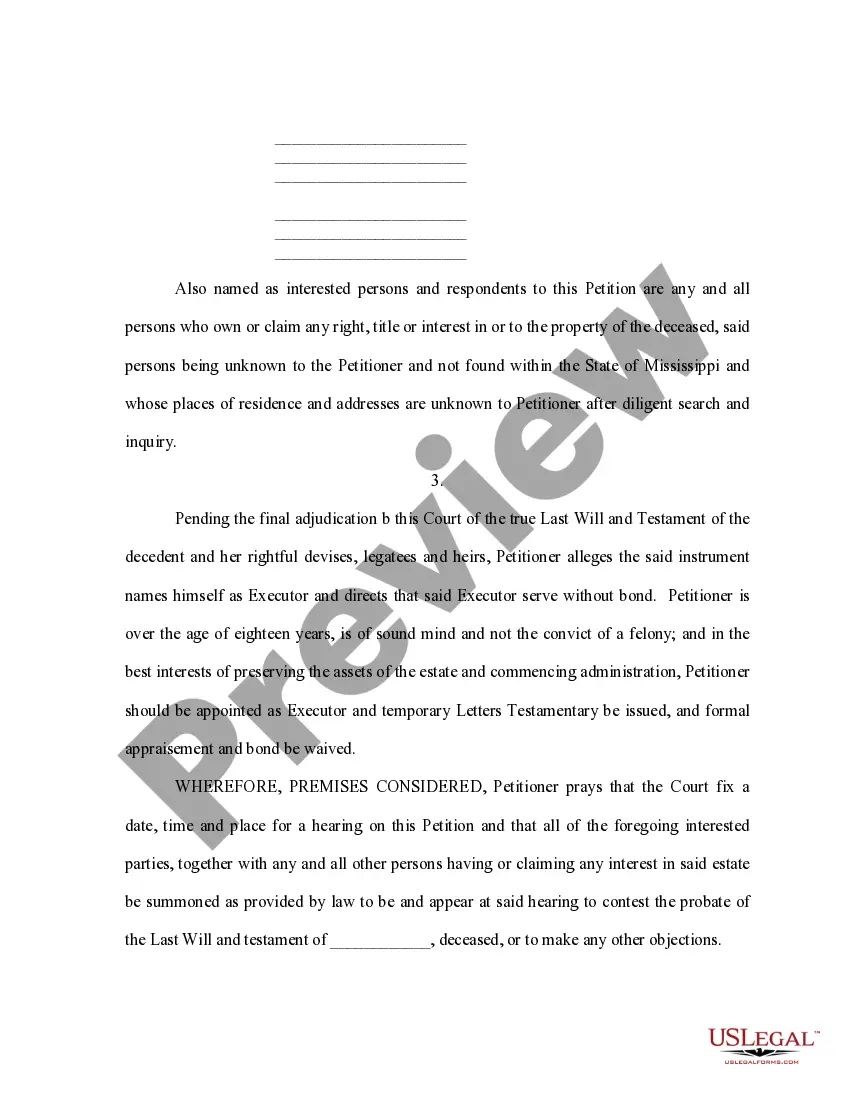
- List of interested parties: Identification of adults and other interested persons regarding the estate.
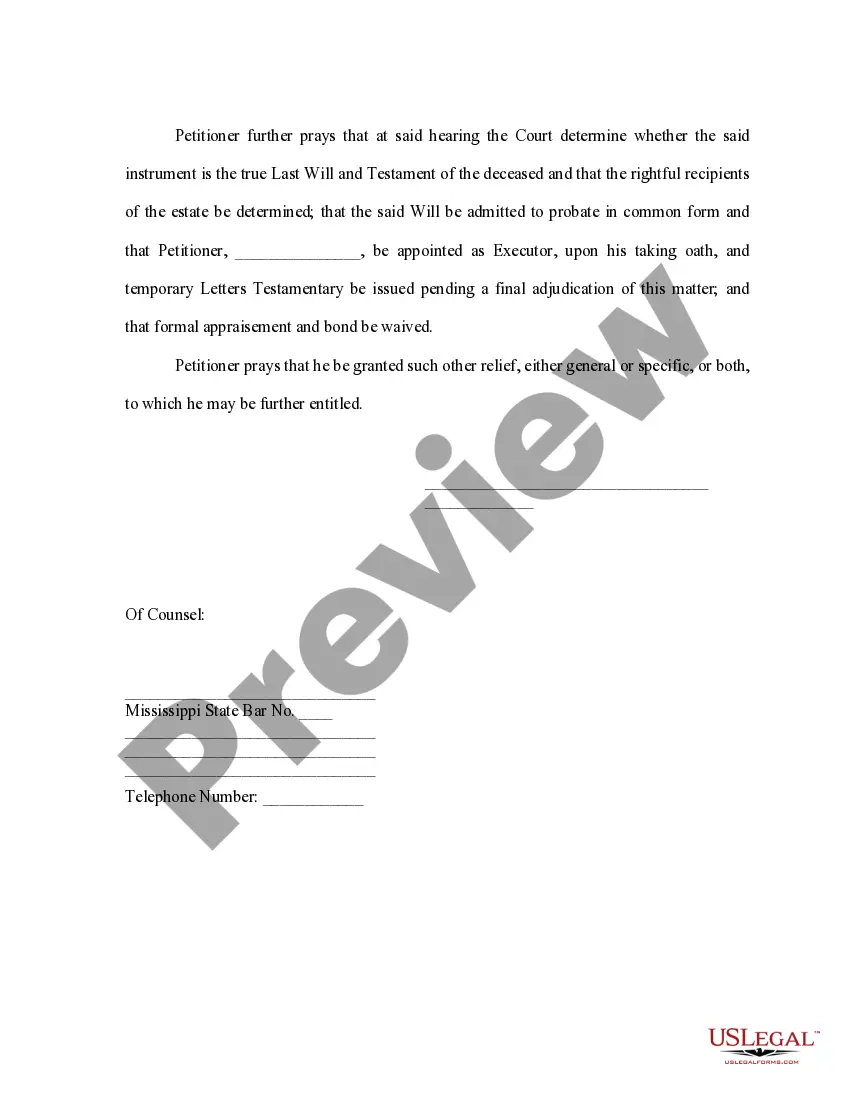
- Request for appointment: A request for the court to appoint the petitioner as executor and issue temporary letters testamentary.
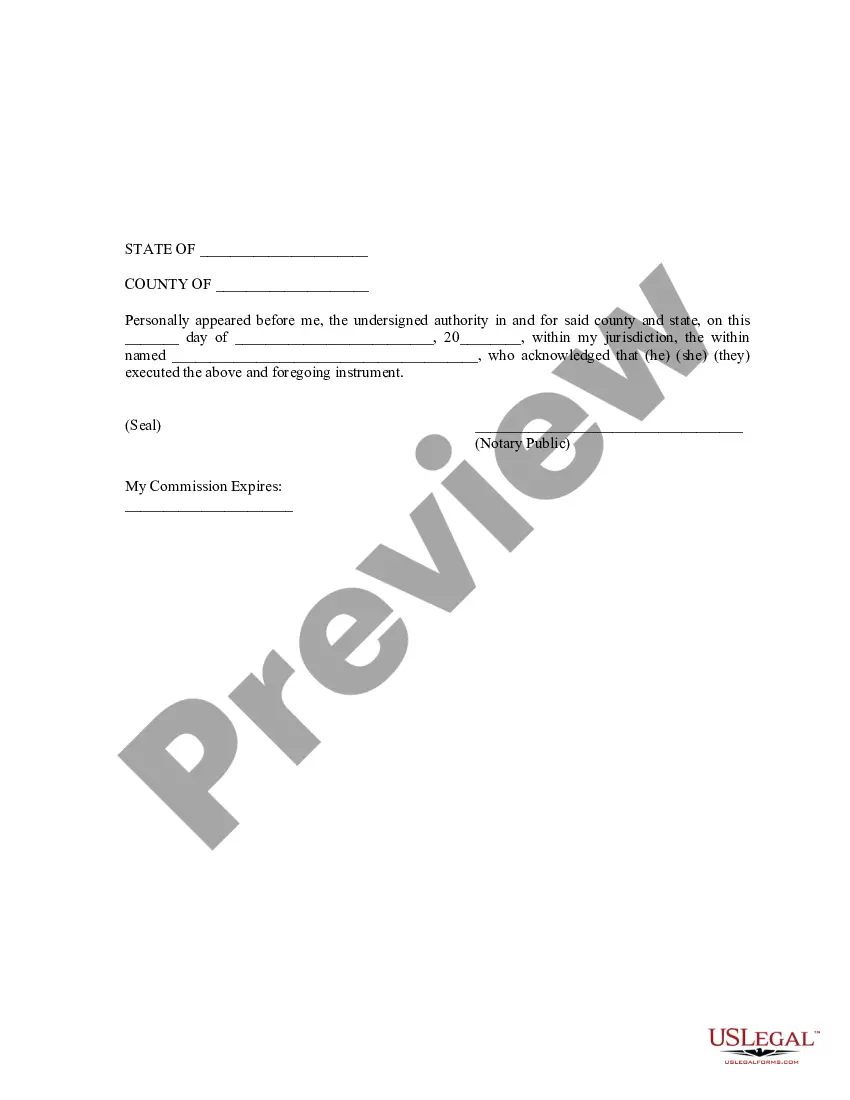
- Verification by notary: A section for notarization to affirm the accuracy of the petitioner's statements.
Common use cases
This form should be used when an individual wishes to probate a will in solemn form, especially when there are potential disputes over the will or when the legitimacy of the document is contested by interested parties. It is typically necessary when dealing with a larger estate or when there are multiple heirs, and formal court approval is sought for the distribution of assets.
Who can use this document
- Executors appointed in the will who need to initiate the probate process.
- Administrators of the estate when there is a will present.
- Individuals seeking to ensure a formal transfer of property according to the deceased's wishes.
How to complete this form
- Identify the decedent and enter their name and date of death at the top of the document.
- Provide your name and address as the petitioner seeking probate.
- Attach the original will of the decedent as an exhibit to the petition.
- List the names and addresses of all interested parties, making sure to include any potential heirs or individuals claiming interest in the estate.
- Make a request for the court to hear the petition and appoint you as the executor.
- Sign the form in the presence of a notary public to validate your petition.
Does this form need to be notarized?
This form needs to be notarized to ensure legal validity. US Legal Forms provides secure online notarization powered by Notarize, allowing you to complete the process through a verified video call, available anytime.
Get your form ready online
Our built-in tools help you complete, sign, share, and store your documents in one place.
Make edits, fill in missing information, and update formatting in US Legal Forms—just like you would in MS Word.
Download a copy, print it, send it by email, or mail it via USPS—whatever works best for your next step.
Sign and collect signatures with our SignNow integration. Send to multiple recipients, set reminders, and more. Go Premium to unlock E-Sign.
If this form requires notarization, complete it online through a secure video call—no need to meet a notary in person or wait for an appointment.
We protect your documents and personal data by following strict security and privacy standards.

Make edits, fill in missing information, and update formatting in US Legal Forms—just like you would in MS Word.

Download a copy, print it, send it by email, or mail it via USPS—whatever works best for your next step.

Sign and collect signatures with our SignNow integration. Send to multiple recipients, set reminders, and more. Go Premium to unlock E-Sign.

If this form requires notarization, complete it online through a secure video call—no need to meet a notary in person or wait for an appointment.

We protect your documents and personal data by following strict security and privacy standards.
Common mistakes to avoid
- Failing to attach the original will, which is crucial for the process.
- Not listing all interested parties, leading to potential legal challenges later.
- Neglecting to sign the document in front of a notary, which can invalidate the petition.
- Using improper formatting or incomplete information that may delay the probate process.
Advantages of online completion
- Convenience of downloading and completing the form at your own pace.
- Access to templates drafted by licensed attorneys ensures legal accuracy.
- Ability to easily edit and customize the form to meet specific needs.
Looking for another form?


Form popularity
FAQ
This is the form of probate that one will choose when they do not believe that someone will contest the will.Common form probate does not require notice to either beneficiaries or other persons. It is designed to quickly appoint an executor and pass the property.
In Mississippi, you can make a living trust to avoid probate for virtually any asset you ownreal estate, bank accounts, vehicles, and so on. You need to create a trust document (it's similar to a will), naming someone to take over as trustee after your death (called a successor trustee).
To write a will, Mississippi law states you must be at least 18 years old, of sound and disposing mind, must intend the document to be your will and must have the written will validly executed. Upon your death, your will must go through probate, a court proceeding that declares the will valid or invalid.
: the form of probate of a will where the will is decreed in open court to be the last will and testament after notice to all interested persons and after hearing the testimony of the attesting witnesses.
: the form of probate of a will where the will is decreed in open court to be the last will and testament after notice to all interested persons and after hearing the testimony of the attesting witnesses.
If you are named in someone's will as an executor, you may have to apply for probate. This is a legal document which gives you the authority to share out the estate of the person who has died according to the instructions in the will. You do not always need probate to be able to deal with the estate.
Net value of probate estate is $50,000 or less, or. Probate asset is bank account or accounts totaling no more than $12,500, or. Probate estate is $500 or less.
Mississippi has a simplified probate process for small estates. To use it, an executor files a written request with the local probate court asking to use the simplified procedure. The court may authorize the executor to distribute the assets without having to jump through the hoops of regular probate.
These guidelines can vary state by state. However, generally, the first step is to file the decedent's will in the probate court in the county of his or her domicile. You will also need to file your appointment as executor with the probate court. The final step of the petition process is to have the will proved.