Mississippi Renunciation of Executorship
About this form
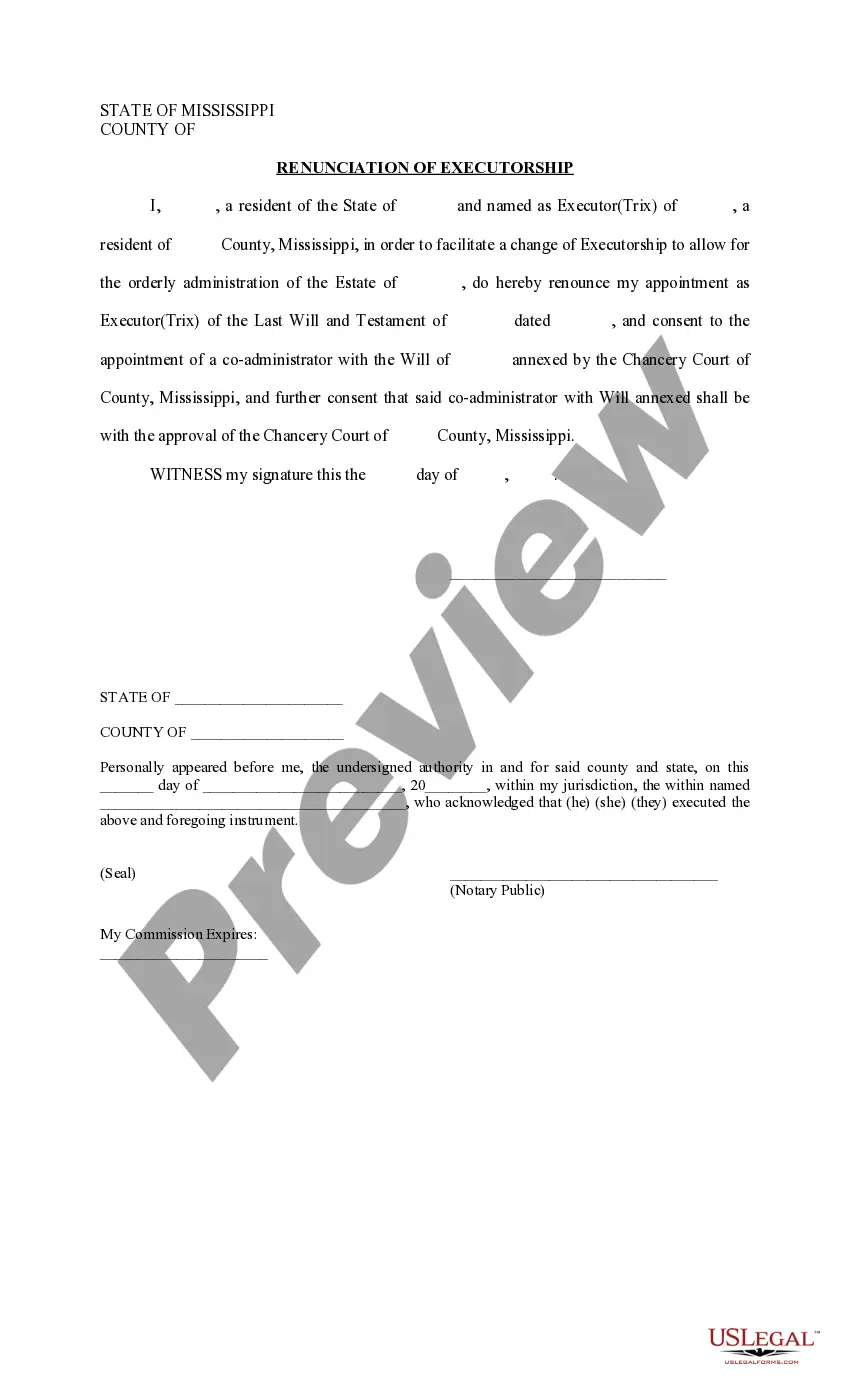
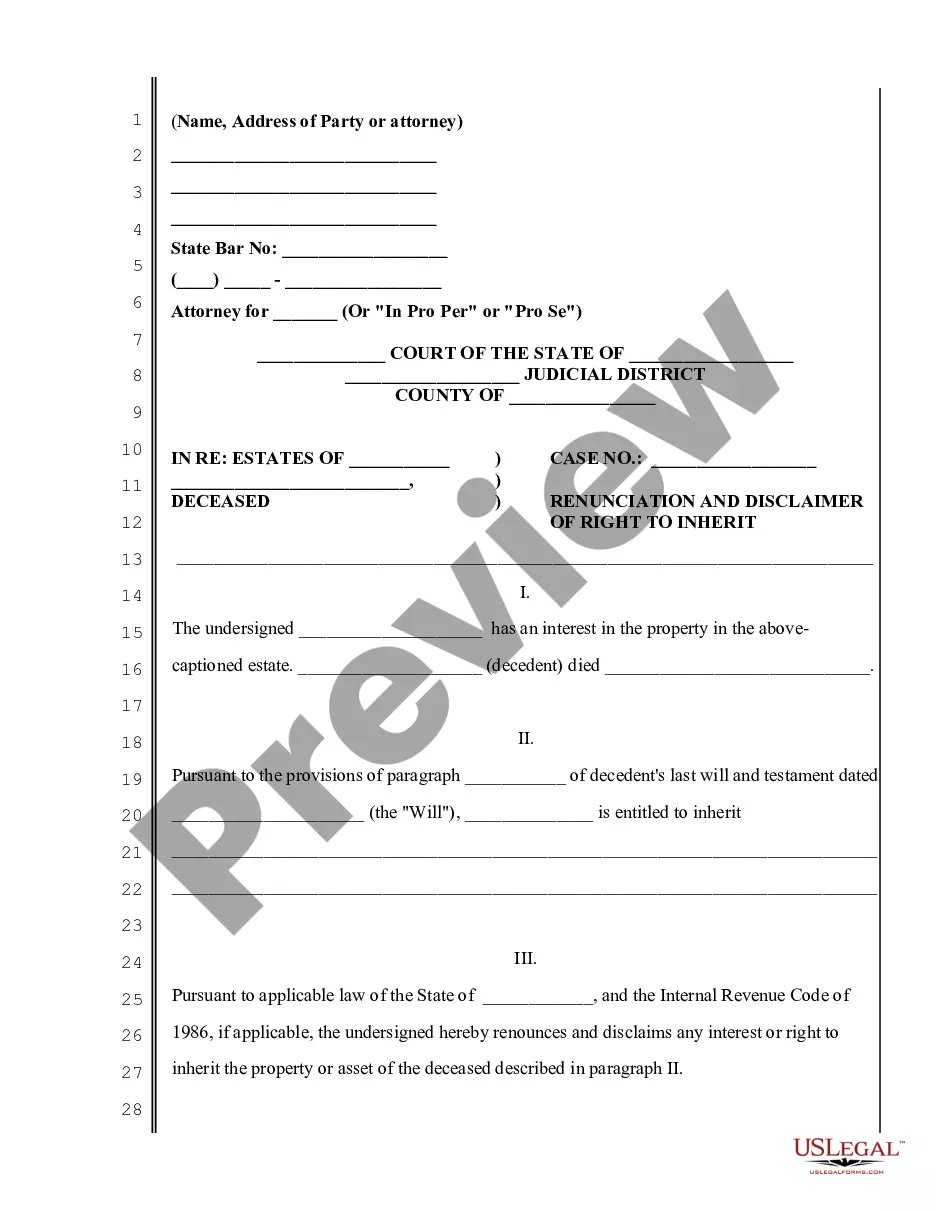
The Renunciation of Executorship is a legal document that allows the executor of an estate to formally decline their position. This form is specifically designed to comply with Mississippi laws and statutes, ensuring that the process follows state requirements. It differs from other estate planning forms by focusing on the executor's choice to relinquish their responsibilities, rather than outlining their duties or the distribution of the estate.
Main sections of this form
- Identification of the executor: Their name and contact information.
- Statement of renunciation: A clear declaration that the executor is declining their role.
- Signature: The executor must sign and date the document to make it official.
- Witness requirements: Depending on state law, a witness may need to be present when signing.
- Filing instructions: Guidance on how to submit the form to the appropriate court or administrator.

When to use this form
This form is used when an individual who has been appointed as an executor of an estate wishes to decline the position. Common scenarios include when the executor realizes they cannot fulfill the responsibilities due to personal obligations, health issues, or a lack of knowledge about estate management. It is crucial to complete this form before any estate administration actions take place to prevent potential legal complications.
Who needs this form
This form is intended for:
- Individuals designated as executors in a will who decide not to serve.
- Heirs or beneficiaries seeking to clarify changes in the estate administration.
- Legal representatives managing the estate who need to comply with Mississippi law.
Steps to complete this form
- Identify the executor by filling in their full name and address.
- Clearly state the decision to renounce the executorship.
- Sign and date the document in accordance with state requirements.
- If required, have the signature witnessed by an approved individual.
- Submit the completed form to the relevant court for processing.
Does this form need to be notarized?
This document requires notarization to meet legal standards. US Legal Forms provides secure online notarization powered by Notarize, allowing you to complete the process through a verified video call, available 24/7.
Get your form ready online
Our built-in tools help you complete, sign, share, and store your documents in one place.
Make edits, fill in missing information, and update formatting in US Legal Forms—just like you would in MS Word.
Download a copy, print it, send it by email, or mail it via USPS—whatever works best for your next step.
Sign and collect signatures with our SignNow integration. Send to multiple recipients, set reminders, and more. Go Premium to unlock E-Sign.
If this form requires notarization, complete it online through a secure video call—no need to meet a notary in person or wait for an appointment.
We protect your documents and personal data by following strict security and privacy standards.

Make edits, fill in missing information, and update formatting in US Legal Forms—just like you would in MS Word.

Download a copy, print it, send it by email, or mail it via USPS—whatever works best for your next step.

Sign and collect signatures with our SignNow integration. Send to multiple recipients, set reminders, and more. Go Premium to unlock E-Sign.

If this form requires notarization, complete it online through a secure video call—no need to meet a notary in person or wait for an appointment.

We protect your documents and personal data by following strict security and privacy standards.
Avoid these common issues
- Failing to sign the form, which renders it invalid.
- Not providing complete identifying information for the executor.
- Missing the witness requirement if stipulated by state law.
Advantages of online completion
- Convenience of immediate access to the form from anywhere.
- Editability to customize the form to specific needs.
- Compliance with legal standards as the form is drafted by licensed attorneys.
Main things to remember
- The Renunciation of Executorship allows an appointed executor to decline their role.
- This form is specific to Mississippi law and includes key components that must be fulfilled.
- It is important to properly complete and submit the form to prevent legal issues.
Looking for another form?


Form popularity
FAQ
Legally you can't 'force' an Executor to sign a Renunciation. If you believe an Executor has done something wrong you might be able to get them removed from the Will, but you'd need to take specialist legal advice on that as it can be very complicated.
You can't force an Executor or Administrator to renounce their appointment, but you can still take action if they haven't renounced, but haven't taken any positive steps.
Net value of probate estate is $50,000 or less, or. Probate asset is bank account or accounts totaling no more than $12,500, or. Probate estate is $500 or less.
Definitions of letter of renunciation a form sent with new shares that can be completed and returned as written notification that the person who has been allotted shares resulting from a rights issue refuses to accept them. The shares can then be sold or transferred to someone else.
If you feel you are unable or unqualified to serve as an executor of a will, you can remove yourself by filing the proper paperwork in probate or surrogate court. A new executor or will administrator may be appointed by the court.
In general, the court will only remove an executor if there is evidence of the following: The executor has been disqualified since the deceased appointed him, ie has been convicted of a crime and sent to prison.
You can resign as an executor if you can no longer handle the duties or feel uncomfortable with the level of responsibility. The executor of an estate has various legal responsibilities, including disposing of estate assets, transferring shares to heirs, paying the deceased's final bills and filing tax returns.
The executor will need to wait until the 2 month time limit is up, before distributing the estate. Six month limit to bring a claim in other cases, it can be sensible for the executors not to pay any beneficiaries until at least 6 months after receiving the grant of probate.
In the best of circumstances, the Mississippi probate process usually takes 4 to 6 months. This would only be possible if the estate was fairly simple, all interested parties are agreeable, and documents are signed and returned to the probate attorney in a timely manner.