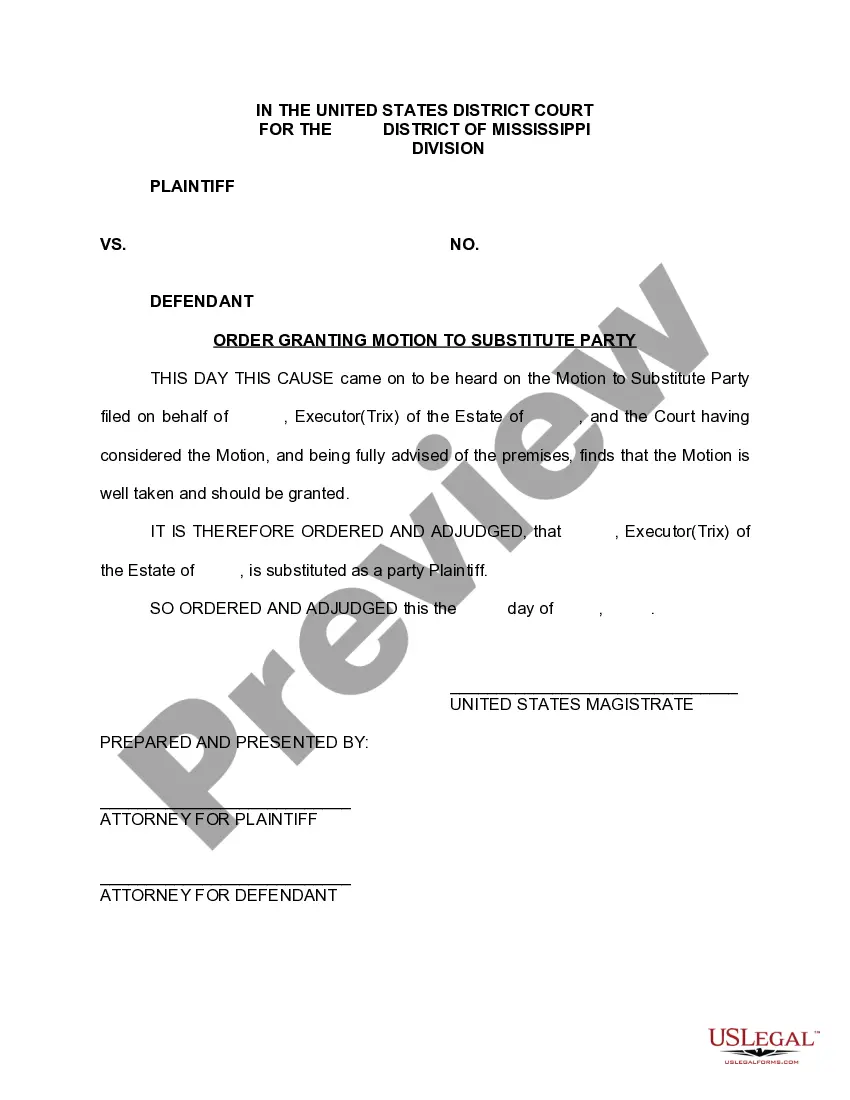
Mississippi Order Granting Motion to Substitute Party
Understanding this form
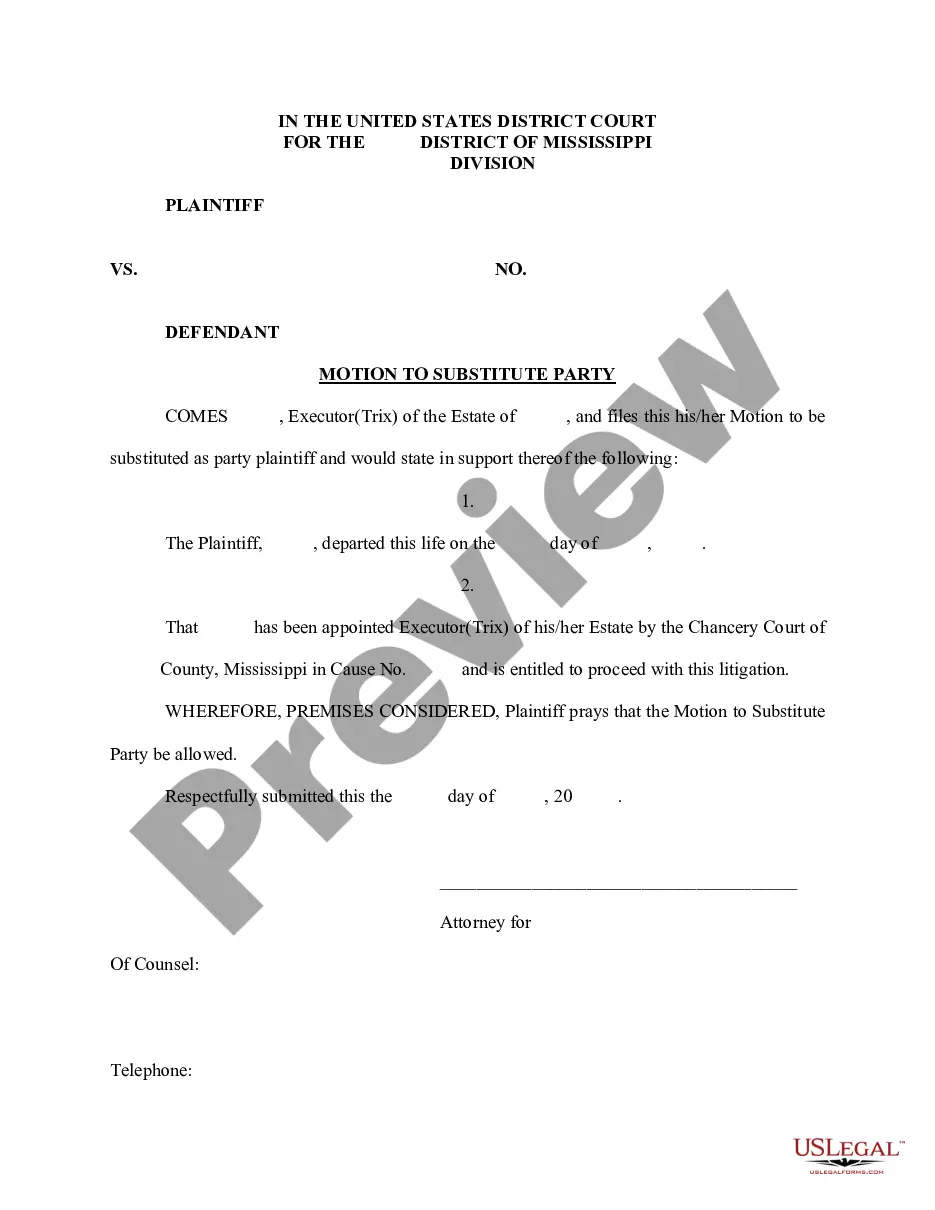
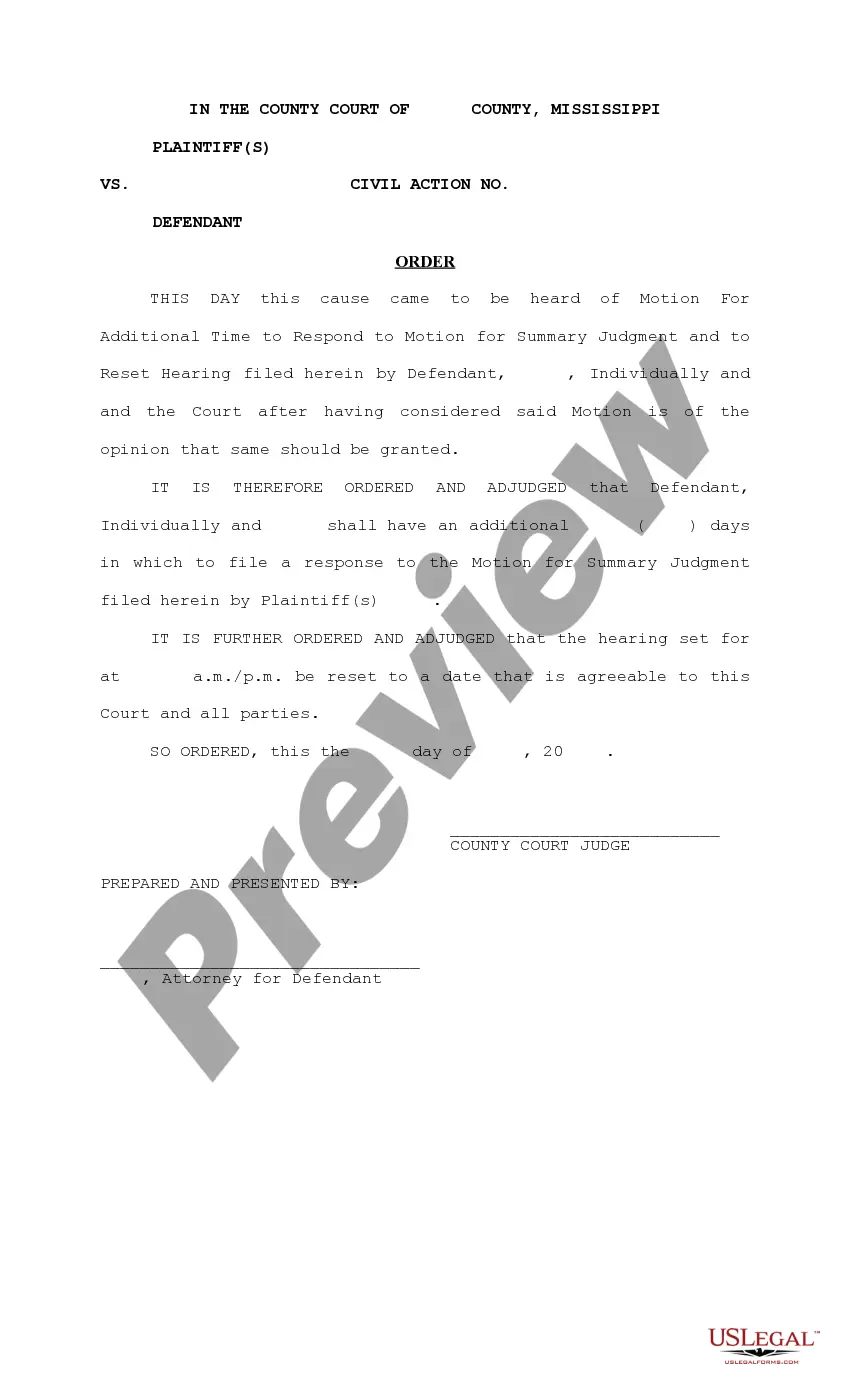
The Order Granting Motion to Substitute Party is a legal document used to formally request the court to substitute one party in a legal case with another. This motion aims to ensure that the legal proceedings continue smoothly when a party can no longer participate due to reasons such as death, incapacity, or change of status. Unlike other motions, this specific order focuses solely on the substitution of parties involved in a case.
Key components of this form
- Case information: Identifies the court case and involved parties.
- Motion details: Outlines the reasons for requesting a substitution.
- Signature lines: Spaces for the signatures of involved parties or their legal representatives.
- Judicial approval: The order must be signed by a judge to be legally binding.
When to use this form
This form is typically used in situations where a party in a lawsuit can no longer participate, such as after their passing, if they become incapacitated, or if a business entity undergoes a change in structure. It is essential to use this form to ensure the legal process continues without interruption, allowing the case to be resolved with the appropriate parties involved.
Who this form is for
- Individuals involved in a lawsuit who need to replace a party.
- Attorneys representing clients in need of a substitution for various reasons.
- Legal representatives of estates when a deceased party is involved.
Completing this form step by step
- Identify the current parties involved in the case.
- Provide details about the party being substituted and the reason for substitution.
- Fill out the case information, including the court, case number, and names of all parties.
- Have the required parties sign the motion to validate it.
- Submit the completed form to the court for approval.
Does this form need to be notarized?
This form does not typically require notarization unless specified by local law. Always verify local requirements to ensure compliance.
Get your form ready online
Our built-in tools help you complete, sign, share, and store your documents in one place.
Make edits, fill in missing information, and update formatting in US Legal Forms—just like you would in MS Word.
Download a copy, print it, send it by email, or mail it via USPS—whatever works best for your next step.
Sign and collect signatures with our SignNow integration. Send to multiple recipients, set reminders, and more. Go Premium to unlock E-Sign.
If this form requires notarization, complete it online through a secure video call—no need to meet a notary in person or wait for an appointment.
We protect your documents and personal data by following strict security and privacy standards.

Make edits, fill in missing information, and update formatting in US Legal Forms—just like you would in MS Word.

Download a copy, print it, send it by email, or mail it via USPS—whatever works best for your next step.

Sign and collect signatures with our SignNow integration. Send to multiple recipients, set reminders, and more. Go Premium to unlock E-Sign.

If this form requires notarization, complete it online through a secure video call—no need to meet a notary in person or wait for an appointment.

We protect your documents and personal data by following strict security and privacy standards.
Avoid these common issues
- Failing to include all necessary signatures.
- Not providing adequate justification for the substitution.
- Submitting the motion without the required case information.
- Neglecting to check state-specific requirements that may affect the form.
Why complete this form online
- Convenient access: Download the form anytime, anywhere.
- Editability: Customize the document to fit your specific case needs.
- Reliability: Forms are drafted by licensed attorneys to ensure legal soundness.
Looking for another form?






Form popularity
FAQ
Anyone can file the Substitution of Attorney form with the court. There is no court rule or code section mandating who should file it.
A Motion for Substitution may be made by any party or by the descendant's successor or representative. It permits a party to substitute into an adversary proceeding or contested matter as a party if any of the following circumstances exist in a case:If a party dies and the claim is not extinguished.
(1) Substitution if the Claim Is Not Extinguished. If a party dies and the claim is not extinguished, the court may order substitution of the proper party. A motion for substitution may be made by any party or by the decedent's successor or representative.A statement noting death must be served in the same manner.
Lawyers can withdraw based on the fact their client refuses to be truthful, refuses to follow the attorney's advice, demands to pursue an unethical course of action, demands unrealistic results, desires to mislead the Court, refuses to cooperate with their counsel as well as countless other reasons.
This means that you are agreeing to release your counsel from the case. Many attorneys will ask for this if you are not paying your bill, or you are not getting along. If you do not sign this, then they have to ask the court to be relieved as counsel.
In such circumstances, the attorney(s) seeking to withdraw should complete and file a Request for Approval of Substitution or Withdrawal of Counsel (Form G-01) and submit a proposed Order on Request for Approval of Substitution or Withdrawal of Counsel (Form G-01 Order).
If an individual/party to a case wishes to change its legal representation or substitute another attorney/law firm for the one currently handling the matter, the individual/party may request the court to do so.