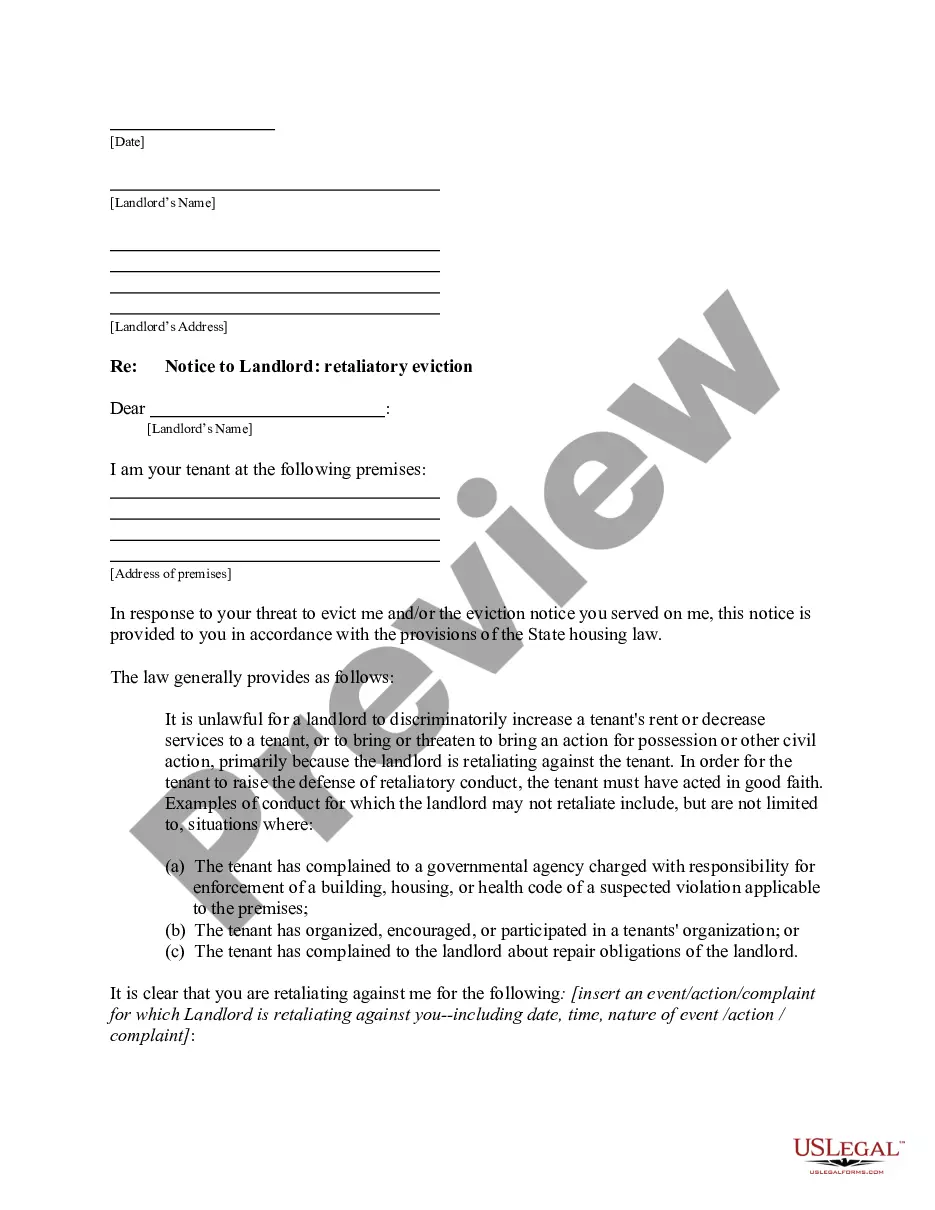
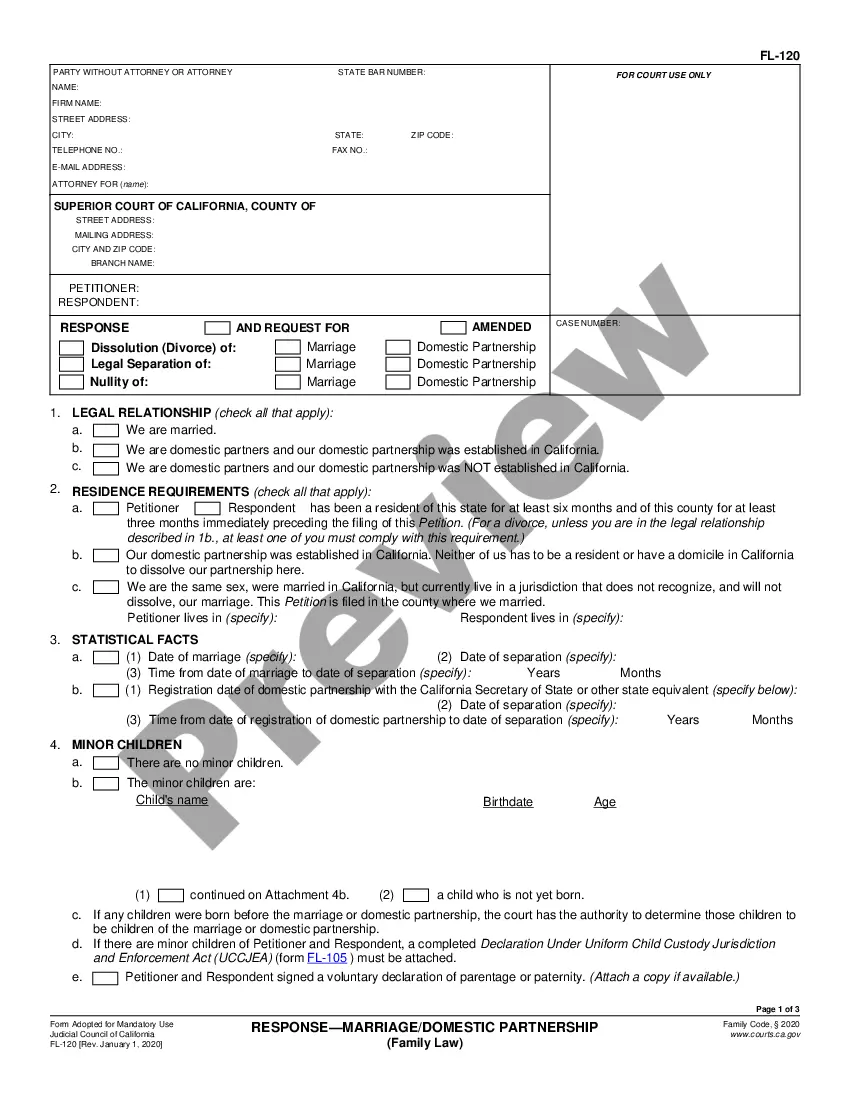
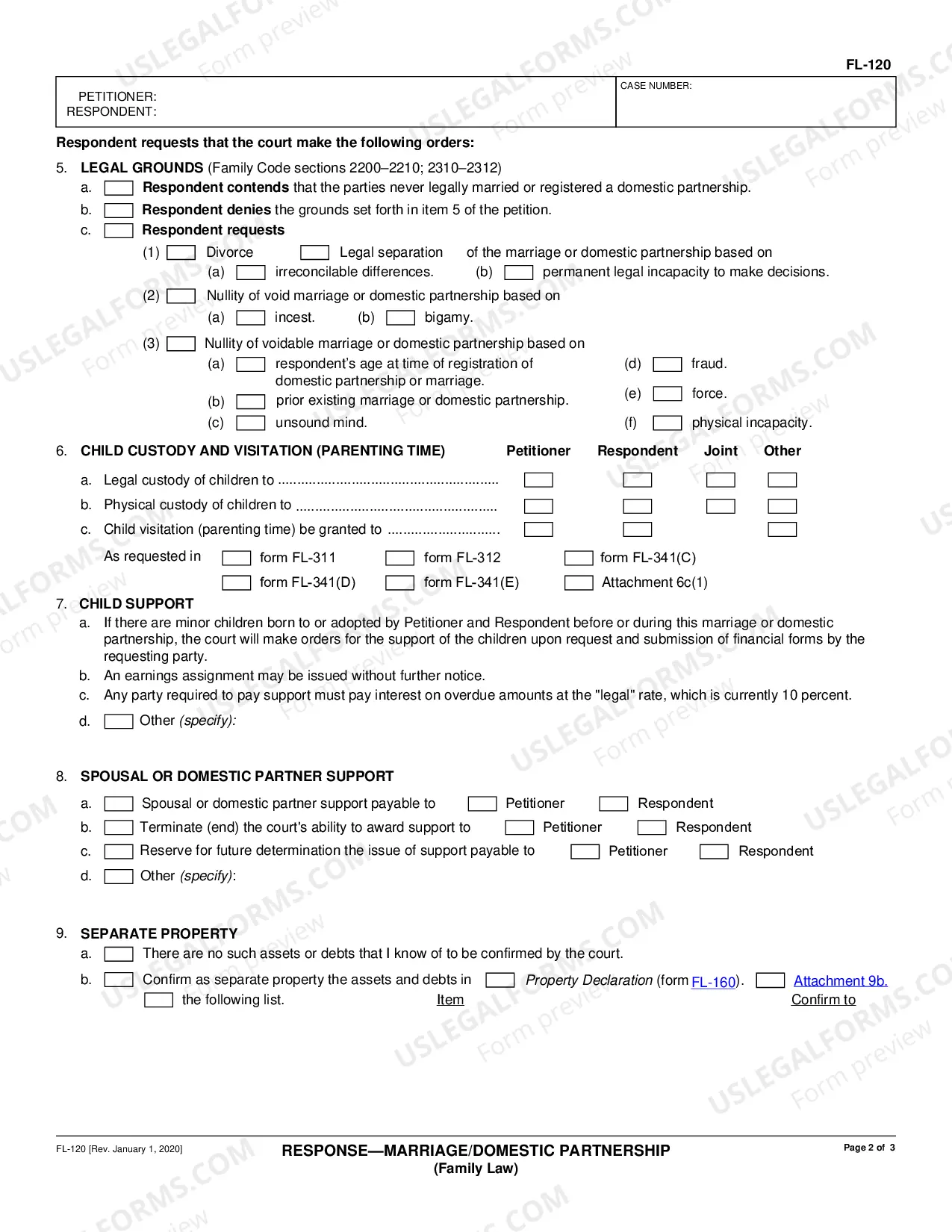
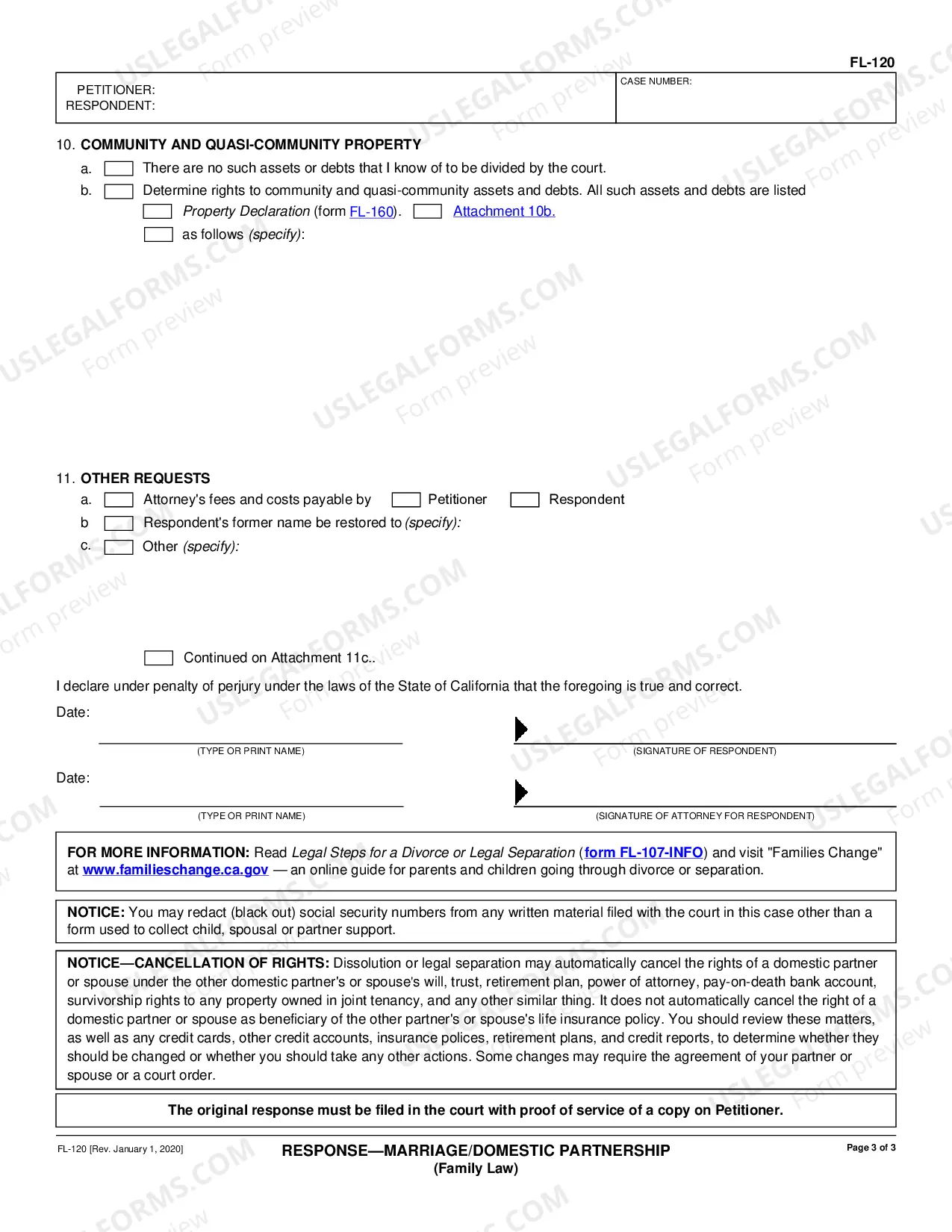
This is an official California Judicial Council family law form, which may be used in domestic litigation in California. Enter the information as indicated on the form and file with the court as appropriate.
California Response - Family Law
State:
California
Control #:
CA-FL-120
Format:
PDF
Instant download
This website is not affiliated with any governmental entity
Public form
Description
Free preview
Get your form ready online
Our built-in tools help you complete, sign, share, and store your documents in one place.
Built-in online Word editor
Make edits, fill in missing information, and update formatting in US Legal Forms—just like you would in MS Word.
Export easily
Download a copy, print it, send it by email, or mail it via USPS—whatever works best for your next step.
E-sign your document
Sign and collect signatures with our SignNow integration. Send to multiple recipients, set reminders, and more. Go Premium to unlock E-Sign.
Notarize online 24/7
If this form requires notarization, complete it online through a secure video call—no need to meet a notary in person or wait for an appointment.
Store your document securely
We protect your documents and personal data by following strict security and privacy standards.

Make edits, fill in missing information, and update formatting in US Legal Forms—just like you would in MS Word.

Download a copy, print it, send it by email, or mail it via USPS—whatever works best for your next step.

Sign and collect signatures with our SignNow integration. Send to multiple recipients, set reminders, and more. Go Premium to unlock E-Sign.

If this form requires notarization, complete it online through a secure video call—no need to meet a notary in person or wait for an appointment.

We protect your documents and personal data by following strict security and privacy standards.
Looking for another form?


How to fill out California Response - Family Law?
If you're seeking suitable California Response - Family Law samples, US Legal Forms is exactly what you need; find documents created and verified by state-certified lawyers.
Using US Legal Forms not only spares you from issues related to legal documents; additionally, you save time, effort, and money! Downloading, printing, and submitting a professional form is significantly less expensive than hiring an attorney to do it for you.
And that's it. In just a few straightforward steps, you have an editable California Response - Family Law. Once your account is created, all future requests will be processed even more efficiently. With a US Legal Forms subscription, just Log In to your account and click the Download button found on the form's page. Then, when you need to use this template again, you'll always be able to find it in the My documents section. Don't waste your time sifting through countless forms on various sites. Purchase professional documents from a single trusted source!
- To get started, complete your registration by entering your email and creating a password.
- Follow the steps below to set up your account and obtain the California Response - Family Law template to address your concerns.
- Utilize the Preview feature or review the file details (if accessible) to confirm that the template is what you need.
- Verify its relevance in your state.
- Click Buy Now to place an order.
- Select a suggested pricing plan.
- Register and pay with your credit card or PayPal.
- Choose an appropriate file format and download the documents.
Form popularity
FAQ
Filing a response in Family Court in California involves submitting a formal written document to address the issues raised in a court petition. You typically have 30 days from the date you were served with the petition to file your response. This document should clearly outline your position and any relevant facts or arguments regarding the case. For assistance with the forms and advice specific to your situation, consider using US Legal Forms for your California Response - Family Law needs.
To appeal a family court decision in California, you must file a notice of appeal within specific time limits. Typically, this timeframe is 60 days from the date the court issues its decision. You will need to prepare your appellate brief, which outlines your reasons for the appeal, and submit it to the court along with the necessary documents. Using resources like US Legal Forms can simplify this process, providing you with the templates and guidance you need for effective California Response - Family Law.
If the respondent does not reply in a California Response - Family Law case, the court may grant a default judgment in favor of the petitioner. This outcome can result in the petitioner receiving what they requested in their initial filing without further contest. It is important to understand that failing to respond does not mean the case will disappear; instead, the court will proceed with the case based on the available information. For those needing assistance, UsLegalForms offers resources to help you navigate the process and ensure your rights are protected.
To appeal a judge's decision in family court in California, first, identify the grounds for your appeal, such as legal errors or misinterpretations of evidence. File a notice of appeal within the specified timeframe, along with relevant documentation. Seeking assistance from a legal professional can enhance your understanding of the process and ensure alignment with California Response - Family Law procedures.
To file an Answer with the court in California, complete the appropriate form, ensuring it's accurately filled out and signed. Include your case number and any necessary exhibits or supporting documents. Filings can often be done online or at your local courthouse. Following these steps closely helps ensure compliance with California Response - Family Law standards.
The biggest mistake in a custody battle often involves failing to focus on the child's best interests. Parents may become entrenched in personal conflicts, which can negatively affect the child. Instead, communicate openly and prioritize a co-parenting approach that values the child's needs. This perspective aligns with California Response - Family Law principles and helps create a more favorable outcome.
When answering family law interrogatories in California, read each question thoroughly and respond accurately. Provide clear and honest answers, as your responses are under oath. Keep your answers concise but complete, emphasizing important details related to your case. Consider using resources like uslegalforms to help structure your responses in line with California Response - Family Law.
To file a response in family court in California, prepare your response document according to court rules. Make sure to include your case number and any necessary forms. You can file in person at the courthouse or electronically, depending on local court options. Ensure that your filing complies with California Response - Family Law requirements for efficiency and clarity.
Writing a response declaration for child custody involves summarizing your position and providing evidence to support your claims. Begin with an introduction that states your relationship to the child, and then outline your response to each claim made in the original petition. Be sure to include pertinent details that uphold California Response - Family Law principles, focusing on the best interests of the child.
To write a response to a petition for child custody in California, start by reviewing the petition carefully. Identify key points you agree or disagree with, and articulate your stance. Use clear, concise language, and support your arguments with relevant facts about the child's welfare. An effective response should demonstrate how your wishes align with California Response - Family Law guidelines.