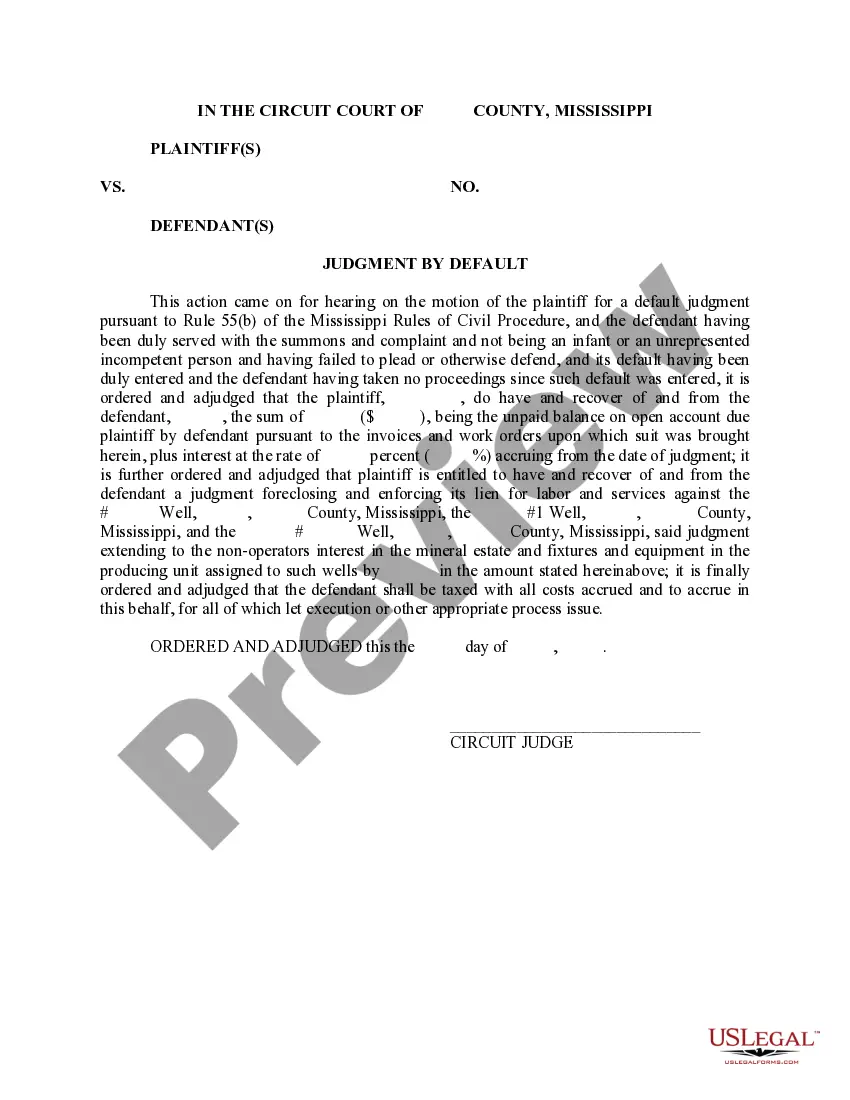
Mississippi Judgment by Default
Understanding this form
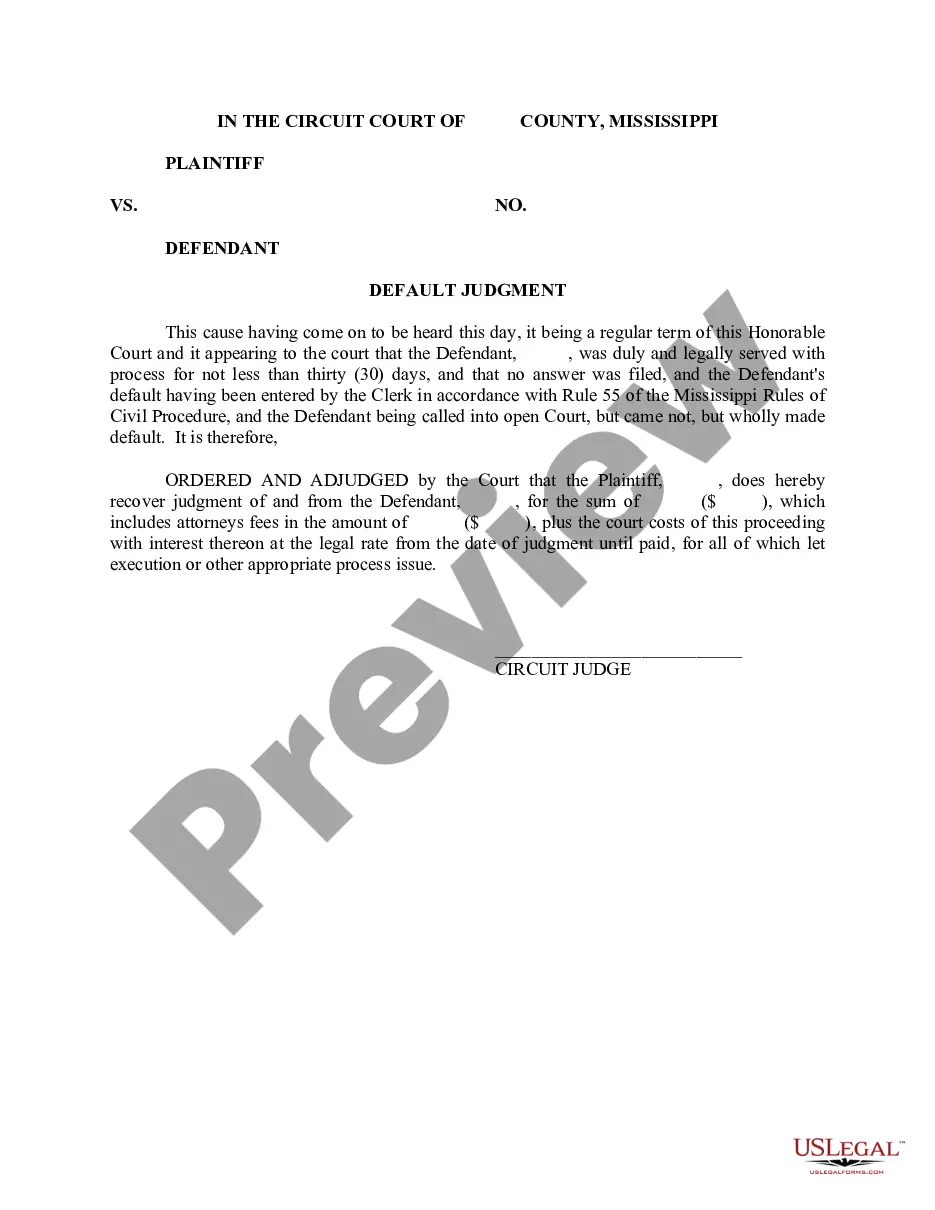
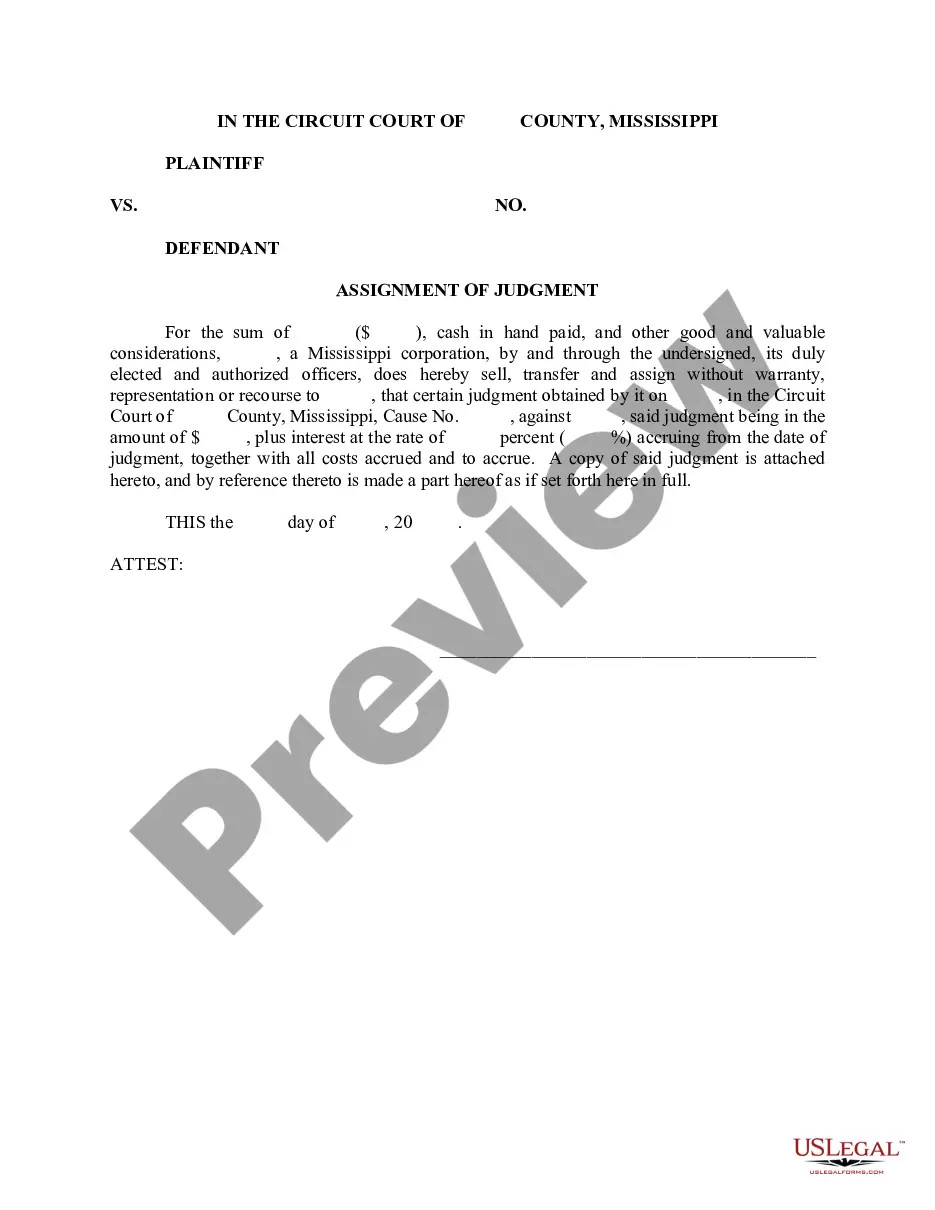
The Judgment by Default is a legal document specifically designed for use in Mississippi. It is issued when one party fails to respond to the opposing party's legal pleadings, allowing the filing party to seek a default judgment in their favor. This form is essential as it streamlines the process of pursuing a judgment when the other party does not participate in the legal proceedings, distinguishing it from other judgment forms which may require more involvement from both parties.
Key components of this form
- Identification of the parties involved in the case.
- The case number related to the legal proceedings.
- Statement confirming that the opposing party failed to respond.
- Details describing the nature of the claim.
- Signature of the filing party or their representative.
- Date of filing the judgment request.
When to use this form
This form should be used in situations where a plaintiff has initiated a legal claim against a defendant, but the defendant has neglected to respond within the required time frame. Common scenarios include debt collection cases, breach of contract disputes, or other civil litigation where the defendant's non-response hinders the plaintiff from moving forward in seeking remedy through the court.
Who this form is for
- Individuals or businesses initiating a lawsuit in Mississippi.
- Parties who have not received a response from the defendant in a civil case.
- Legal representatives filing on behalf of a client for default judgment.
Steps to complete this form
- Identify the parties involved by providing their names and addresses.
- Enter the relevant case number and court information.
- Confirm the lack of response from the opposing party by including specific dates.
- Clearly describe the nature of the claim for which you are seeking judgment.
- Sign and date the form to validate your request.
Notarization requirements for this form
Notarization is generally not required for this form. However, certain states or situations might demand it. You can complete notarization online through US Legal Forms, powered by Notarize, using a verified video call available anytime.
Get your form ready online
Our built-in tools help you complete, sign, share, and store your documents in one place.
Make edits, fill in missing information, and update formatting in US Legal Forms—just like you would in MS Word.
Download a copy, print it, send it by email, or mail it via USPS—whatever works best for your next step.
Sign and collect signatures with our SignNow integration. Send to multiple recipients, set reminders, and more. Go Premium to unlock E-Sign.
If this form requires notarization, complete it online through a secure video call—no need to meet a notary in person or wait for an appointment.
We protect your documents and personal data by following strict security and privacy standards.

Make edits, fill in missing information, and update formatting in US Legal Forms—just like you would in MS Word.

Download a copy, print it, send it by email, or mail it via USPS—whatever works best for your next step.

Sign and collect signatures with our SignNow integration. Send to multiple recipients, set reminders, and more. Go Premium to unlock E-Sign.

If this form requires notarization, complete it online through a secure video call—no need to meet a notary in person or wait for an appointment.

We protect your documents and personal data by following strict security and privacy standards.
Common mistakes
- Failing to provide complete contact information for all parties.
- Omitting the case number or incorrectly citing it.
- Not including the specific timeline of the opposing party's non-response.
- Neglecting to sign and date the form before submission.
Benefits of completing this form online
- Quick and easy access to the form without needing to visit a physical location.
- Editable templates that ensure you can customize the information as needed.
- Reliable updates to the document to comply with changing Mississippi laws.
Quick recap
- A Judgment by Default is essential for obtaining a court ruling when one party does not respond.
- Understanding when and how to use this form can simplify legal proceedings.
- Be mindful of serving the other party and completing all sections accurately to avoid mistakes.
Looking for another form?

Form popularity
FAQ
If you do not think the default judgment was appropriately entered against you, you must file a motion with the court asking the judge to set aside (void or nullify) the judgment. If the judge grants your motion, the case starts back up again.
Default judgments happen when you don't respond to a lawsuit often from a debt collector and a judge resolves the case without hearing your side.Next up could be wage garnishment or a bank account levy, which allows a creditor to remove money from your bank accounts to repay the debt.
Renew the judgment Money judgments automatically expire (run out) after 10 years. To prevent this from happening, the creditor must file a request for renewal of the judgment with the court BEFORE the 10 years run out.
Once a default is entered, the defendant is no longer able to file a response or otherwise participate in the case. When the default is entered, you may also ask the court to enter a judgment in your favor.
If you do not think the default judgment was appropriately entered against you, you must file a motion with the court asking the judge to set aside (void or nullify) the judgment. If the judge grants your motion, the case starts back up again.
Typically, a court's rules governing enforcement of default judgments include procedures for wage garnishments, attachment of bank accounts and seizure of assets. The plaintiff can usually pursue more than one of these enforcement mechanisms simultaneously.
First, you can ask the court to set aside the default judgment and give you an opportunity to contest it. Next, you can settle the debt with the debt buyer for an amount less than what the default judgment is for. And finally you can eliminate the default judgment completely by filing for bankruptcy.
A default judgment is a ruling granted by a court or judge.For example, when a defendant is summoned to appear before the court in a case brought by a plaintiff, but fails to respond to the court's legal order, the judge can rule for default judgment and thereby decide the case in the plaintiff's favor.