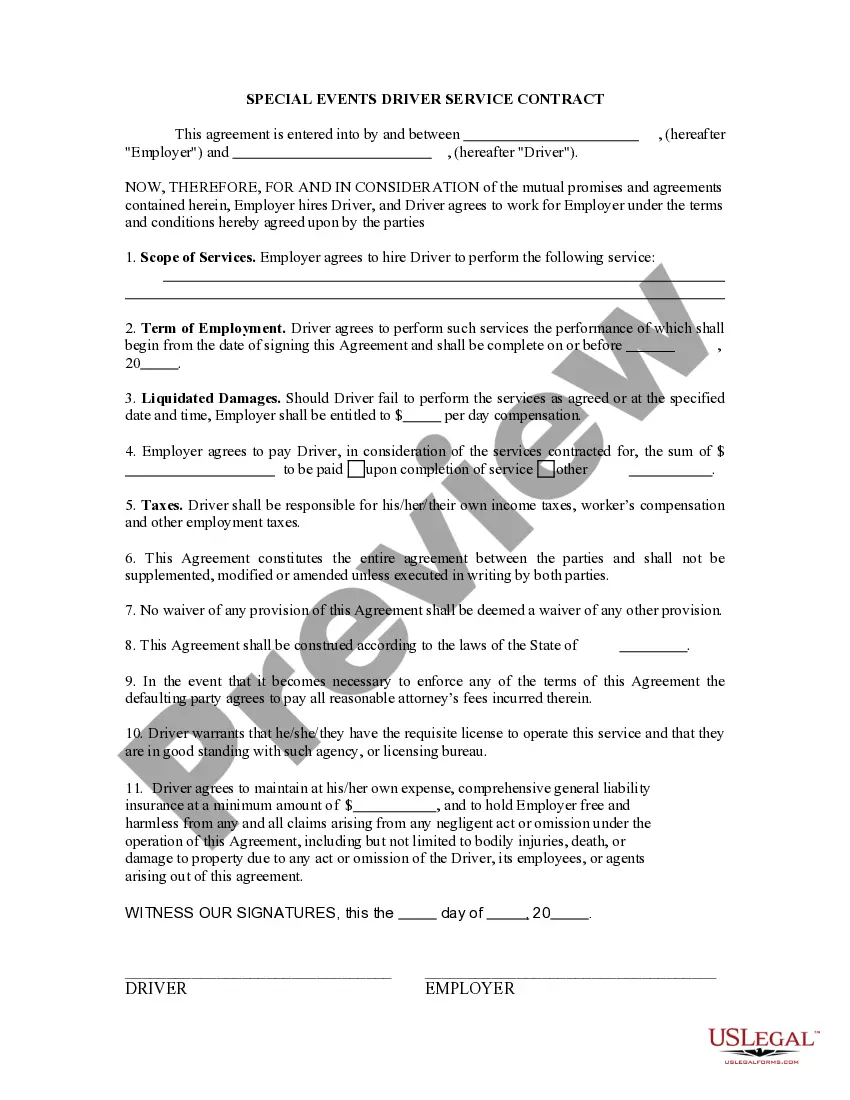
Self-Employed Special Events Driver Services Contract
Overview of this form
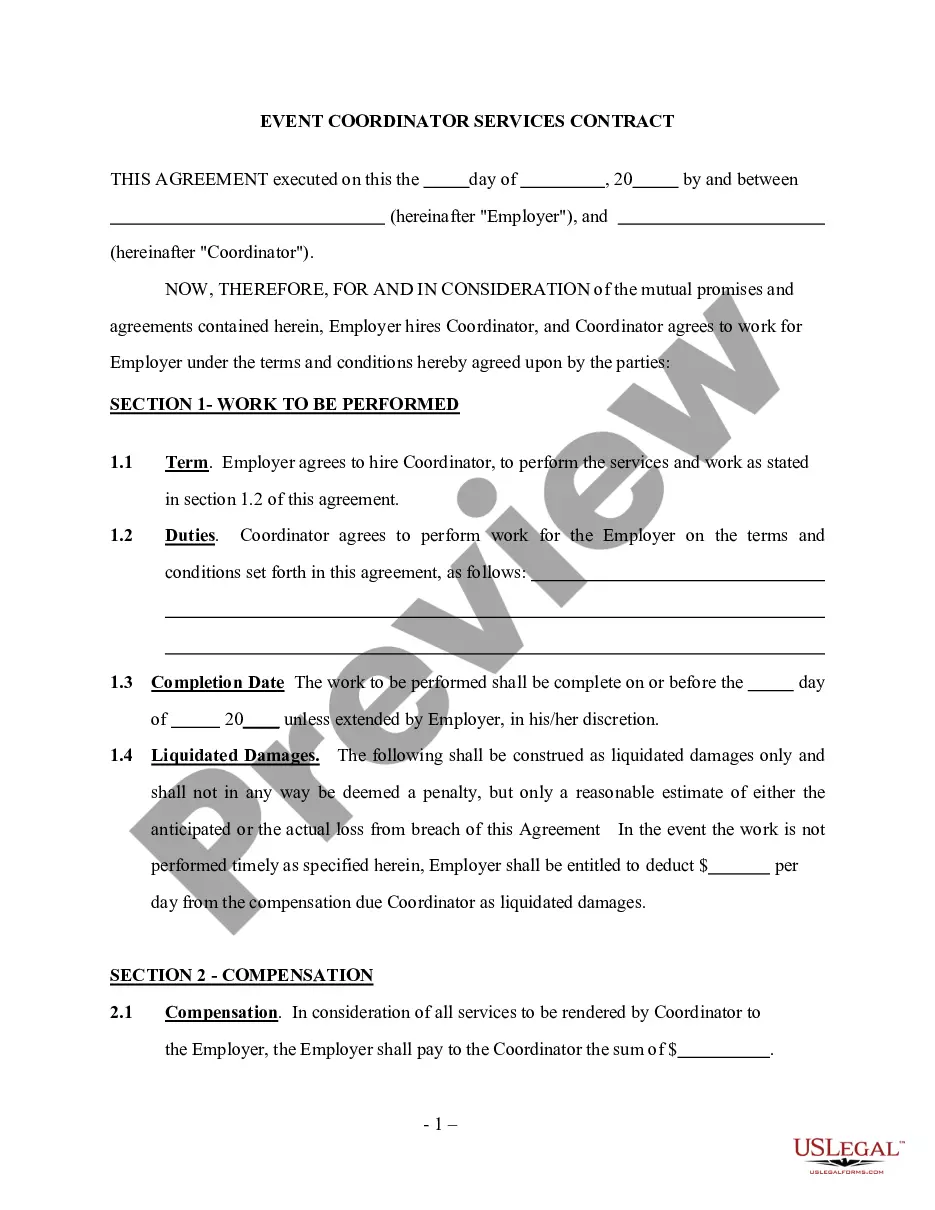
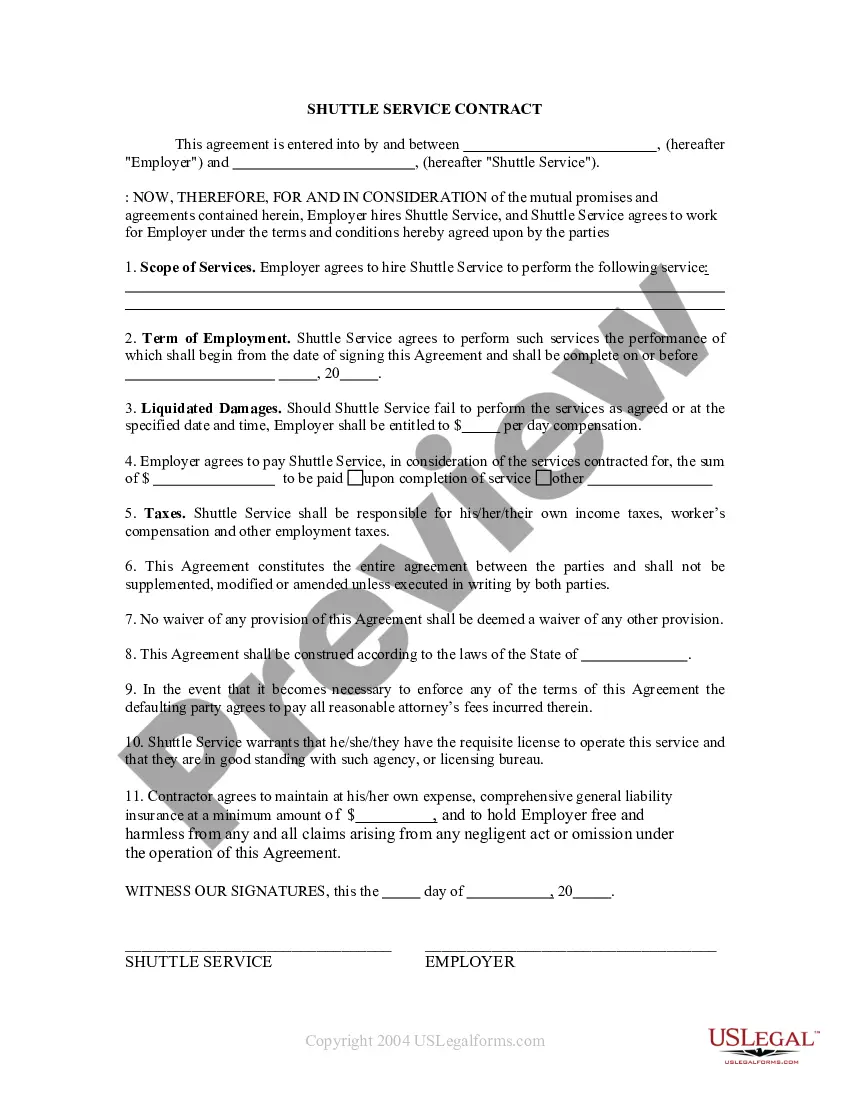
The Self-Employed Special Events Driver Services Contract is a legal agreement between a company or event coordinator and an independent contractor hired to provide transportation services during an event. This contract clearly outlines the responsibilities of the driver and the terms of the engagement, setting it apart from other service contracts by specifically addressing the unique needs of special events and the nature of independent contractor relationships.
Key parts of this document
Scope of Services: Details the specific transportation services the driver will provide during the event.
Entire Agreement Clause: States that the written contract forms the complete understanding between the parties.
No Waiver Clause: Clarifies that not enforcing a provision does not mean that party waives future enforcement.
Signatures: Area for both parties to sign, indicating their agreement to the terms.
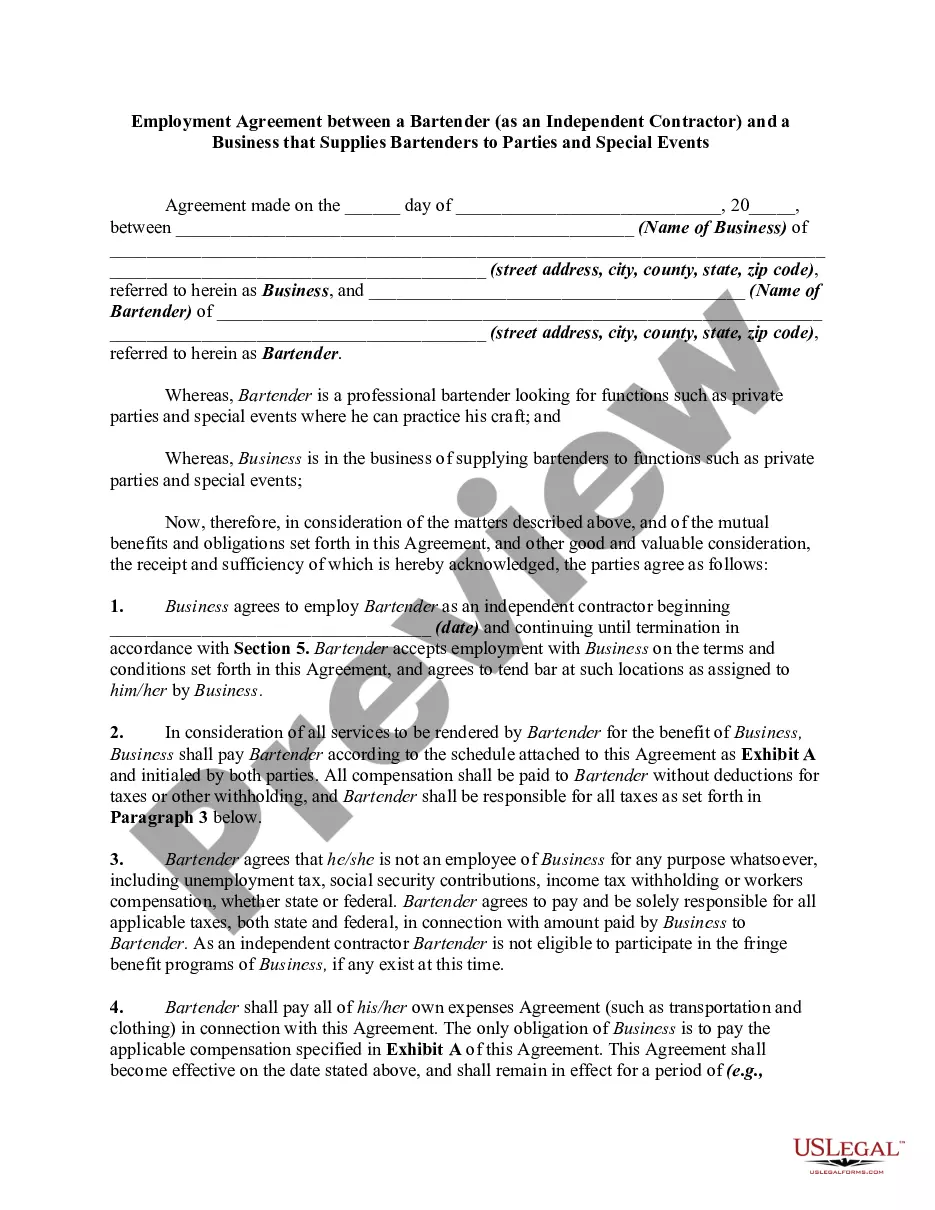
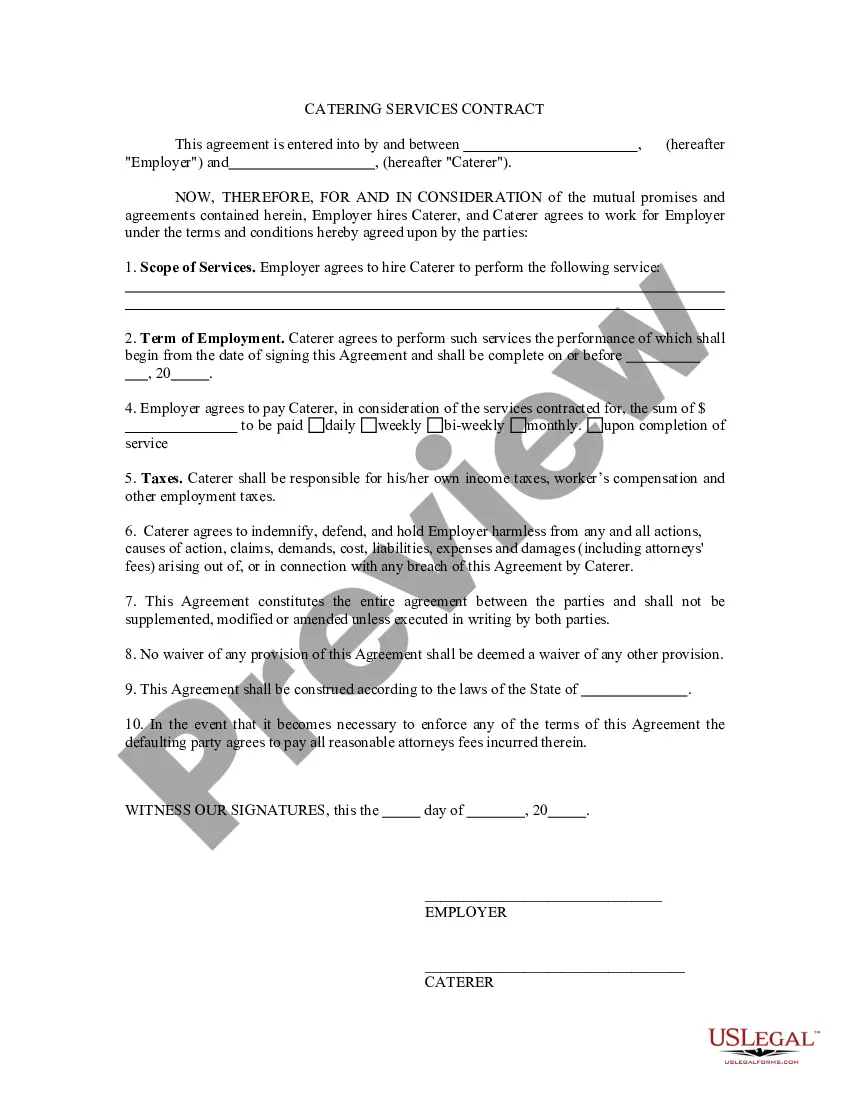
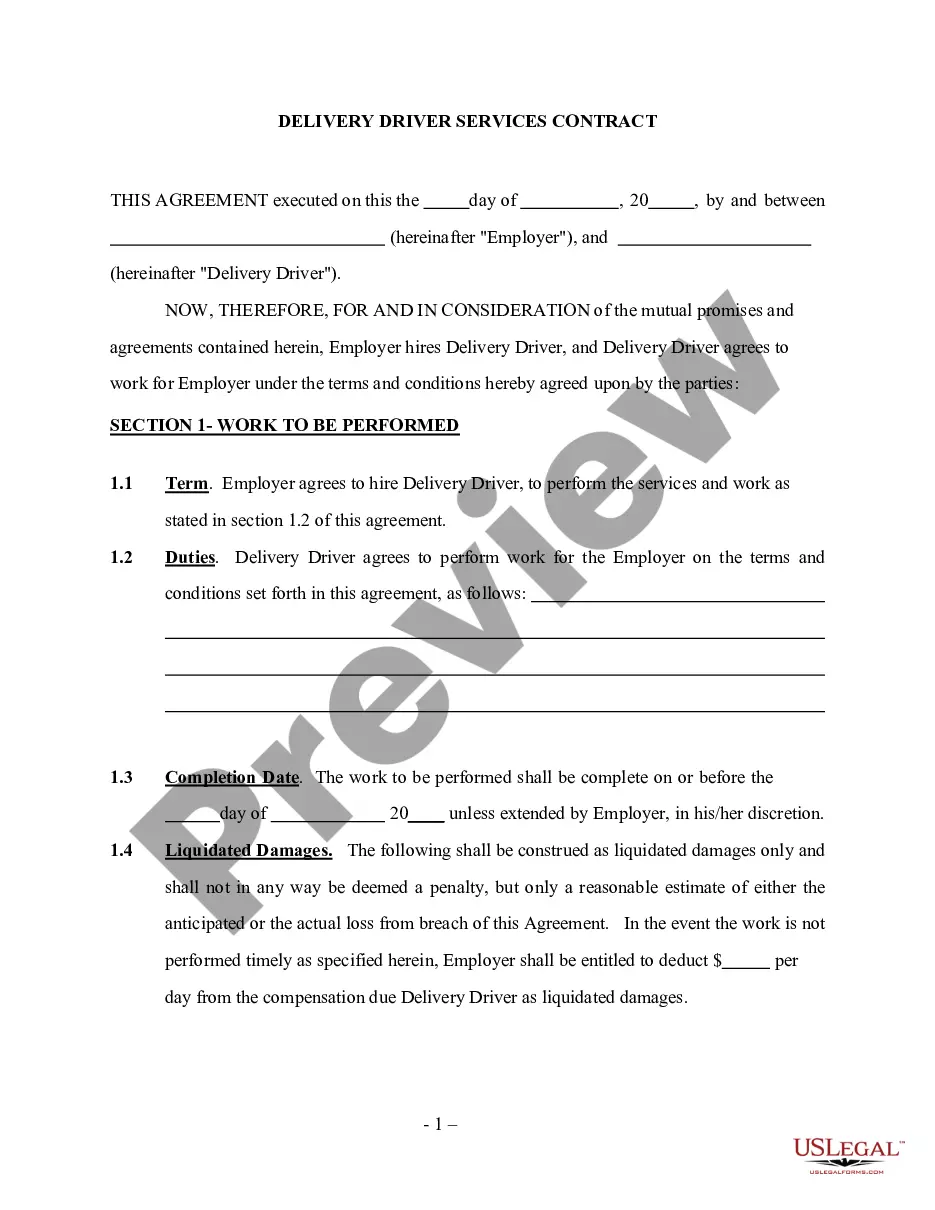
Common use cases
You should use the Self-Employed Special Events Driver Services Contract when you are an event coordinator or company hiring drivers to transport individuals during a special event. This is particularly essential for sports events, concerts, festivals, or any situation where organized transportation for a group is required, ensuring that all terms are clear to avoid potential disputes.
Intended users of this form
Event coordinators looking to hire independent contractors for driver services.
Companies hosting special events needing on-site transportation for guests, employees, or participants.
Independent contractors providing transportation services at events.
Completing this form step by step
Identify the parties: Enter the names and contact information for the employer and driver.
Specify the services: Clearly outline the transportation services the driver will provide during the event.
Enter dates: Indicate the date(s) of the event and the duration the driver will be required.
Detail payment terms: Specify the payment amount and method agreed upon by both parties.
Sign the contract: Ensure that both parties review the terms and sign the contract to make it legally binding.
Is notarization required?
Notarization is generally not required for this form. However, certain states or situations might demand it. You can complete notarization online through US Legal Forms, powered by Notarize, using a verified video call available anytime.
Get your form ready online
Our built-in tools help you complete, sign, share, and store your documents in one place.
Make edits, fill in missing information, and update formatting in US Legal Forms—just like you would in MS Word.
Download a copy, print it, send it by email, or mail it via USPS—whatever works best for your next step.
Sign and collect signatures with our SignNow integration. Send to multiple recipients, set reminders, and more. Go Premium to unlock E-Sign.
If this form requires notarization, complete it online through a secure video call—no need to meet a notary in person or wait for an appointment.
We protect your documents and personal data by following strict security and privacy standards.

Make edits, fill in missing information, and update formatting in US Legal Forms—just like you would in MS Word.

Download a copy, print it, send it by email, or mail it via USPS—whatever works best for your next step.

Sign and collect signatures with our SignNow integration. Send to multiple recipients, set reminders, and more. Go Premium to unlock E-Sign.

If this form requires notarization, complete it online through a secure video call—no need to meet a notary in person or wait for an appointment.

We protect your documents and personal data by following strict security and privacy standards.
Mistakes to watch out for
Failing to specify the scope of services, leading to misunderstandings about responsibilities.
Not including payment terms, which can result in disputes over compensation.
Neglecting to obtain signatures from both parties, making the agreement unenforceable.
Benefits of using this form online
Convenient download: Access the form anytime and anywhere, allowing for quick setup.
Editability: Easily customize the contract to fit specific event needs without starting from scratch.
Reliability: The forms are drafted by licensed attorneys, ensuring they meet legal standards.
Legal use & context
- The contract serves as a legally binding agreement stipulating the terms of the engagement between the event organizer and the driver.
- It provides protection for both parties, establishing clear expectations and recourse in case of disputes.
- Ensure that the form complies with local laws to maintain its enforceability.
Key takeaways
- The Self-Employed Special Events Driver Services Contract is essential for defining the terms of service for hired drivers during events.
- Proper completion of the form is crucial to avoid legal disputes between the parties involved.
- This form is adaptable for use in various states, with attention needed for local legal requirements.
Looking for another form?


Form popularity
FAQ
An independent delivery driver contract is between a company seeking to hire an individual to deliver goods to customers. The most common types are short to medium distance drivers for delivering goods for companies such as Amazon or for food-related businesses.
Since delivery drivers, for the most part, have to operate within the limits of company policies, time constraints, and usually only work for one company they should not be classified as independent contractors.
Independent contractors pay their own Social Security and Medicare taxes and do not receive employee benefits.Truck drivers are often owner-operators of their own freelance business and are therefore considered independent contractors.
A 1099 employee is one person or an entire company that you hire to do a specific job for you.In trucking, your 1099 employee would be an owner-operator or an independent contractor. A 1099 employee is not a company driver, so that means you don't provide benefits for them (say, such as health insurance).
Truck drivers' employment status is classified based on a variety of factors. Generally speaking, companies can only classify truck drivers as independent contractors if the truckers have control over how and when they perform their duties.
Independent contractor truck drivers are freelance owner-operators of their own commercial truck. In this role, you can choose which assignments to accept, set your own hours, and negotiate payment and contract conditions.
As a contract driver, your primary responsibilities are to drive a vehicle to transport materials or items on a contract basis. Your duties vary depending on the details of each contract.
A delivery contract, or delivery order contract, is an agreement that provides for delivery orders of property. It usually doesn't specify an exact quantity, outside of a minimum or maximum amount. These types of agreements can be used for varying purposes.