Mississippi Summary Judgment Motion
Overview of this form
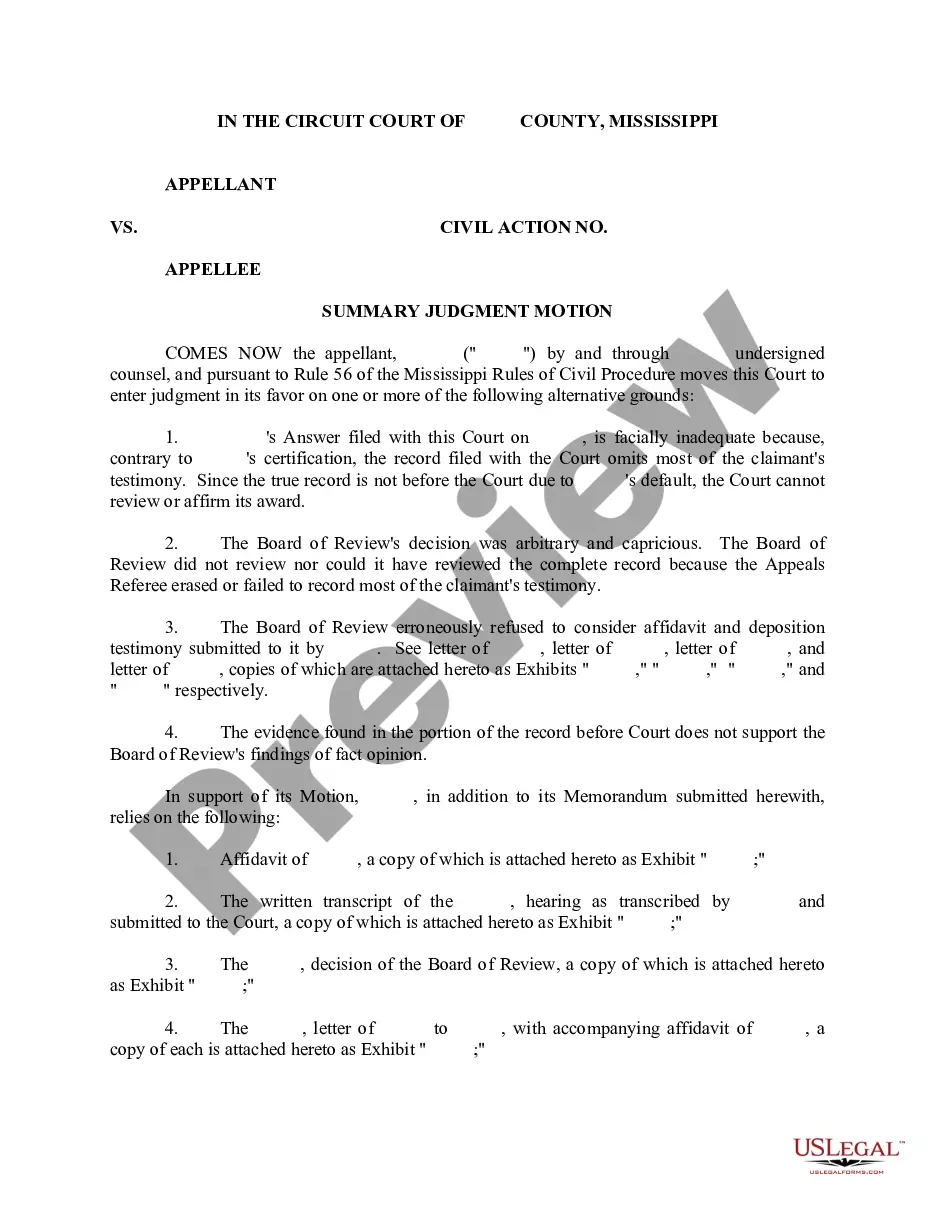
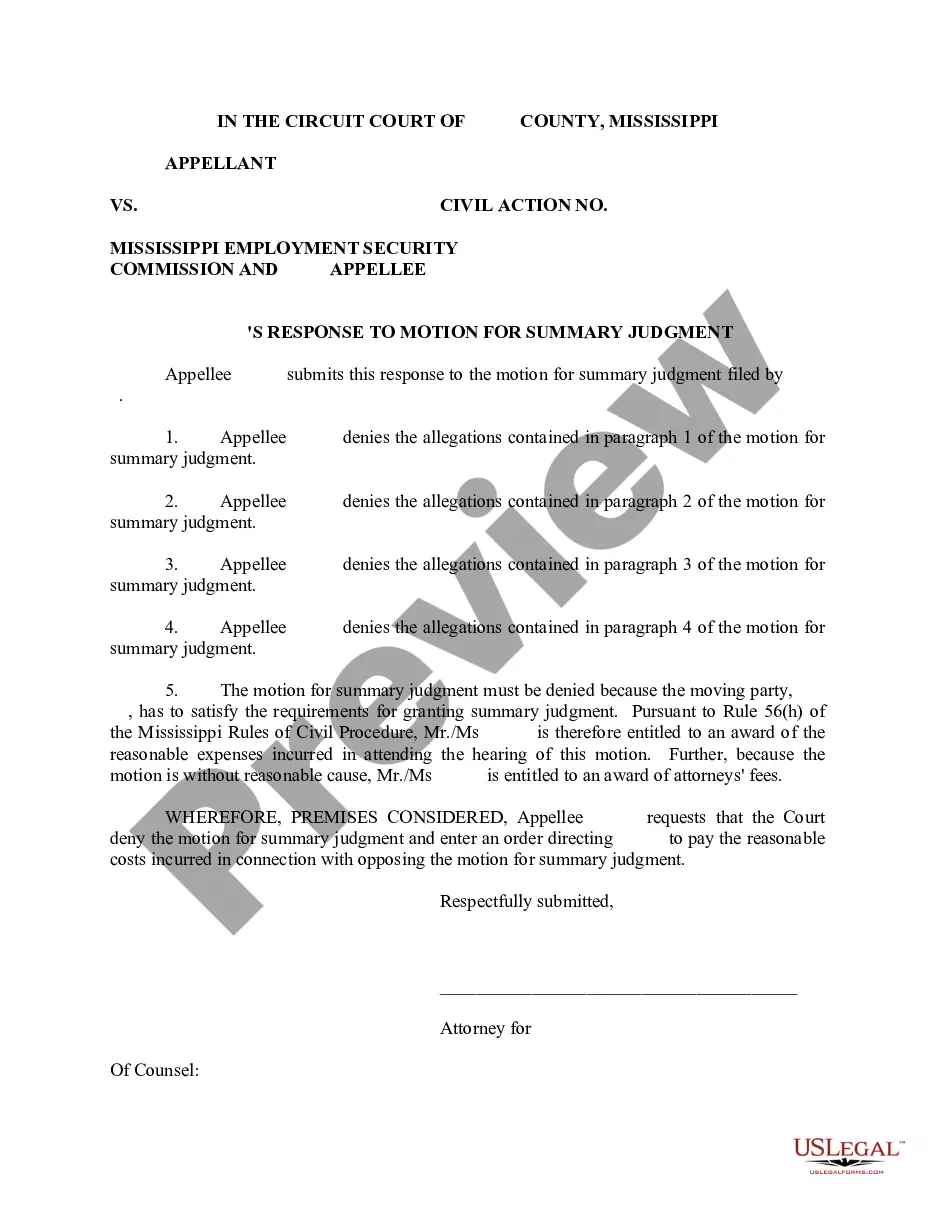
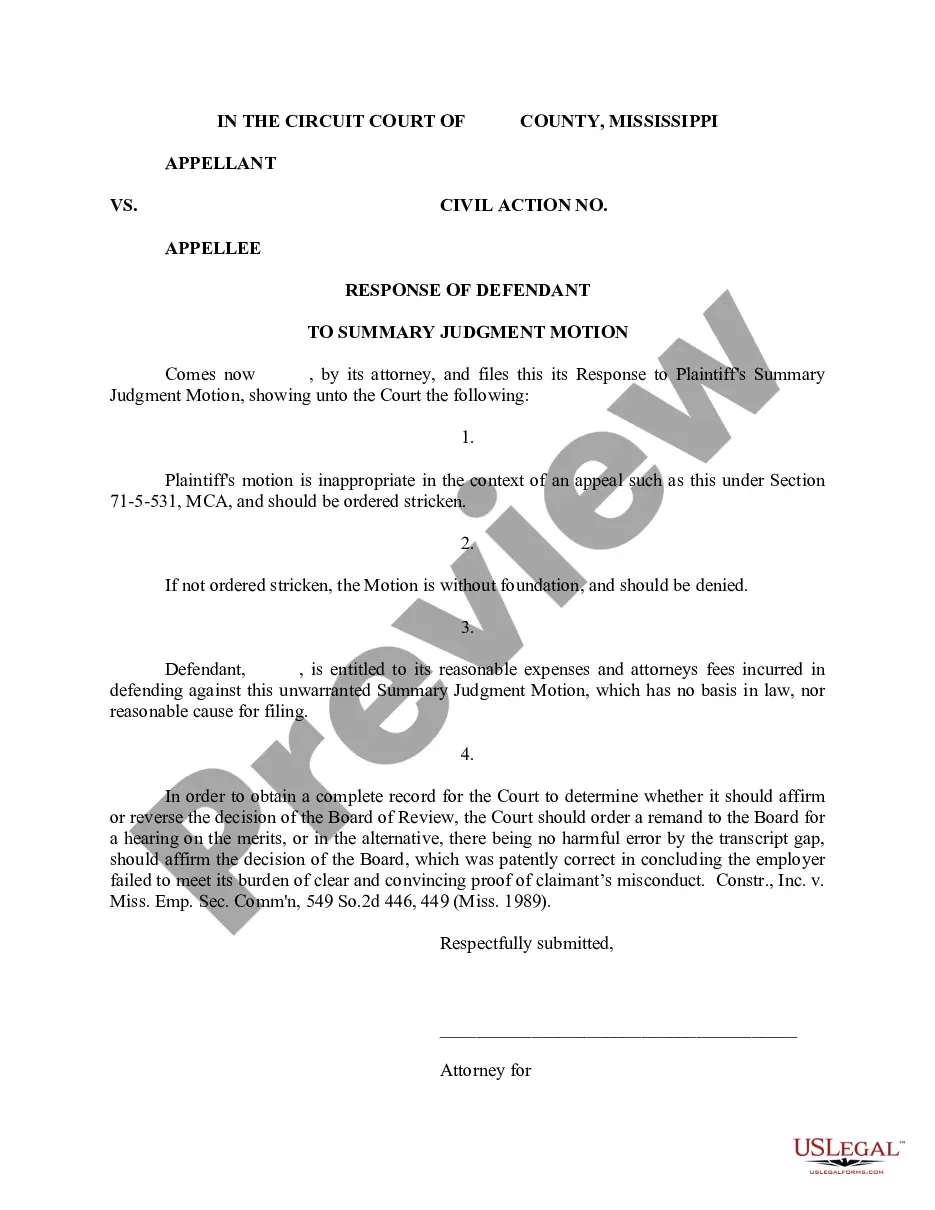
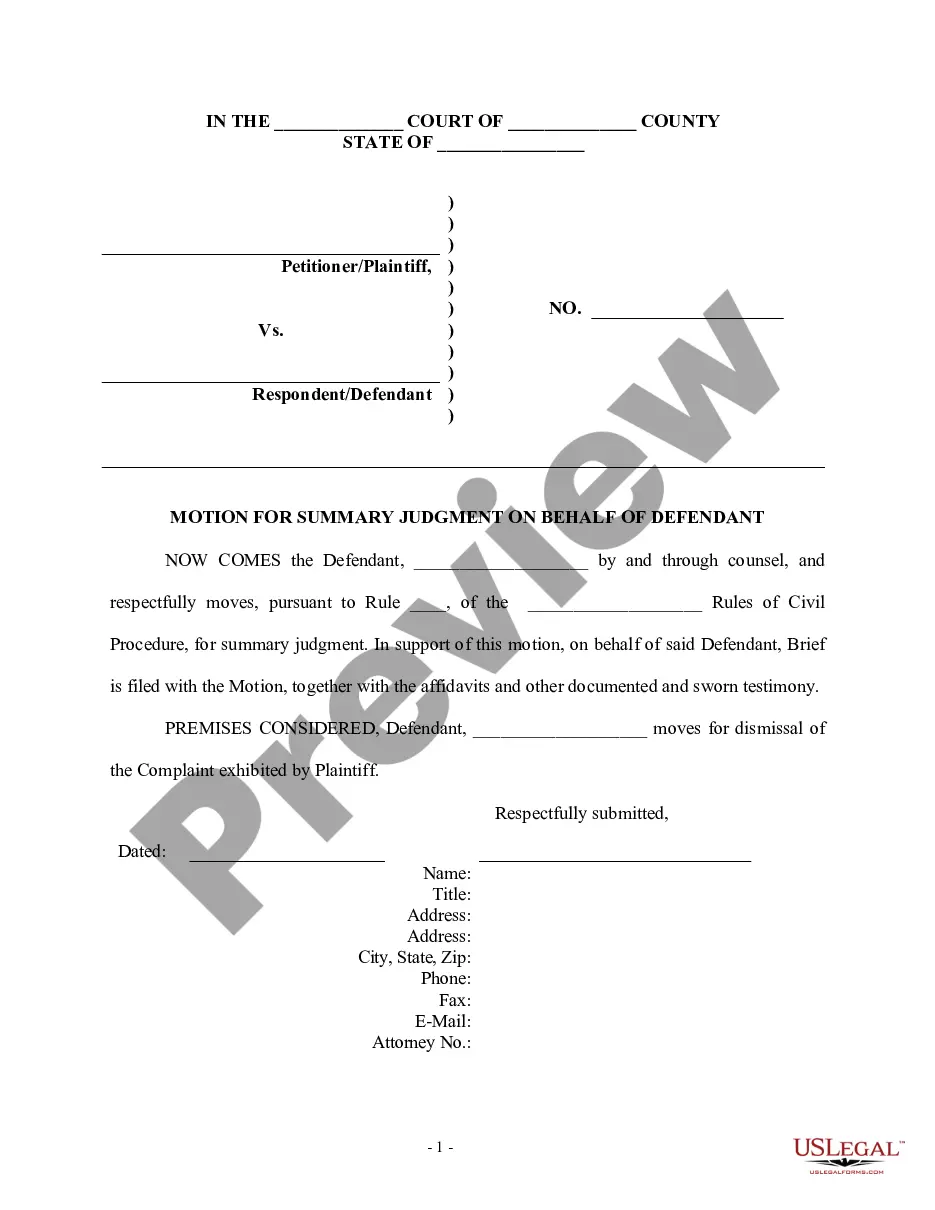
A Summary Judgment Motion is a formal request made to a court, asking it to rule in favor of one party based on the evidence presented, without going to trial. This document is critical in streamlining court proceedings by resolving cases where there are no genuine disputes regarding material facts. Unlike other motions, such as a motion to dismiss, a Summary Judgment Motion specifically seeks a judgment based on the merits of the case.
Key components of this form
- Caption with court information: Includes the names of the parties and the court where the motion is filed.
- Statement of facts: A clear outline of the facts that support the motion for summary judgment.
- Legal standards: A section that outlines the legal basis for granting summary judgment under applicable law.
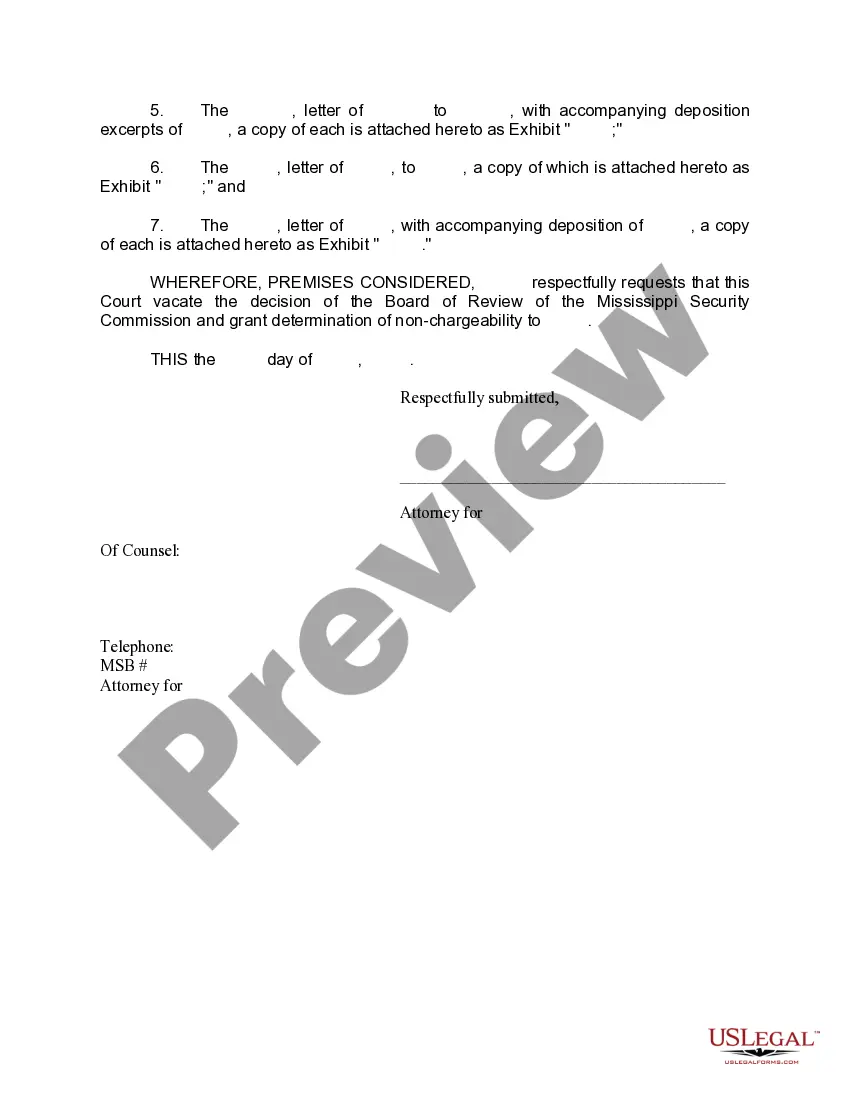
- Argument section: Detailed reasoning and evidence supporting the request for judgment.
- Conclusion: A summary requesting the court to grant the motion and issue a summary judgment.
When to use this document
Use a Summary Judgment Motion when you believe there is sufficient evidence to support your case, and no factual disputes exist that require a trial. This form is commonly used in civil disputes where one party seeks to have the court decide the issue based on the law and undisputed facts, such as contract disputes, negligence cases, or other civil lawsuits.
Who can use this document
- Individuals involved in civil litigation who wish to expedite court proceedings.
- Legal professionals representing clients in cases where a summary judgment may be appropriate.
- Parties who have clear evidence to support their claim or defense and want to avoid the cost and time of a trial.
Instructions for completing this form
- Identify the parties involved in the case and the applicable court.
- Prepare a statement of facts that accurately outlines the relevant facts of your case.
- Cite the legal standards that apply to your motion for summary judgment, referencing relevant laws or case precedents.
- Craft a clear argument section, providing compelling reasons and supporting evidence for your request.
- Conclude with a request for the court to grant the motion and issue a ruling in your favor.
Does this form need to be notarized?
This form does not typically require notarization unless specified by local law. It is important to check local regulations to confirm whether a notary is needed for your motion.
Get your form ready online
Our built-in tools help you complete, sign, share, and store your documents in one place.
Make edits, fill in missing information, and update formatting in US Legal Forms—just like you would in MS Word.
Download a copy, print it, send it by email, or mail it via USPS—whatever works best for your next step.
Sign and collect signatures with our SignNow integration. Send to multiple recipients, set reminders, and more. Go Premium to unlock E-Sign.
If this form requires notarization, complete it online through a secure video call—no need to meet a notary in person or wait for an appointment.
We protect your documents and personal data by following strict security and privacy standards.

Make edits, fill in missing information, and update formatting in US Legal Forms—just like you would in MS Word.

Download a copy, print it, send it by email, or mail it via USPS—whatever works best for your next step.

Sign and collect signatures with our SignNow integration. Send to multiple recipients, set reminders, and more. Go Premium to unlock E-Sign.

If this form requires notarization, complete it online through a secure video call—no need to meet a notary in person or wait for an appointment.

We protect your documents and personal data by following strict security and privacy standards.
Common mistakes
- Including disputed facts that can undermine the motion.
- Failing to provide adequate supporting evidence for the legal arguments presented.
- Neglecting to follow the specific formatting requirements of the court.
Benefits of completing this form online
- Convenient access to legal forms that are ready to download and fill out.
- Editable templates that allow customization based on individual circumstances.
- Reliable resources drafted by licensed attorneys to ensure compliance with legal standards.
Quick recap
- A Summary Judgment Motion is used to request a ruling without a trial when there are no significant factual disputes.
- Properly drafted motions can expedite legal proceedings and resolve disputes efficiently.
- Ensure compliance with state-specific requirements to avoid pitfalls during submission.
Looking for another form?



Form popularity
FAQ
A motion is a way to ask the court for certain action. The party will move the court for an order or other action. This subchapter concerns usual pretrial motions, such as motions to dismiss and motions for summary judgment, but will not deal with discovery motions.
Motions filed, the percent of cases with motions granted in whole or in part, and the percent of cases terminated by summary judgment. The percentage of cases with summary judgment motions, averaged across the six courts in the study, has increased from approximately 12% in 1975, to 17% in 1985, to 19% in 1988.
What happens during a motion for summary judgment hearing? Once the motion and response has been filed, the judge will read both and then preside over a hearing. At the hearing, each party will be given a certain amount of time to reiterate their argument in front of the judge.
A summary judgment motion is usually the last thing a plaintiff and their legal team ever want to see.If you win the summary judgment, then you get to do exactly what you were trying to do before the motion was ever filed, which is progress your client's case towards litigation with a chance of settlement.
If the motion is granted, the judgment on the issue or case is deemed to be a final judgment from which a party may seek an appeal. The court of appeal can reverse the grant of summary judgment and reinstate the claim in the lower court. However, this is rarely done and most summary judgments are upheld on appeal.
When a motion for summary judgment is denied, the nonmoving party achieves a form of premium that enables a case to settle for an additional amount. Put simply, the settlement value of a case increases when a motion for summary judgment is denied.
The grant of summary judgment usually results in a final judgment only if the grant resolves all issues as to all parties. An order for summary judgment is interlocutory if it does not entirely end the proceedings before the trial court.
Unless the requirements of Code of Civil Procedure 437c, subdivision (f)(2), are met a party may not file a second summary judgment motion.
Check a judge's standing orders before filing. Although Rule 56 does not prohibit successive summary judgment motions,15 some judges limit a party to a single summary judgment motion.