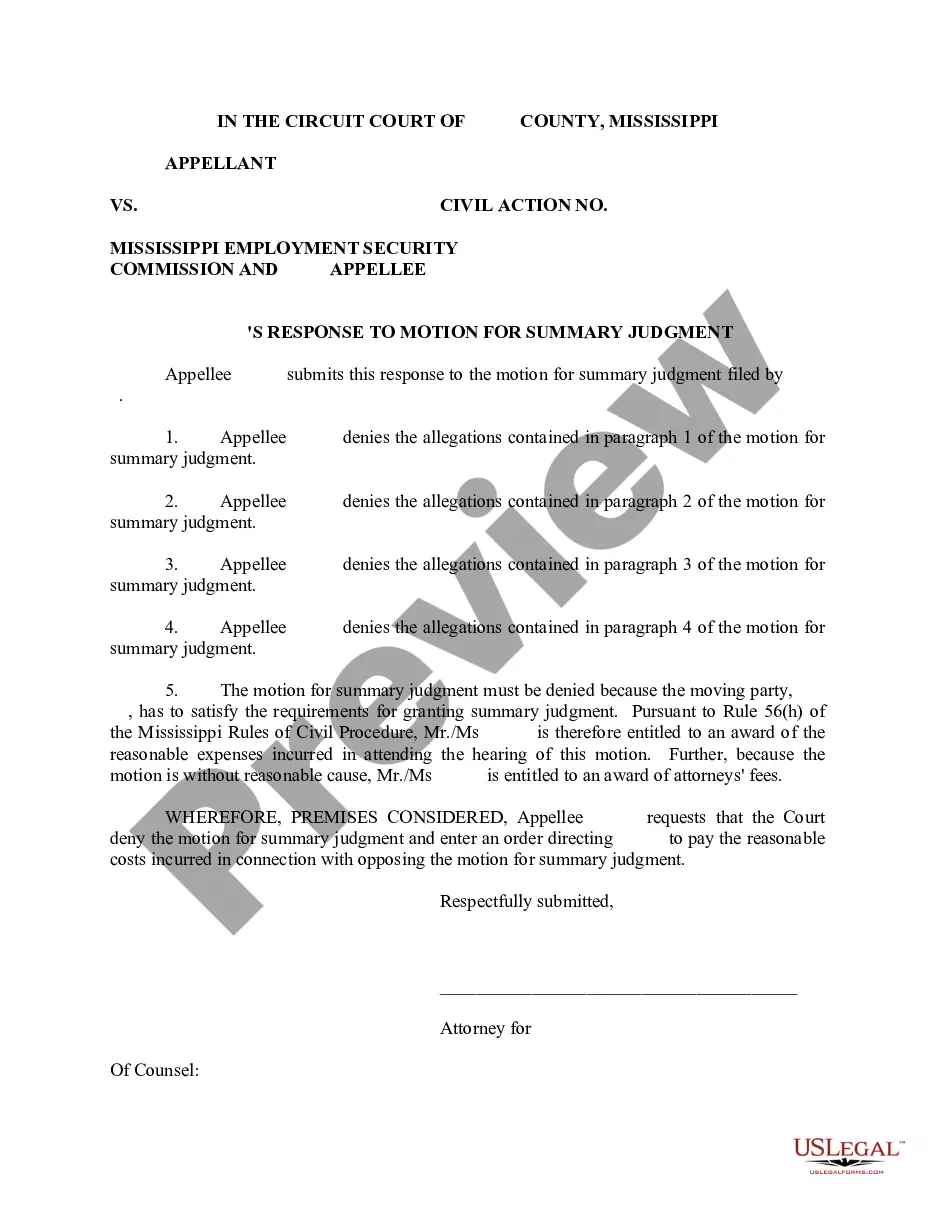
Mississippi Appellee's Response to Motion for Summary Judgment
What this document covers
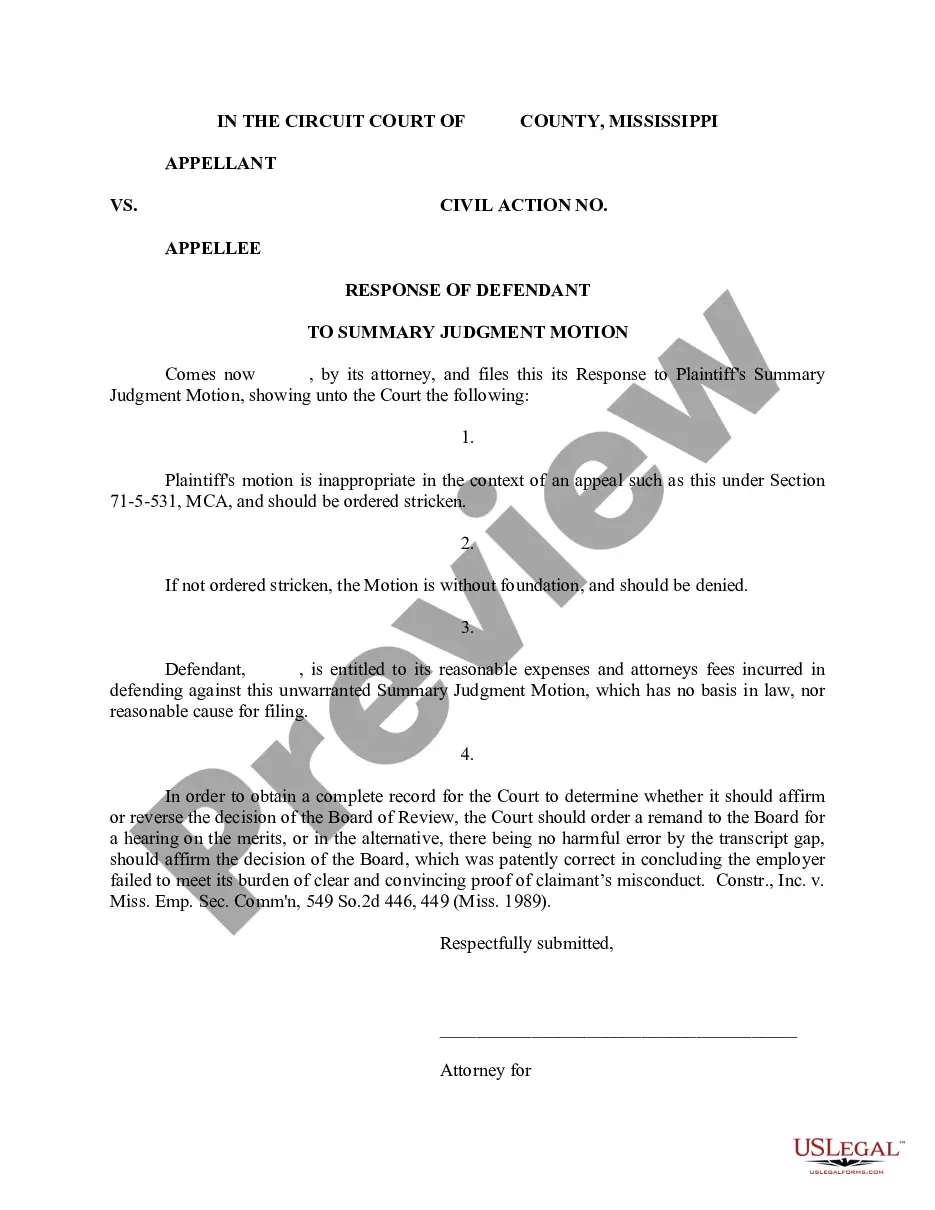
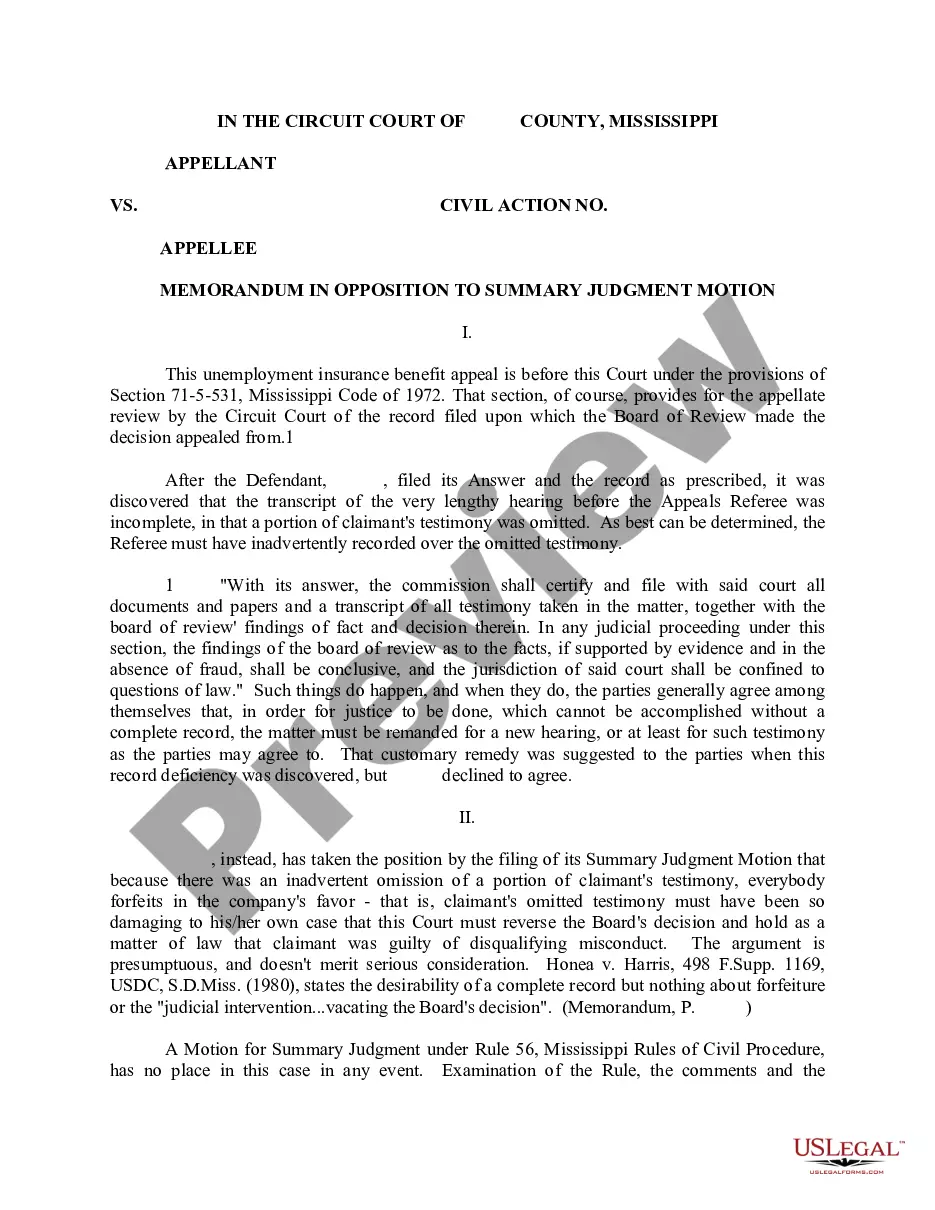
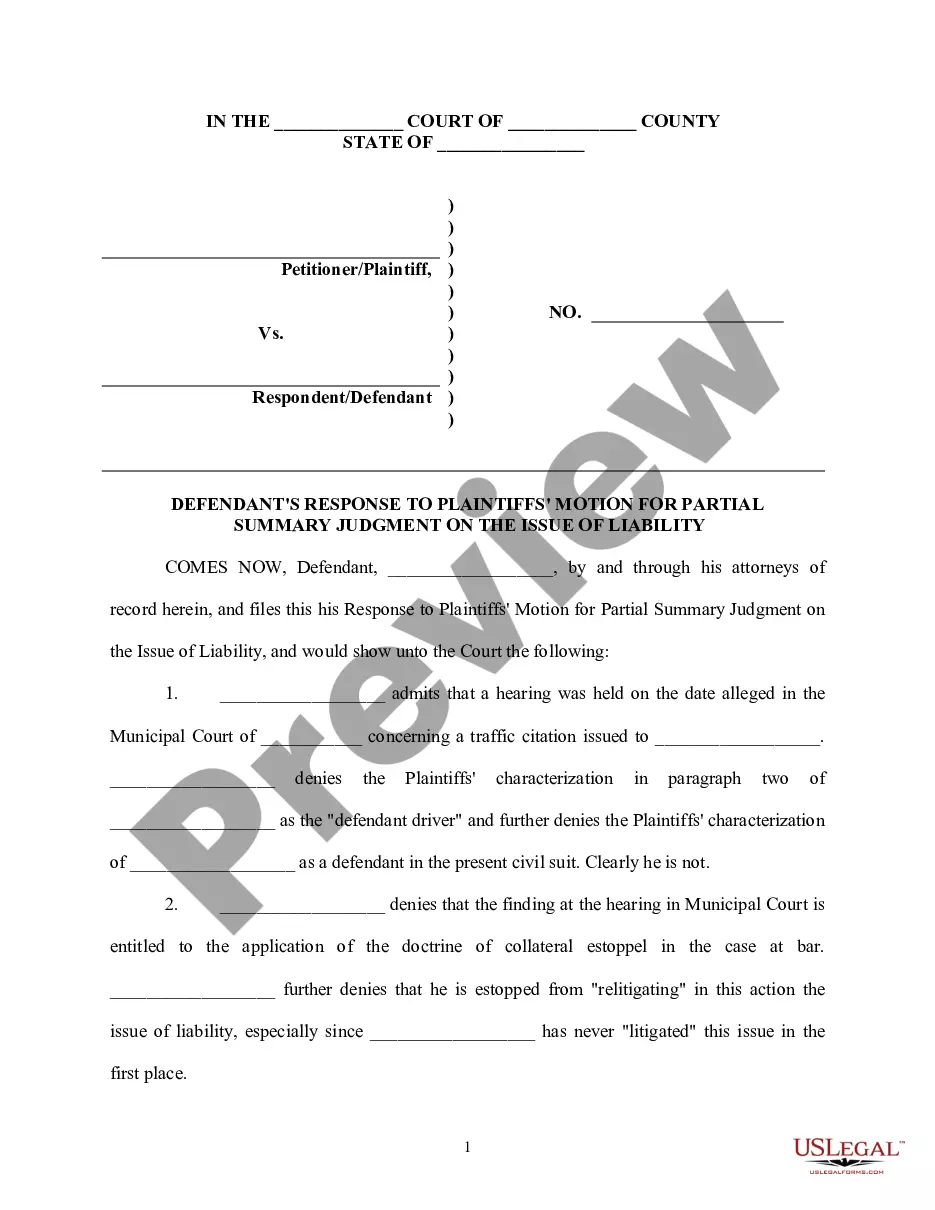
This Appellee's Response to Motion for Summary Judgment is a legal form used to respond to a motion filed by the appellant seeking a summary judgment. This response allows the appellee to present arguments and evidence as to why the motion should be denied. Unlike other legal forms, this document is specifically tailored for appellate proceedings, offering a structured way to contest the claims made in the motion.
Key components of this form
- Identification of the parties involved in the case.
- Statement addressing the appellant's motion for summary judgment.
- Legal arguments and statutes supporting the response.
- Evidence and documents referenced in the response.
- Signature and date lines for formal submission.

Common use cases
This form should be used when you are the appellee and have received a motion for summary judgment from the appellant. It is essential to respond within the specified timeframe, typically set by the court, to ensure your position is formally recognized and considered during the appellate process. Additionally, this form can be used when you need to counter the arguments presented in the motion and present your own evidence and legal justification for denying the summary judgment.
Who needs this form
- Individuals or entities named as appellees in an appellate case.
- Legal representatives responding to a motion for summary judgment on behalf of their clients.
- Parties looking to structure their legal arguments comprehensively and clearly when contesting an appellant's claims.
Completing this form step by step
- Identify the parties and provide their legal names at the beginning of the document.
- Clearly state your response to the appellant's motion, addressing each point raised.
- Cite relevant laws and precedents that support your argument against the motion.
- Attach evidence or documentation that corroborates your position.
- Sign and date the form, ensuring all required fields are filled out completely.
Notarization guidance
This form usually doesn’t need to be notarized. However, local laws or specific transactions may require it. Our online notarization service, powered by Notarize, lets you complete it remotely through a secure video session, available 24/7.
Get your form ready online
Our built-in tools help you complete, sign, share, and store your documents in one place.
Make edits, fill in missing information, and update formatting in US Legal Forms—just like you would in MS Word.
Download a copy, print it, send it by email, or mail it via USPS—whatever works best for your next step.
Sign and collect signatures with our SignNow integration. Send to multiple recipients, set reminders, and more. Go Premium to unlock E-Sign.
If this form requires notarization, complete it online through a secure video call—no need to meet a notary in person or wait for an appointment.
We protect your documents and personal data by following strict security and privacy standards.

Make edits, fill in missing information, and update formatting in US Legal Forms—just like you would in MS Word.

Download a copy, print it, send it by email, or mail it via USPS—whatever works best for your next step.

Sign and collect signatures with our SignNow integration. Send to multiple recipients, set reminders, and more. Go Premium to unlock E-Sign.

If this form requires notarization, complete it online through a secure video call—no need to meet a notary in person or wait for an appointment.

We protect your documents and personal data by following strict security and privacy standards.
Avoid these common issues
- Failing to respond within the court's deadline.
- Not clearly addressing all points raised in the appellant's motion.
- Neglecting to provide substantiating evidence or legal authority.
- Omitting to sign and date the response form.
Advantages of online completion
- Convenience of downloading and filling out the form at your own pace.
- Editable format allowing you to tailor responses to fit specific legal circumstances.
- Access to forms drafted by licensed attorneys, ensuring legal compliance.
Looking for another form?
Form popularity
FAQ
Ordinarily, a party cannot appeal a denial of summary judgment after trial has taken place, unless the arguments were renewed in a motion for judgment as a matter of law under Federal Rule of Civil Procedure 50.Denials of summary judgment generally cannot be appealed after a full trial on the merits.
An order granting summary judgment determines the parties' rights, but it is not appealable.
Attack the Legal Argument. The first place to look for a weakness in your opponent's motion is at their legal argument. Attack the Evidence. Attack the Separate Statement. Consider Whether Your Opponent's Motion Meets its Burden. Consider Seeking a Continuance to Conduct More Discovery. Conclusion.
The moving party has the initial burden to show that summary judgment is proper even if the moving party would not have the BURDEN OF PROOF at trial. The court generally examines the evidence presented with the motion in the light most favorable to the opposing party.
Judgment on the pleadings is a motion made after pleading and before discovery; summary judgment happens after discovery and before trial; JMOL occurs during trial.Timing is very important in making a motion for JMOL; the motion can be made only after the opposing party has presented its case.
Ordinarily, a party cannot appeal a denial of summary judgment after trial has taken place, unless the arguments were renewed in a motion for judgment as a matter of law under Federal Rule of Civil Procedure 50.Denials of summary judgment generally cannot be appealed after a full trial on the merits.
19, 2008) (motions to dismiss or for summary judgment are not responsive pleadings, and therefore do not cut off a plaintiff's right to amend his pleadings once at any time).
If the motion is granted, the judgment on the issue or case is deemed to be a final judgment from which a party may seek an appeal. The court of appeal can reverse the grant of summary judgment and reinstate the claim in the lower court. However, this is rarely done and most summary judgments are upheld on appeal.
Under Rules 8.104 and 8.108, three possible deadlines govern the filing of a notice of appeal: (1) 60 days from service of either the judgment or appealable order; (2) 30 days from the denial of a timely-filed post-trial motion; or, (3) if neither of the first two applies, then 180 days after entry of judgment or