Release regarding Fencing Training
Understanding this form
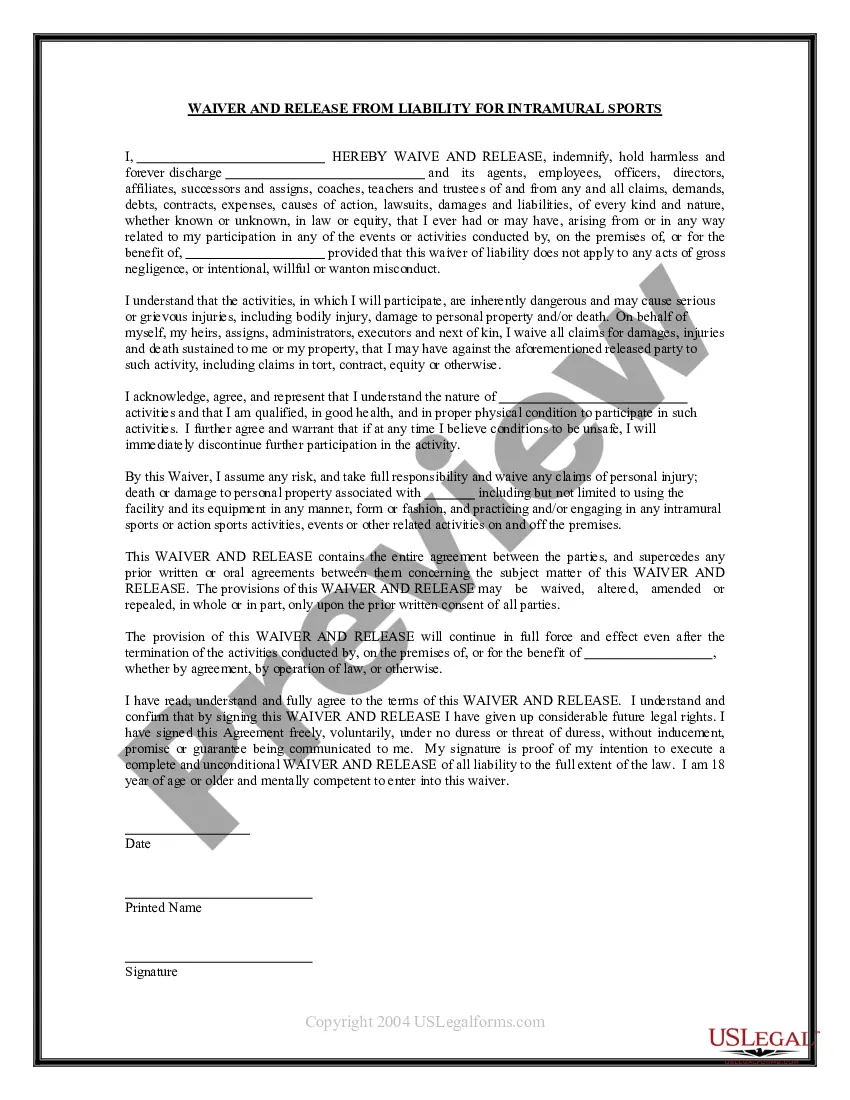
The Release regarding Fencing Training is a legal document that allows individuals to participate in fencing activities while acknowledging the inherent risks involved. By signing this form, participants voluntarily assume responsibility for their actions and agree not to hold the organizing entity liable for any potential injuries or damages that may occur during these activities. This release serves as a crucial safeguard for both the participant and the organizers, distinguishing it from other participation waivers by its specific focus on the sport of fencing.
Key components of this form
- Identification of the participant and the fencing activities
- A release of liability clause for the organizing entity and its representatives
- A statement acknowledging the risks associated with fencing
- Certification of the participant's health and fitness to engage in fencing
- Signature of the participant, with a requirement for a parent or guardian if under 18




When to use this document
This form should be used when an individual intends to participate in fencing training or activities, especially in an organized setting such as a club or school. It is essential for protecting both the participant and the organizers from legal claims arising from injuries or accidents that may occur during practice or competitions.
Who should use this form
- Individuals planning to participate in fencing training or activities
- Organizers and coaches of fencing clubs and programs
- Parents or guardians of participants under the age of 18
Completing this form step by step
- Enter the participant's name and the name of the college or organization sponsoring the fencing activities.
- Specify the location (campus) where the fencing training will take place.
- Read the release of liability carefully and ensure understanding of its implications.
- Sign the form, ensuring the date is clearly filled in.
- If the participant is under 18, secure a parent or guardian's signature as well.
Is notarization required?
Notarization is not commonly needed for this form. However, certain documents or local rules may make it necessary. Our notarization service, powered by Notarize, allows you to finalize it securely online anytime, day or night.
Get your form ready online
Our built-in tools help you complete, sign, share, and store your documents in one place.
Make edits, fill in missing information, and update formatting in US Legal Forms—just like you would in MS Word.
Download a copy, print it, send it by email, or mail it via USPS—whatever works best for your next step.
Sign and collect signatures with our SignNow integration. Send to multiple recipients, set reminders, and more. Go Premium to unlock E-Sign.
If this form requires notarization, complete it online through a secure video call—no need to meet a notary in person or wait for an appointment.
We protect your documents and personal data by following strict security and privacy standards.

Make edits, fill in missing information, and update formatting in US Legal Forms—just like you would in MS Word.

Download a copy, print it, send it by email, or mail it via USPS—whatever works best for your next step.

Sign and collect signatures with our SignNow integration. Send to multiple recipients, set reminders, and more. Go Premium to unlock E-Sign.

If this form requires notarization, complete it online through a secure video call—no need to meet a notary in person or wait for an appointment.

We protect your documents and personal data by following strict security and privacy standards.
Avoid these common issues
- Failing to provide a parent or guardian's signature when the participant is under 18.
- Not filling in the specific campus or organization name where activities will occur.
- Omitting the date of the signature, which can invalidate the form.
Why complete this form online
- Immediate access to a legally formatted document, saving time and effort.
- Easy customization to fit specific events or participants' needs.
- Convenient download options for securely storing or printing the completed form.
Legal use & context
- This release form helps reduce liability for fencing clubs and organizations.
- It serves as a record of informed consent for participation in potentially hazardous activities.
- Ensure that all fields are completed accurately to uphold the validity of the release.
Quick recap
- The Release regarding Fencing Training is essential for safety and legal protection for participants and organizers.
- It is crucial to ensure all signatures are obtained, especially for minors.
- Participants should fully understand the risks involved in fencing before signing the release.
Looking for another form?





Form popularity
FAQ
'En-garde' is French for 'on guard', and is uttered by the referee before the start of the bout to signify to the fencers that they should get into positions. An epee is one of three main weapons that are employed in fencing.
The referee then calls "Ready?" In some countries, the fencers are required to confirm that they are. Finally the referee will call "Fence!", and the bout will start. Judging is often done in French, in which case the referee will say "En garde! Prets? Allez!" or, if both fencers are female, "En garde!
A well-timed yell can even help you motivate yourself, like a mini pep talk. You'll often hear fencers yelling things like Come on! Let's do this!, Here we go! And so on.
Foil, a sword with a light, flexible blade of rectangular cross section tapering to a blunt point. It was designed as a practice weapon for the smallsword fashionable in the 17th century and is now used primarily in the sport of fencing.
10 Tips to help fencers be light on their feet. Igor Chirashnya. Think outside of the strip. Being light on your feet is about more than just practicing those same drills over and over again. Isolate your feet. Kick off your shoes. Work your leg muscles. Improve your balance. Try a balance beam. Work distance drills.
'En-garde' is French for 'on guard', and is uttered by the referee before the start of the bout to signify to the fencers that they should get into positions. An epee is one of three main weapons that are employed in fencing. It is light, with a triangular blade and large hand guard.
A fencer is someone who participates in the sport of fencing, or sword fighting.The word fencer comes from the verb fence, "defend oneself," from the noun fence, "fortification," a shortened form of defense.
Breathe. Take it slow. Sabre requires aggression. If you're having trouble fencing aggressively, get pissed off at your opponent. Whilst advancing, have your arm close to you. - can have longer attacks. Whilst retreating, have your arms further away from you - easier to parry earlier on, or to make a counter attack.
Advance: Basic forward movement from En Garde position. Bout: A spar between two fencers, at a competition or at practice. Director: Also Referee. En Garde: Ready position for fencing. En Garde Lines: Lines on the Piste that indicate where to take a ready position. Epee: One of the three fencing weapons.