Mississippi Notice Of Partial Satisfaction Of Judgment In A Civil Case
What this document covers
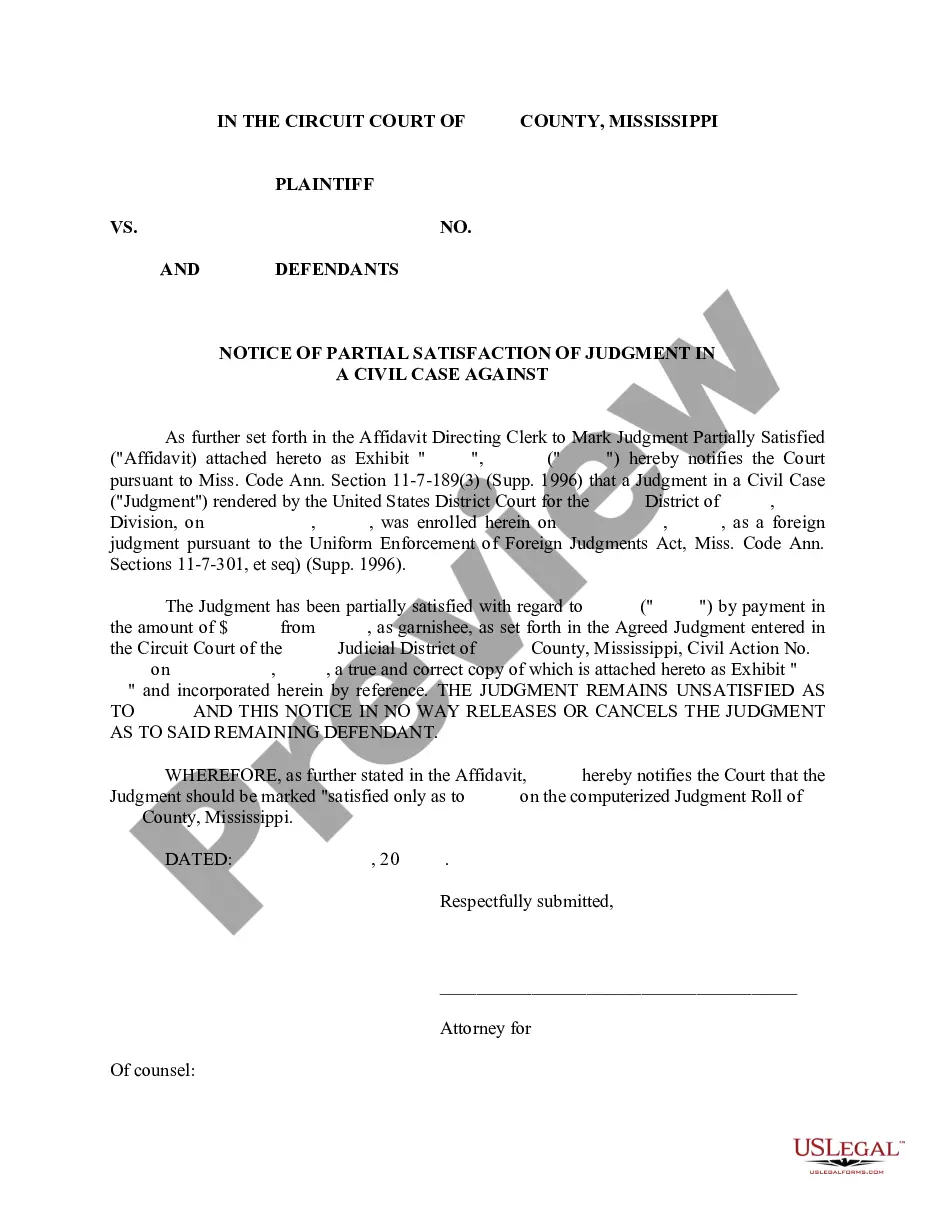
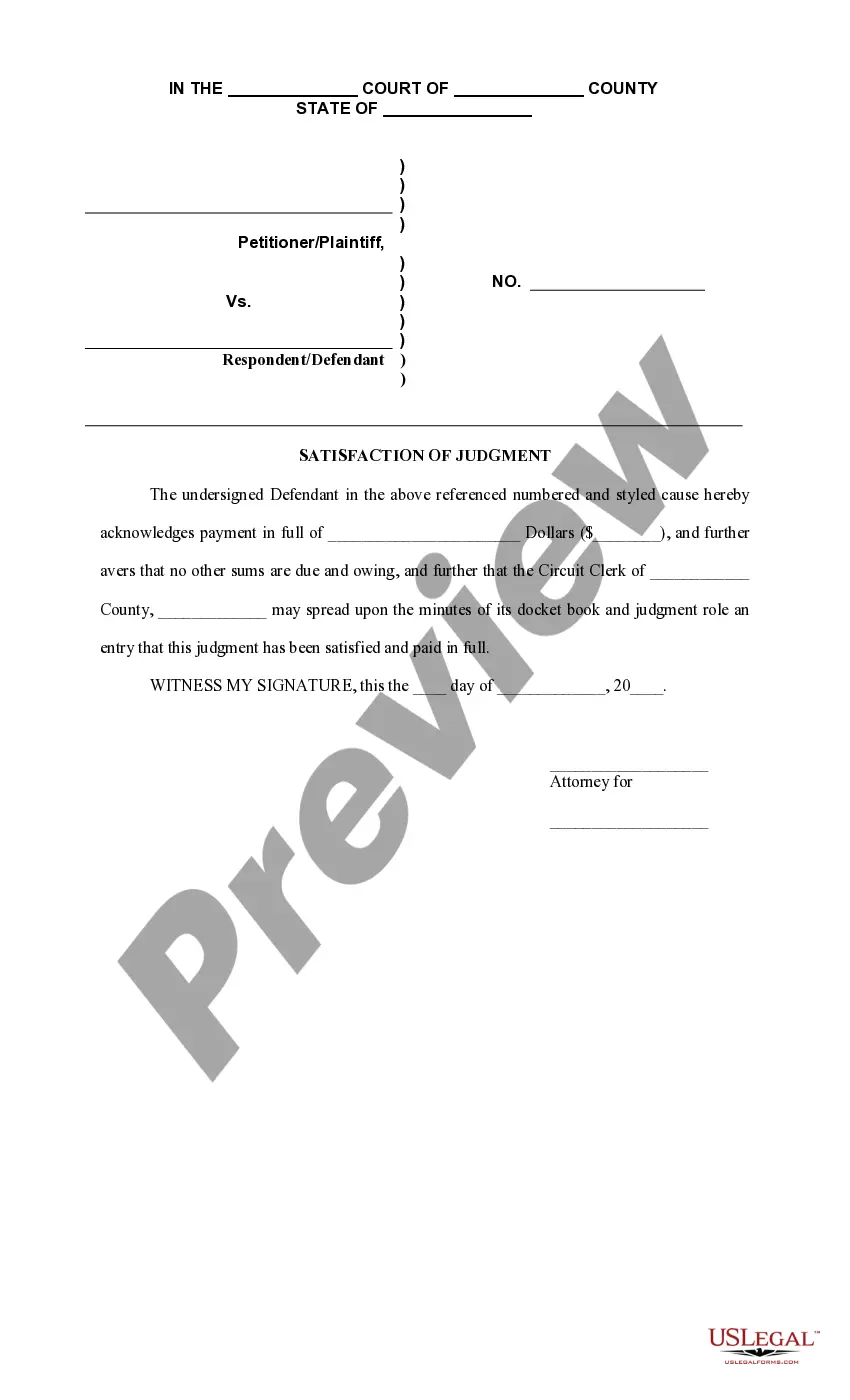
The Notice of Partial Satisfaction of Judgment in a Civil Case is a legal document that informs a party about the partial satisfaction of a judgment against them. This form serves to notify involved parties that a portion of the judgment amount has been paid or fulfilled, which is an important aspect of the legal process. Unlike a full satisfaction notice, which indicates that the total amount owed has been settled, this notice specifically addresses partial payments. Utilizing this form helps prevent delays in legal proceedings by ensuring proper communication about judgment payments.
Key parts of this document
- The title of the court case and the parties involved.
- A statement delineating the amount satisfied and the remaining balance.
- The date of the judgment and the date of payment.
- Details on how the payment was made (e.g., cash, check).
- Signature of the creditor or their representative.

When to use this document
This form is necessary in situations where a judgment has been rendered in a civil case, and a portion of the judgment has been paid. It is commonly used by creditors who need to notify debtors that some of their obligations have been fulfilled, but there remains an outstanding balance. Using this notice is crucial in cases where ongoing enforcement actions may depend on accurate reporting of the judgment status, such as wage garnishments or property liens.
Intended users of this form
This form is intended for:
- Creditors seeking to document a partial payment of a judgment.
- Debtors who need formal acknowledgment of their payment towards an outstanding judgment.
- Attorneys representing either party in civil litigation.
How to complete this form
- Identify the parties involved in the judgment.
- Provide details about the case, including court title and case number.
- Specify the amount that has been satisfied and any remaining balance.
- Include the date of the payment and the method used.
- Sign and date the form to validate it.
Is notarization required?
This form does not typically require notarization unless specified by local law. Be sure to verify your local regulations regarding notarization for legal notices to ensure compliance.
Get your form ready online
Our built-in tools help you complete, sign, share, and store your documents in one place.
Make edits, fill in missing information, and update formatting in US Legal Forms—just like you would in MS Word.
Download a copy, print it, send it by email, or mail it via USPS—whatever works best for your next step.
Sign and collect signatures with our SignNow integration. Send to multiple recipients, set reminders, and more. Go Premium to unlock E-Sign.
If this form requires notarization, complete it online through a secure video call—no need to meet a notary in person or wait for an appointment.
We protect your documents and personal data by following strict security and privacy standards.

Make edits, fill in missing information, and update formatting in US Legal Forms—just like you would in MS Word.

Download a copy, print it, send it by email, or mail it via USPS—whatever works best for your next step.

Sign and collect signatures with our SignNow integration. Send to multiple recipients, set reminders, and more. Go Premium to unlock E-Sign.

If this form requires notarization, complete it online through a secure video call—no need to meet a notary in person or wait for an appointment.

We protect your documents and personal data by following strict security and privacy standards.
Common mistakes
- Failing to include all necessary parties in the notice.
- Omitting the correct case number or judgment date.
- Not providing sufficient detail about the payment made.
- Missing the signature, which may invalidate the notice.
Advantages of online completion
- Convenience of downloading and completing the form at any time.
- Editability allows tailoring to specific case details without starting from scratch.
- Reliable templates drafted by licensed attorneys to ensure legal compliance.
Legal use & context
- This form provides a formal record of the partial satisfaction of a judgment that can be referenced in future legal proceedings.
- It facilitates communication between parties, helping to avoid misunderstandings regarding outstanding debts.
- Proper use of this notice can prevent unnecessary legal actions related to enforcement of the judgment.
Main things to remember
- The Notice of Partial Satisfaction of Judgment is essential for documenting partial payments.
- Ensure accurate information is provided to prevent legal complications.
- This form can aid both creditors and debtors in maintaining clear communication regarding judgments.
Looking for another form?

Form popularity
FAQ
A document signed by the party who is owed money under a court judgment (called the judgment creditor) stating that the full amount due on the judgment has been paid.
Judgments are no longer factored into credit scores, though they are still public record and can still impact your ability to qualify for credit or loans.You should pay legitimate judgments and dispute inaccurate judgments to ensure these do not affect your finances unduly.
You may ask your judgment creditor to file a satisfaction of judgment form. The length of time gives to the creditor to file the form varies from state to state, but it is usually between 14 and 30 days after your request.
The Satisfaction of Judgment form should be signed by the judgment creditor when the judgment is paid, and then filed with the court clerk. Don't forget to do this; otherwise, you may have to track down the other party later.
A Satisfaction of Judgment is basically an official receipt which says that you owed a certain amount, but that it has been paid, either partially or in full.
A document signed by the party who is owed money under a court judgment (called the judgment creditor) stating that the full amount due on the judgment has been paid.
You will need one original, notarized copy for the judgment debtor. If you recorded an abstract of judgment to place a lien against the debtor's real property, you will need an original, notarized copy of your Acknowledgment of Satisfaction of Judgment (EJ-100) for each county where you placed a lien.
If the judgment creditor does not immediately file an Acknowledgement of Satisfaction of Judgment (EJ-100) when the judgment is satisfied, the judgment debtor may make a formal written demand for the creditor to do so. The judgment creditor has 15 days after receiving the debtor's request to serve the acknowledgement.