Mississippi Resolution Authorizing Filing of Eminent Domain Action
Understanding this form
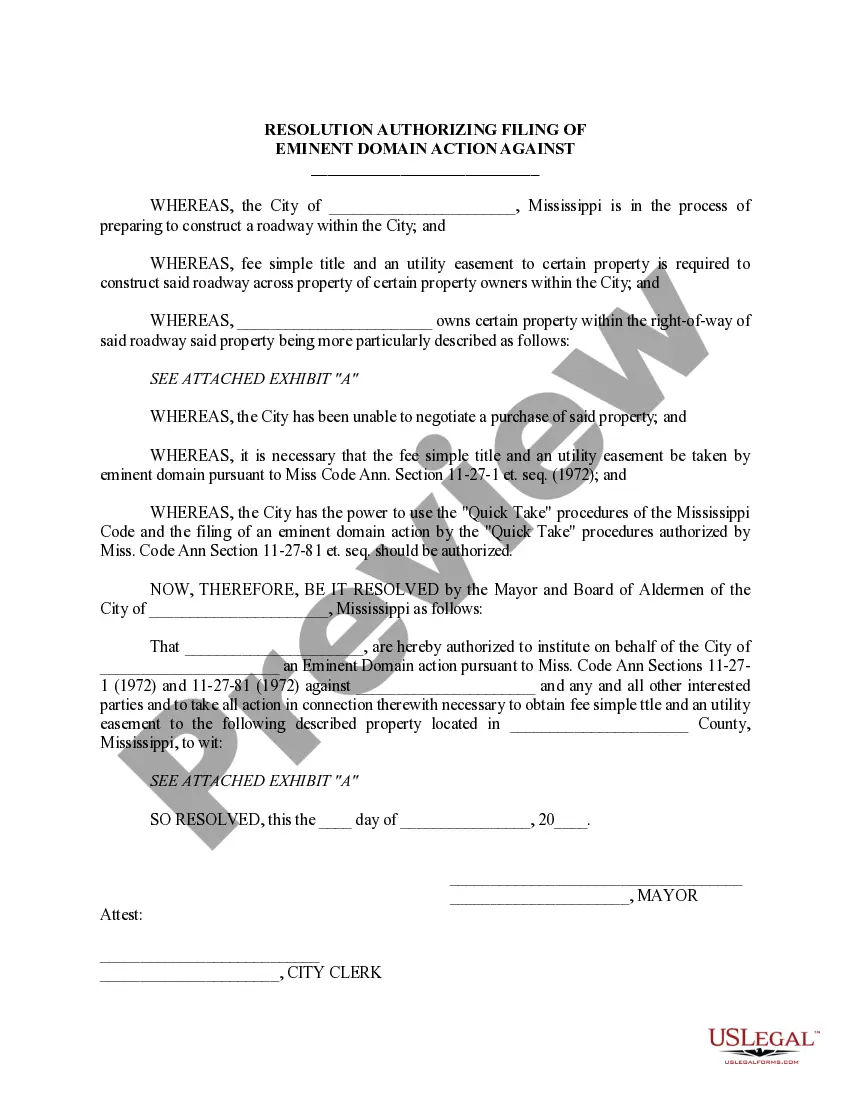
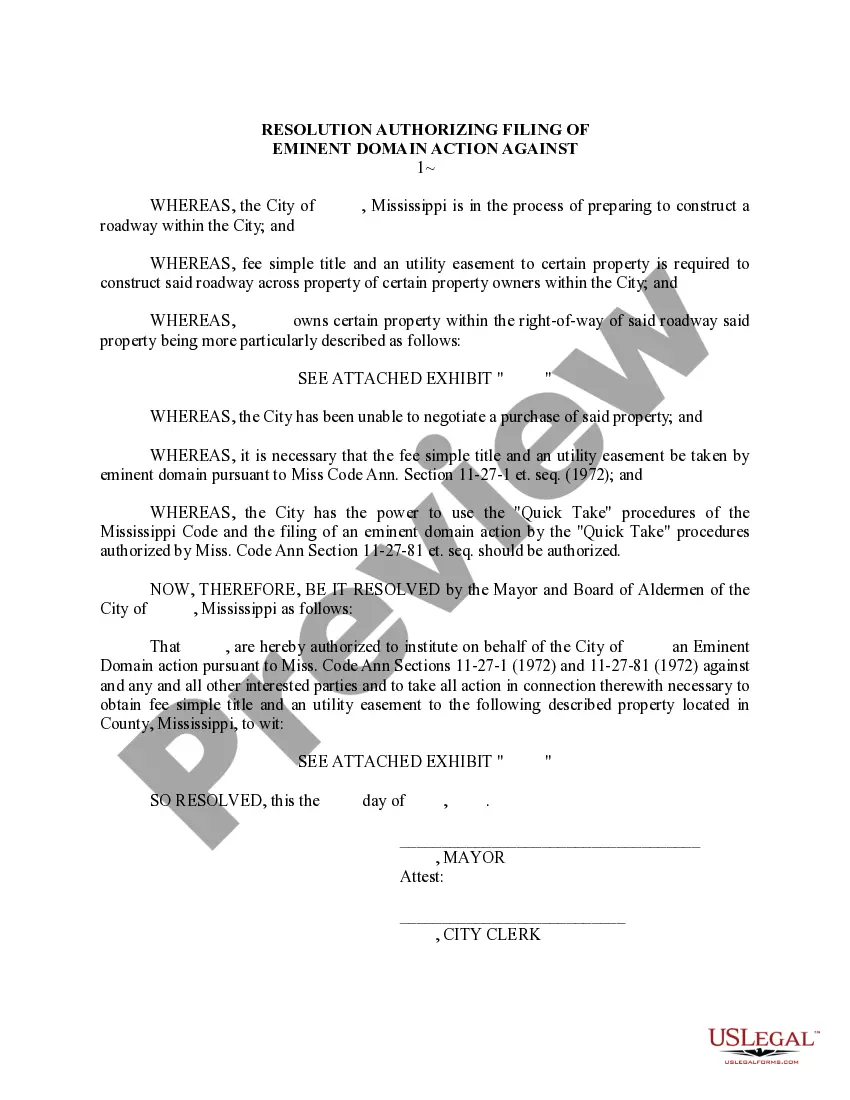
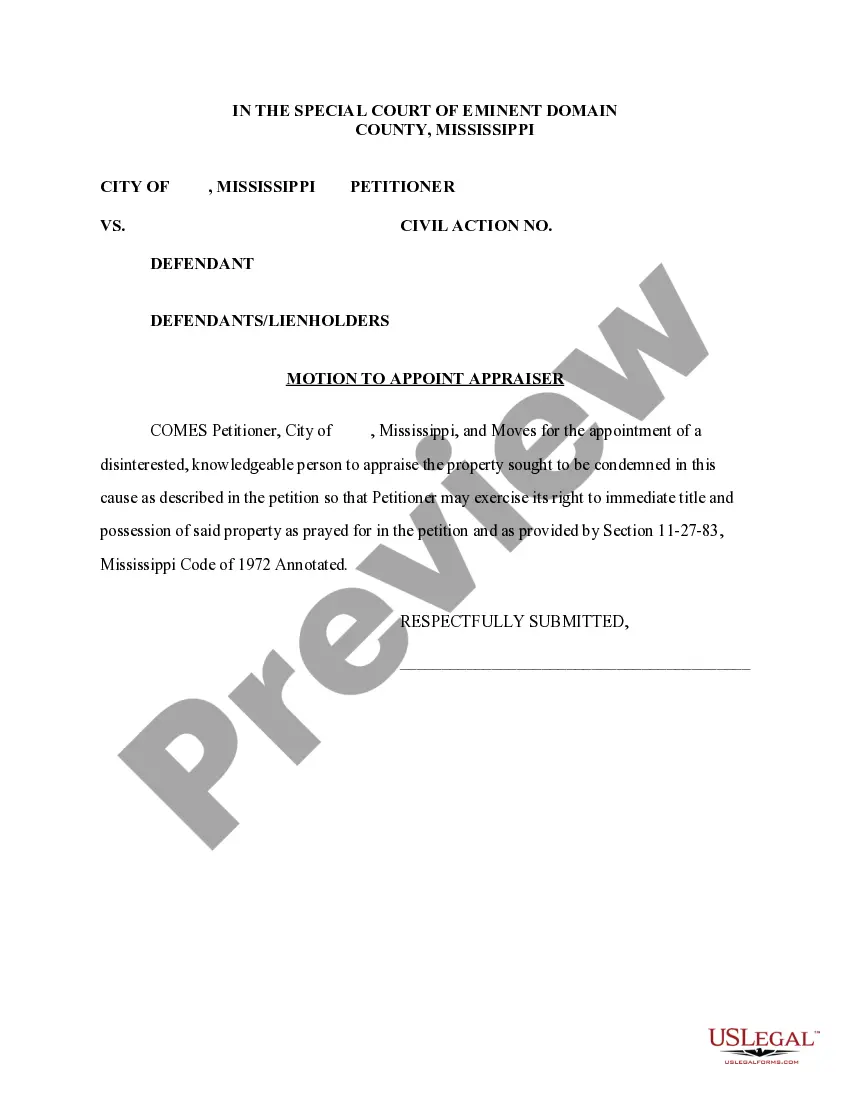
The Resolution Authorizing Filing of Eminent Domain Action is a legal document used by a town's governing body in Mississippi to initiate proceedings against a private landowner. This resolution confirms that the town has attempted to negotiate the purchase of the property, but no agreement has been reached. It authorizes the commencement of eminent domain action to secure the necessary property for public use.
Form components explained
- Identification of the City and the property owner.
- A declaration of the need for property for a public roadway.
- A statement regarding unsuccessful negotiation for the property's purchase.
- Authorization for the Mayor and Aldermen to file the eminent domain action.
- References to relevant Mississippi Code statutes for legal backing.
- Signatures of the Mayor and City Clerk to validate the resolution.
When this form is needed
This form is necessary when a municipal government seeks to obtain land for public projects, such as road construction, but has been unable to reach a negotiated agreement with the property owner. It is used specifically when the city plans to exercise its right of eminent domain under Mississippi law.
Who needs this form
- Municipalities in Mississippi, such as towns or cities.
- Local government officials, including mayors and members of the Board of Aldermen.
- City legal counsel responsible for property acquisition processes.
Instructions for completing this form
- Identify the city and the property owner involved in the action.
- Clearly describe the property needed for public use.
- State the attempts made to negotiate with the property owner.
- Fill in the appropriate date and signature lines for the Mayor and City Clerk.
- Attach any relevant exhibits or descriptions of the property as referenced in the resolution.
Notarization guidance
This form must be notarized to be legally valid. US Legal Forms provides secure online notarization powered by Notarize, allowing you to complete the process through a verified video call.
Get your form ready online
Our built-in tools help you complete, sign, share, and store your documents in one place.
Make edits, fill in missing information, and update formatting in US Legal Forms—just like you would in MS Word.
Download a copy, print it, send it by email, or mail it via USPS—whatever works best for your next step.
Sign and collect signatures with our SignNow integration. Send to multiple recipients, set reminders, and more. Go Premium to unlock E-Sign.
If this form requires notarization, complete it online through a secure video call—no need to meet a notary in person or wait for an appointment.
We protect your documents and personal data by following strict security and privacy standards.

Make edits, fill in missing information, and update formatting in US Legal Forms—just like you would in MS Word.

Download a copy, print it, send it by email, or mail it via USPS—whatever works best for your next step.

Sign and collect signatures with our SignNow integration. Send to multiple recipients, set reminders, and more. Go Premium to unlock E-Sign.

If this form requires notarization, complete it online through a secure video call—no need to meet a notary in person or wait for an appointment.

We protect your documents and personal data by following strict security and privacy standards.
Typical mistakes to avoid
- Failing to properly identify the property owner or the property location.
- Omitting details about negotiation attempts made prior to filing.
- Not including required signatures from the appropriate officials.
Benefits of using this form online
- Convenient access to the form for immediate download and use.
- Editability allows for customization to fit specific circumstances.
- Reliability in terms of compliance with Mississippi legal standards.
Legal use & context
- This form authorizes a municipal government to legally acquire private property for public use through eminent domain.
- It must be used in conjunction with applicable state laws and regulations concerning property acquisition.
- Proper completion and filing of the resolution are essential for the action to be valid and enforceable in a court of law.
Main things to remember
- The resolution is necessary for municipalities to pursue eminent domain legally.
- Clear and accurate completion of the form is crucial to avoid legal challenges.
- Understanding state-specific laws is imperative to the successful use of the form.
Looking for another form?
Form popularity
FAQ
Under Eminent Domain law, the government can take private property for public use but must provide landowners with just compensation.Further, if the government leaves out certain property or fails to provide select landowners with just compensation, landowners can sue the government under Inverse Condemnation.
The federal government's power of eminent domain has long been used in the United States to acquire property for public use. Eminent domain ''appertains to every independent government. It requires no constitutional recognition; it is an attribute of sovereignty. Boom Co.
Eminent domain has been utilized traditionally to facilitate transportation, supply water, construct public buildings, and aid in defense readiness. Early federal cases condemned property for construction of public buildings (e.g., Kohl v.
In most cases, it is not possible to refuse an eminent domain action. The power of eminent domain is a legal right of the government.However, you can oppose the government's requests if they are not acting justly, and can refuse their compensation offers to ensure you receive a fair sum.
Eminent domain refers to the power of the government to take private property and convert it into public use. The Fifth Amendment provides that the government may only exercise this power if they provide just compensation to the property owners.
Eminent domain refers to the power of the government to take private property and convert it into public use. The Fifth Amendment provides that the government may only exercise this power if they provide just compensation to the property owners.
Eminent domain in the United States refers to the power of a state or the federal government to take private property for public use while requiring "just" compensation to be given to the original owner.The most common uses are for government buildings and other facilities, public utilities, highways and railroads.
So, what is eminent domain? Basically, the government can force the sale of private property in the name of public use. For example, if your house is next to a freeway that's scheduled for widening, the government can force you to sell so long as you are paid fairly.
Eminent domain entitles a governmentwhether federal, state or localto take the property that it needs as long as it's for legitimate public use.The U.S. Supreme Court has even ruled that a government transfer of property from one private owner to another for the purpose of economic development is a public use.
The only way to stop eminent domain is to challenge the government's right to take. You can only do this if the government's proposed taking does not meet the requirements for public necessity or public purpose.