Mississippi Affidavit regarding Eminent Domain
What is this form?
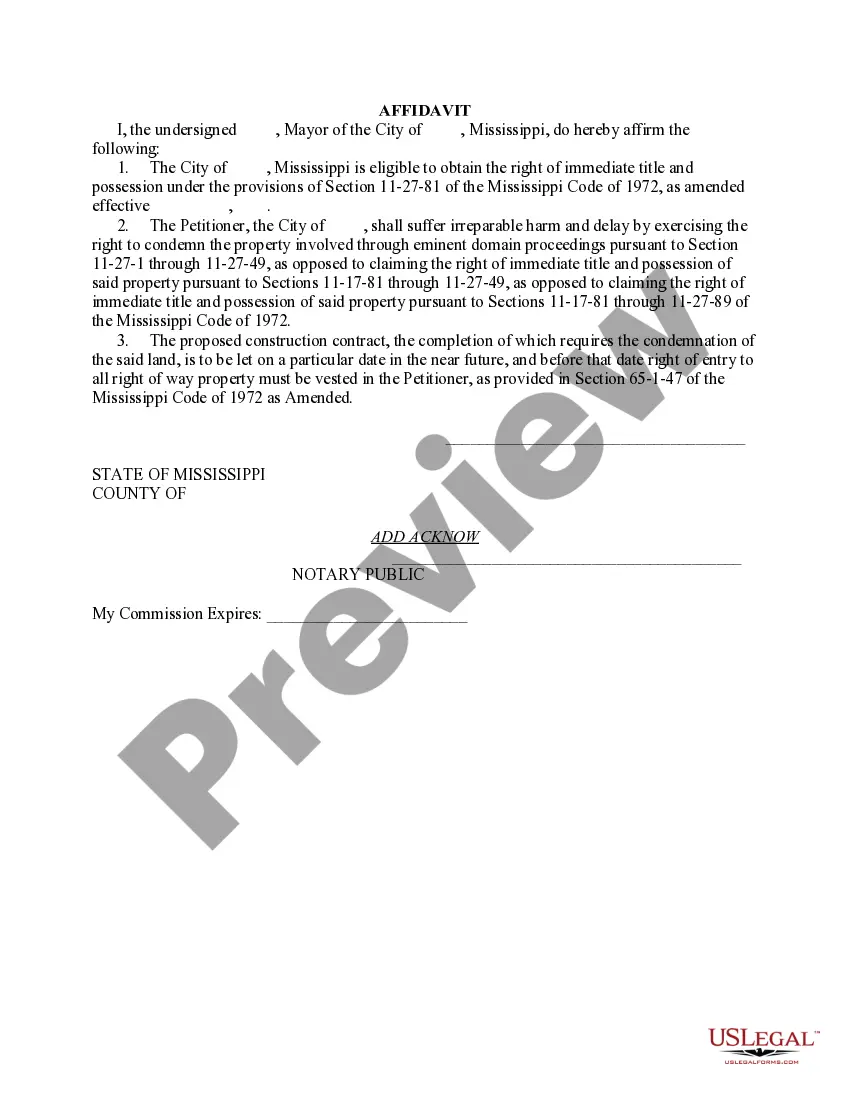
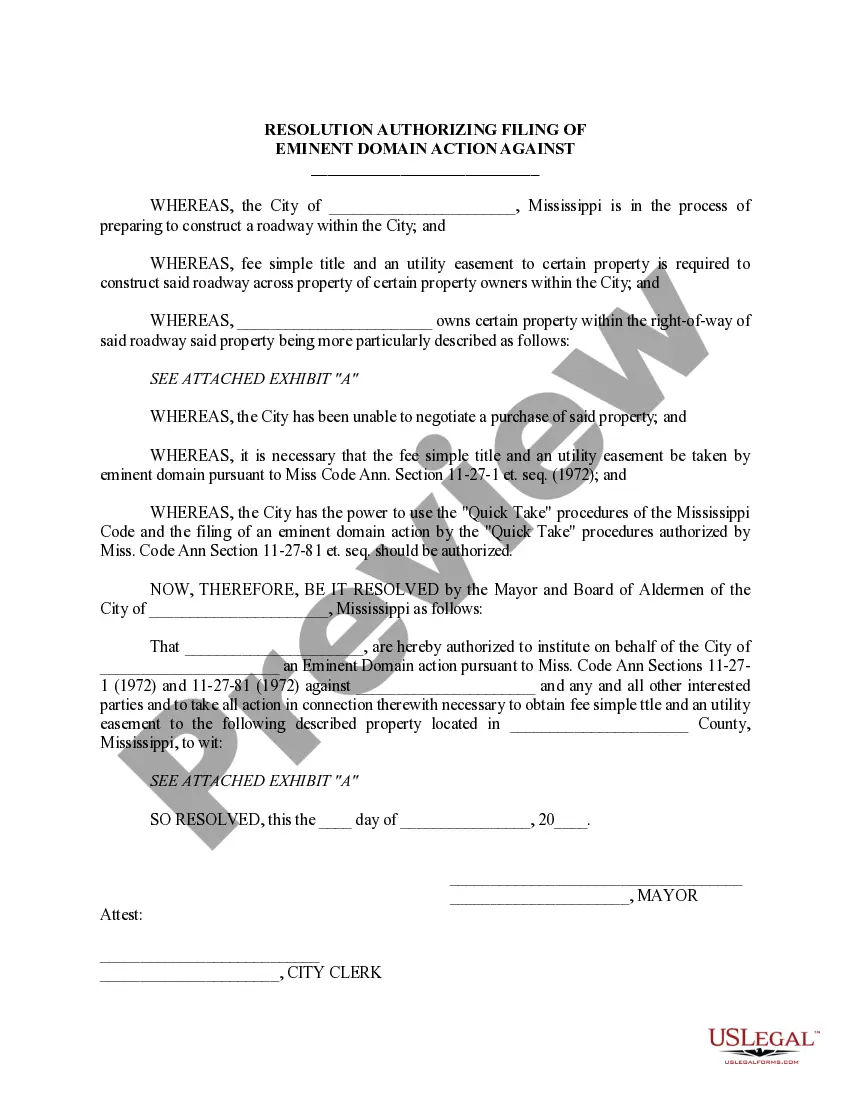
The Affidavit regarding Eminent Domain is a sworn, written statement used to provide essential facts related to property condemnation under eminent domain laws. This legal form allows an affiant to declare specific details about a proposed construction contract that necessitates the taking of land. This affidavit is distinct from other property-related affidavits due to its focus on government powers and the legal process surrounding the acquisition of private property for public use.
Form components explained
- Statement of facts regarding the property and its condemnation.
- Date of the proposed construction contract requiring land acquisition.
- Reference to relevant legal provisions under state law.
- Affiant's declaration and signature.
- Notary public's signature and stamp to validate the affidavit.
When this form is needed
This form is necessary when a property owner needs to provide a sworn statement for a proposed construction project that involves the condemnation of their land. It may be utilized when a government entity or authorized organization seeks to acquire property for public use, ensuring all legalities are adhered to. Situations might include road expansion projects, public utilities installations, or other government initiatives requiring land use.
Who needs this form
- Property owners facing imminent domain proceedings.
- Government agencies initiating a condemnation process.
- Attorneys representing clients in eminent domain cases.
- Real estate professionals involved in property acquisition for public projects.
- Individuals seeking clarity in their property rights during eminent domain actions.
Completing this form step by step
- Identify the parties involved, including the affiant and the government entity.
- Specify the property to be condemned, including its legal description.
- Clearly state the facts relevant to the proposed construction contract.
- Enter the date of the project's intended commencement.
- Have the affidavit signed by the affiant in the presence of a notary public.
- Ensure the notary public completes their section with a signature and stamp.
Does this form need to be notarized?
This form needs to be notarized to ensure legal validity. US Legal Forms provides secure online notarization powered by Notarize, allowing you to complete the process through a verified video call, available anytime.
Get your form ready online
Our built-in tools help you complete, sign, share, and store your documents in one place.
Make edits, fill in missing information, and update formatting in US Legal Forms—just like you would in MS Word.
Download a copy, print it, send it by email, or mail it via USPS—whatever works best for your next step.
Sign and collect signatures with our SignNow integration. Send to multiple recipients, set reminders, and more. Go Premium to unlock E-Sign.
If this form requires notarization, complete it online through a secure video call—no need to meet a notary in person or wait for an appointment.
We protect your documents and personal data by following strict security and privacy standards.

Make edits, fill in missing information, and update formatting in US Legal Forms—just like you would in MS Word.

Download a copy, print it, send it by email, or mail it via USPS—whatever works best for your next step.

Sign and collect signatures with our SignNow integration. Send to multiple recipients, set reminders, and more. Go Premium to unlock E-Sign.

If this form requires notarization, complete it online through a secure video call—no need to meet a notary in person or wait for an appointment.

We protect your documents and personal data by following strict security and privacy standards.
Avoid these common issues
- Failing to include the specifics of the property being condemned.
- Omitting the required date for the proposed construction.
- Not obtaining the necessary notarization before submission.
- Using incorrect legal references or outdated statutes.
- Forgetting to sign the affidavit in front of a notary.
Advantages of online completion
- Easy access to legal templates created by licensed attorneys.
- Convenient to download and fill out at your own pace.
- Edit the document as necessary to fit your circumstances.
- Save time and reduce errors compared to drafting your own affidavit from scratch.
- Secure storage of completed forms with immediate download options.
Legal use & context
- The affidavit serves as a formal acknowledgment of the necessity for land acquisition under the procedure of eminent domain.
- It assists in minimizing disputes by clearly documenting the facts supporting the need for condemnation.
- Legal enforceability may depend on proper completion and notarization of the affidavit.
Key takeaways
- An Affidavit regarding Eminent Domain is essential for property owners facing land acquisition by the government.
- It must be completed accurately, signed, and notarized to ensure its legal standing.
- This form helps clarify the legal rights involved in the eminent domain process, benefiting both the property owner and the acquiring party.
Looking for another form?
Form popularity
FAQ
The eminent domain power is subjected to certain constitutional limits such as: The property acquired must be taken for a public use; The state must pay just compensation in exchange for the property; No person must be deprived of his/her property without due process of law.
However, the Fifth Amendment to the United States Constitution places an important limitation on the power of eminent domain. The Fifth Amendment says, in part: 2026 nor shall private property be taken for public use, without just compensation. This part of the Fifth Amendment is known as the takings clause.
Property taken by eminent domain may be for government use or by delegation to third parties, who will devote it to public or civic use or, in some cases, to economic development. The most common uses are for government buildings and other facilities, public utilities, highways and railroads.
Eminent domain refers to the power of the government to take private property and convert it into public use. The Fifth Amendment provides that the government may only exercise this power if they provide just compensation to the property owners.
Assuming you decline, the government will file an action in court to seize your property through eminent domain. Then, the court schedules an Order of Taking. This is a court hearing in which the government argues that it attempted to purchase your land for a fair price and is justified in seizing it for public use.
In most cases, it is not possible to refuse an eminent domain action. The power of eminent domain is a legal right of the government.However, you can oppose the government's requests if they are not acting justly, and can refuse their compensation offers to ensure you receive a fair sum.
The condemnation of your properties for the erection of a business and technology park whose owners are private parties does not serve the public good and are therefore an abuse of the eminent domain authority.