Mississippi Motion to Appoint Appraiser
What is this form?
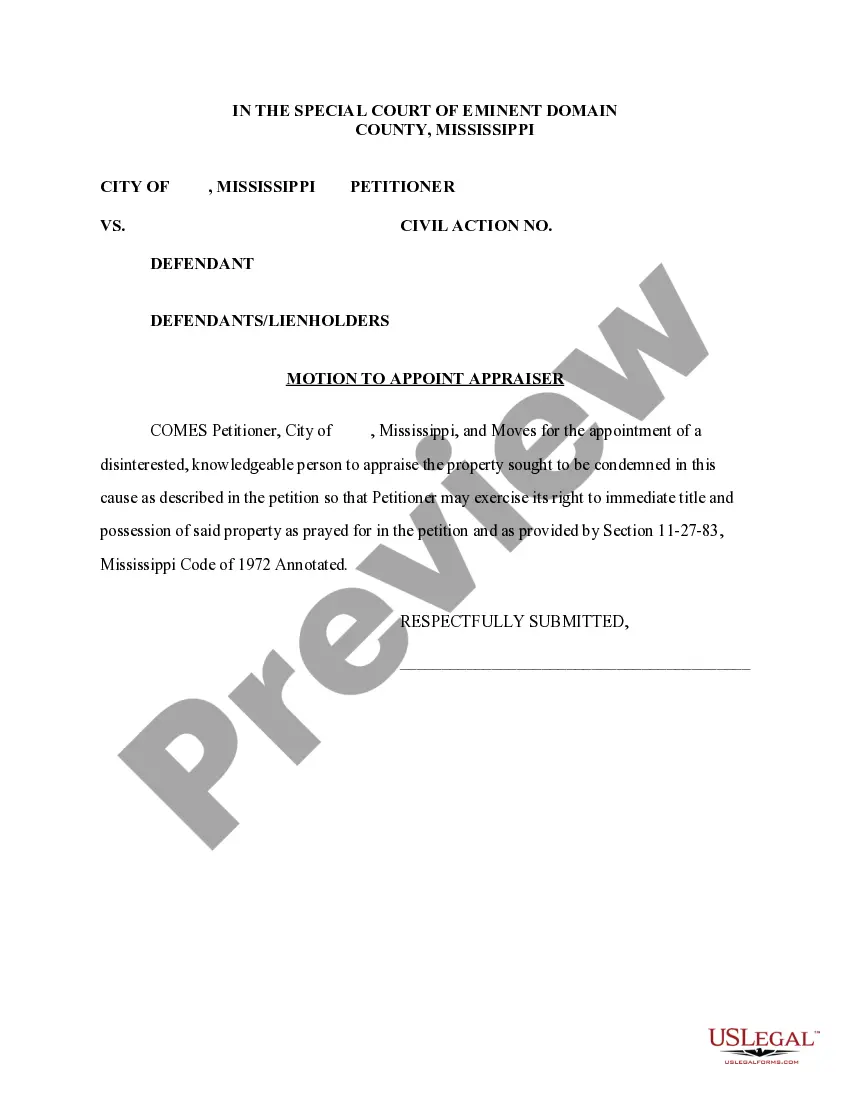
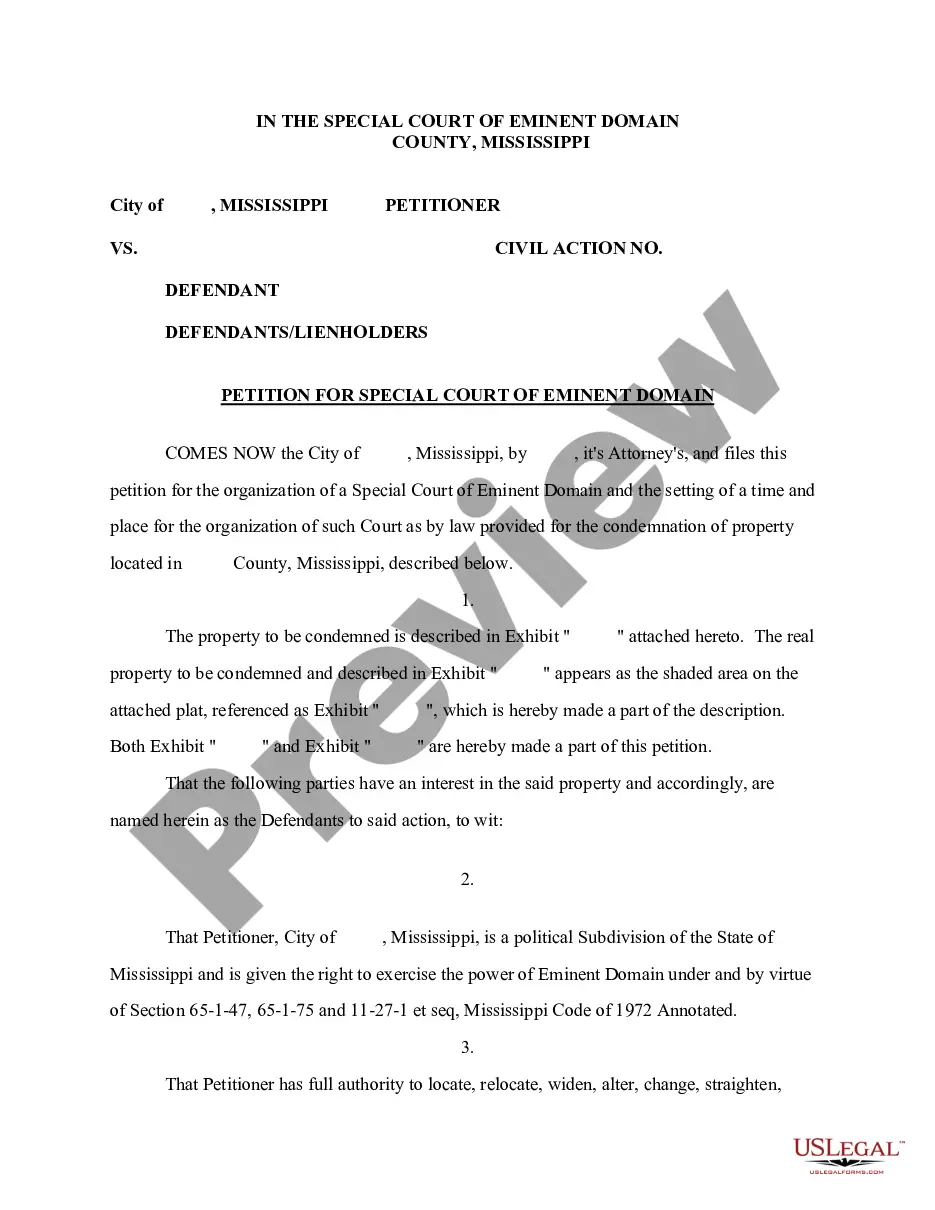
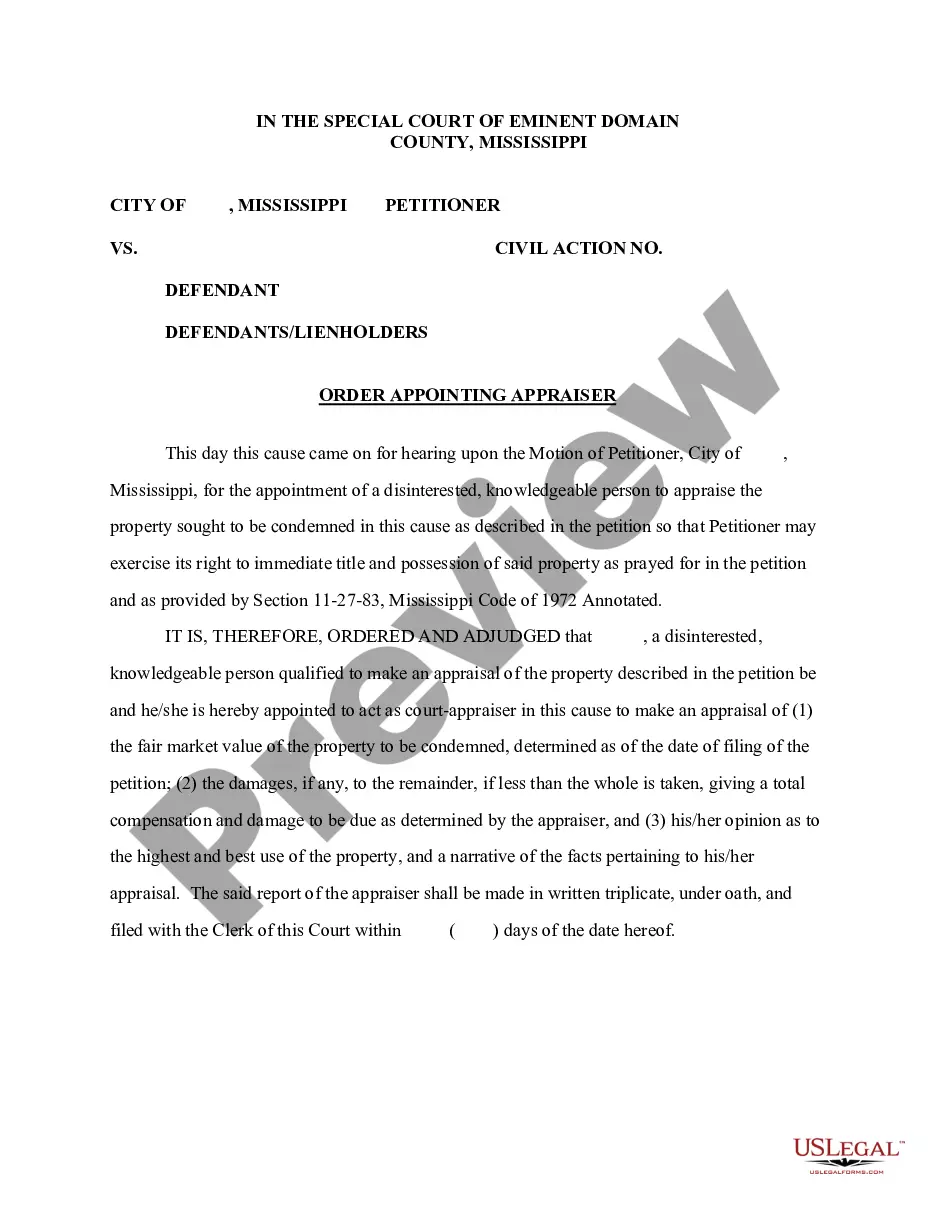
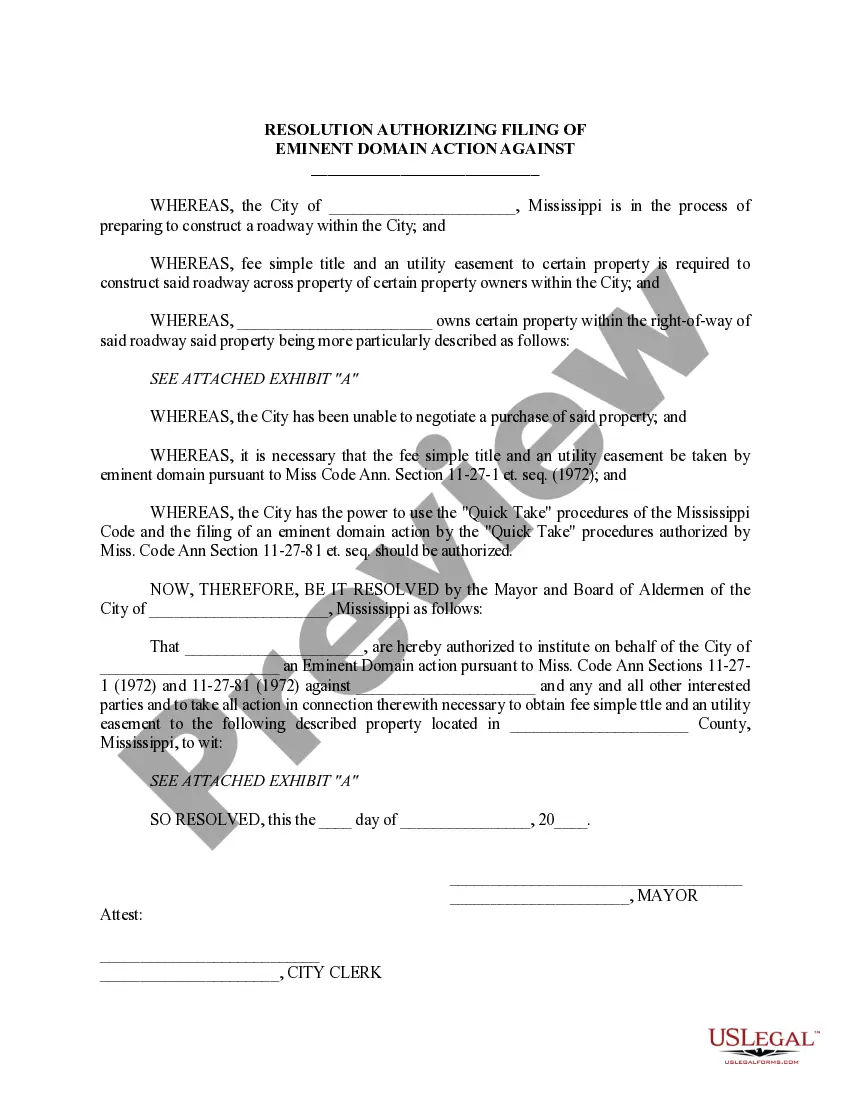
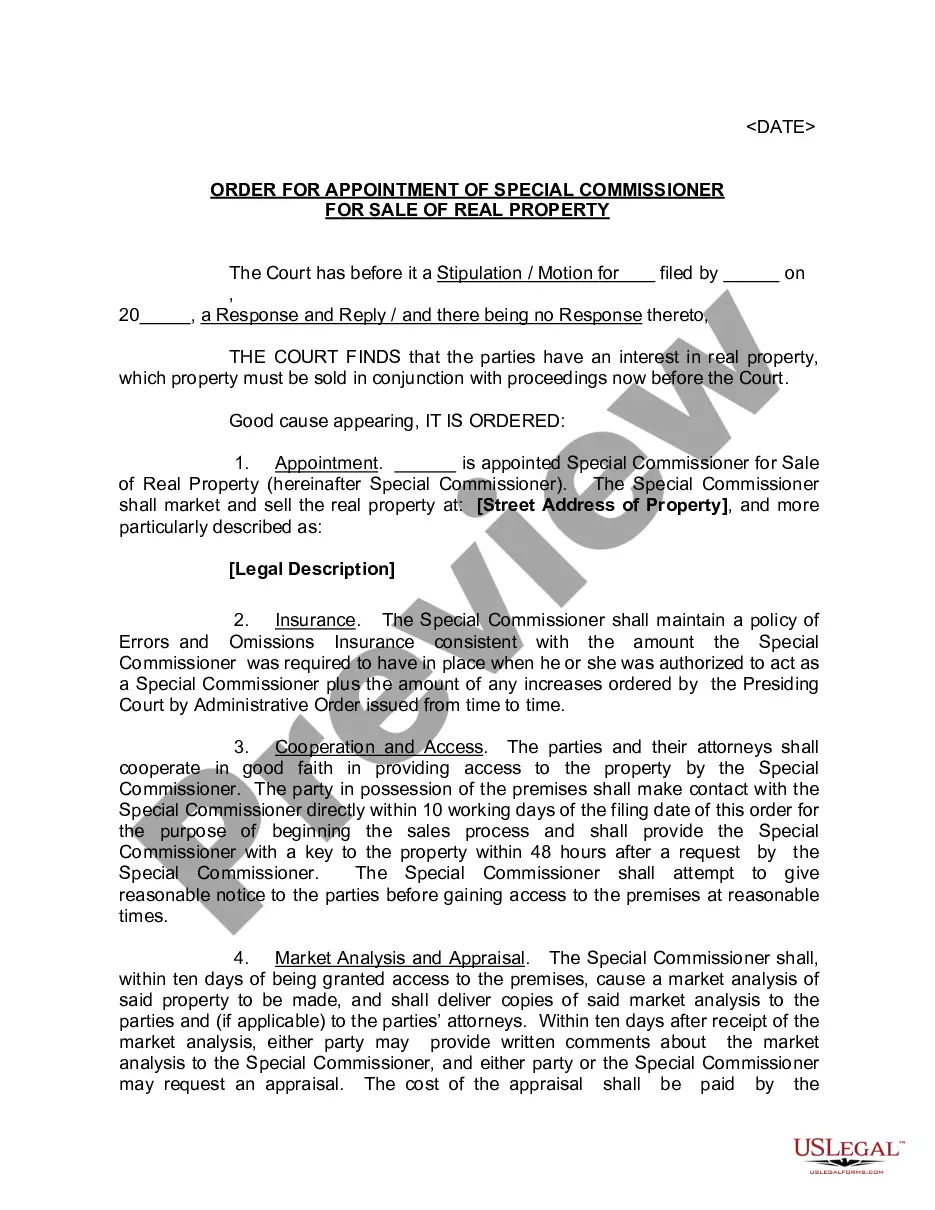
A Motion to Appoint Appraiser is a formal written request made to the court, asking for the appointment of an appraiser to assess property value in a legal matter. This motion is distinct from other court motions as it specifically addresses valuation issues, which may arise during disputes involving property division, estate settlements, or financial assessments.
Key parts of this document
- Case title: Specifies the names of the parties involved in the legal action.
- Motion request: Clearly states the request for the court to appoint a certified appraiser.
- Justification: Provides reasons why an appraiserâs assessment is necessary for the case.
- Signature block: Contains spaces for signatures of the requesting party and their attorney.

When to use this form
This form is typically used in situations where the value of a property needs to be determined for legal purposes. Common scenarios include divorce proceedings where assets are divided, estate settlements where property values are necessary for tax purposes, or disputes between parties over the value of real estate.
Who this form is for
This form is intended for:
- Individuals involved in divorce proceedings.
- Executors or administrators of an estate.
- Parties to a legal dispute involving property value.
- Attorneys representing clients who need property appraisals.
How to prepare this document
- Identify the case title, including the names of the parties involved.
- Clearly state your request for the appointment of an appraiser.
- Provide a justification outlining why the appraisal is necessary.
- Include the date and your contact information.
- Sign the motion and have your attorney sign if you have legal representation.
Notarization requirements for this form
This form does not typically require notarization unless specified by local law. Ensure you verify the requirements in your jurisdiction to confirm compliance.
Get your form ready online
Our built-in tools help you complete, sign, share, and store your documents in one place.
Make edits, fill in missing information, and update formatting in US Legal Forms—just like you would in MS Word.
Download a copy, print it, send it by email, or mail it via USPS—whatever works best for your next step.
Sign and collect signatures with our SignNow integration. Send to multiple recipients, set reminders, and more. Go Premium to unlock E-Sign.
If this form requires notarization, complete it online through a secure video call—no need to meet a notary in person or wait for an appointment.
We protect your documents and personal data by following strict security and privacy standards.

Make edits, fill in missing information, and update formatting in US Legal Forms—just like you would in MS Word.

Download a copy, print it, send it by email, or mail it via USPS—whatever works best for your next step.

Sign and collect signatures with our SignNow integration. Send to multiple recipients, set reminders, and more. Go Premium to unlock E-Sign.

If this form requires notarization, complete it online through a secure video call—no need to meet a notary in person or wait for an appointment.

We protect your documents and personal data by following strict security and privacy standards.
Avoid these common issues
- Failing to provide sufficient justification for the appraisal request.
- Not properly identifying all parties involved in the case.
- Missing signatures from required individuals.
- Submitting the form without checking local filing rules.
Benefits of completing this form online
- Convenience of immediate download for instant access to legal templates.
- Editability allows customization to fit specific case details.
- Access to forms drafted by licensed attorneys ensures accuracy and compliance with legal standards.
Looking for another form?

Form popularity
FAQ
Residential appraisers or small commercial appraisers could be sued for professional negligence. In those cases, the most likely claimant in a suit is likely to be the borrower.
Step 1: Meet the Basic Requirement: Step 2: Complete the Required Hours of Working Experience. Step 3: Fulfill the Education Requirement. Step 4: Submit Application to the Mississippi Appraisal Board. Step 5: Pass the Certified General Appraiser Exam.
Any unrepaired or ongoing structural damage can hurt your appraisal. Home appraisers are training to look for telltale signs of structural damage, such as cracks in the walls or flooring.
In most residential property transactions you are able to choose your real estate agent and your lender, but you cannot choose your appraiser. Instead the appraiser must be chosen by your lender to provide a level of independence from the buyer and seller.
Step 1: Meet the Basic Requirement: Step 2: Complete the Required Hours of Working Experience. Step 3: Fulfill the Education Requirement. Step 4: Submit Application to the Mississippi Appraisal Board. Step 5: Pass the Certified General Appraiser Exam.
Be sure to have any safety equipment installed and working properly. Walk around your home before the appraisal with a critical eye. Inform your home appraiser of any home improvements you have done on your home. Do some sprucing up. Do some research on other homes in the neighborhood. Clean your heart out.
To become a real estate appraiser, it indeed requires lots of hard work and persistence. Not only you would need to finish all the required course works, but you must obtain the necessary work experience. Therefore, many people would like more reassurance before they start investing in this career.
The average income for home appraisers is $60,040 as of 2020, according to PayScale, although a certified residential real estate appraiser may earn $100,000 or more, as they become more experienced.
Job Outlook Employment of property appraisers and assessors is projected to grow 3 percent from 2019 to 2029, about as fast as the average for all occupations. Employment growth will be driven by economic expansion and population increases.