Mississippi Judgment Appointing Conservator
About this form
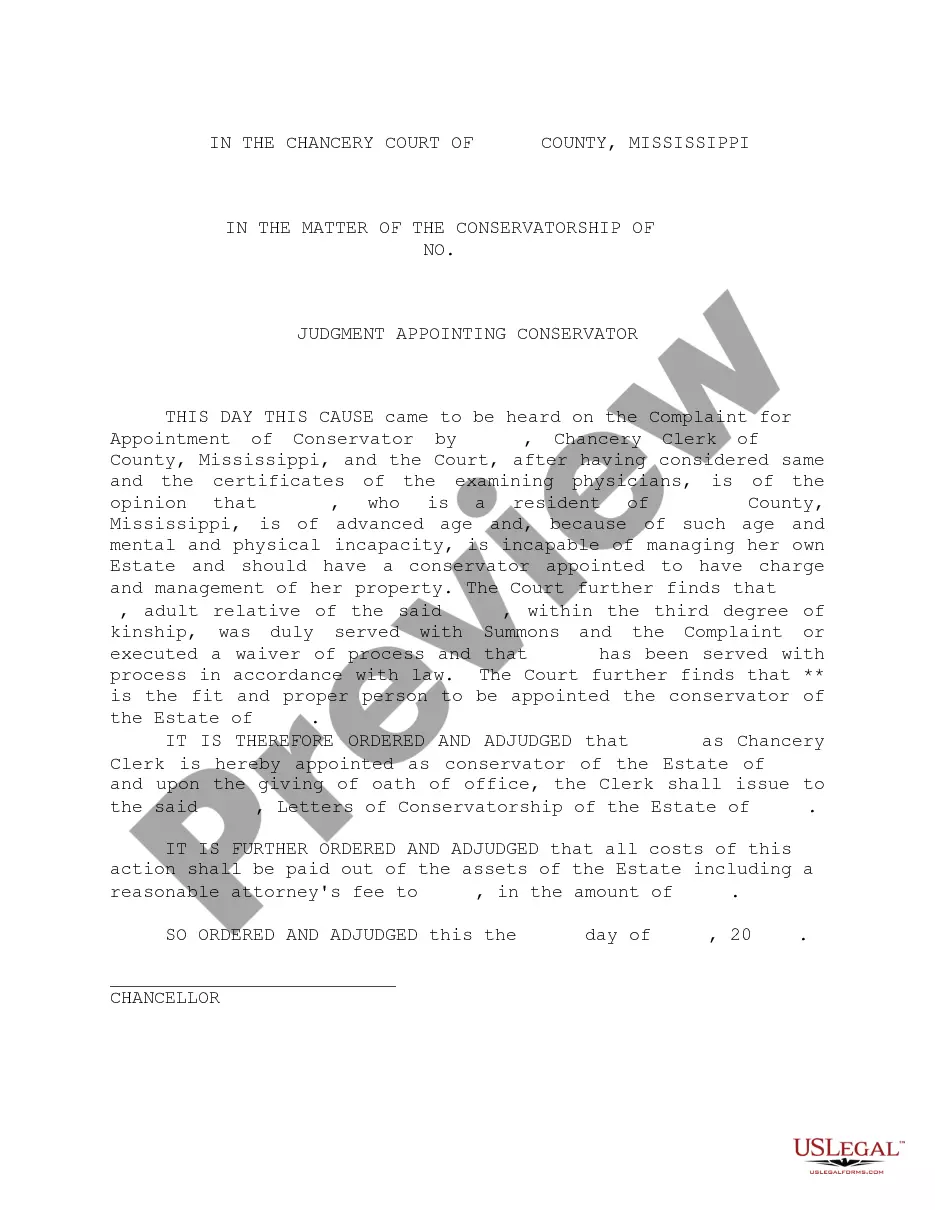
The Judgment Appointing Conservator is a legal document used to officially appoint a conservator for an individual who is unable to manage their own affairs due to incapacity. This form becomes binding once signed by a judge, distinguishing it from other forms of conservatorship applications, as it formalizes the court's decision and the appointed conservator's authority.
Form components explained
- Identification of the conservatee, the person in need of a conservator.
- Details of the proposed conservator, including their qualifications and relationship to the conservatee.
- Specific powers granted to the conservator, outlining their responsibilities and autonomy.
- Judgment statement, formalizing the court's decision and the basis for the appointment.
- Signature section for the judge, validating the judgment.


Situations where this form applies
This form is necessary when a court has determined that an individual is unable to manage their personal or financial affairs due to mental or physical incapacity. It provides a legal framework for appointing a conservator to act in their best interests, ensuring their needs are met and their rights are protected.
Who can use this document
- Family members or close friends who seek to become a conservator for an incapacitated individual.
- Attorneys representing a client who requires conservatorship.
- Individuals preparing for court proceedings related to conservatorship and needing a formal judgment.
How to complete this form
- Identify the conservatee by providing their full name and relevant personal details.
- Specify the proposed conservator's name and relationship to the conservatee.
- Outline the specific powers and responsibilities the conservator will have.
- Include the court's findings justifying the appointment of a conservator.
- Obtain the judge's signature to finalize the judgment.
Is notarization required?
This form does not typically require notarization unless specified by local law.
Get your form ready online
Our built-in tools help you complete, sign, share, and store your documents in one place.
Make edits, fill in missing information, and update formatting in US Legal Forms—just like you would in MS Word.
Download a copy, print it, send it by email, or mail it via USPS—whatever works best for your next step.
Sign and collect signatures with our SignNow integration. Send to multiple recipients, set reminders, and more. Go Premium to unlock E-Sign.
If this form requires notarization, complete it online through a secure video call—no need to meet a notary in person or wait for an appointment.
We protect your documents and personal data by following strict security and privacy standards.

Make edits, fill in missing information, and update formatting in US Legal Forms—just like you would in MS Word.

Download a copy, print it, send it by email, or mail it via USPS—whatever works best for your next step.

Sign and collect signatures with our SignNow integration. Send to multiple recipients, set reminders, and more. Go Premium to unlock E-Sign.

If this form requires notarization, complete it online through a secure video call—no need to meet a notary in person or wait for an appointment.

We protect your documents and personal data by following strict security and privacy standards.
Common mistakes to avoid
- Failing to provide complete information about the conservatee and proposed conservator.
- Not detailing the specific powers granted to the conservator.
- Overlooking the requirement for the judge's signature to make the form legally binding.
Why use this form online
- Instant access to a professionally drafted form that meets legal standards.
- Easy customization to suit specific circumstances without needing legal expertise.
- Convenience of downloading and completing the form at your own pace.
Legal use & context
- The judgment becomes legally binding upon the judge's signature.
- It serves as a formal commitment to protect the interests of an individual lacking the capacity to manage their own affairs.
- Subject to appeal, the conservatorship can be contested under specific circumstances.
Quick recap
- The Judgment Appointing Conservator is essential for establishing legal authority over an individualâs affairs.
- It requires careful completion to reflect the court's judgment accurately.
- Uses may vary based on state requirements, so always verify local laws.
Looking for another form?
Form popularity
FAQ
File a Petition For Conservatorship with the court: File a Confidential Supplemental Information Form: File a Confidential Conservatorship Screening Form: File a Duties of Conservator Form: Serve Notice on the Conservatee: Provide Notice to the Conservatee's Relatives:
How is a guardianship or conservatorship set up? Someone interested in the individual's welfare must file a petition in Superior Court, Probate Division, requesting appointment of a guardian or conservator. Once the petition is reviewed by the Probate Division and accepted for filing, a hearing is scheduled.
A conservatorship may be established after a relative, friend, or public official petitions the court for appointment of a conservator. The petition must contain information on why the individual cannot manage his or her financial affairs or make appropriate decisions concerning his or her personal care.
An emergency conservatorship takes 5 court days notice. In other words, you can file a petition for the conservatorship, mail copies of the documents to all legally required persons, and and the court will set a hearing on the matter within 5 days.
Yes, a conservatorship can be contested in any state. Sometimes, the simplest way to contest a conservatorship is to object to the petition for conservatorship to stop the conservatorship in the first place, or to file a competing petition for conservatorship.
Upon petition by the individual or one or more of his friends or relatives, a court can appoint a conservator if a person is incapable of managing his own estate by reason of advanced age, physical incapacity or mental weakness2026 MS Code § 93-13-251.
Get a capacity assessment. Have a professional assess whether the adult can make decisions on their own. Fill out the application forms. If you want to apply for guardianship. Submit your application package.
A conservatorship is a court case where a judge appoints a responsible person or organization (called the conservator) to care for another adult (called the conservatee) who cannot care for himself or herself or manage his or her own finances.