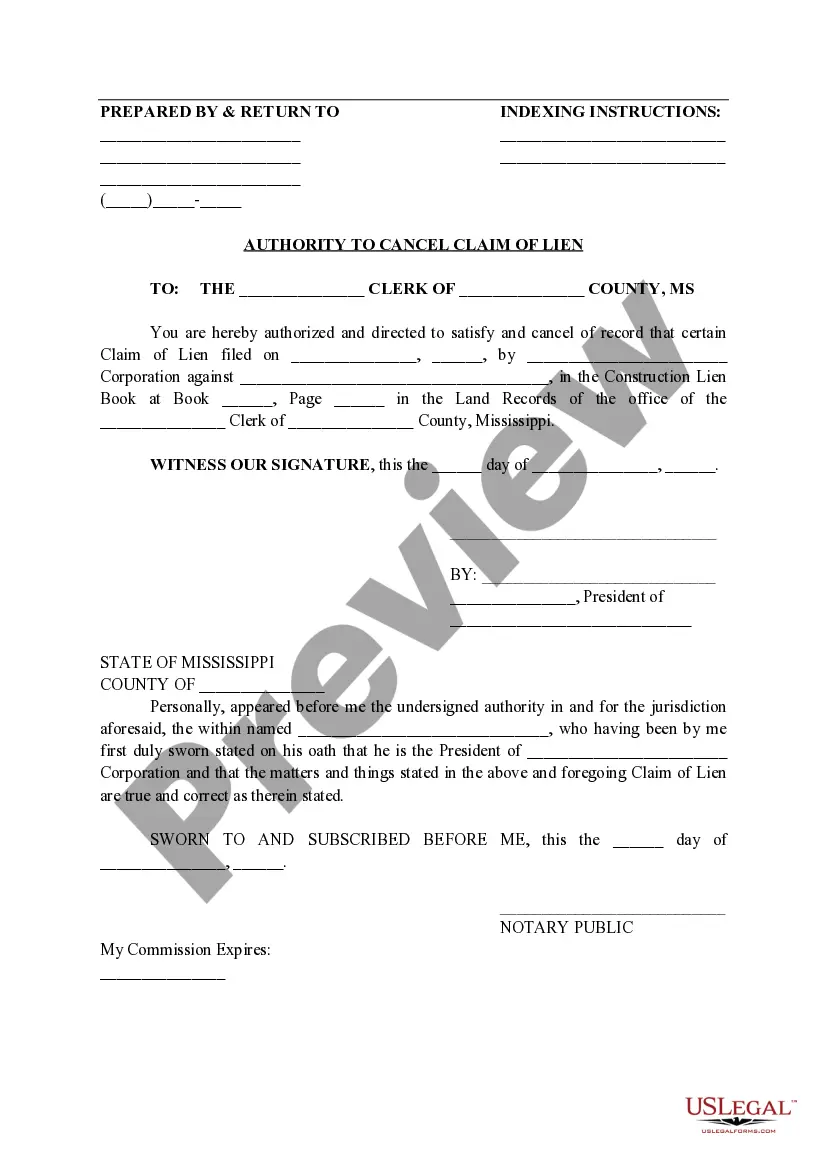
Mississippi Authority to Cancel Claim of Lien
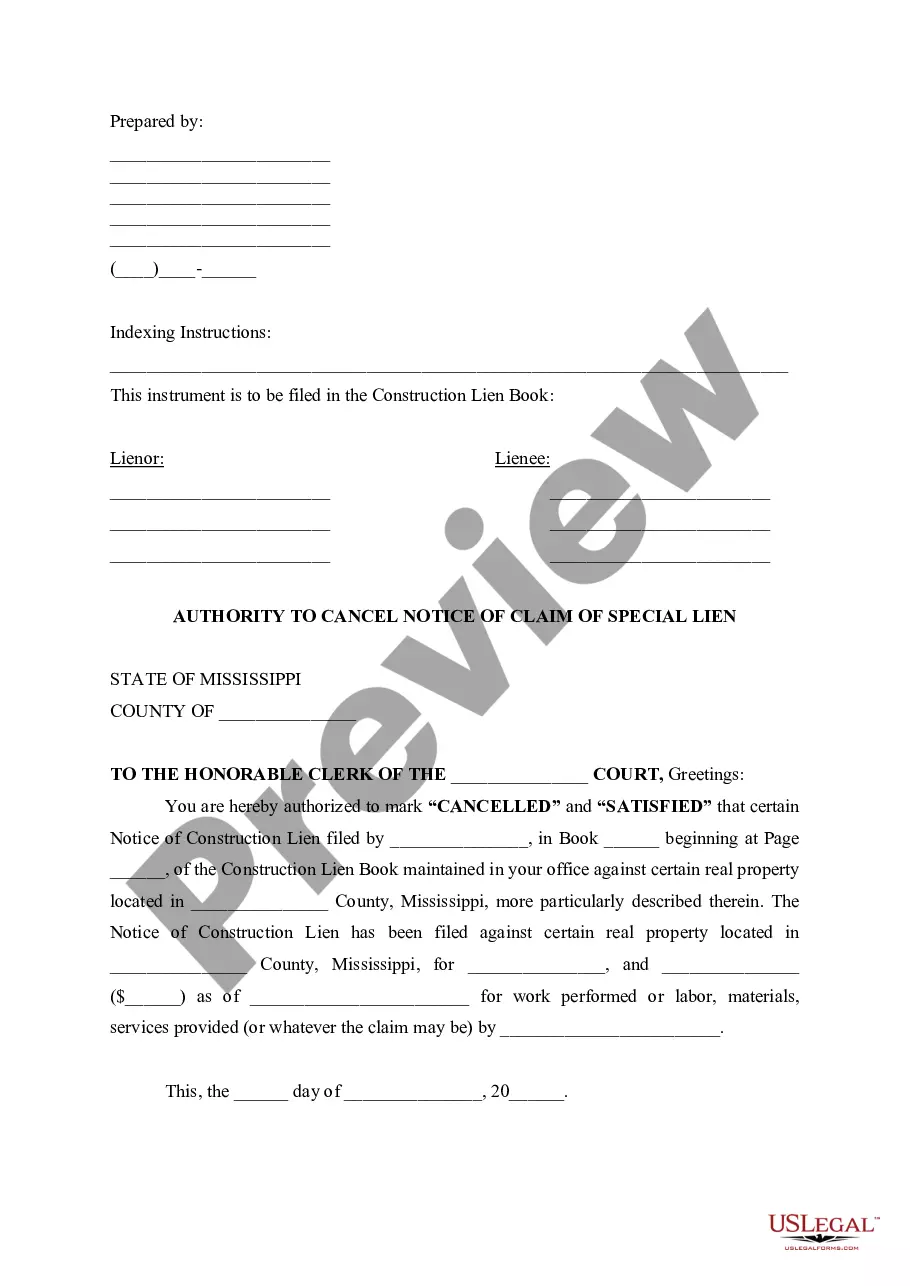
About this form
The Authority to Cancel Claim of Lien is a legal document used by a lienor to officially authorize the cancellation of a previously filed Claim of Lien on real property. This form is essential when the debt for which the lien was placed has been satisfied. By filing this document, the lienor ensures that the property is cleared of the lien, which differs from other forms that might be used to establish or amend a lien.
Key parts of this document
- Identifying information of the lienor and the property.
- Date of the original Claim of Lien filing.
- Details of the lien being canceled, including the book and page number in the land records.
- Signature of the lienor or an authorized representative, verifying their authority.
- Notary acknowledgment, affirming the identity of the signer.
Situations where this form applies
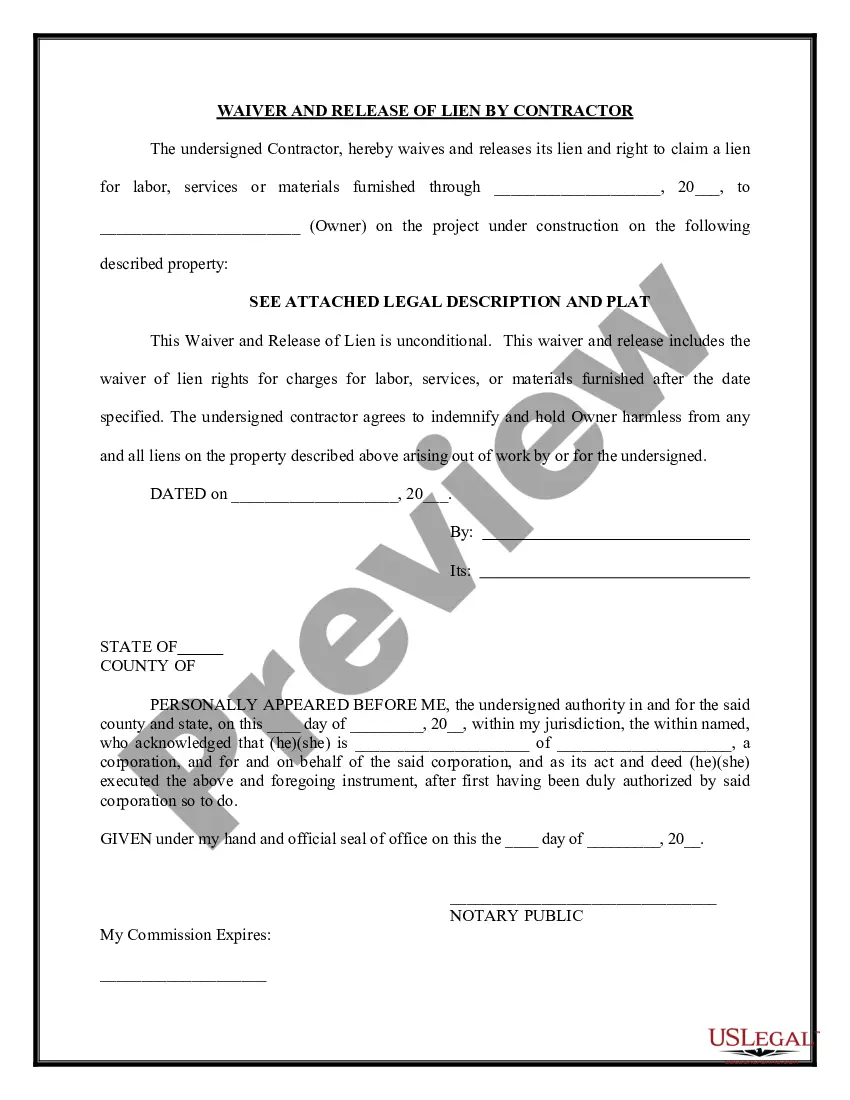
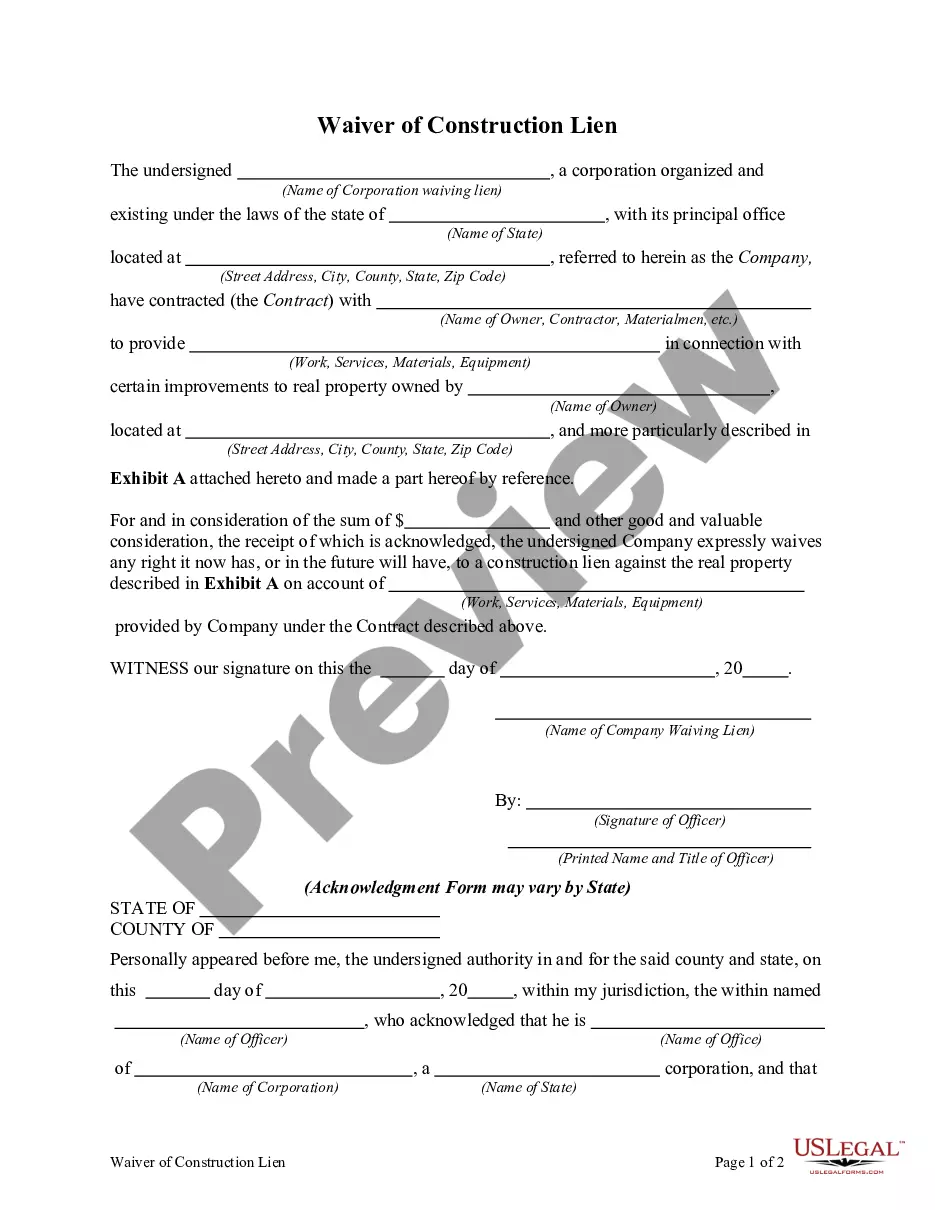
This form should be used when a lienor has completed all necessary payments or work related to the property and wishes to remove the lien from the public record. Common scenarios include completing a home renovation where a contractor placed a lien for unpaid services, or settling a dispute over unpaid dues related to property maintenance. Utilizing this form ensures the property is not encumbered by outdated or unnecessary liens.
Who should use this form
- Lienors, such as contractors or suppliers, who have filed a Claim of Lien for unpaid work.
- Property owners seeking to clear their property titles from any liens.
- Legal professionals handling real estate transactions that require the removal of liens.
Steps to complete this form
- Identify the lienor and provide their full legal name and address.
- Fill in the date on which the original Claim of Lien was filed.
- Provide the details of the property affected by the lien, including its legal description.
- Enter the book and page number where the Claim of Lien is recorded.
- Sign the document in the capacity of an authorized representative, ensuring it is dated appropriately.
- Have the form notarized by a designated notary public to validate the cancellation.
Does this form need to be notarized?
Yes, this form must be notarized to be legally valid. Notarization provides an official verification of the identity of the signer and ensures the authenticity of the cancellation process. US Legal Forms offers integrated online notarization services, making it easy to complete this step via secure video calls, available 24/7.
Get your form ready online
Our built-in tools help you complete, sign, share, and store your documents in one place.
Make edits, fill in missing information, and update formatting in US Legal Forms—just like you would in MS Word.
Download a copy, print it, send it by email, or mail it via USPS—whatever works best for your next step.
Sign and collect signatures with our SignNow integration. Send to multiple recipients, set reminders, and more. Go Premium to unlock E-Sign.
If this form requires notarization, complete it online through a secure video call—no need to meet a notary in person or wait for an appointment.
We protect your documents and personal data by following strict security and privacy standards.

Make edits, fill in missing information, and update formatting in US Legal Forms—just like you would in MS Word.

Download a copy, print it, send it by email, or mail it via USPS—whatever works best for your next step.

Sign and collect signatures with our SignNow integration. Send to multiple recipients, set reminders, and more. Go Premium to unlock E-Sign.

If this form requires notarization, complete it online through a secure video call—no need to meet a notary in person or wait for an appointment.

We protect your documents and personal data by following strict security and privacy standards.
Mistakes to watch out for
- Failing to include accurate information about the original Claim of Lien.
- Not obtaining a notarization, which is crucial for legal validation.
- Missing signatures or improperly identifying authorized representatives.
- Filing the form without confirming that all obligations related to the lien have been resolved.
Why complete this form online
- Convenient access to templates drafted by licensed attorneys.
- Quick and easy completion process, allowing for direct download.
- Editability enables users to customize the form to fit their specific needs.
- Reliability of having professionally drafted forms ensures legal compliance.
Looking for another form?
Form popularity
FAQ
Formalize a defense for disputing the amount of the lien. Gather supporting documentation for your rebuttal, depending on the type of lien. Contact the agent representing the creditor to dispute the amount of the claim. Negotiate a payment settlement with the creditor if you cannot pay the amount you owe in full.
If a creditor puts a lien on your property, you may make an offer to settle the amount for less than you owe. As part of the negotiations, get the creditor to agree to release the lien. If you need help in the negotiations, consider hiring a debt settlement lawyer to help you.
A tax lien recorded on the State Tax Lien Registry covers all property in Mississippi. To avoid having a tax lien filed against your property, send the Department of Revenue full payment before the due date as set forth in your Assessment Notice.
The simplest way to prevent liens and ensure that subcontractors and suppliers are paid is to pay with joint checks. This is when both parties endorse the check. Compare the contractor's materials or labor bill to the schedule of payments in your contract and the Preliminary Notices.
The answer is simple no. In Mississippi, paying the property taxes on someone else's land does not affect ownership in any manner. You simply cannot obtain title to someone's land by paying their taxes for them.
If a creditor gets a judgment against you, it can then place a lien on your property. The lien gives the creditor an interest in your property so that it can get paid for the debt you owe.And in some cases, the lien gives the creditor the right to force a sale of your property in order to get paid.
What Is a Fraudulent Lien?the claimant is owed money on another job by the same general contractor or property owner, but didn't file a lien on that project before time expired; or. the claimant wants to file a lien because of personal reasons generally related to the identity of the property owner.
Invalid Liens A lien stays in the county records and on your property title until you take action to remove it.If the contractor, subcontractor, laborer, or material supplier fails to follow any of the specific time frames, you can petition the court to remove the lien.