Mississippi Justice Court Summons
Understanding this form
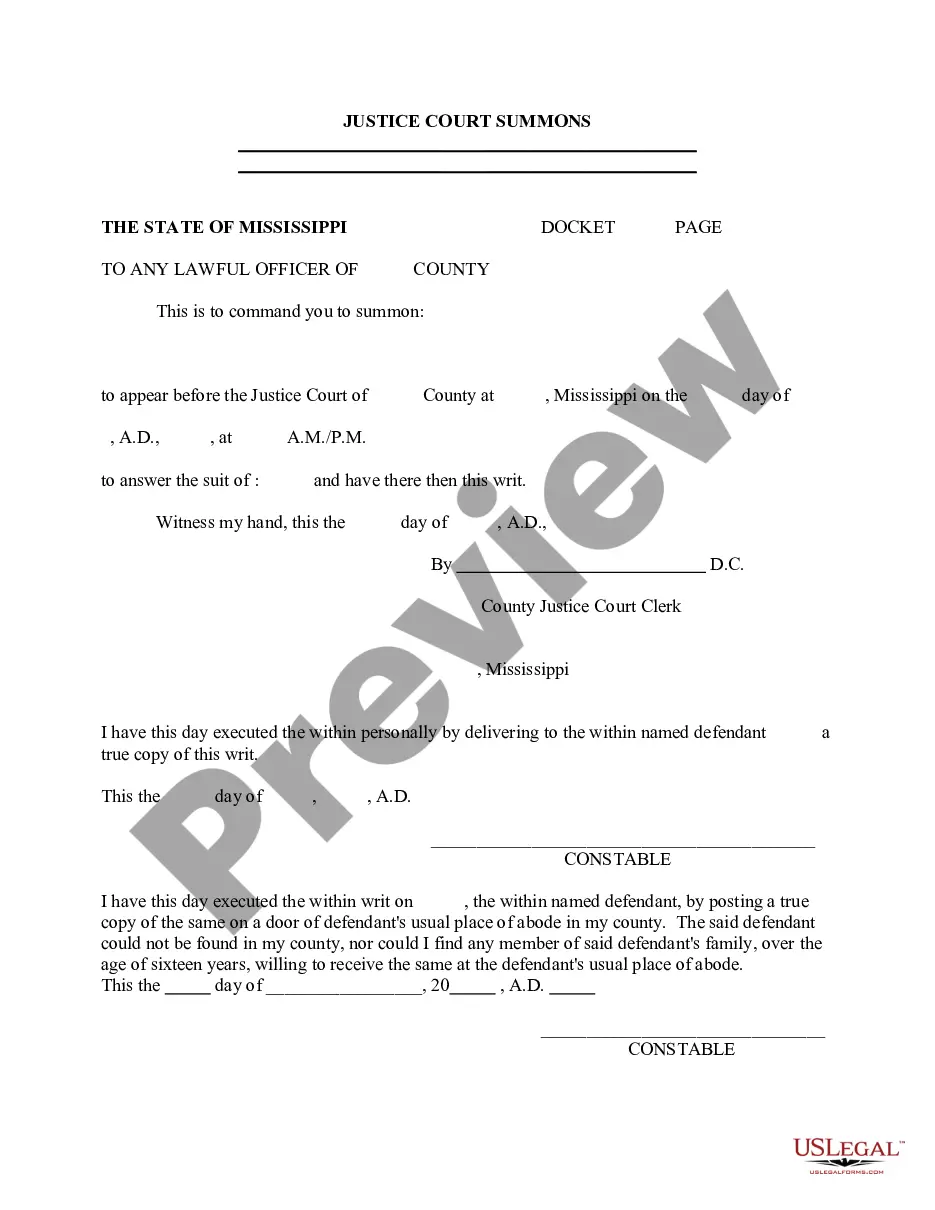
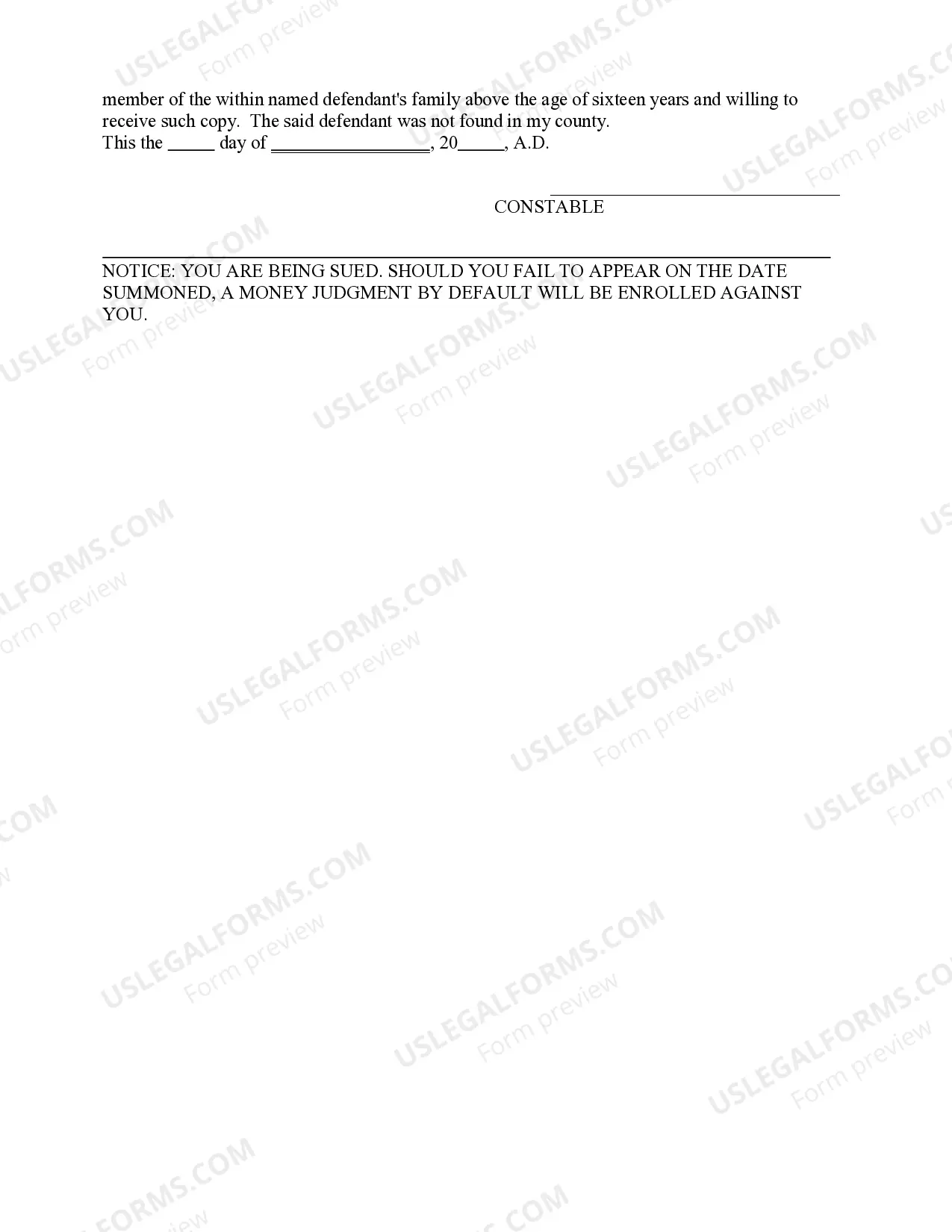
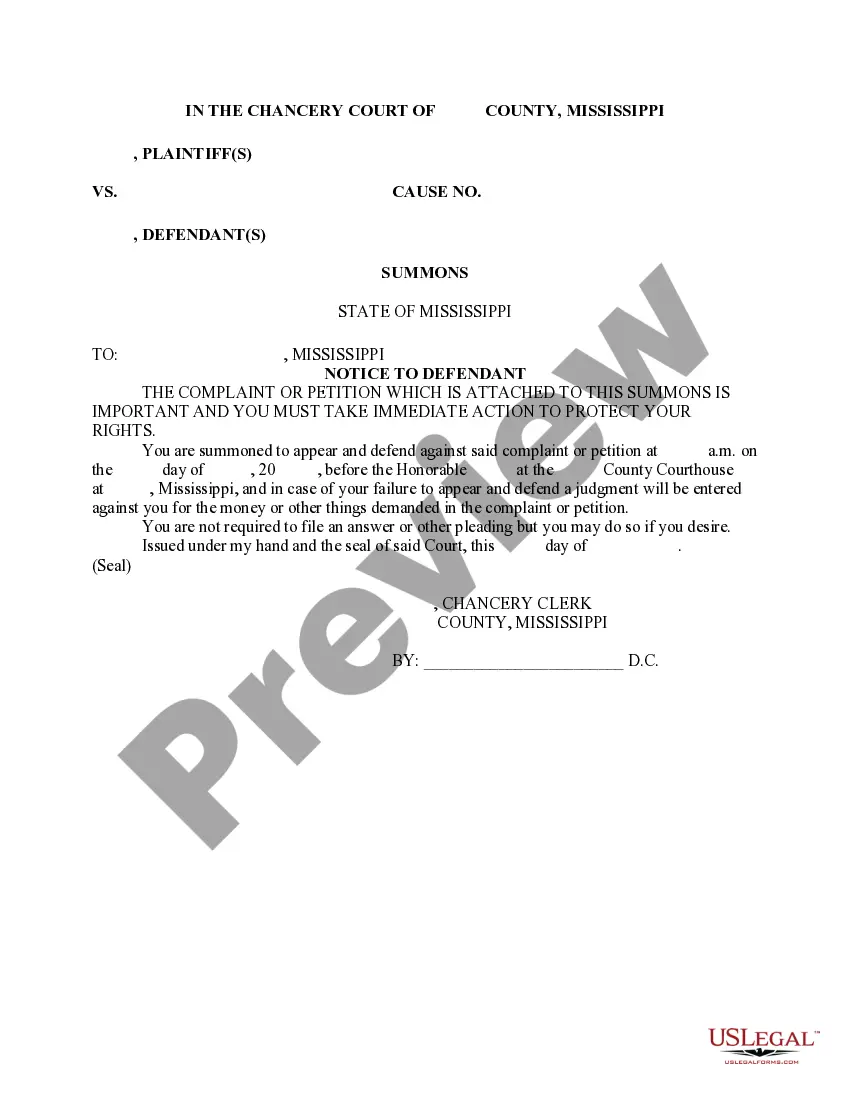
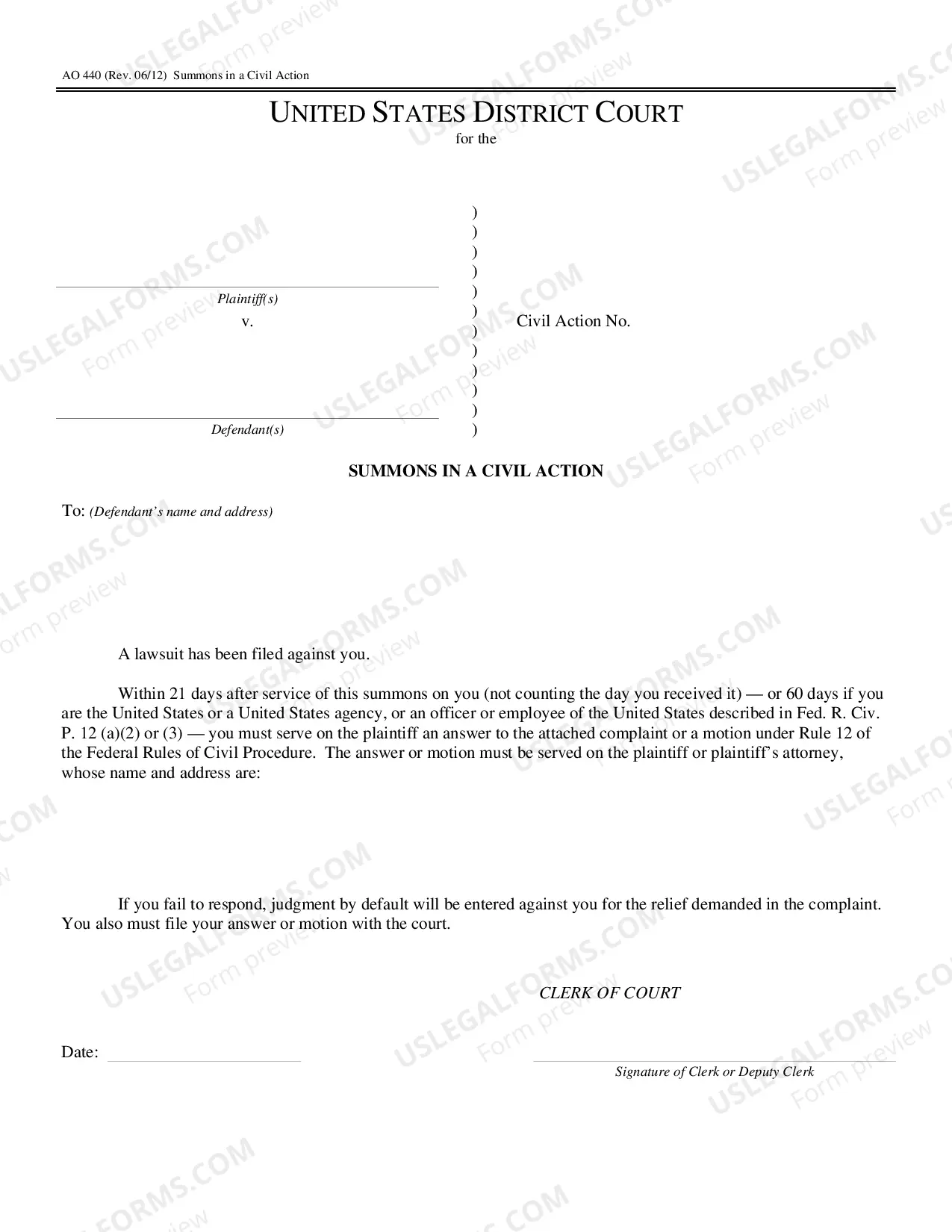
The Justice Court Summons is a legal document used in Mississippi to inform a defendant that a lawsuit has been filed against them. The summons requires the party being sued to appear in court on a specified date and time. Failure to appear may result in a Default Judgment against them. This form is crucial for initiating a legal proceeding and differs from other summonses by specifically addressing justice court cases in Mississippi.
Key parts of this document
- Case name and number: Identifies the lawsuit and relevant court information.
- Defendant's name and address: Specifies who is being sued.
- Date and time of appearance: Indicates when the defendant must appear in court.
- Court location: Provides the address of the courthouse where the hearing will take place.
- Signature of the court clerk: Validates the summons.
Situations where this form applies
This form should be used when you have filed a case against another party in a Mississippi justice court and are required to serve them with notice of the lawsuit. It is essential in situations such as landlord-tenant disputes, small claims, or other civil matters where a court appearance is necessary to resolve the case.
Who this form is for
Individuals or entities that are initiating a legal action in Mississippi's justice court should use this form, specifically:
- Plaintiffs seeking to notify defendants of upcoming court hearings.
- Landlords pursuing eviction processes.
- Parties involved in small claims or civil disputes.
Instructions for completing this form
- Identify the case name and number at the top of the document.
- Enter the full name and address of the defendant being served.
- Specify the date and time the defendant must appear in court.
- Fill in the courthouse address where the hearing will take place.
- Have the court clerk sign the form to validate it.
Notarization guidance
In most cases, this form does not require notarization. However, some jurisdictions or signing circumstances might. US Legal Forms offers online notarization powered by Notarize, accessible 24/7 for a quick, remote process.
Get your form ready online
Our built-in tools help you complete, sign, share, and store your documents in one place.
Make edits, fill in missing information, and update formatting in US Legal Forms—just like you would in MS Word.
Download a copy, print it, send it by email, or mail it via USPS—whatever works best for your next step.
Sign and collect signatures with our SignNow integration. Send to multiple recipients, set reminders, and more. Go Premium to unlock E-Sign.
If this form requires notarization, complete it online through a secure video call—no need to meet a notary in person or wait for an appointment.
We protect your documents and personal data by following strict security and privacy standards.

Make edits, fill in missing information, and update formatting in US Legal Forms—just like you would in MS Word.

Download a copy, print it, send it by email, or mail it via USPS—whatever works best for your next step.

Sign and collect signatures with our SignNow integration. Send to multiple recipients, set reminders, and more. Go Premium to unlock E-Sign.

If this form requires notarization, complete it online through a secure video call—no need to meet a notary in person or wait for an appointment.

We protect your documents and personal data by following strict security and privacy standards.
Mistakes to watch out for
- Incorrectly identifying the defendant, which can lead to validity issues.
- Failing to include the correct case number or court date.
- Not obtaining the court clerk's signature on the summons.
Benefits of completing this form online
- Convenient access from anywhere, saving time and travel.
- Edit and customize the form easily to meet your specific needs.
- Reliable templates drafted by licensed attorneys, ensuring legal accuracy.
Summary of main points
- The Justice Court Summons is vital for notifying defendants in Mississippi court cases.
- Completing the form accurately is essential to avoid mistakes that could invalidate the summons.
- Using online templates simplifies the process, providing convenience and legal compliance.
Looking for another form?

Form popularity
FAQ
There is a $30 filing fee for a case asking for up to $1500. To claim over $1500, and up to $5,000, there is a filing fee of $50. If your claim is above $5,000, the filing fee is $75.
If you are selected to serve on this Grand jury panel, you will serve approximately one to three days every month for an eighteen (18) month period.
It's difficult to come up with an average number for how much suing someone costs, but you should expect to pay somewhere around $10,000 for a simple lawsuit. If your lawsuit is complicated and requires a lot of expert witnesses, the cost will be much, much higher.
Justice Courts have jurisdiction over small claims civil cases involving amounts of $3,500 or less, misdemeanor criminal cases and any traffic offense that occurs outside a municipality. Justice Court judges may conduct bond hearings and preliminary hearings in felony criminal cases and may issue search warrants.
The current requirement under the Mississippi Constitution is residency within the county for two years preceding the election. Making Justice Court judges' salaries commensurate with supervisors in the same county. The recommendation would mean a salary range of $29,000 to $46,700.
Sixteen-year-old William Haymon has spent more than 500 days in an adult jail in rural Lexington, Mississippi. There are no state rules governing how long a person can be incarcerated without being formally charged with a crime.
A charge is brought against someone by a prosecutor. But in an indictment, a grand jury brings the charges against the defendant. All indictments are charges, but not all charges are indictments.
The criminal statute of limitations requires prosecutors to file criminal charges against a suspect within two years for misdemeanors and within five years for certain felonies, but there is no time limit in Mississippi for charges of murder, kidnapping, rape, burglary, robbery, larceny, and several other serious
Unlike a criminal complaint which can only be filed 2 times without cause there is no limit on going to the grand jury. At some point there may come a time when the prosecutor decides there in not enough evidence to proceed.