Missouri Transfer on Death Deed or TOD - Beneficiary Deed for two Individuals to an Individual
About this form
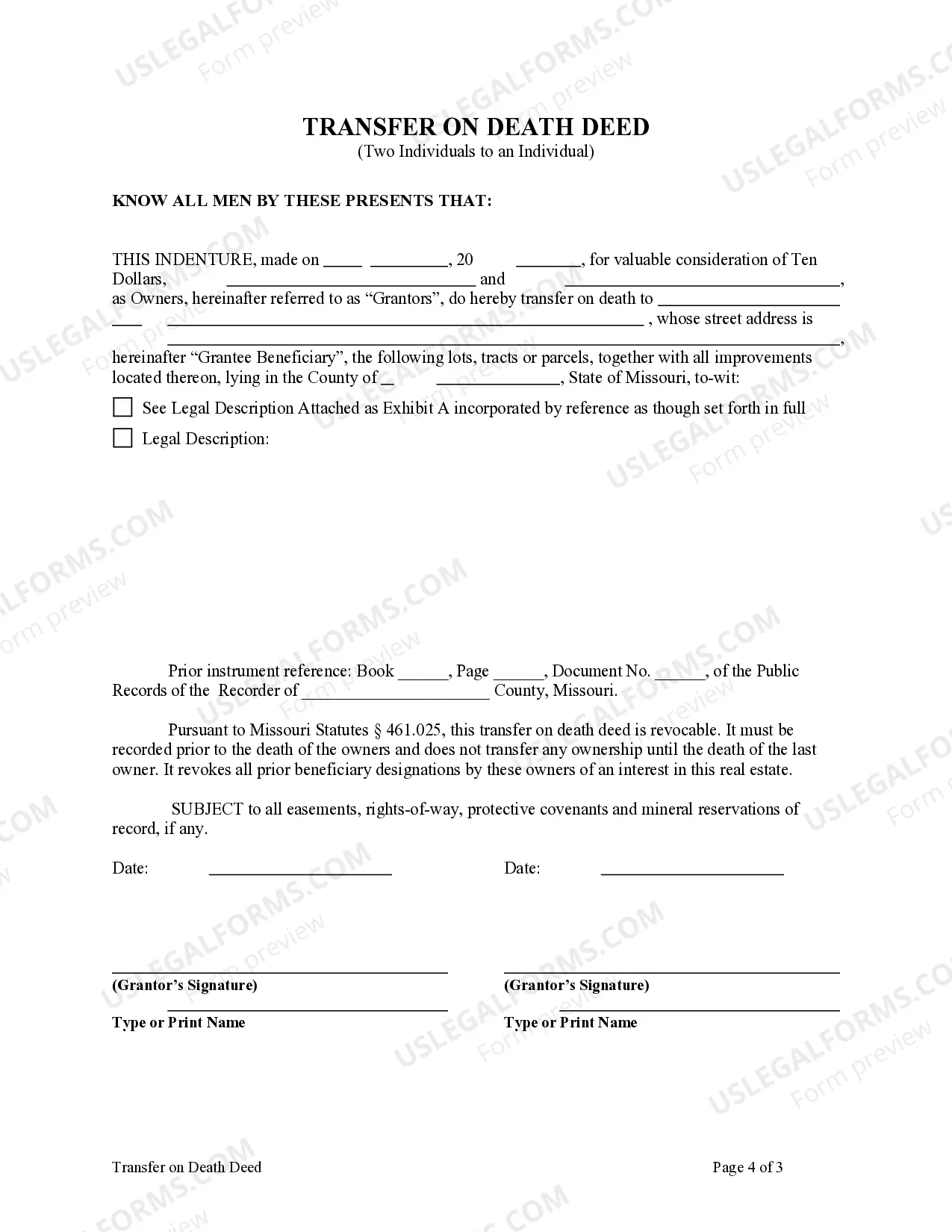
The Transfer on Death Deed (TOD) enables two individuals to transfer property title to an individual upon the death of the original owners. This deed is a useful estate planning tool that allows for the smooth transition of real estate without the need for probate, setting it apart from traditional wills and trusts.
What’s included in this form
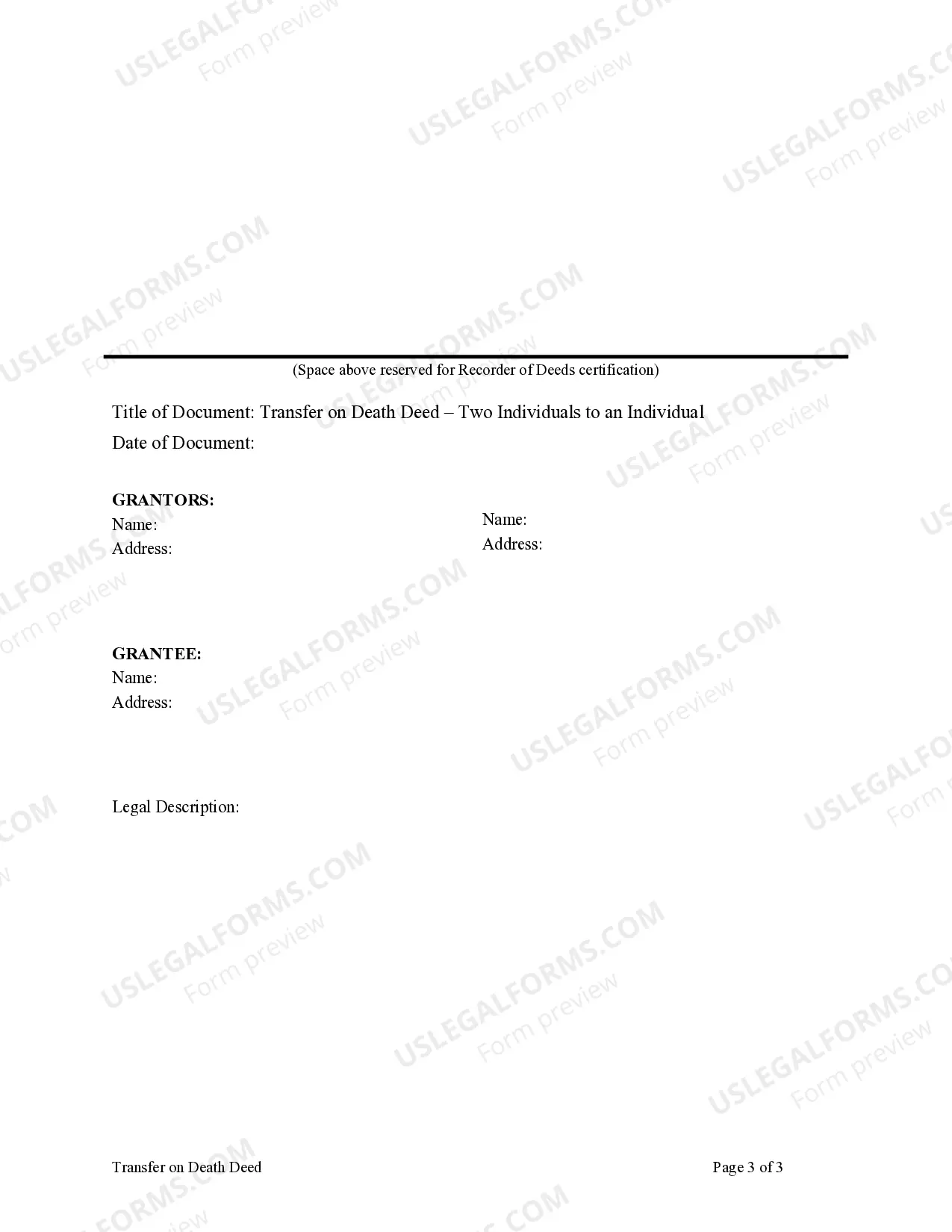
- Grantors: The two individuals transferring the property.
- Grantee: The individual receiving the property upon the grantors' passing.
- Legal Description: Detailed description of the property being transferred.
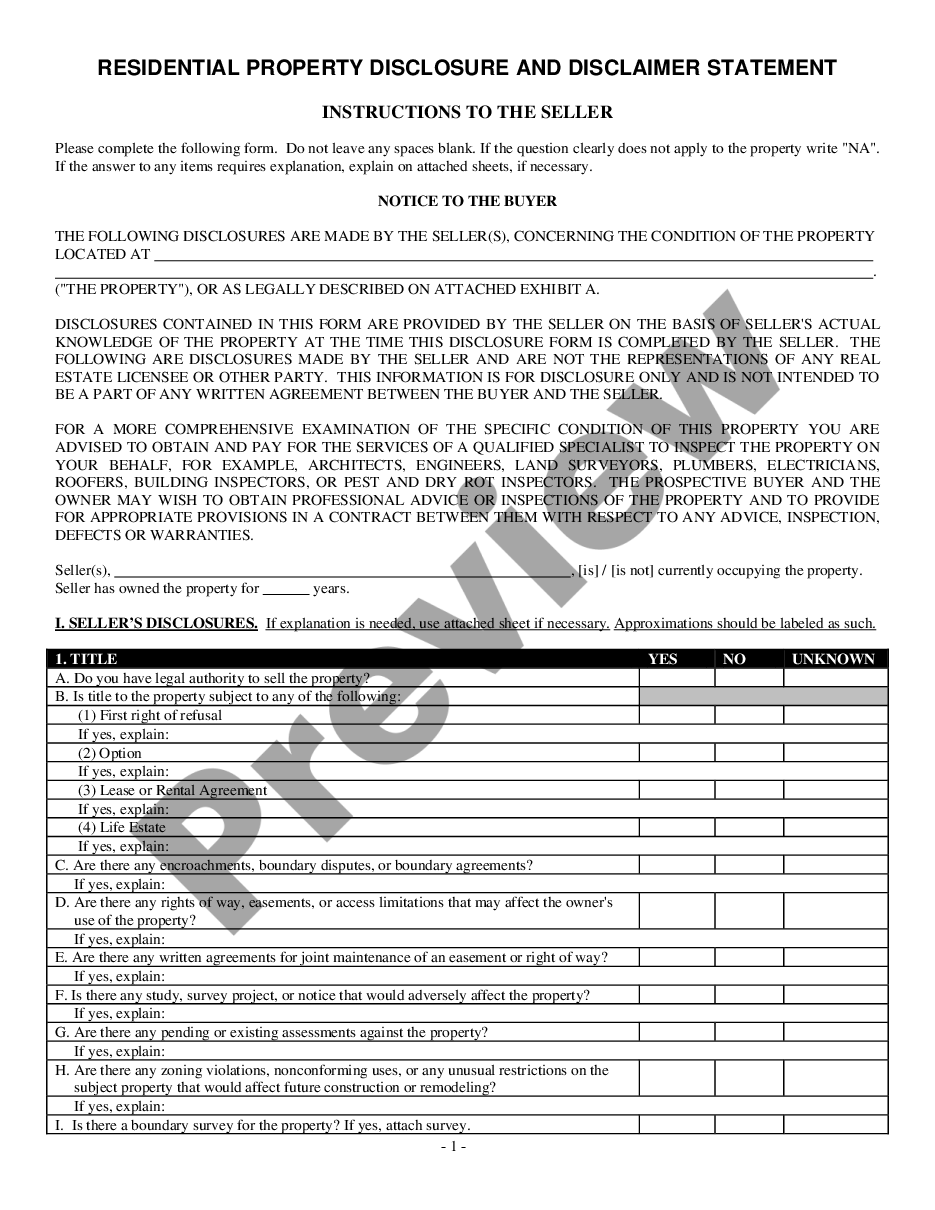
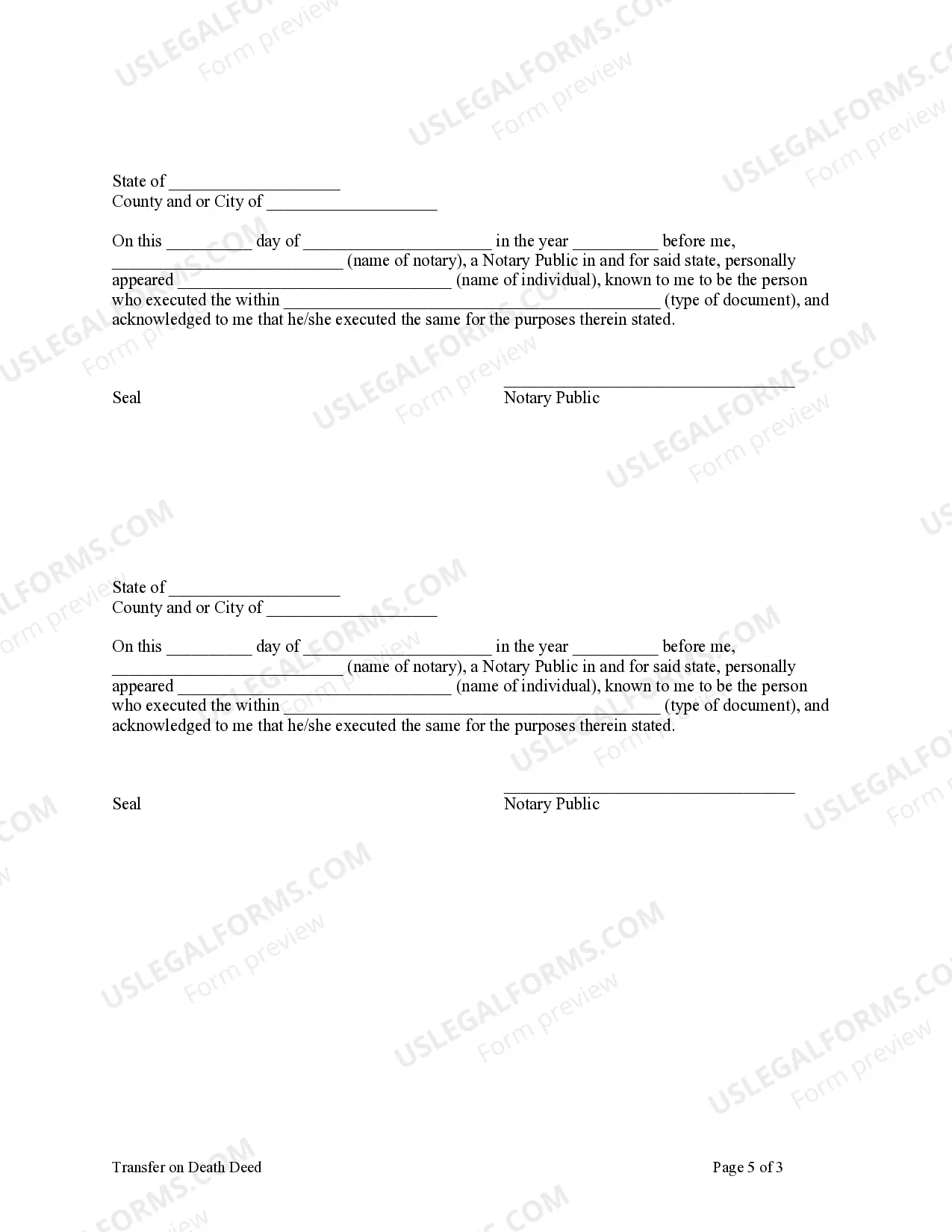
- Notary Section: Space to acknowledge the signing of the document by a notary public.
- Revocability Clause: Indicates that the deed can be revoked before the grantors' death.




When to use this form
You should use the Transfer on Death Deed when you want to ensure that your real estate automatically passes to a designated individual upon your death, avoiding the complexities of probate. This form is ideal for couples who wish to transfer property to a single person while retaining full control over the property during their lifetime.
Who can use this document
This form is suitable for:
- Couples or joint owners wanting to specify a beneficiary for their property.
- Individuals looking to simplify estate transfer processes.
- Those desiring to retain ownership rights until death.
Completing this form step by step
Follow these steps to complete the Transfer on Death Deed:
- Identify yourself as the grantors and the beneficiary.
- Clearly describe the property being transferred.
- Sign the deed in the presence of a notary public.
- Record the completed deed with the appropriate government office.
- Keep a copy for your records.
Does this document require notarization?
Yes, this form must be notarized to be legally valid. U.S. Legal Forms offers integrated online notarization, allowing you to complete the process via secure video calls, 24/7, without needing to travel.
Get your form ready online
Our built-in tools help you complete, sign, share, and store your documents in one place.
Make edits, fill in missing information, and update formatting in US Legal Forms—just like you would in MS Word.
Download a copy, print it, send it by email, or mail it via USPS—whatever works best for your next step.
Sign and collect signatures with our SignNow integration. Send to multiple recipients, set reminders, and more. Go Premium to unlock E-Sign.
If this form requires notarization, complete it online through a secure video call—no need to meet a notary in person or wait for an appointment.
We protect your documents and personal data by following strict security and privacy standards.

Make edits, fill in missing information, and update formatting in US Legal Forms—just like you would in MS Word.

Download a copy, print it, send it by email, or mail it via USPS—whatever works best for your next step.

Sign and collect signatures with our SignNow integration. Send to multiple recipients, set reminders, and more. Go Premium to unlock E-Sign.

If this form requires notarization, complete it online through a secure video call—no need to meet a notary in person or wait for an appointment.

We protect your documents and personal data by following strict security and privacy standards.
Common mistakes to avoid
- Failing to notarize the document, which is necessary for validity.
- Not properly identifying the property, leading to potential confusion later.
- Not recording the deed with local authorities, invalidating the transfer.
Benefits of using this form online
- Convenient online completion, allowing for edits before finalizing.
- Easy access to forms developed by licensed attorneys.
- Ability to store and share documents securely online.
Summary of main points
- The Transfer on Death Deed allows for a direct transfer of property upon death without probate.
- It is important to complete the form accurately and have it notarized.
- Once recorded, the deed legally secures the intended beneficiaryâs right to the property.
Looking for another form?
Form popularity
FAQ
Certainly, a Transfer on Death Deed or TOD - Beneficiary Deed for two Individuals to an Individual can accommodate two beneficiaries. This feature provides a straightforward way to transfer property without the need for probate, streamlining the process for your loved ones. However, consider specifying how the property will be shared to avoid potential conflicts later. Tools like US Legal Forms can help you draft a comprehensive deed that meets your specific needs.
Yes, you can have two beneficiaries on a Transfer on Death Deed or TOD - Beneficiary Deed for two Individuals to an Individual in Missouri. This flexibility allows you to designate multiple beneficiaries, ensuring your property passes smoothly according to your wishes. However, it's important to clearly outline how the property will be divided among the beneficiaries to prevent any confusion in the future. You may want to use platforms like US Legal Forms to create a clear and legally sound deed.
Using a Missouri Transfer on Death Deed or TOD - Beneficiary Deed for two Individuals to an Individual can have some disadvantages. One significant concern is that it may not address estate taxes, leaving the beneficiary responsible for any financial obligations. Additionally, if the deed is not properly executed or recorded, it could lead to disputes among heirs. It's essential to consult with a legal professional to ensure that this option aligns with your estate planning goals.
Filling out a beneficiary deed form involves entering your name, the property’s legal description, and the names of the beneficiaries. Make sure to double-check all information for accuracy. Using resources from USLegalForms can help streamline this process and ensure you meet all legal requirements.
To fill out a TOD deed, start by entering your personal details, including your name, address, and the legal description of the property. Then, clearly identify the beneficiaries and ensure their names are spelled correctly. Utilizing tools from platforms like USLegalForms can provide templates and guidance to help you complete your TOD deed accurately.
Yes, a Missouri Transfer on Death Deed can designate two individuals as beneficiaries. This allows both parties to inherit the property jointly, simplifying the transfer process. It is crucial to specify how the property will be divided or managed between the beneficiaries to avoid confusion later.
To fill out a Missouri beneficiary deed form, start by providing your name and address, followed by the details of the property you wish to transfer. Next, clearly list the beneficiaries you intend to inherit the property. Ensure all information is correct to prevent issues after your passing; using a reliable platform like USLegalForms can simplify this process.
The TOD rule in Missouri allows property owners to transfer their real estate to named beneficiaries upon their death without going through probate. This rule streamlines the inheritance process, making it easier for heirs to claim the property. Keeping this rule in mind can help you effectively use a Missouri Transfer on Death Deed or TOD - Beneficiary Deed for two Individuals to an Individual.
While you can complete a Missouri Transfer on Death Deed or TOD - Beneficiary Deed for two Individuals to an Individual without a lawyer, legal assistance can ensure accuracy and compliance with Missouri laws. A lawyer can provide guidance on the specific requirements and implications of creating a TOD deed. This support can help you avoid mistakes that may complicate the transfer process later.
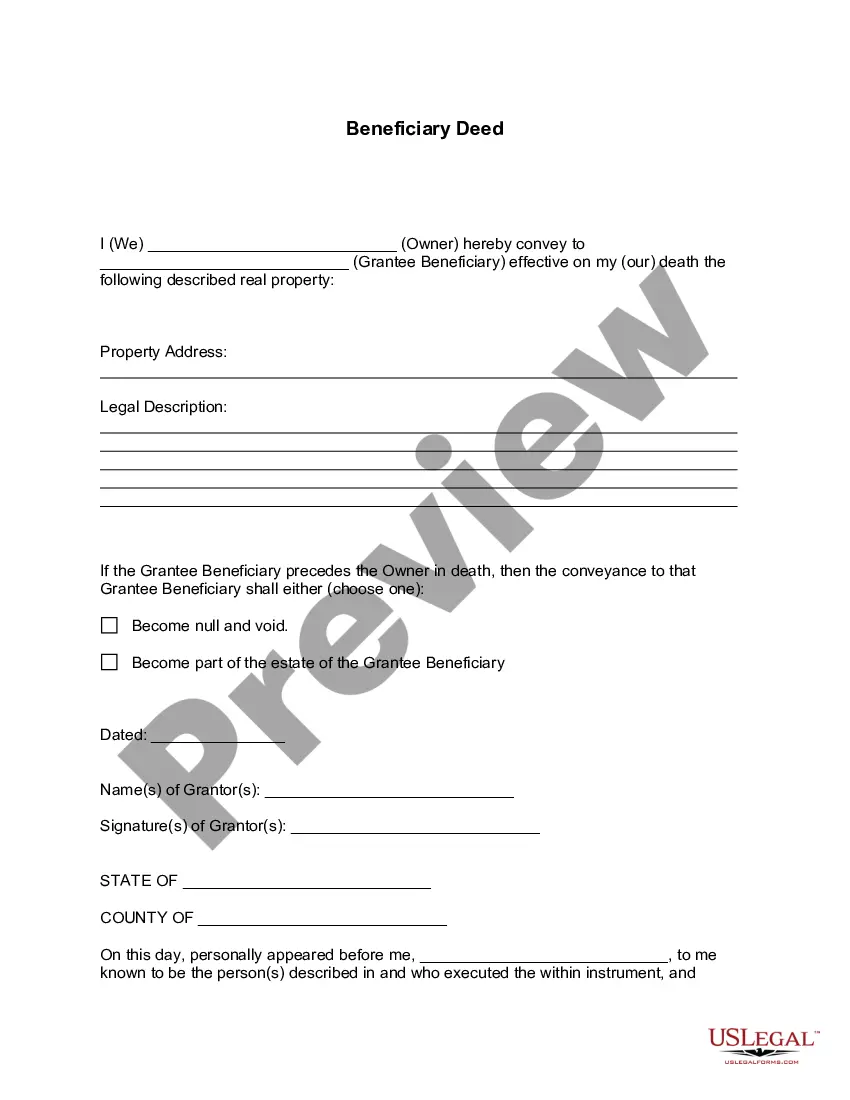
A beneficiary deed, also known as a Missouri Transfer on Death Deed, allows property owners to designate beneficiaries who will inherit the property upon their death. This deed helps avoid probate and simplifies the transfer process. It is essential for those looking to pass on real estate to individuals without the complications of a lengthy legal procedure.