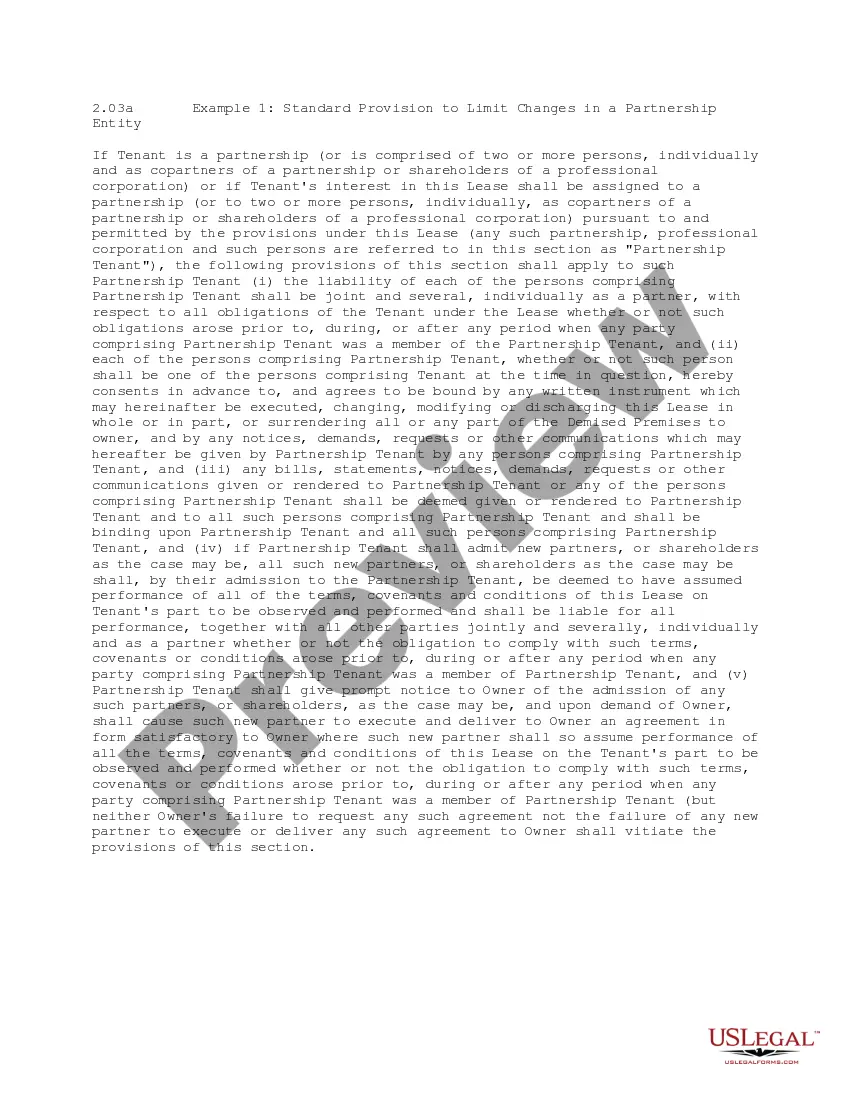
Standard Provision to Limit Changes in a Partnership Entity
What this document covers
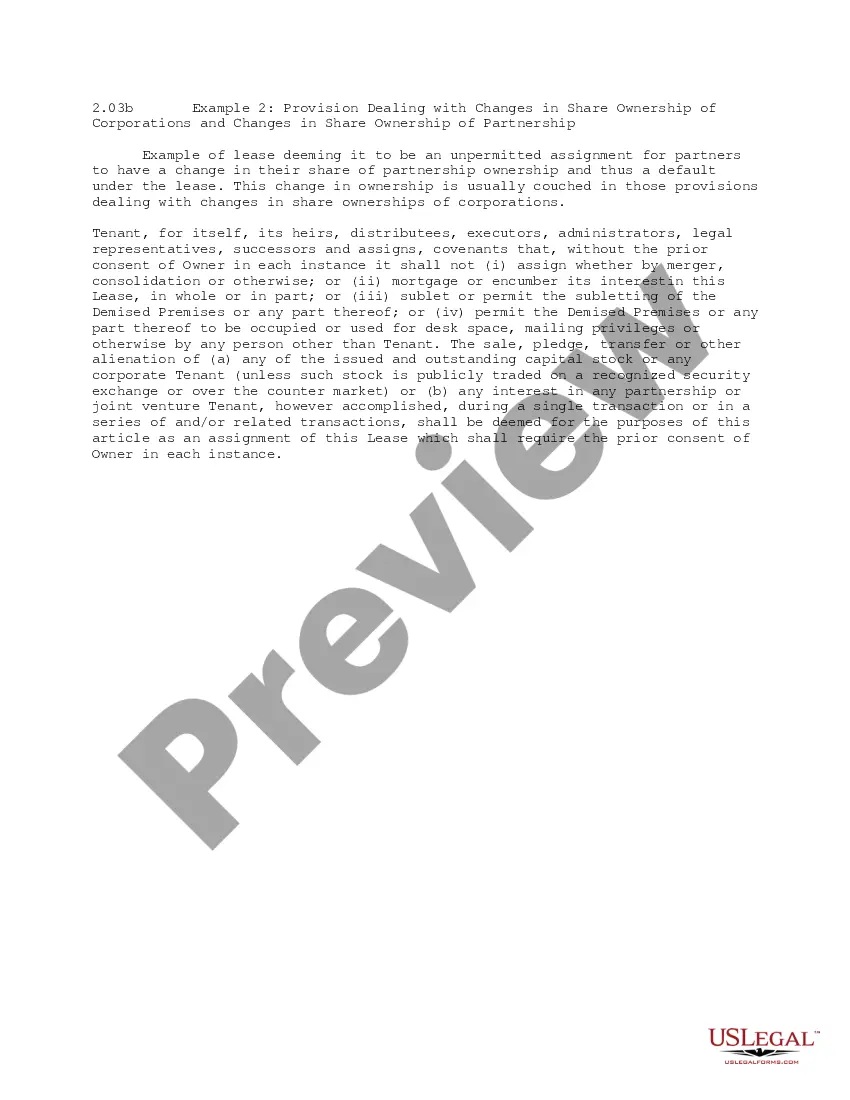
The Standard Provision to Limit Changes in a Partnership Entity is a legal document designed for partnership tenants in lease agreements. This form clarifies the responsibilities and liabilities of partners and shareholders involved in a lease. Unlike standard leases, this provision specifically addresses the complexities that arise when a tenant is a partnership, ensuring that all members are held accountable for the lease terms, regardless of changes in partnership structure or individuals involved.
Key parts of this document
- Definition of Partnership Tenant: Clarifies who qualifies as a partnership tenant and includes professional corporations.
- Joint and Several Liability: States all partners are individually responsible for lease obligations, whether the obligations arose before or after their partnership.
- Consent to Lease Modifications: Partners agree to be bound by any changes to the lease, even if made after their association with the partnership.
- Notification Requirement: Partners must notify the landlord upon admitting new members to the partnership and ensure these new members assume lease obligations.
- Document Binding: Clarifies that communications and obligations apply to all partners collectively and individually.
When to use this form
This form should be used when a partnership is leasing property or if a partnership will be assigned a tenant's lease. It is particularly useful in situations where there may be changes in partnership composition, such as the addition of new partners, or changes in the roles of existing partners, ensuring that all parties are aware of their responsibilities and liabilities under the lease.
Who needs this form
This form is intended for:
- Partnerships entering into lease agreements.
- Professional corporations leasing property.
- Existing tenants who plan to assign their lease to a partnership.
- Property owners and landlords who seek clarity on tenant responsibilities in partnership leases.
How to complete this form
- Identify the partnership entities involved, including their names and addresses.
- Specify the property being leased, including details like address and lease term.
- List all current partners and their roles within the partnership.
- Include details about any new partners or shareholders anticipated during the lease term.
- Seek signatures from all listed partners to acknowledge agreement to the lease conditions.
Notarization guidance
In most cases, this form does not require notarization. However, some jurisdictions or signing circumstances might. US Legal Forms offers online notarization powered by Notarize, accessible 24/7 for a quick, remote process.
Get your form ready online
Our built-in tools help you complete, sign, share, and store your documents in one place.
Make edits, fill in missing information, and update formatting in US Legal Forms—just like you would in MS Word.
Download a copy, print it, send it by email, or mail it via USPS—whatever works best for your next step.
Sign and collect signatures with our SignNow integration. Send to multiple recipients, set reminders, and more. Go Premium to unlock E-Sign.
If this form requires notarization, complete it online through a secure video call—no need to meet a notary in person or wait for an appointment.
We protect your documents and personal data by following strict security and privacy standards.

Make edits, fill in missing information, and update formatting in US Legal Forms—just like you would in MS Word.

Download a copy, print it, send it by email, or mail it via USPS—whatever works best for your next step.

Sign and collect signatures with our SignNow integration. Send to multiple recipients, set reminders, and more. Go Premium to unlock E-Sign.

If this form requires notarization, complete it online through a secure video call—no need to meet a notary in person or wait for an appointment.

We protect your documents and personal data by following strict security and privacy standards.
Mistakes to watch out for
- Failing to include all partners in the lease agreement.
- Not updating the lease when new partners are admitted to the partnership.
- Overlooking the requirement to notify landlords about changes in partnership structure.
- Assuming individual partners are not liable for obligations originated before they joined the partnership.
Benefits of completing this form online
- Convenient access to legal documents anytime and anywhere.
- Editable templates allow for tailored agreements that fit specific partnership needs.
- Reliability of forms drafted by licensed attorneys to ensure compliance with legal standards.
Legal use & context
- This form is legally binding, enforcing the obligations of partners in a lease agreement.
- Proper use helps prevent disputes arising from misunderstandings about partnership obligations.
- Allows partnerships to operate under a clear framework while managing lease arrangements.
Quick recap
- The form clarifies the roles and responsibilities of partners in a lease agreement.
- It facilitates legal protection for both the partnership and the property owner.
- Utilizing this template can prevent legal complications related to partner changes.
Glossary of terms
- Partnership Tenant: A legal entity comprised of partners who share liability for lease obligations.
- Joint and Several Liability: Each partner is individually responsible for fulfilling the lease obligations, regardless of which partner incurred them.
- Lease Agreement: A contract outlining the rights and responsibilities of landlords and tenants.
Looking for another form?

Form popularity
FAQ
Most typically, the partnership agreement will be altered to amend the profit and loss sharing ratios for the prior year.Such a change can also have other ancillary effects, such as changing the way nonrecourse liabilities may be shared among the partners under Sec.
Generally, when there's a change in one or more partnership interests during a year, the variation creates a segment, or distinct time period, within the partnership's tax year on which to base income allocations.
Build a real relationship. The best and often most successful partnerships are built on the foundation of a friendship or working rapport together. Establish a plan early on. Once you become interested in a business as a potential partner, don't wait to get things moving. Cross blogging.
Select organisation(s) with shared interest, vision, goal & objectives. Understand partners' motivations and interests. Choose diverse and credible partners. Analyse strengths and weaknesses and ensure they complement each other.
Sacrificing ratio. New profit sharing ratio. Revaluation of assets and Reassessment of liabilities. Valuation and adjustment of goodwill. Adjustment of partners' capitals. Distribution of accumulated profits (reserves)
Set clear expectations. You should have a strong connection with the business you partner with, but hammering out the details of that partnership has to be more technical than emotional. Consider your partner a part of your team. Give the partnership room to grow. Make honesty and transparency your watchwords.
Successful partnerships require partners who are consistently attuned to what is happening within and outside of the relationship, and the possible impacts on the partnership.They set aside preconceived notions about the other partners and see each person for who they are and for what they bring to the relationship.
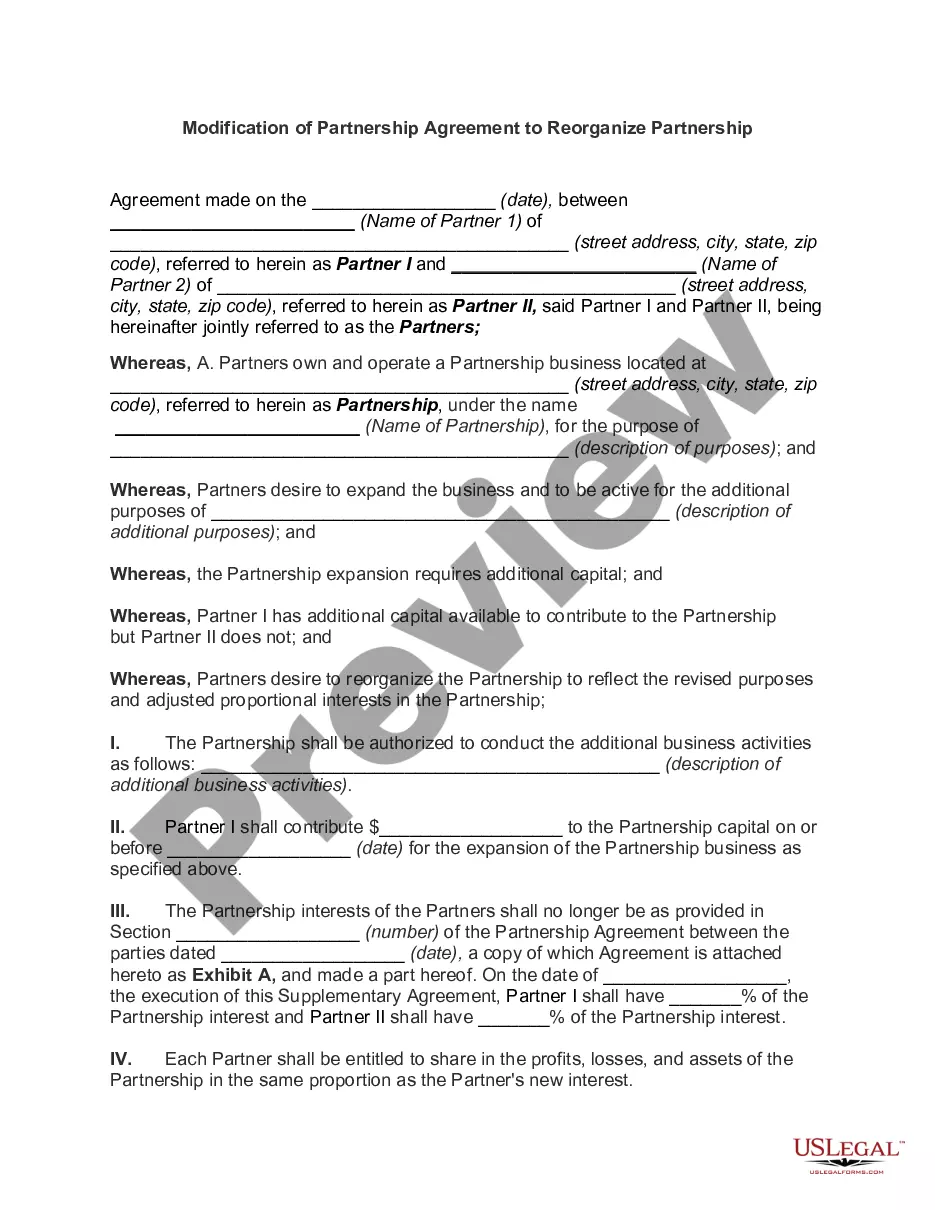
A Partnership Agreement may be amended in accordance with the terms of that agreement.
Many partnerships arise from one-off funding opportunities, or personal connections.Partnerships can also take many forms from equal partnerships who come together to design and deliver a joint piece of work; to partnerships where one organisation is providing a service to the other.