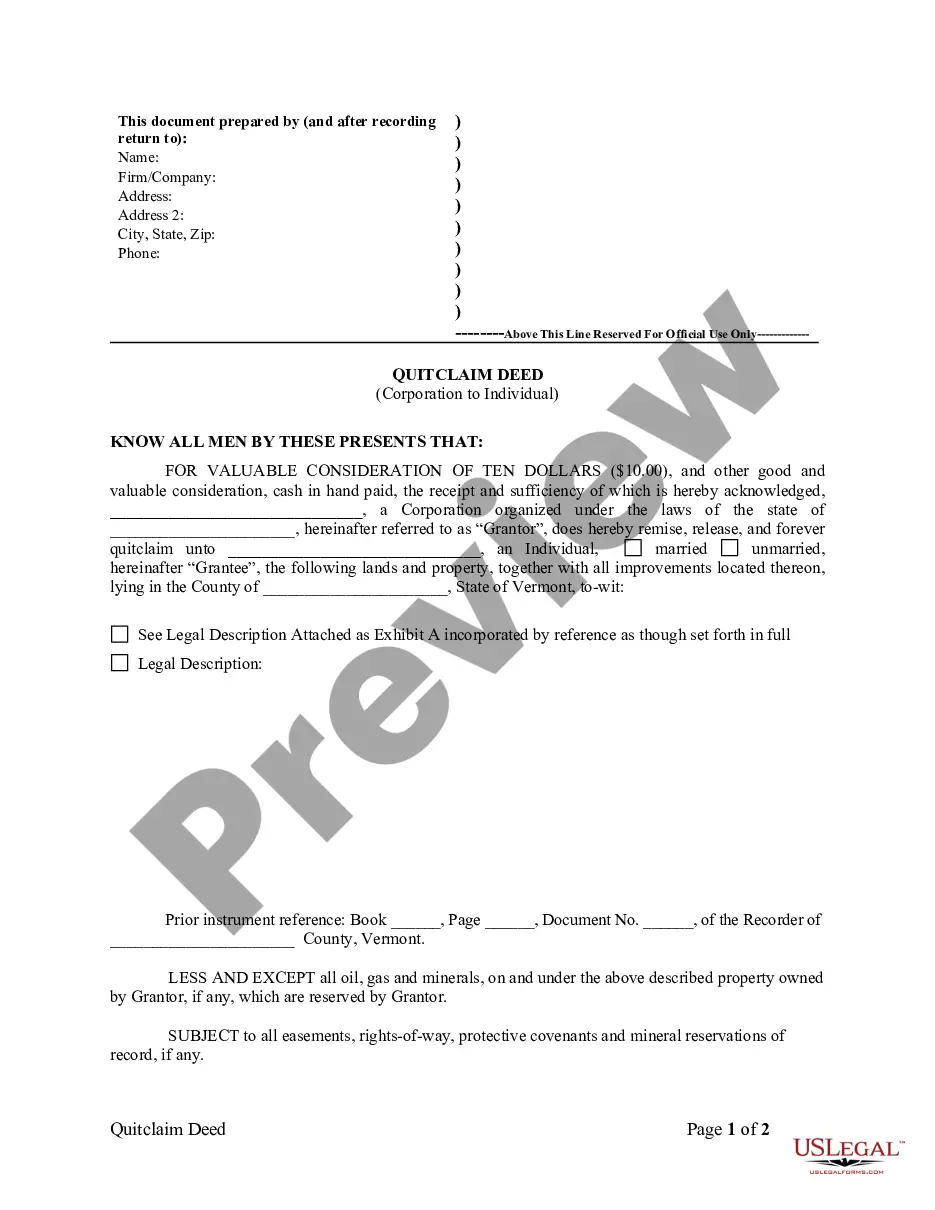
Missouri Complaint for a Declaratory Judgment through the Circuit Court Ordering the Department of Revenue to issue a Certificate of Title to Complainant
Overview of this form
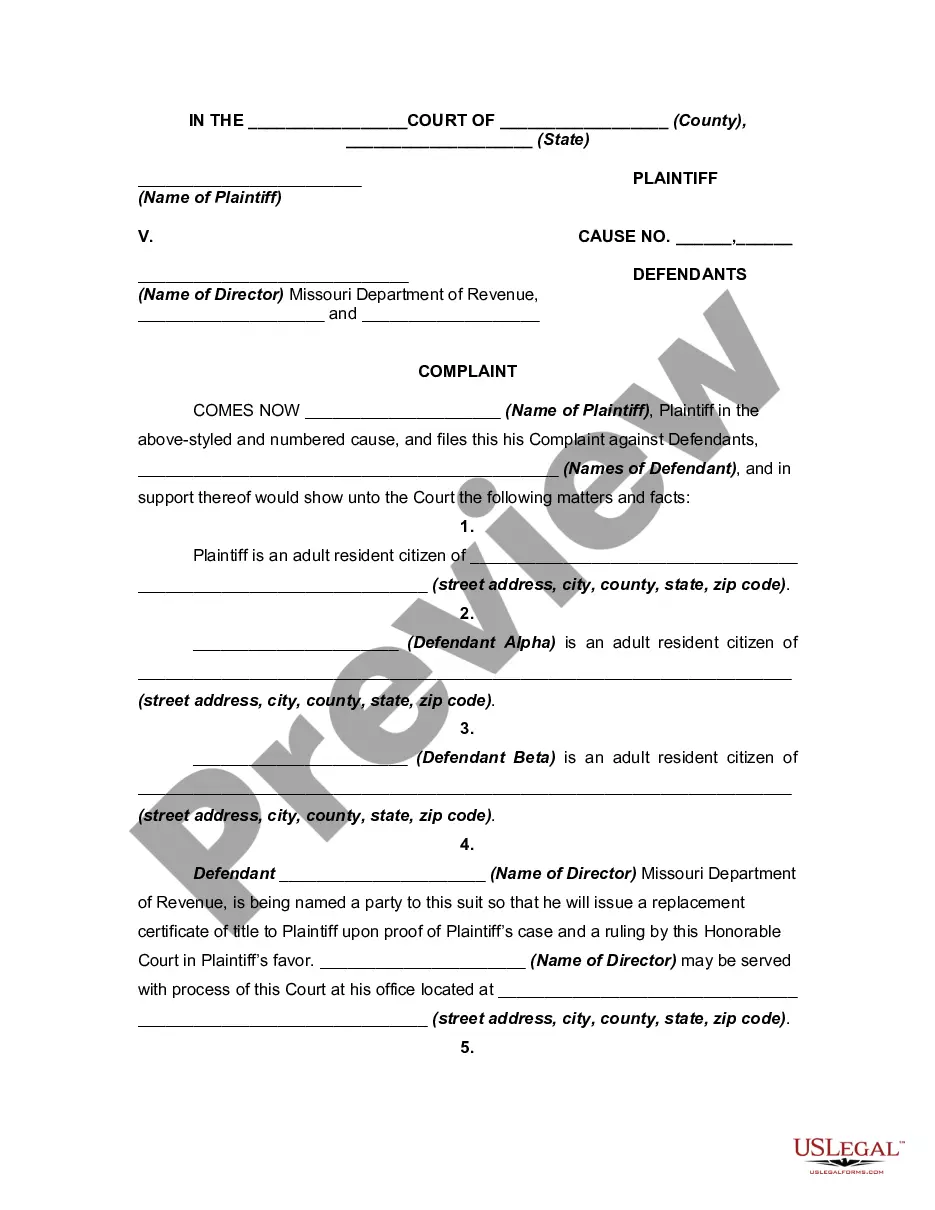
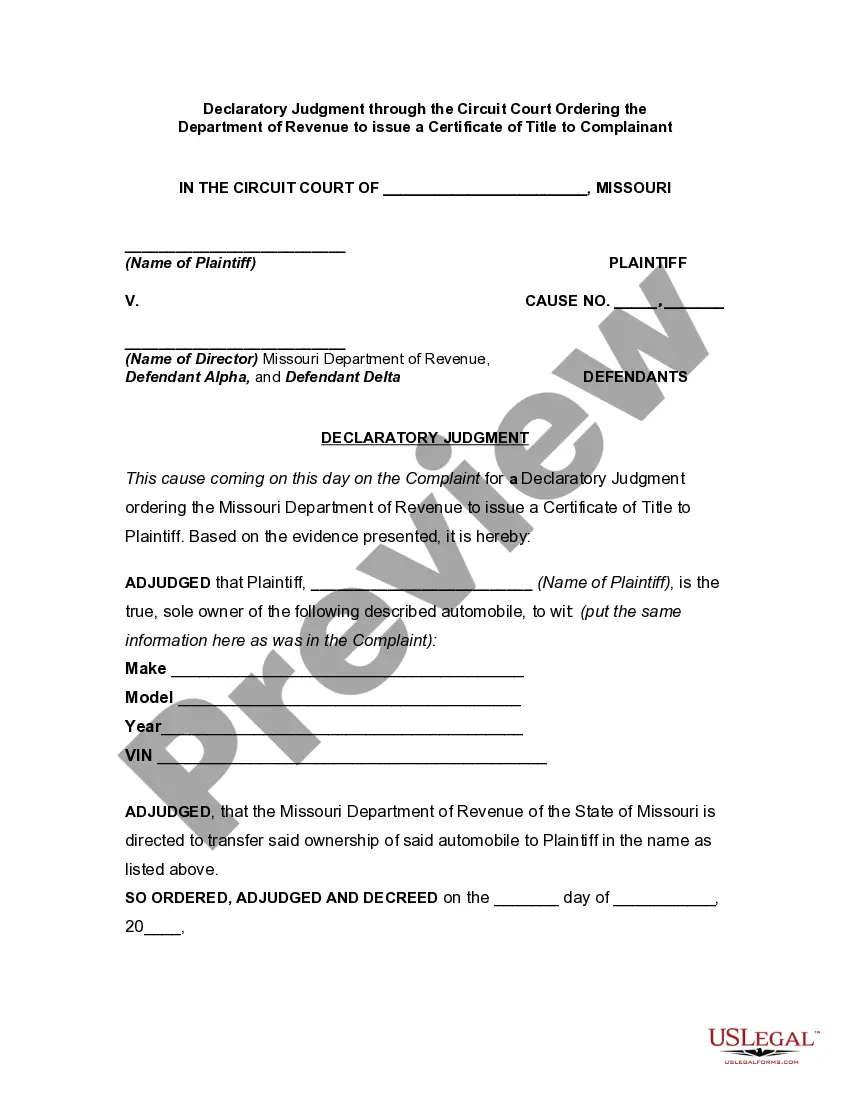
The Complaint for a Declaratory Judgment is a legal document used to request a court ruling that a person is the rightful owner of a vehicle. This form is particularly useful when you do not possess a bill of sale but can provide adequate proof of ownership. By filing this complaint, you can ask the Circuit Court to order the Department of Revenue to issue a Certificate of Title in your name.
Main sections of this form
- Names and addresses of the plaintiff and defendants.
- Details about the vehicle, including make, model, year, and VIN.
- Allegations regarding ownership and purchase circumstances.
- Request for the court to issue a judgment recognizing ownership.
- Verification by a notary public as part of the filing process.




When this form is needed
You should use this form when you have purchased a vehicle but lack a formal title or bill of sale, and you need to establish legal ownership. This scenario may arise if you obtained the vehicle from someone who failed to transfer the title correctly or if you suspect that the title is in another person's name due to abandonment or fraud.
Who this form is for
- Individuals who have purchased a vehicle without receiving a title.
- Owners looking to prove their rightful ownership in a legal setting.
- Anyone who wants to obtain a Certificate of Title from the Department of Revenue through a court order.
Instructions for completing this form
- Identify all parties involved, including the plaintiff and defendants.
- Provide the vehicle's details, such as make, model, and VIN.
- State the circumstances of the purchase and the lack of title.
- Attach any supporting documents that prove your ownership, such as canceled checks or correspondence.
- Sign the complaint in front of a notary public for verification.
Does this document require notarization?
This form must be notarized to be legally valid. US Legal Forms provides secure online notarization powered by Notarize, allowing you to complete the process through a verified video call.
Get your form ready online
Our built-in tools help you complete, sign, share, and store your documents in one place.
Make edits, fill in missing information, and update formatting in US Legal Forms—just like you would in MS Word.
Download a copy, print it, send it by email, or mail it via USPS—whatever works best for your next step.
Sign and collect signatures with our SignNow integration. Send to multiple recipients, set reminders, and more. Go Premium to unlock E-Sign.
If this form requires notarization, complete it online through a secure video call—no need to meet a notary in person or wait for an appointment.
We protect your documents and personal data by following strict security and privacy standards.

Make edits, fill in missing information, and update formatting in US Legal Forms—just like you would in MS Word.

Download a copy, print it, send it by email, or mail it via USPS—whatever works best for your next step.

Sign and collect signatures with our SignNow integration. Send to multiple recipients, set reminders, and more. Go Premium to unlock E-Sign.

If this form requires notarization, complete it online through a secure video call—no need to meet a notary in person or wait for an appointment.

We protect your documents and personal data by following strict security and privacy standards.
Common mistakes
- Failing to provide complete addresses for all parties.
- Not including all relevant documentation to support the claim of ownership.
- Omitting to sign the complaint in front of a notary.
- Not filing the complaint in the correct jurisdiction or court.
Benefits of completing this form online
- Easy to download and complete at your convenience.
- Editable templates allow for customization based on individual circumstances.
- Access to professionally drafted forms ensures legal compliance.
Looking for another form?
Form popularity
FAQ
To obtain a court-ordered title in Missouri, you will need to file a Missouri Complaint for a Declaratory Judgment through the Circuit Court Ordering the Department of Revenue to issue a Certificate of Title to Complainant. This complaint should detail your ownership and the circumstances that necessitate the court's intervention. After filing, the court will review your request and issue a judgment if you meet the necessary criteria. Using platforms like uslegalforms can simplify this process by providing templates and guidance tailored to your needs.
To obtain a declaratory judgment in Missouri, you must establish that an actual dispute exists regarding your legal rights or obligations. Your Missouri Complaint for a Declaratory Judgment through the Circuit Court Ordering the Department of Revenue to issue a Certificate of Title to Complainant should clearly outline the facts and the legal issues at hand. Additionally, ensure that you have proper jurisdiction and standing to file the complaint. By following these guidelines, you can navigate the process more effectively.
A complaint for declaratory judgment is a legal document filed in court when a party seeks a court's determination on a specific legal question. In the context of a Missouri Complaint for a Declaratory Judgment through the Circuit Court Ordering the Department of Revenue to issue a Certificate of Title to Complainant, it requests the court to clarify rights and duties regarding title issuance. This type of complaint helps resolve uncertainties and can prevent future disputes. Using platforms like uslegalforms can simplify drafting and filing this essential document.
In a Missouri Complaint for a Declaratory Judgment through the Circuit Court Ordering the Department of Revenue to issue a Certificate of Title to Complainant, the burden of proof typically lies with the complainant. This means you must present sufficient evidence to demonstrate your entitlement to the relief sought. It's essential to establish that the Department of Revenue has a duty to act and that you have a legitimate interest in the matter. Understanding this burden can help you effectively prepare your case.
A second consideration is whether it makes business sense to undertake the costs that go along with a declaratory judgment action. Even in a relatively simple case, it may take $10,000 to $20,000 to obtain a summary judgment on the duty to defend.
Declaratory relief is defined as an action by any person interested in a deed, will, contract or other written instrument, executive order or resolution, to determine any question of construction or validity arising from the instrument, executive order or regulation, or statute, and for a declaration of his rights and
The Court clarified that declaratory judgment jurisdiction required disputes to be 'definite and concrete, touching the legal relations of the parties having adverse legal interests'; and that it be 'real and substantial' and 'admit of specific relief through a decree of a conclusive character, as distinguished from
Review the facts of the case. Research and obtain additional evidence and title information from the client or the Missouri Department of Revenue. File a petition asking the appropriate court for a declaratory judgment.
A declaratory judgment is a binding judgment from a court defining the legal relationship between parties and their rights in a matter before the court. Typically, a party will first send a cease and desist letter prior to seeking declaratory judgment from a court.A declaratory judgment is also called a declaration.
The above submissions of counsel for the defendants are the mainstay of the contention for the defendants by their counsel, Chief Benson, S.A.N., that declaratory judgments can sometimes be stayed having accepted, as I understand him to have done, that, generally speaking, declaratory judgments cannot be stayed.