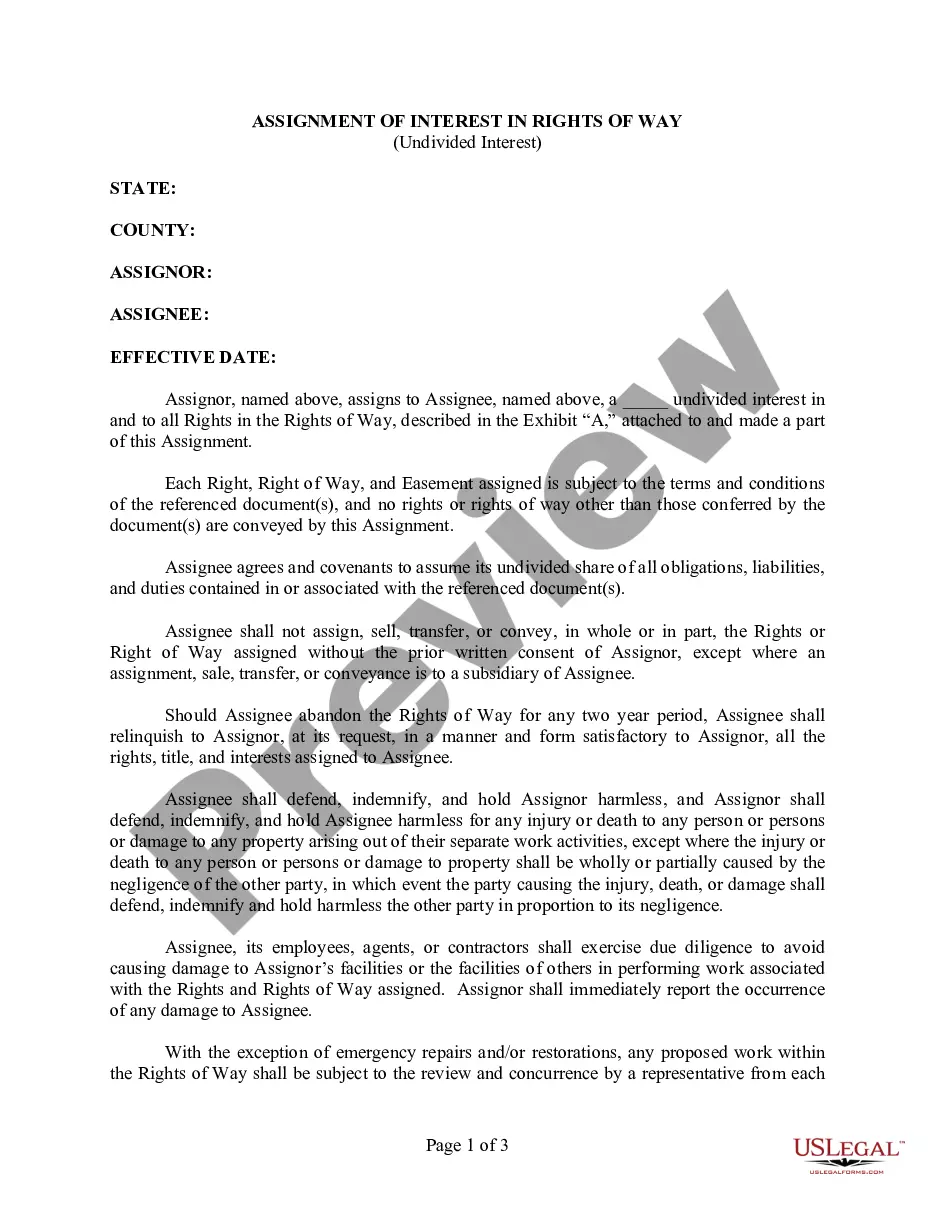
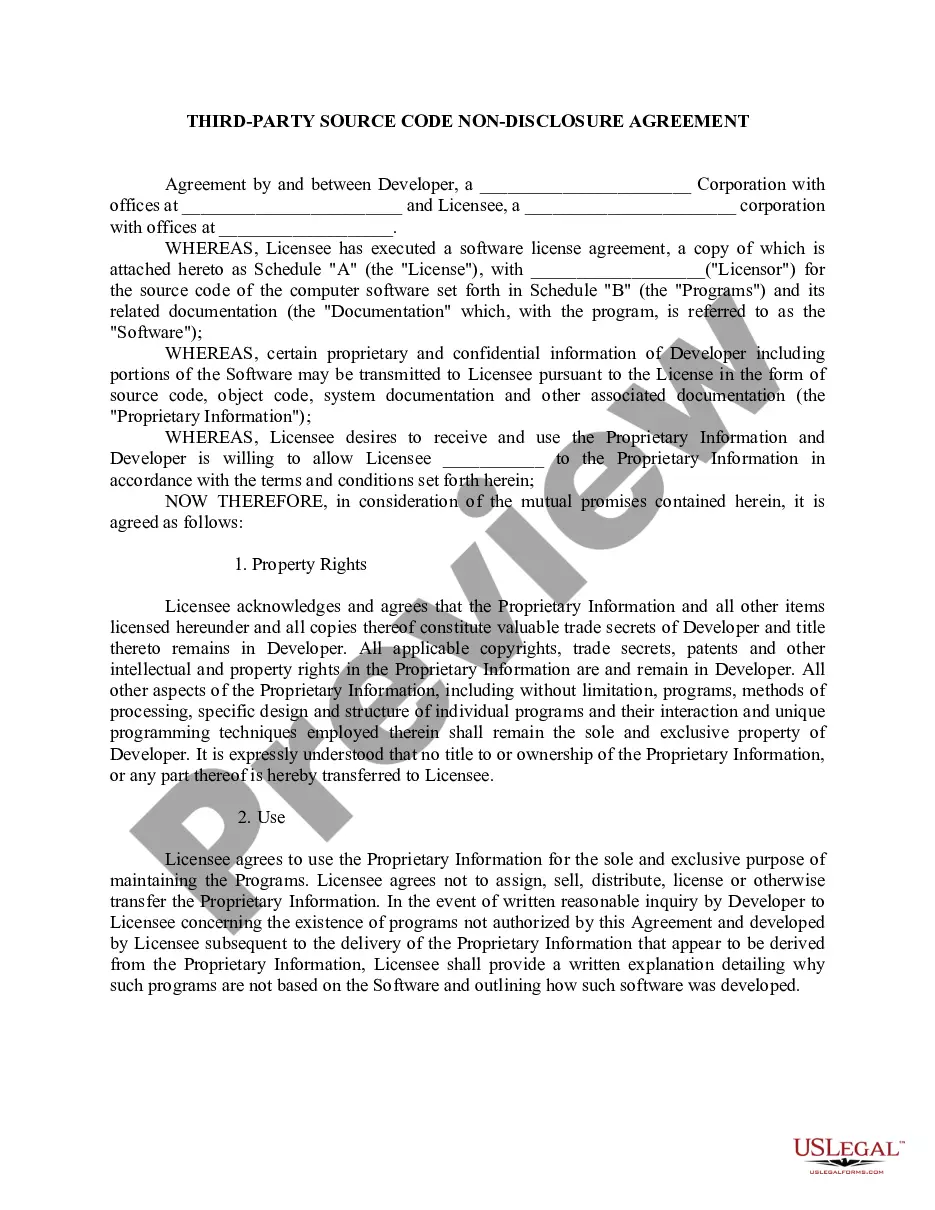
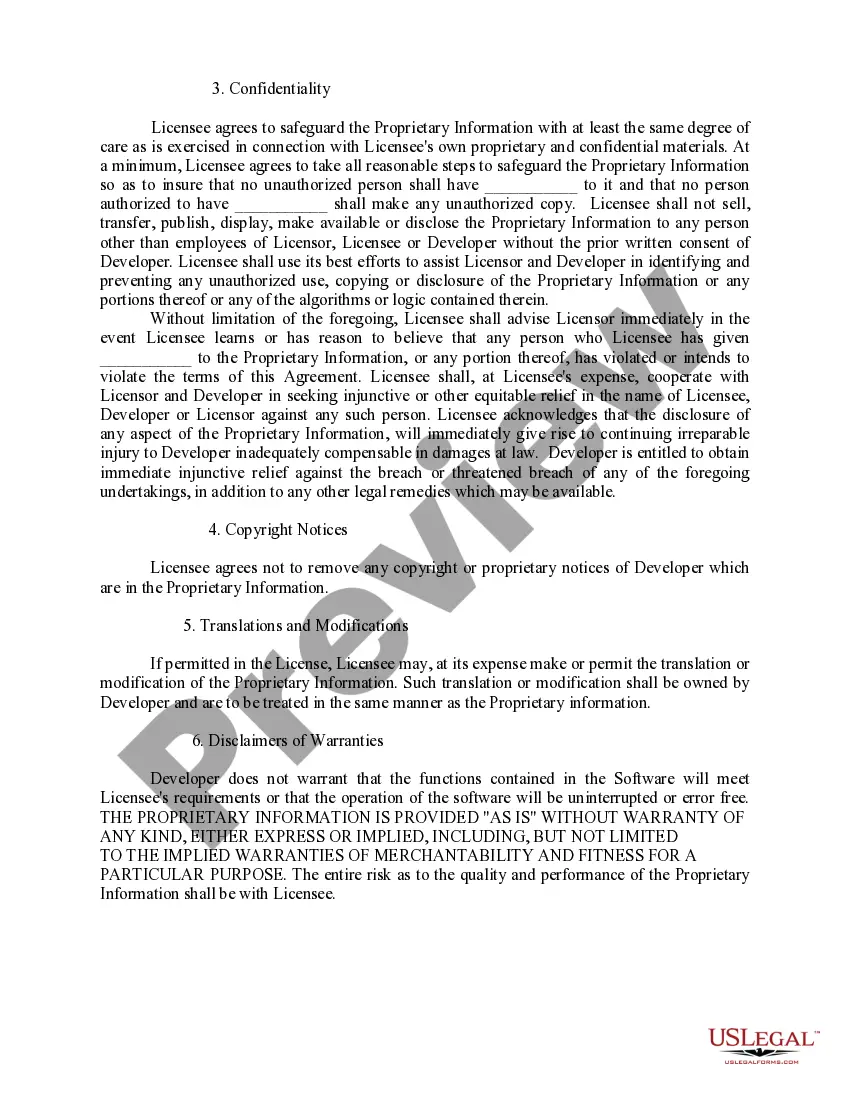
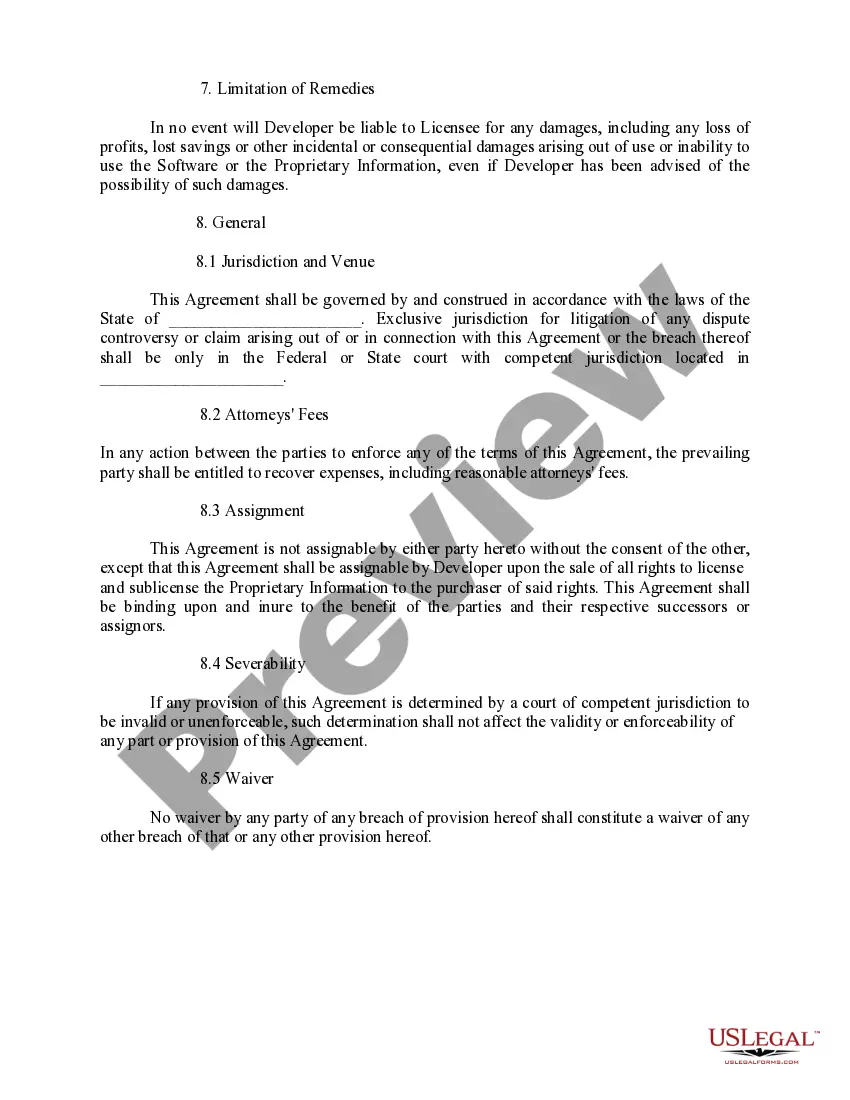
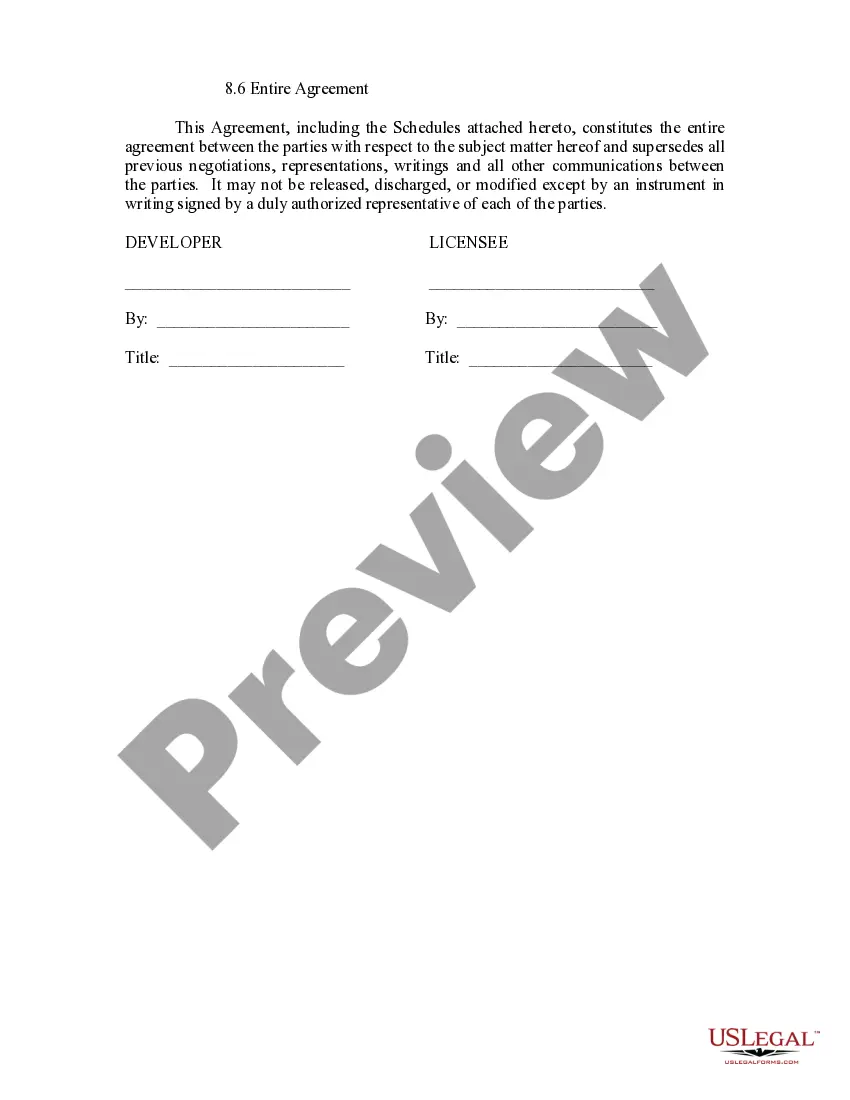
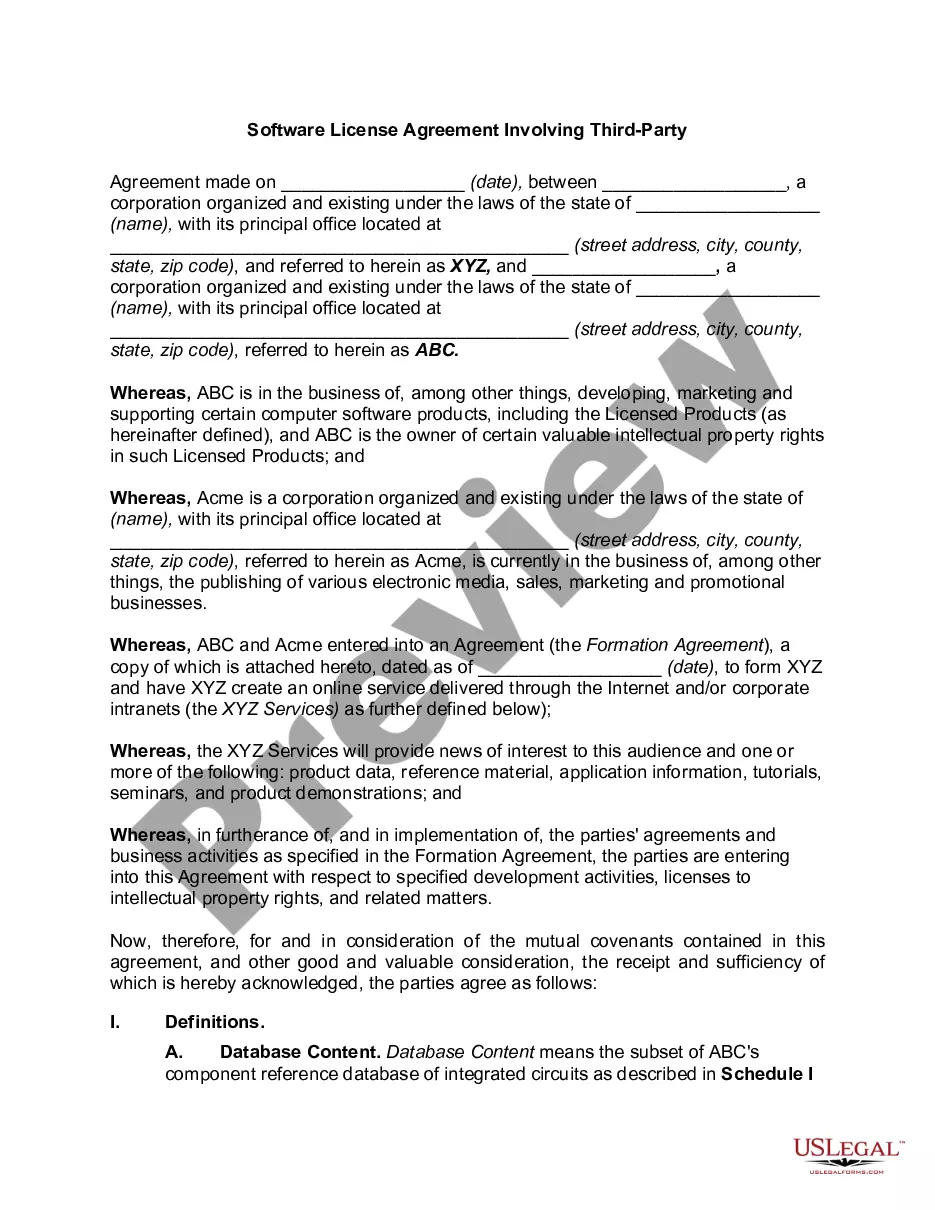
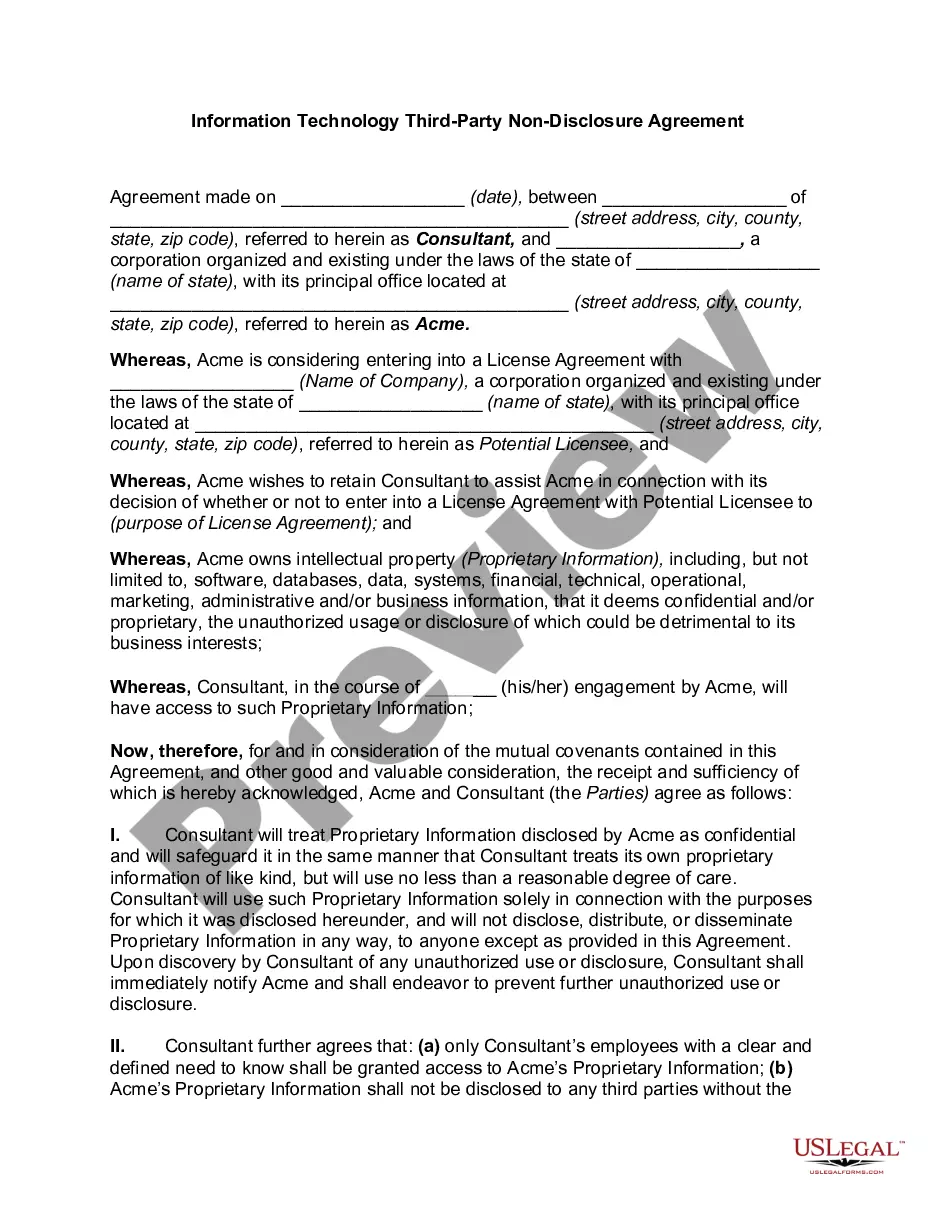
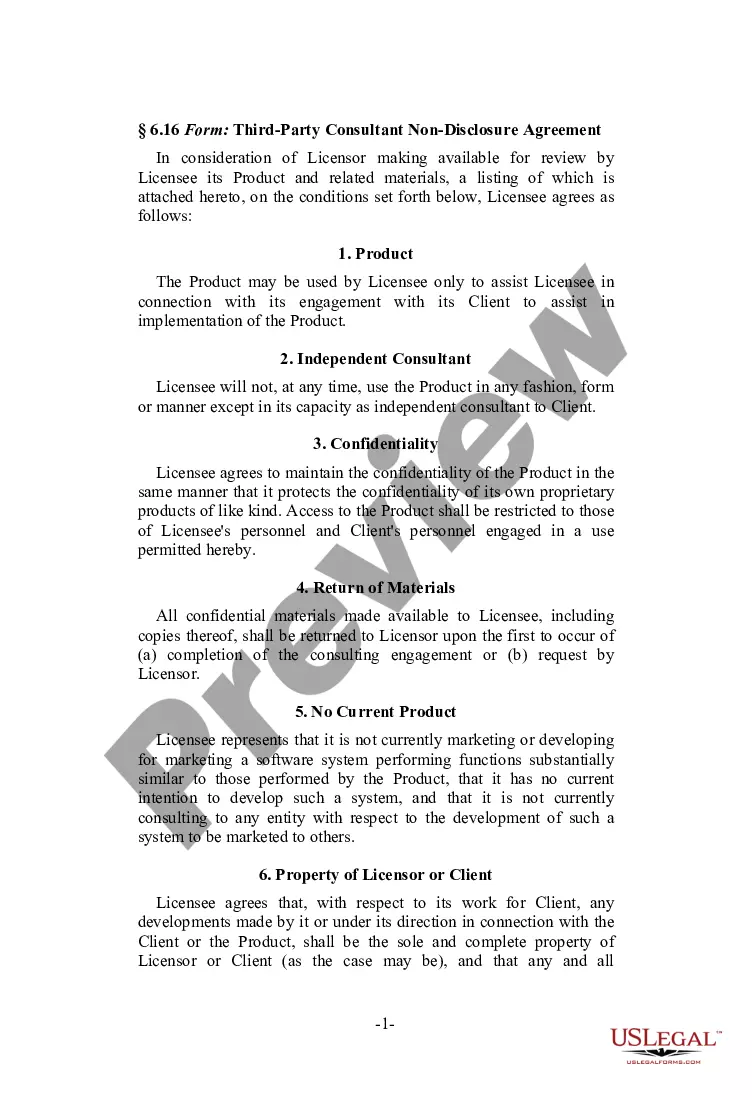
This form is a Third- Party Source Code Non-Disclosure Agreement. The licensee acknowledges and agrees that the proprietary information and all other items licensed under the contract and all copies constitute valuable trade secrets of the developer and title to the information remains in the developer. Also, all applicable copyrights, trade secrets, patents and other intellectual and property rights in the proprietary information are to remain in the developer.
Minnesota Third-Party Source Code Nondisclosure Agreement
Category:
State:
Multi-State
Control #:
US-KWP-0001-A
Format:
Word;
Rich Text
Instant download
Description
Free preview
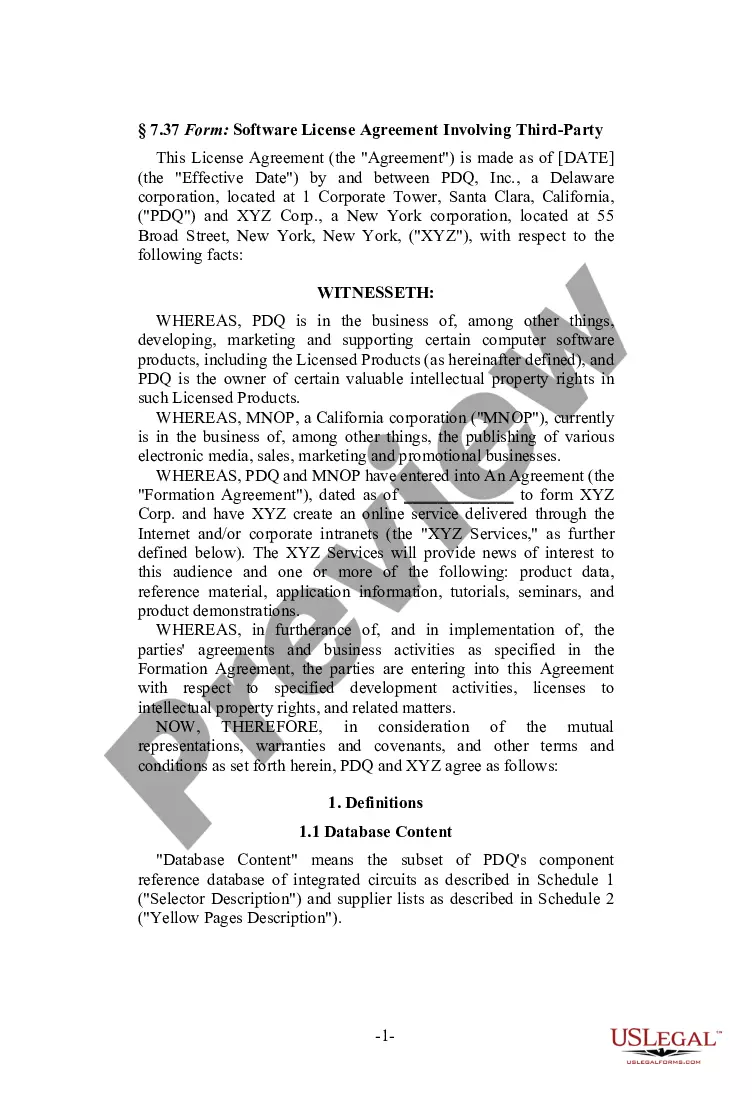
Get your form ready online
Our built-in tools help you complete, sign, share, and store your documents in one place.
Built-in online Word editor
Make edits, fill in missing information, and update formatting in US Legal Forms—just like you would in MS Word.
Export easily
Download a copy, print it, send it by email, or mail it via USPS—whatever works best for your next step.
E-sign your document
Sign and collect signatures with our SignNow integration. Send to multiple recipients, set reminders, and more. Go Premium to unlock E-Sign.
Notarize online 24/7
If this form requires notarization, complete it online through a secure video call—no need to meet a notary in person or wait for an appointment.
Store your document securely
We protect your documents and personal data by following strict security and privacy standards.

Make edits, fill in missing information, and update formatting in US Legal Forms—just like you would in MS Word.

Download a copy, print it, send it by email, or mail it via USPS—whatever works best for your next step.

Sign and collect signatures with our SignNow integration. Send to multiple recipients, set reminders, and more. Go Premium to unlock E-Sign.

If this form requires notarization, complete it online through a secure video call—no need to meet a notary in person or wait for an appointment.

We protect your documents and personal data by following strict security and privacy standards.
Looking for another form?



How to fill out Third-Party Source Code Nondisclosure Agreement?
Selecting the optimal authorized document template can be a challenge. Naturally, there are numerous templates available on the web, but how do you find the legal form you need? Utilize the US Legal Forms website. The service offers thousands of templates, including the Minnesota Third-Party Source Code Nondisclosure Agreement, suitable for business and personal purposes. All forms are reviewed by experts and comply with state and federal regulations.
If you are already registered, Log In to your account and click on the Download button to access the Minnesota Third-Party Source Code Nondisclosure Agreement. Use your account to search through the legal forms you have previously purchased. Navigate to the My documents section of your account and obtain another copy of the document you need.
If you are a new user of US Legal Forms, here are simple steps for you to follow: First, ensure you have selected the correct form for your city/state. You can preview the form using the Review button and check the form details to confirm it is suitable for you. If the form does not meet your requirements, use the Search field to find the right form. Once you are confident that the form is correct, click on the Get now button to retrieve the form. Choose the pricing plan you want and enter the necessary information. Create your account and pay for the order using your PayPal account or credit card. Select the document format and download the authorized document template to your device. Complete, modify, print, and sign the acquired Minnesota Third-Party Source Code Nondisclosure Agreement.
- US Legal Forms is the largest collection of legal forms where you can find various document templates.
- Use the service to obtain professionally created documents that comply with state regulations.
- Ensure that the selected form meets your specific needs and requirements.
- Take advantage of the search functionality to locate the appropriate document quickly.
- Review your account history to access any previously purchased forms.
- Download the document in your preferred format for convenience.
Form popularity
FAQ
No, NDAs are not illegal in Minnesota. They can be effective tools for protecting confidential information as long as they comply with state laws. A Minnesota Third-Party Source Code Nondisclosure Agreement, crafted with care, can provide the necessary legal framework to ensure your sensitive data remains secure.
Rule of Practice 521 in Minnesota governs the procedures for handling trade secrets and confidential information in legal proceedings. This rule helps maintain the confidentiality of sensitive materials during litigation. Incorporating a Minnesota Third-Party Source Code Nondisclosure Agreement can complement your strategy when navigating these legal waters.
Filing under seal in Minnesota involves submitting a document to the court that requests confidentiality. You must include a clear justification for why the document should be sealed, citing relevant laws or concerns. When dealing with sensitive information, a Minnesota Third-Party Source Code Nondisclosure Agreement can support your case for sealing documents.
party nondisclosure agreement is a legal document that protects sensitive information shared between three parties. This type of NDA ensures that all parties involved understand their obligations to maintain confidentiality. Utilizing a Minnesota ThirdParty Source Code Nondisclosure Agreement can help safeguard proprietary information during collaborations.
Yes, NDAs are legal in Minnesota as long as they adhere to state laws and do not impose unreasonable restrictions. A well-structured Minnesota Third-Party Source Code Nondisclosure Agreement can offer protection for sensitive information while remaining enforceable. Always consult legal guidance to ensure compliance with local regulations.
Minnesota Statute 181.13 outlines the requirements for certain types of agreements, including non-disclosure agreements. This law emphasizes the importance of clarity and fairness in contractual obligations. When drafting a Minnesota Third-Party Source Code Nondisclosure Agreement, it is vital to align with this law to ensure compliance and protect all parties involved.
An NDA can be deemed illegal if it restricts a party from exercising their legal rights or if it violates public policy. For example, if the agreement includes terms that prevent someone from reporting illegal activities, it may not hold up in court. Understanding the limitations of a Minnesota Third-Party Source Code Nondisclosure Agreement is crucial to ensure it remains enforceable.
The five key elements of a non-disclosure agreement include the definition of confidential information, obligations of the receiving party, the term of the agreement, exclusions from confidentiality, and the consequences of breach. A Minnesota Third-Party Source Code Nondisclosure Agreement specifically addresses these elements to protect your proprietary code. By clearly outlining these components, you establish a strong legal foundation that deters unauthorized use or sharing. Understanding these elements helps you create an effective agreement tailored to your needs.
Yes, source code is considered confidential information. It contains the unique programming instructions that define how software operates, making it a valuable asset for any business. By using a Minnesota Third-Party Source Code Nondisclosure Agreement, you can protect this sensitive information from unauthorized disclosure. This agreement ensures that anyone who accesses your source code is legally bound to keep it confidential, safeguarding your intellectual property.
Filling a non-disclosure agreement form involves several key steps. First, identify the parties and provide their contact information. Next, clearly describe the confidential information as outlined in the Minnesota Third-Party Source Code Nondisclosure Agreement. Be sure to include the terms of confidentiality and any limitations on the use of the information. Finally, have all parties sign the form to make it legally enforceable, ensuring compliance and protection.