An independent contractor is a person or business who performs services for another person pursuant to an agreement and who is not subject to the other's control, or right to control, the manner and means of performing the services. The exact nature of the independent contractor's relationship with the hiring party is important since an independent contractor pays his/her own Social Security, income taxes without payroll deduction, has no retirement or health plan rights, and often is not entitled to worker's compensation coverage.
There are a number of factors which to consider in making the decision whether people are employees or independent contractors. One of the most important considerations is the degree of control exercised by the company over the work of the workers. An employer has the right to control an employee. It is important to determine whether the company had the right to direct and control the workers not only as to the results desired, but also as to the details, manner and means by which the results were accomplished. If the company had the right to supervise and control such details of the work performed, and the manner and means by which the results were to be accomplished, an employer-employee relationship would be indicated. On the other hand, the absence of supervision and control by the company would support a finding that the workers were independent contractors and not employees.
Another factor to be considered is the connection and regularity of business between the independent contractor and the hiring party. Important factors to be considered are separate advertising, procurement of licensing, maintenance of a place of business, and supplying of tools and equipment by the independent contractor. If the service rendered is to be completed by a certain time, as opposed to an indefinite time period, a finding of an independent contractor status is more likely.
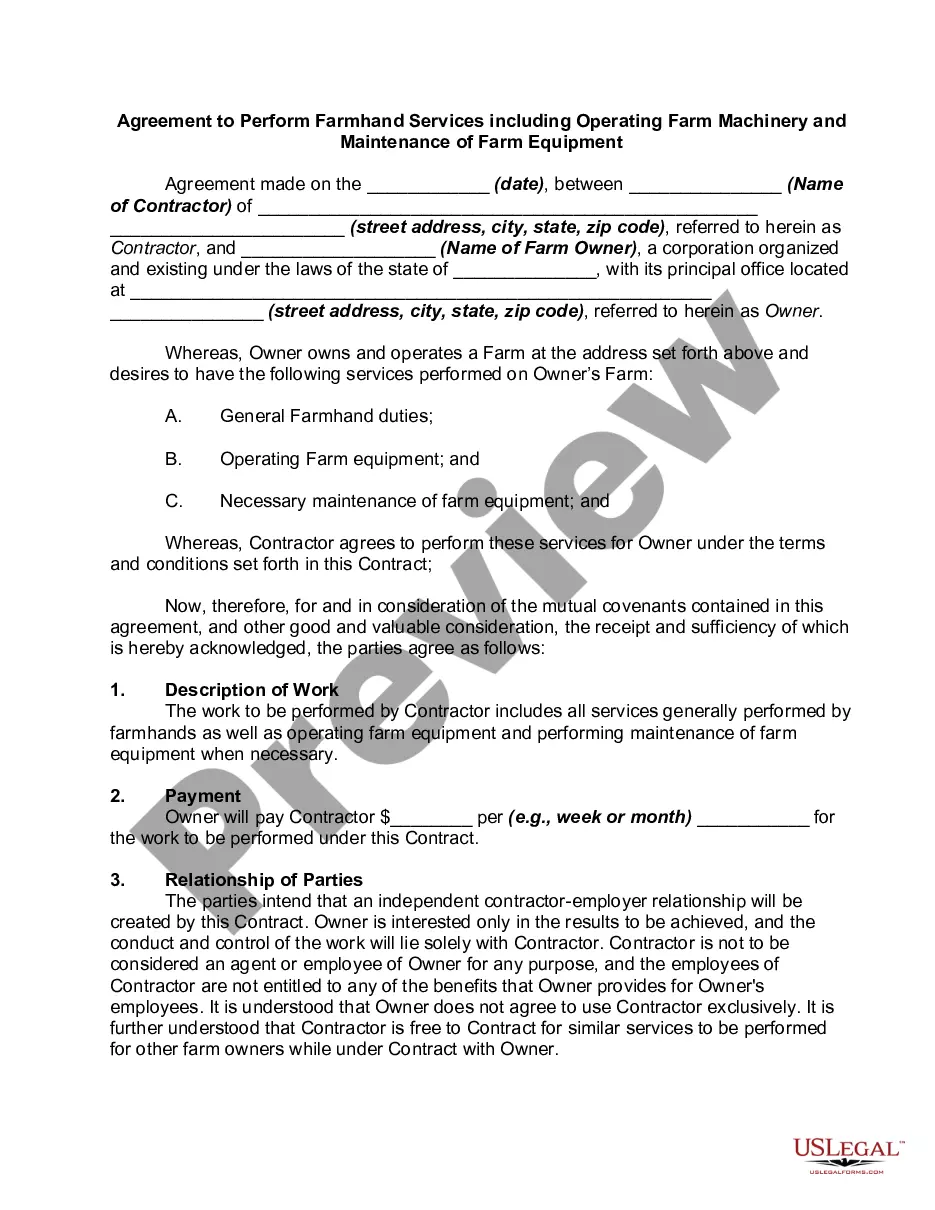
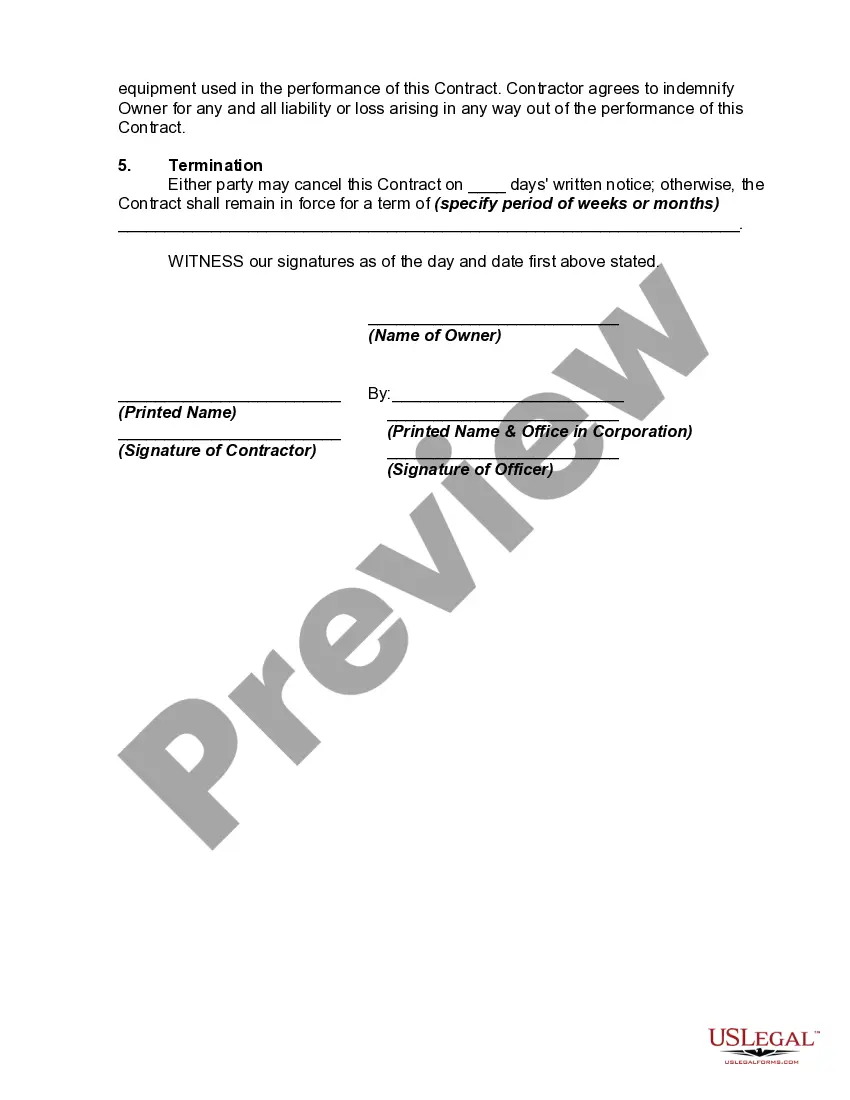
Minnesota Agreement to Perform Farmhand Services including Operating Farm Machinery and Maintenance of Farm Equipment
Instant download
Description
Free preview
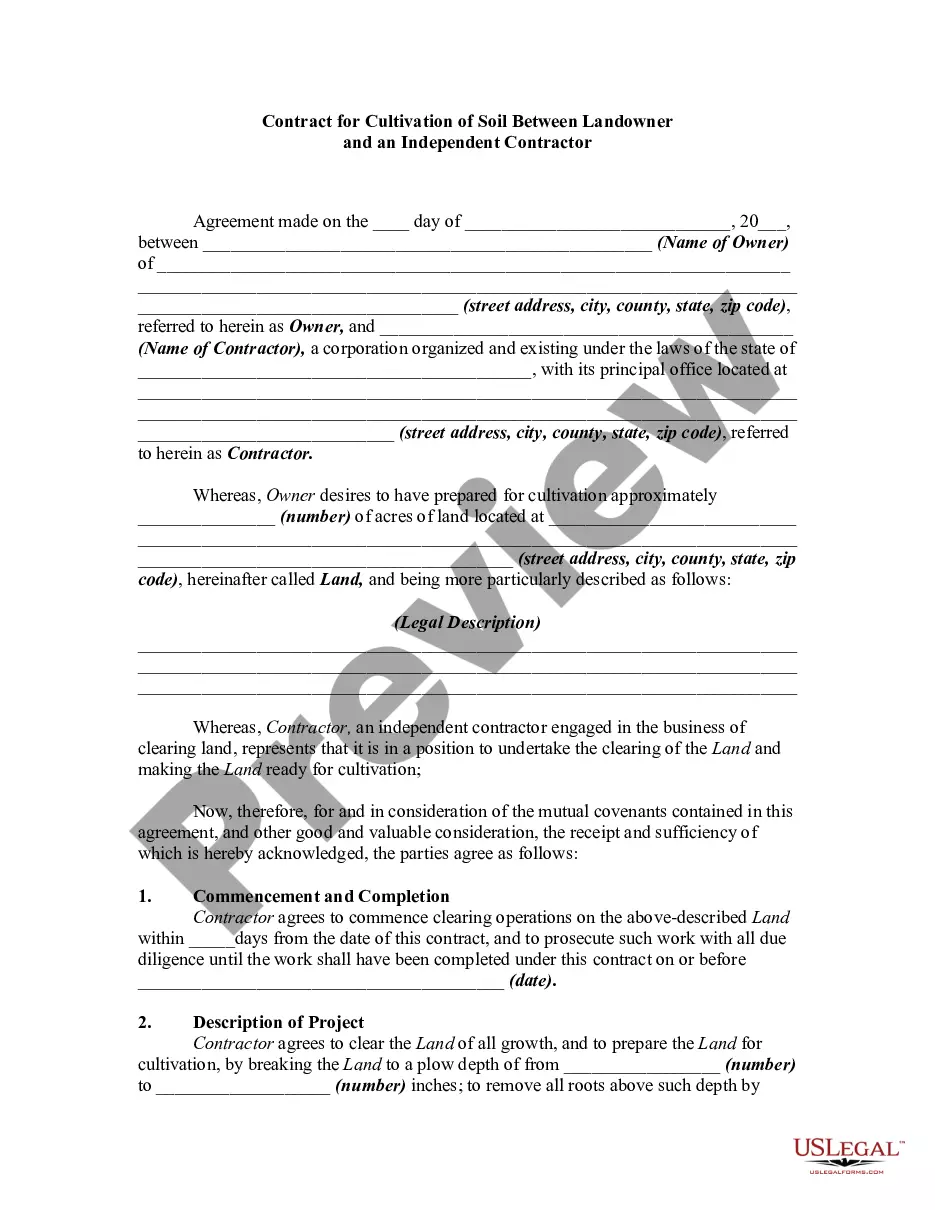
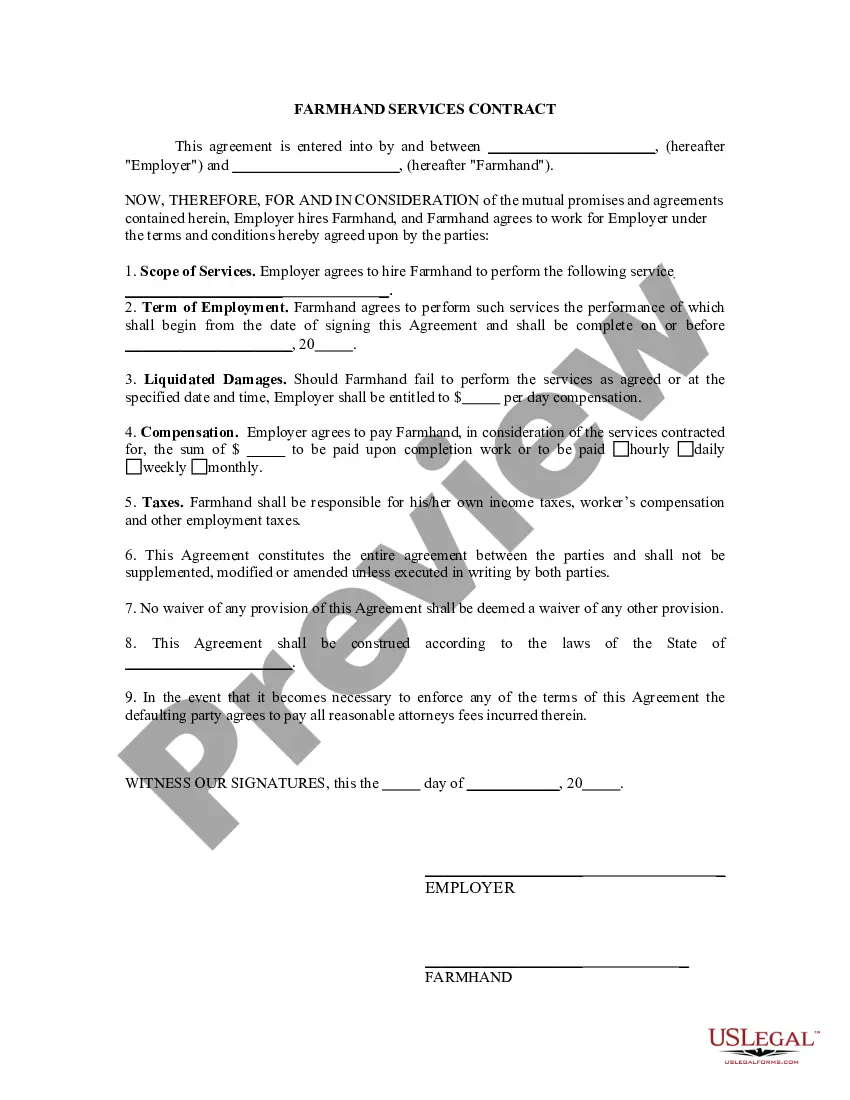
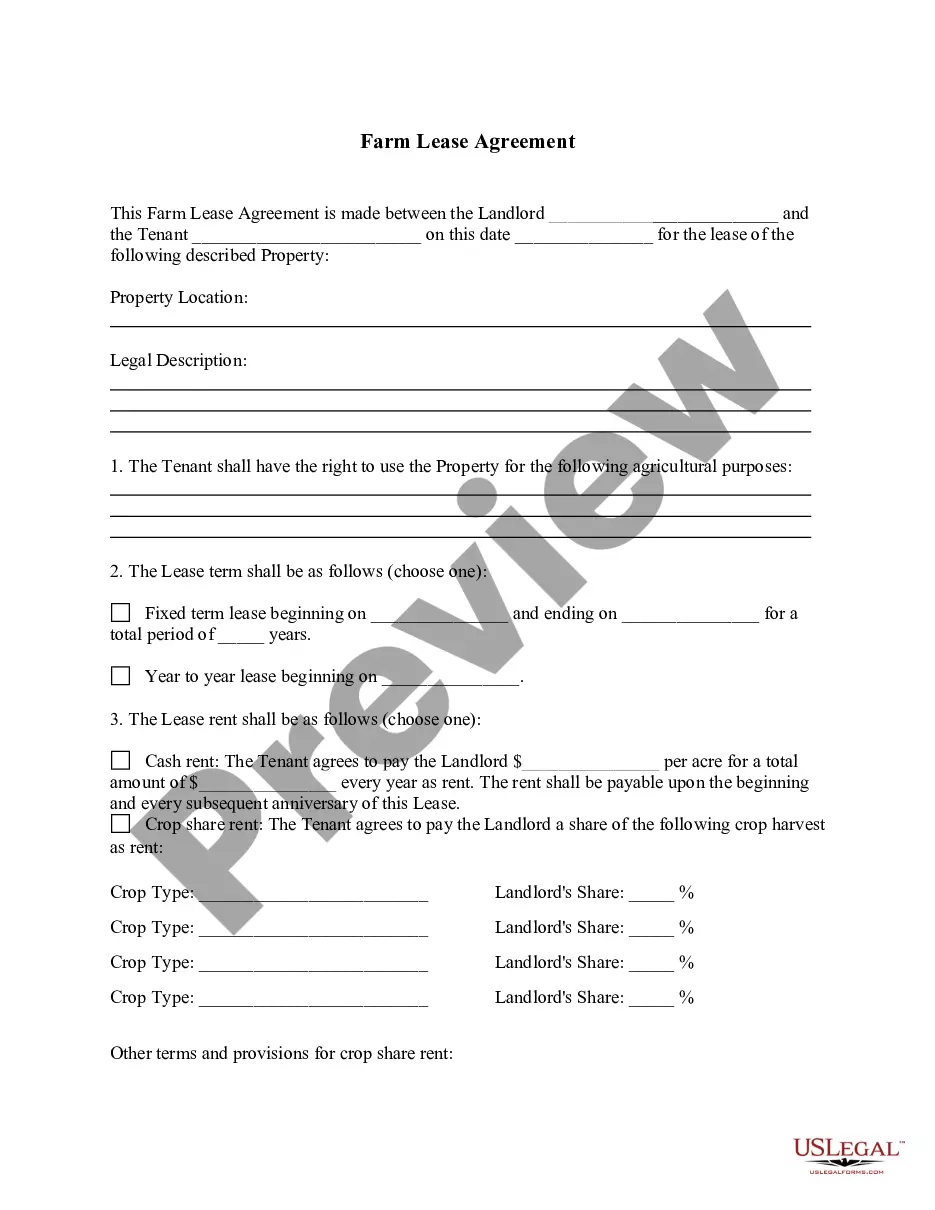
Get your form ready online
Our built-in tools help you complete, sign, share, and store your documents in one place.
Built-in online Word editor
Make edits, fill in missing information, and update formatting in US Legal Forms—just like you would in MS Word.
Export easily
Download a copy, print it, send it by email, or mail it via USPS—whatever works best for your next step.
E-sign your document
Sign and collect signatures with our SignNow integration. Send to multiple recipients, set reminders, and more. Go Premium to unlock E-Sign.
Notarize online 24/7
If this form requires notarization, complete it online through a secure video call—no need to meet a notary in person or wait for an appointment.
Store your document securely
We protect your documents and personal data by following strict security and privacy standards.

Make edits, fill in missing information, and update formatting in US Legal Forms—just like you would in MS Word.

Download a copy, print it, send it by email, or mail it via USPS—whatever works best for your next step.

Sign and collect signatures with our SignNow integration. Send to multiple recipients, set reminders, and more. Go Premium to unlock E-Sign.

If this form requires notarization, complete it online through a secure video call—no need to meet a notary in person or wait for an appointment.

We protect your documents and personal data by following strict security and privacy standards.
Looking for another form?




How to fill out Agreement To Perform Farmhand Services Including Operating Farm Machinery And Maintenance Of Farm Equipment?
Selecting the appropriate legal document template can be challenging.
Naturally, there is an array of templates accessible online, but how do you acquire the legal form you require.
Utilize the US Legal Forms website.
If you are a new user of US Legal Forms, here are some simple steps for you to follow: First, ensure you have selected the correct form for your city/state. You can preview the document by using the Preview button and review the form outline to confirm it is the right one for you. If the form does not satisfy your requirements, use the Search field to find the appropriate one. Once you are sure that the document works, click the Buy now button to obtain it. Select your payment plan preference and input the necessary information. Create your account and pay for the transaction using your PayPal account or credit card. Choose the file format and download the legal document template to your device. Complete, modify, print, and sign the acquired Minnesota Agreement to Provide Farmhand Services including Operation of Farm Machinery and Maintenance of Agricultural Equipment. US Legal Forms is the largest library of legal documents where you can find various paper templates. Utilize the service to download professionally crafted documents that meet state requirements.
- The service offers a multitude of templates, such as the Minnesota Agreement to Provide Farmhand Services including Operation of Farm Machinery and Maintenance of Agricultural Equipment, which you can employ for both business and personal purposes.
- All the forms are evaluated by experts and comply with federal and state regulations.
- If you are already registered, Log In to your account and then click the Download button to acquire the Minnesota Agreement to Provide Farmhand Services including Operation of Farm Machinery and Maintenance of Agricultural Equipment.
- Use your account to search through the legal forms you have obtained previously.
- Visit the My documents tab in your account and get an additional copy of the document you need.
Form popularity
FAQ
The average size of a farm in Minnesota is about 350 acres, but sizes can range widely based on operational needs and type of farming. Crop farms may be larger than those devoted to livestock. This variety showcases the diverse agricultural landscape in the state. By adhering to the Minnesota Agreement to Perform Farmhand Services including Operating Farm Machinery and Maintenance of Farm Equipment, farmers can better manage operations across farms of all sizes.
In Minnesota, a farm is typically defined as a tract of land used for farming activities, which may include growing crops and raising livestock. The purpose must be commercial; if the land is utilized for personal use, it may not qualify. Recognizing what defines a farm helps in proper legal and operational planning. You can solidify these definitions through the Minnesota Agreement to Perform Farmhand Services including Operating Farm Machinery and Maintenance of Farm Equipment.
The average size of a farm in Minnesota is around 350 acres, though this number can vary significantly based on the type of farming operations. Many farms operate on smaller or larger scales depending on their specific agricultural focus. This diversity shows the variety of farming practices in the state. The Minnesota Agreement to Perform Farmhand Services including Operating Farm Machinery and Maintenance of Farm Equipment supports all sizes of farming operations.
In Minnesota, a farm vehicle is typically defined as a vehicle primarily used to transport farm products, equipment, or livestock. This includes trucks and trailers that owners use for agricultural purposes. Knowing what qualifies helps in ensuring compliance with Minnesota regulations. By integrating the Minnesota Agreement to Perform Farmhand Services including Operating Farm Machinery and Maintenance of Farm Equipment, farmers can effectively manage their farm vehicles.
Minnesota is rich in agricultural land, boasting around 25 million acres of farmland. This vast area serves as a hub for grain production, dairy, and livestock farming. Understanding the scope of Minnesota’s agricultural landscape helps farmers and farmhands alike. Utilizing the Minnesota Agreement to Perform Farmhand Services including Operating Farm Machinery and Maintenance of Farm Equipment can optimize operations across this extensive farmland.
Farm equipment comprises tools and machinery used in agricultural operations. Examples include tractors, combine harvesters, plows, and seed drills. This equipment plays a critical role in enhancing farm productivity. With a Minnesota Agreement to Perform Farmhand Services including Operating Farm Machinery and Maintenance of Farm Equipment, you ensure that these vital machines receive proper care and operation.
In the United States, there isn’t a strict definition of how many acres make a farm. However, in Minnesota, land can be considered a farm if it is primarily used for agricultural activities. Thus, even small plots of land can qualify as farms when dedicated to growing crops or raising livestock. The Minnesota Agreement to Perform Farmhand Services including Operating Farm Machinery and Maintenance of Farm Equipment applies to these varied farm sizes.
The new farmer grant in Minnesota provides financial assistance to individuals who are starting their farming careers. This program supports various startup costs, including equipment purchases and operating expenses. By utilizing the Minnesota Agreement to Perform Farmhand Services including Operating Farm Machinery and Maintenance of Farm Equipment, new farmers can ensure they maximize their investment and build a successful agricultural business.
To qualify as a farm in Minnesota, an operation must primarily produce agricultural products for sale. This includes traditional farming, livestock, and even some specialized operations like fish farming. Utilizing the Minnesota Agreement to Perform Farmhand Services including Operating Farm Machinery and Maintenance of Farm Equipment can enhance efficiencies, making any qualifying farm operation more competitive and productive.
Minnesota's right to farm law safeguards farmers' ability to engage in agricultural practices without unnecessary interference. This law aims to protect farmers from nuisance lawsuits, allowing them to operate their farms even amidst changing demographics in nearby areas. The Minnesota Agreement to Perform Farmhand Services including Operating Farm Machinery and Maintenance of Farm Equipment aligns with this law, making farming operations more sustainable and resilient.