Construction of the Premises
What is this form?
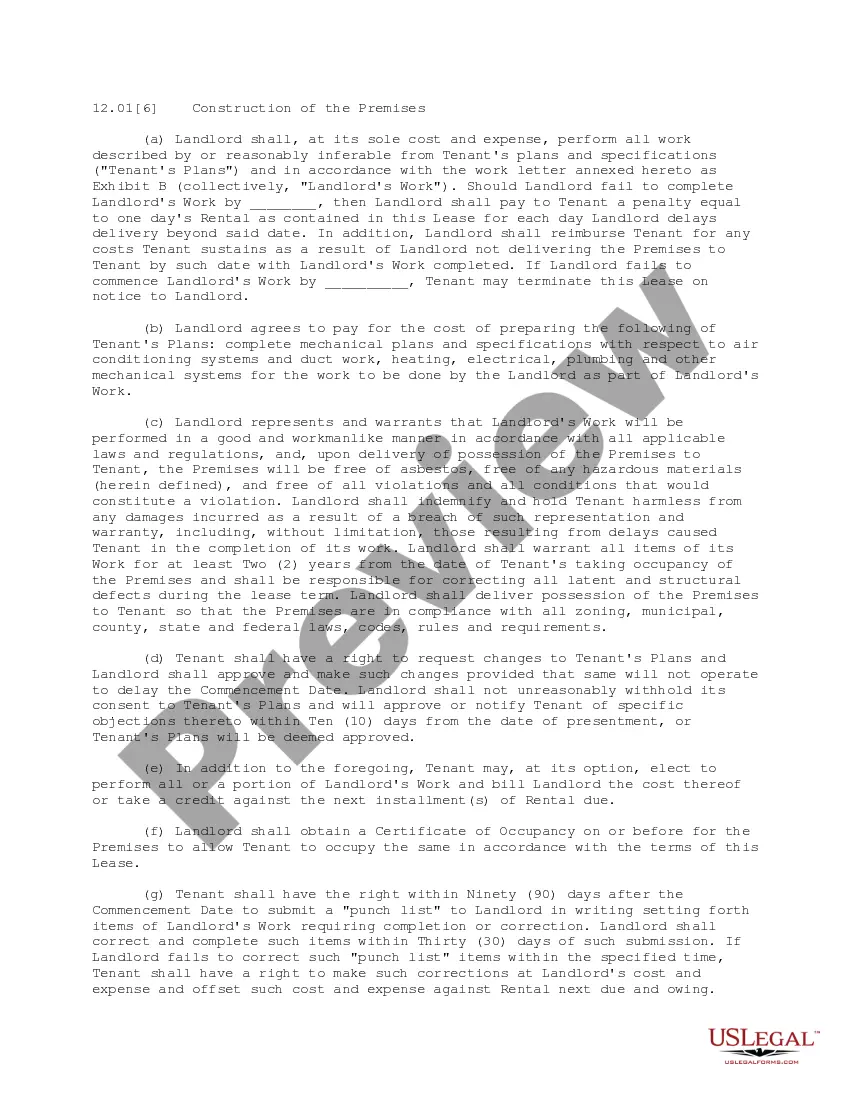
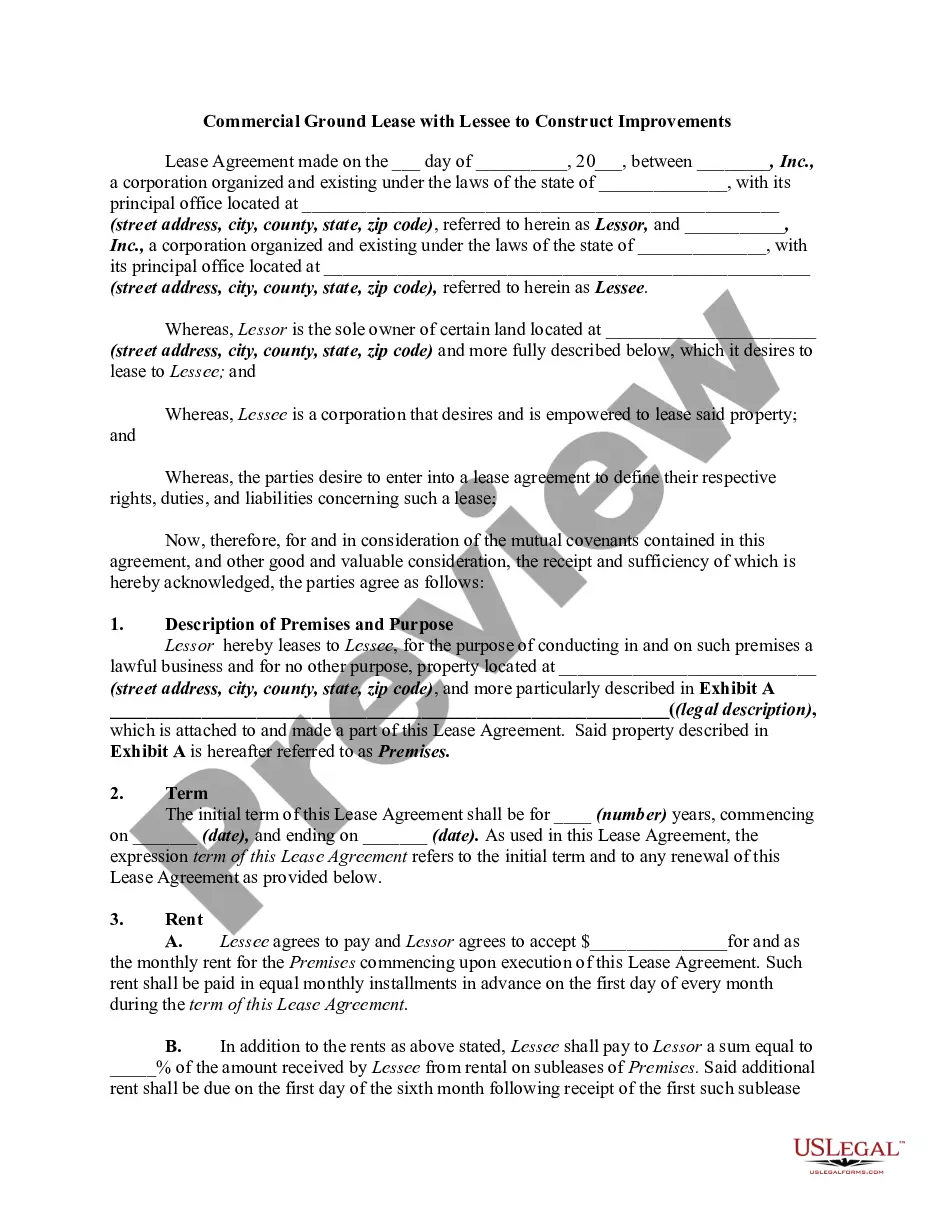
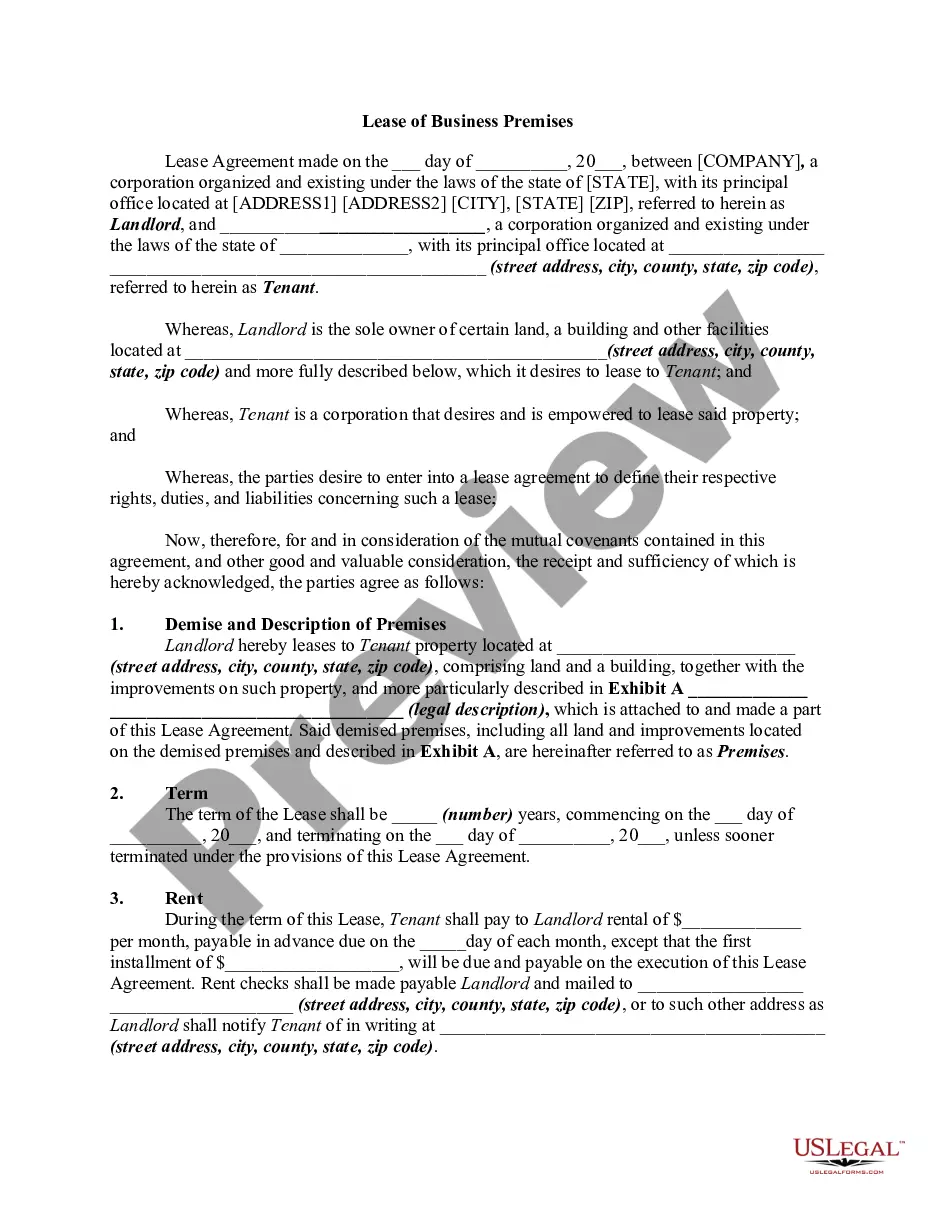
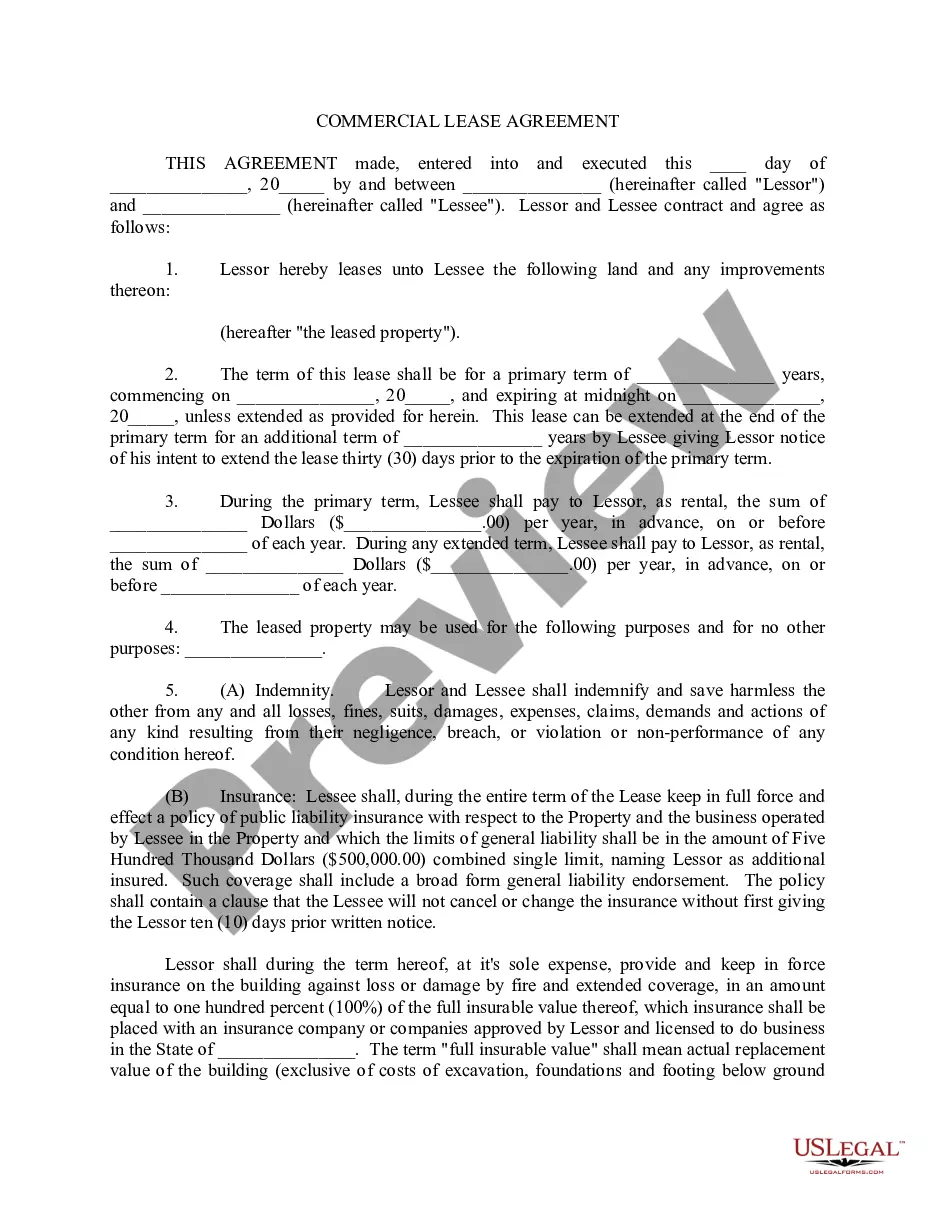
The Construction of the Premises form is a legal document used in commercial leasing to outline the landlord's responsibilities regarding the construction and delivery of the leased space. This form specifies the costs related to construction work, the timeline for completion, and the plans submitted by the tenant, which distinguishes it from other general lease agreements. It ensures both parties are clear on their obligations concerning any construction work required before the tenant takes possession of the premises.
Key parts of this document
- Landlord's obligation to complete specified construction work in a timely manner.
- Protocol for approving changes to tenant's plans without delaying construction.
- Indemnification clause protecting the tenant against hazardous materials and construction defects.
- Tenant's right to perform landlord's work if delays occur.
- Requirement for obtaining a Certificate of Occupancy before tenant move-in.
- Process for the tenant to submit a punch list for corrections after occupancy.
When to use this document
This form is essential when entering into a commercial lease where construction or modifications to the premises are necessary before the tenant can occupy the space. It is particularly useful when the landlord is responsible for completing significant alterations, and both parties need to agree on specific terms related to construction timelines and options for changes in tenant plans.
Who this form is for
- Commercial landlords responsible for building or renovating leased premises.
- Tenants negotiating the lease of a space that requires construction work before occupancy.
- Property managers overseeing the completion of lease agreements involving substantial alterations.
- Legal professionals drafting or reviewing commercial leases with parties involved in construction.
Completing this form step by step
- Identify the parties involved in the lease agreement (landlord and tenant).
- Complete the construction timeline and specify dates for completion and commencement.
- Detail the tenant's plans, ensuring they comply with any necessary regulations.
- Review and agree upon any changes to the plans, ensuring prompt approvals.
- Include any indemnification clauses relevant to hazardous materials or defects.
- Finalize the terms by signing and dating the document with all parties present.
Does this document require notarization?
In most cases, this form does not require notarization. However, some jurisdictions or signing circumstances might. US Legal Forms offers online notarization powered by Notarize, accessible 24/7 for a quick, remote process.
Get your form ready online
Our built-in tools help you complete, sign, share, and store your documents in one place.
Make edits, fill in missing information, and update formatting in US Legal Forms—just like you would in MS Word.
Download a copy, print it, send it by email, or mail it via USPS—whatever works best for your next step.
Sign and collect signatures with our SignNow integration. Send to multiple recipients, set reminders, and more. Go Premium to unlock E-Sign.
If this form requires notarization, complete it online through a secure video call—no need to meet a notary in person or wait for an appointment.
We protect your documents and personal data by following strict security and privacy standards.

Make edits, fill in missing information, and update formatting in US Legal Forms—just like you would in MS Word.

Download a copy, print it, send it by email, or mail it via USPS—whatever works best for your next step.

Sign and collect signatures with our SignNow integration. Send to multiple recipients, set reminders, and more. Go Premium to unlock E-Sign.

If this form requires notarization, complete it online through a secure video call—no need to meet a notary in person or wait for an appointment.

We protect your documents and personal data by following strict security and privacy standards.
Typical mistakes to avoid
- Failing to specify clear deadlines for construction completion.
- Not detailing the procedure for approving changes to tenant's plans.
- Omitting the requirement for a Certificate of Occupancy.
- Overlooking the need for indemnification against construction-related issues.
- Neglecting to provide the tenant with an opportunity to submit a punch list.
Benefits of using this form online
- Instant access to professionally drafted legal documents tailored for your needs.
- Easy to fill out and edit, ensuring all necessary details are included.
- Convenient tools for electronically signing the document.
- Reliable templates that comply with legal standards and requirements.
Legal use & context
- This form enforces the rights and obligations of both parties regarding construction work.
- Proper completion and execution can prevent legal disputes related to construction delays.
- Understanding the warranty obligations encourages accountability from the landlord.
Looking for another form?
Form popularity
FAQ
(Entry 1 of 2) 1a : a proposition antecedently supposed or proved as a basis of argument or inference specifically : either of the first two propositions of a syllogism from which the conclusion is drawn. b : something assumed or taken for granted : presupposition.
The property refers to the entirety of the land, buildings, structures, equipment, etc., owned by the landowner, while the premises refers to only that portion of the property and/or components of it that are the subject of the lease.
Definitions. The Premises describes what is being leased. At minimum, this means the land, but can also include buildings and other infrastructure such as greenhouses, wells, and fencing. Leased equipment could be part of the Premises, or could be contained in a separate lease.
(Entry 1 of 2) 1a : a proposition antecedently supposed or proved as a basis of argument or inference specifically : either of the first two propositions of a syllogism from which the conclusion is drawn. b : something assumed or taken for granted : presupposition.
The Merriam-Webster dictionary defines premises as a tract of land with buildings thereon, whereas premise is a proposition anecdotally supposed or proved as a basis of argument or interference.Premises, already a single noun, cannot be replaced by premise, and the two are quite different.
Premises. n. 1) in real estate, land and the improvements on it, a building, store, shop, apartment, or other designated structure. The exact premises may be important in determining if an outbuilding (shed, cabana, detached garage) is insured or whether a person accused of burglary has actually entered a structure.
: inside a building or on the area of land that it is on The hotel has a restaurant on the premises. No smoking is allowed on the premises.
In Contract Law, Terms means Terms of a Contract, the conditions and warranties agreed upon between parties to the contract. Contract terms may be verbal or in writing. Conditions are those terms which are so important that one or more of the parties would not enter into the contract without them.