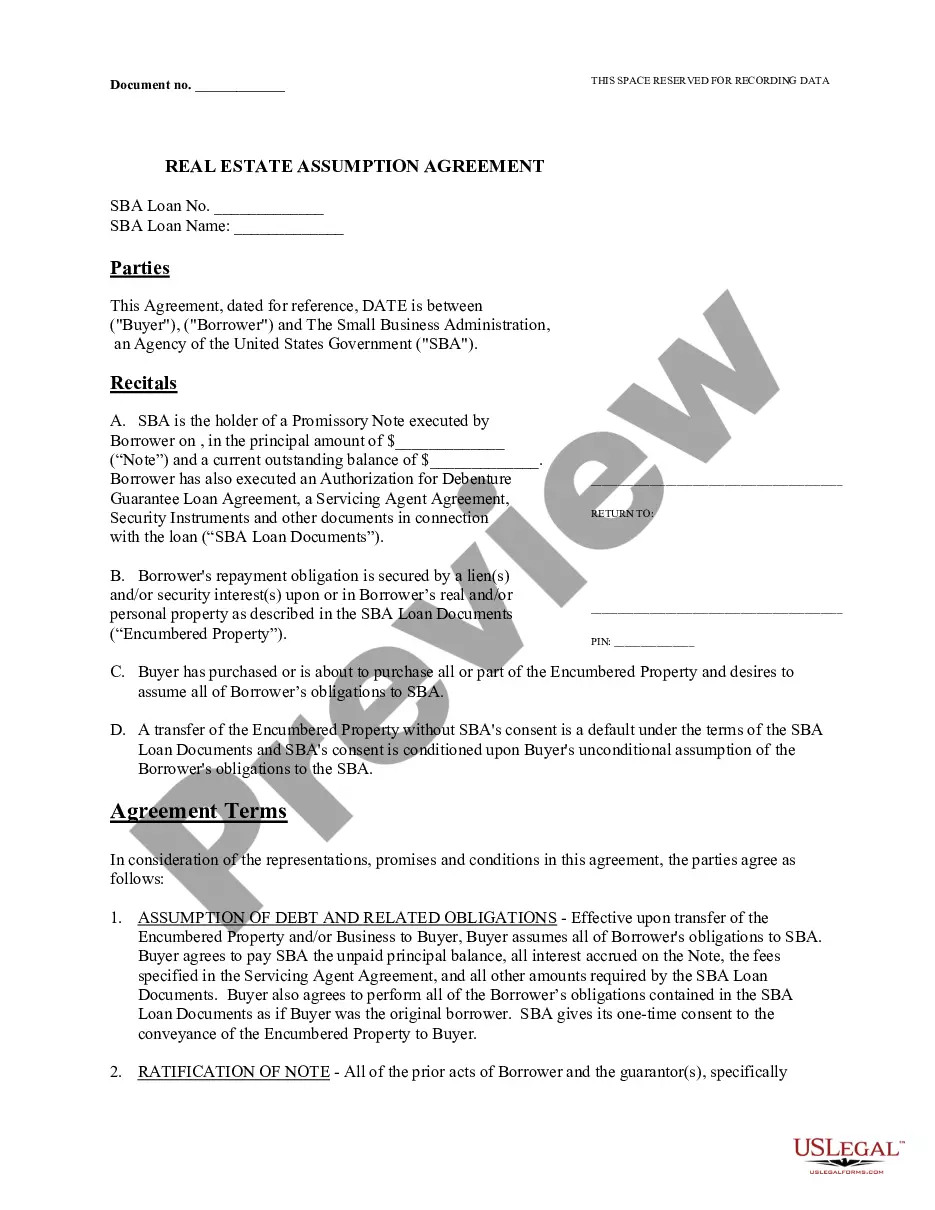
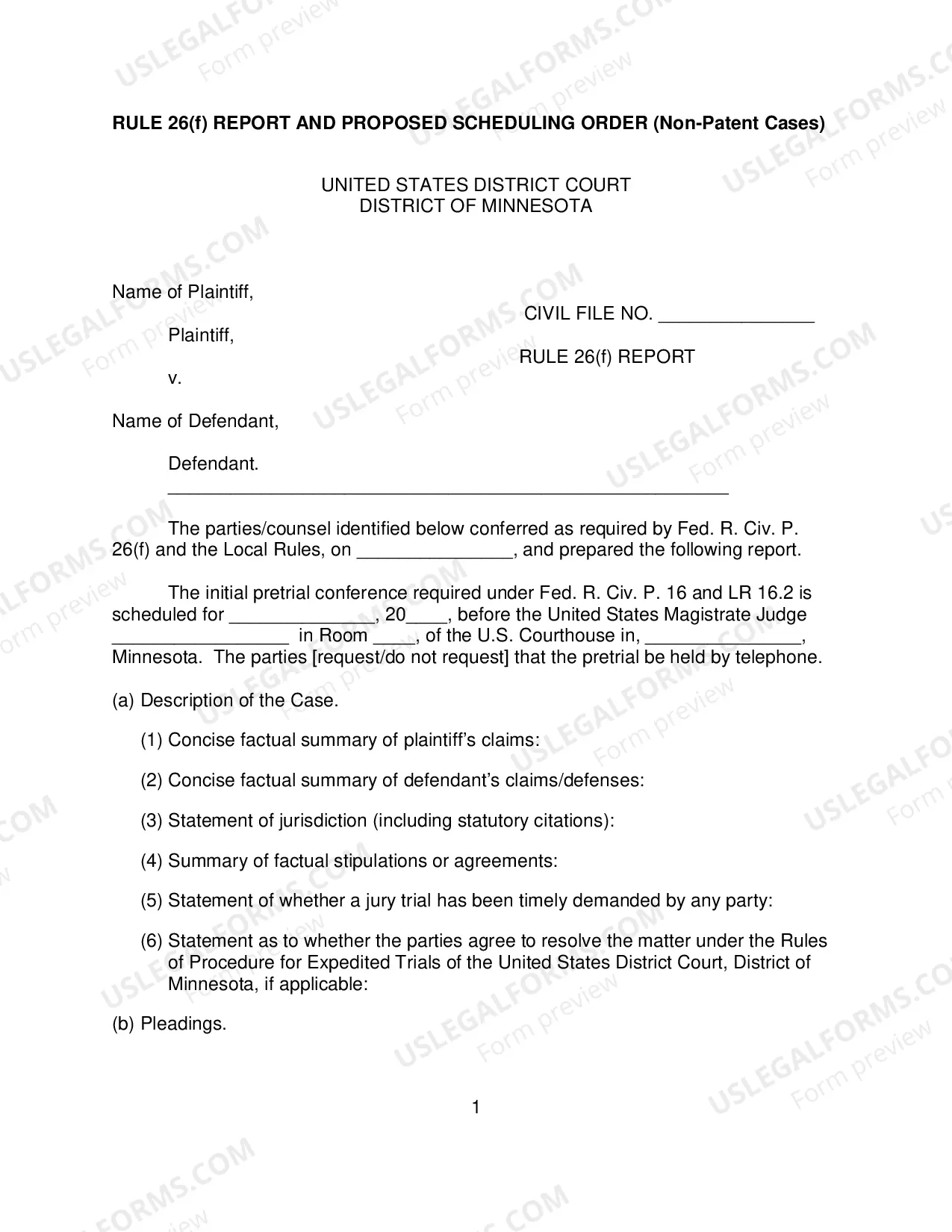
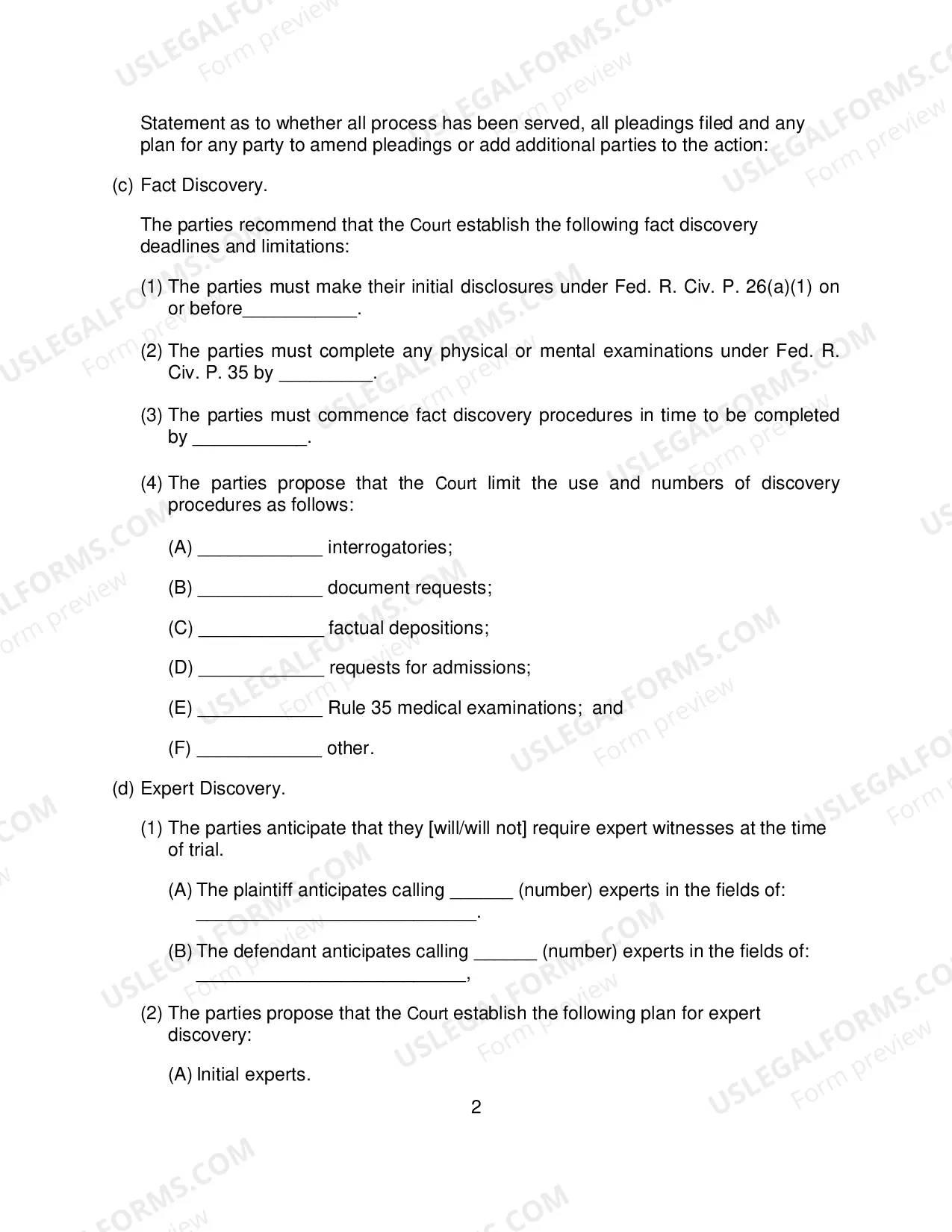
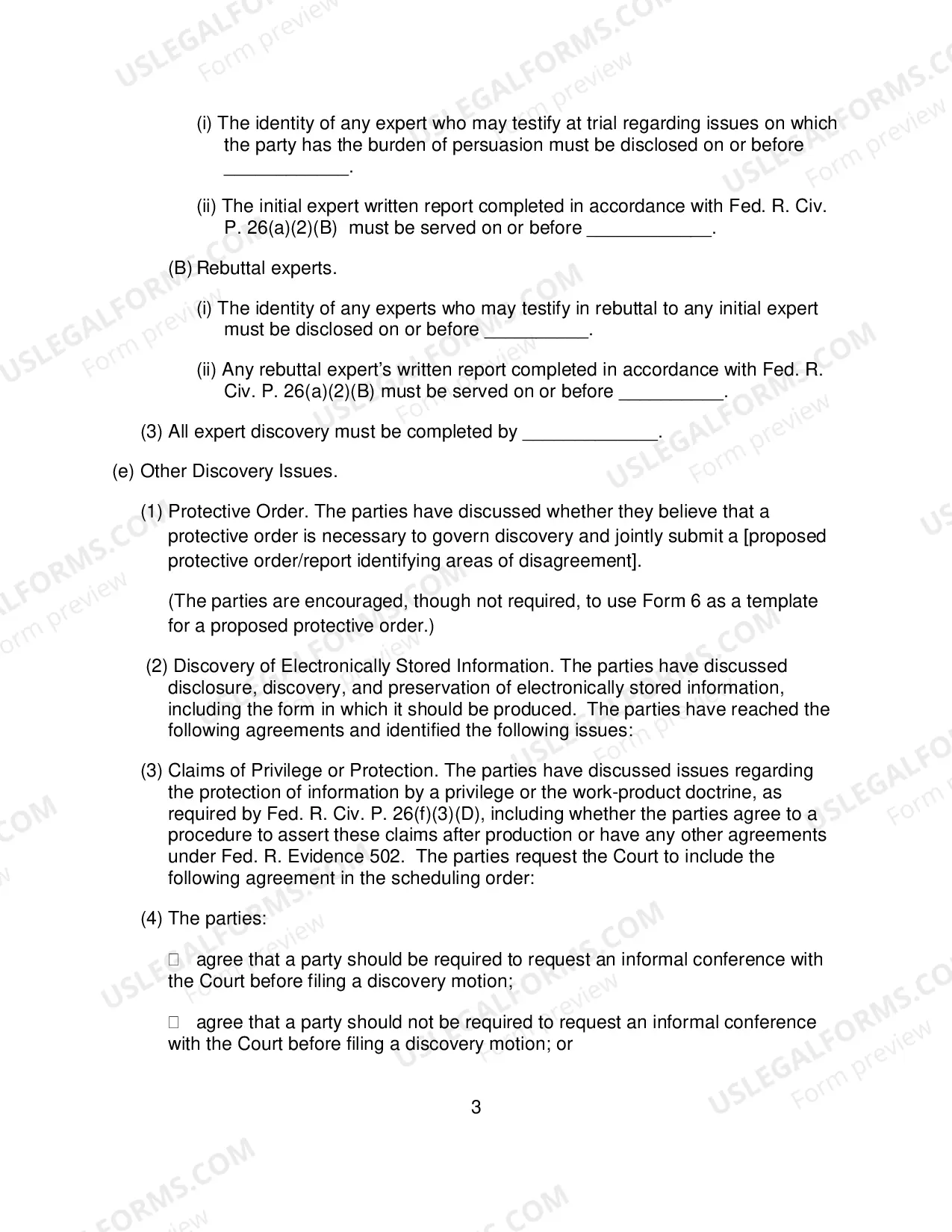
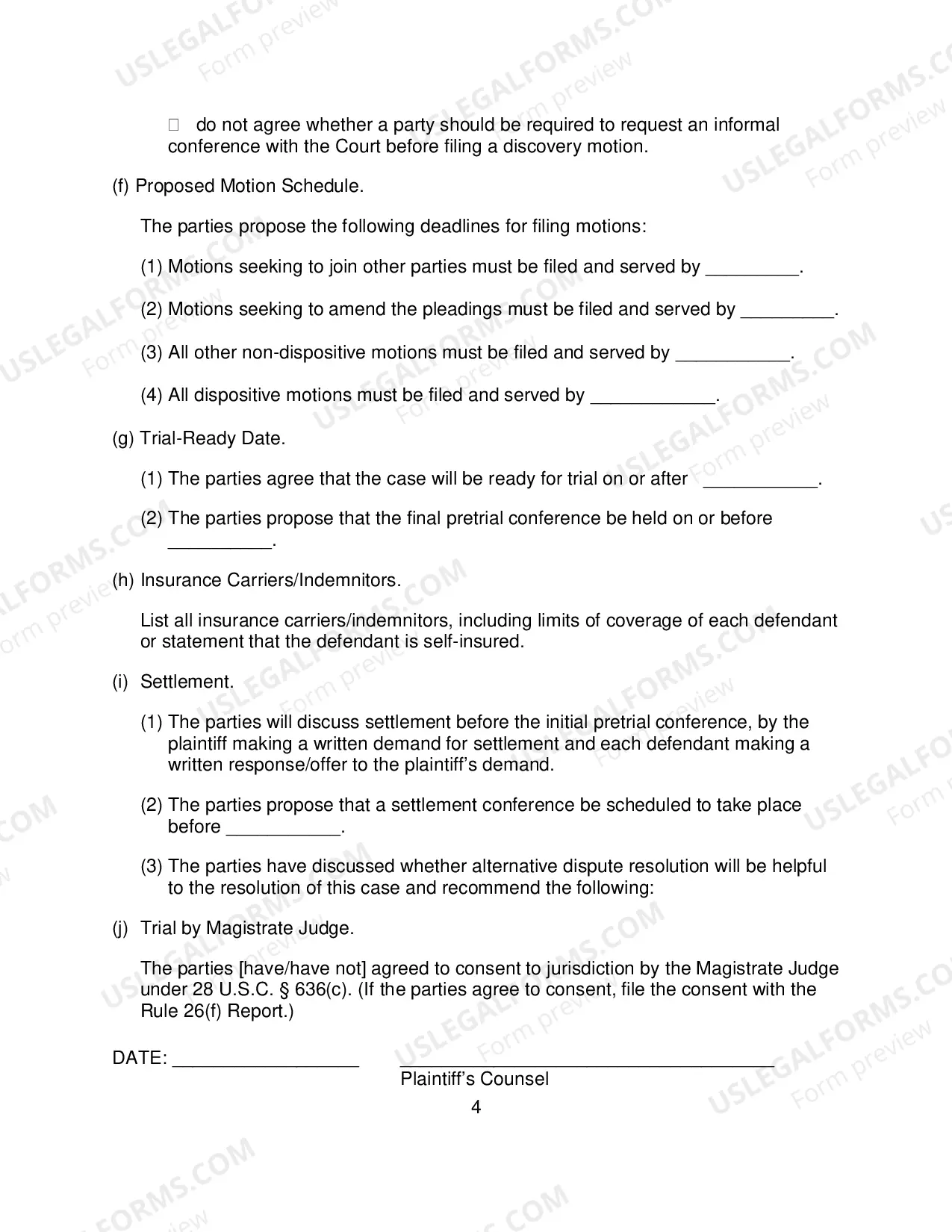
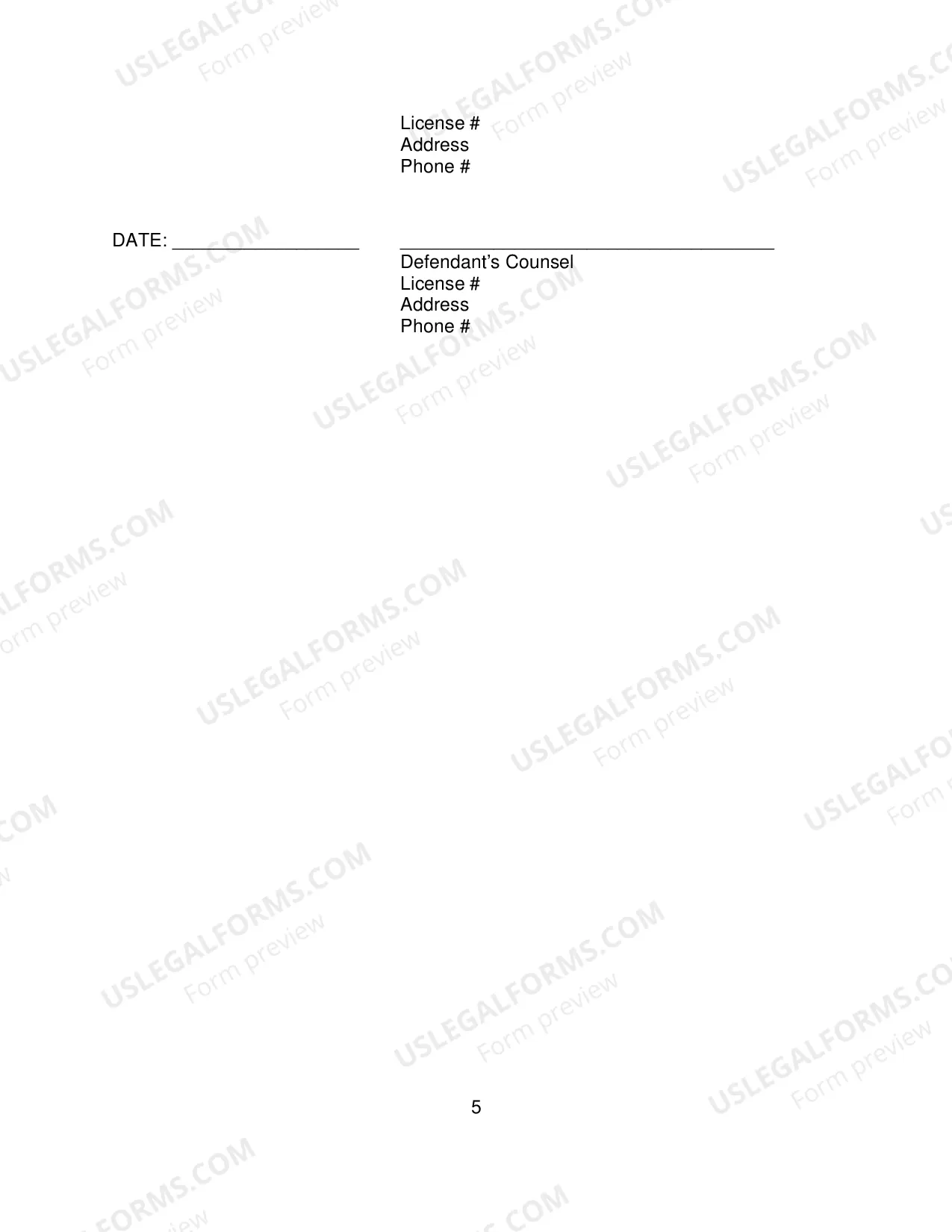
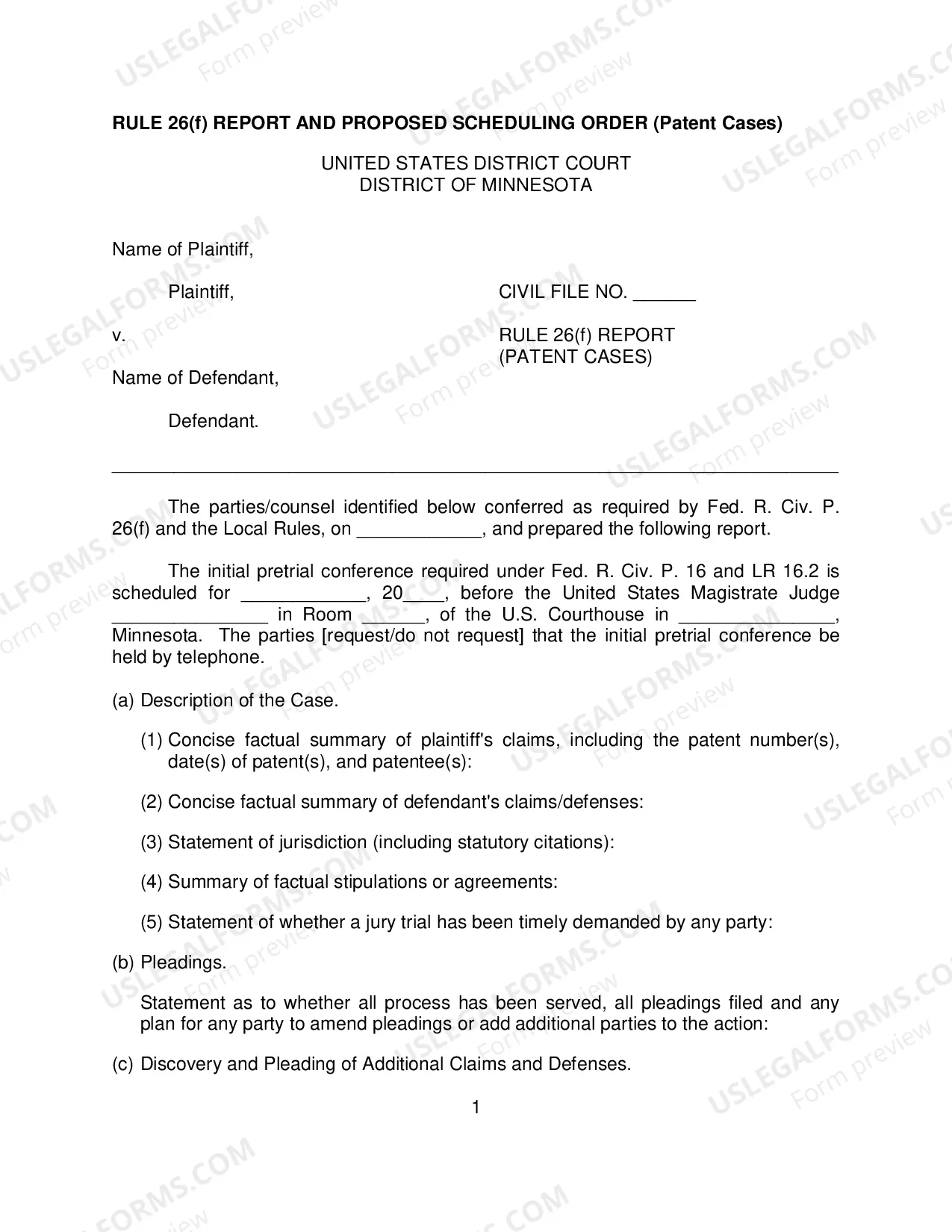
Minnesota Rule 26(f) Report and Proposed Scheduling Order Form (non-patent cases) is a document submitted to the court during the early stages of a Minnesota state civil lawsuit. The purpose of the document is for the parties involved in the case to agree upon a schedule for the discovery and other pre-trial procedures. It includes details such as the time period for each procedure, the deadlines for filing documents, and the date for the pre-trial conference. There are two types of Minnesota Rule 26(f) Reports and Proposed Scheduling Order Forms: Form A, which is used in actions for damages, and Form B, which is used in all other civil cases. Both Forms must be completed and signed by all parties, and submitted to the court before the pre-trial conference.
Minnesota Rule 26(f) Report and Proposed Scheduling Order Form (non-patent cases)
Description
Get your form ready online
Our built-in tools help you complete, sign, share, and store your documents in one place.
Make edits, fill in missing information, and update formatting in US Legal Forms—just like you would in MS Word.
Download a copy, print it, send it by email, or mail it via USPS—whatever works best for your next step.
Sign and collect signatures with our SignNow integration. Send to multiple recipients, set reminders, and more. Go Premium to unlock E-Sign.
If this form requires notarization, complete it online through a secure video call—no need to meet a notary in person or wait for an appointment.
We protect your documents and personal data by following strict security and privacy standards.

Make edits, fill in missing information, and update formatting in US Legal Forms—just like you would in MS Word.

Download a copy, print it, send it by email, or mail it via USPS—whatever works best for your next step.

Sign and collect signatures with our SignNow integration. Send to multiple recipients, set reminders, and more. Go Premium to unlock E-Sign.

If this form requires notarization, complete it online through a secure video call—no need to meet a notary in person or wait for an appointment.

We protect your documents and personal data by following strict security and privacy standards.
Looking for another form?

How to fill out Minnesota Rule 26(f) Report And Proposed Scheduling Order Form (non-patent Cases)?
If you’re looking for a method to effectively prepare the Minnesota Rule 26(f) Report and Proposed Scheduling Order Form (non-patent cases) without engaging a lawyer, then you’ve arrived at the right destination.
US Legal Forms has established itself as the largest and most trusted repository of official templates for every personal and business circumstance. Every document you discover on our online service is crafted in accordance with federal and state laws, ensuring that your paperwork is in compliance.
Another excellent aspect of US Legal Forms is that you will never misplace the documents you obtained - you can locate any of your downloaded templates in the My documents section of your profile whenever required.
- Ensure the document you view on the page aligns with your legal needs and state laws by reviewing its text description or exploring the Preview mode.
- Enter the form title in the Search tab at the top of the page and select your state from the list to locate an alternative template if there are any discrepancies.
- Repeat the content verification and click Buy now when you are assured of the documentation's adherence to all requirements.
- Log in to your account and click Download. Sign up for the service and select a subscription plan if you do not already have one.
- Utilize your credit card or the PayPal option to purchase your US Legal Forms subscription. The document will be available for download immediately after.
- Select the format in which you wish to receive your Minnesota Rule 26(f) Report and Proposed Scheduling Order Form (non-patent cases) and download it by clicking the appropriate button.
- Import your template to an online editor for quick completion and signing or print it out to prepare your hard copy manually.
Form popularity
FAQ
In Minnesota, the order for disclosure is guided by the Minnesota Rule 26(f) Report and Proposed Scheduling Order Form (non-patent cases). This rule outlines the timeline and responsibilities for parties to disclose relevant information before trial. It aims to promote transparency and efficiency in the discovery process. By following these guidelines, you can ensure that all parties have the necessary information to prepare their cases effectively.
Rule 26 refers to a section of the Federal Rules of Civil Procedure that governs the discovery process in litigation. In Minnesota, it emphasizes the importance of early planning and communication between parties regarding the case schedule. This rule aims to promote efficiency and prevent misunderstandings throughout the legal process. For those needing assistance, the US Legal Forms platform offers resources and templates for the Minnesota Rule 26(f) Report and Proposed Scheduling Order Form, making compliance easier.
The Minnesota Rule 26(f) Report is a document that outlines the parties' proposed scheduling order for litigation in non-patent cases. It serves as a crucial tool for attorneys to communicate their plans regarding discovery, deadlines, and other case management matters. By utilizing this report, parties can streamline the litigation process and reduce the chance of disputes. You can efficiently create this report using the US Legal Forms platform, which provides templates tailored to the Minnesota Rule 26(f) Report and Proposed Scheduling Order Form.
Rule 26(f) describes a conference of two parties (the plaintiff and defendant) to cooperate and set out a clear plan for the process of discovery. In terms of responsibility for arrangement, both parties are jointly responsible?and this remains true as the case progresses.
Rule 26(f) requires federal litigants to confer early in a case, develop a discovery plan, and submit to the court a written report outlining the plan.
Discovery-related communications between counsel are not typically filed, electronically or otherwise, without an order of the court. This includes initial disclosures, discovery responses, and expert disclosures are also not filed.
FRCP 26 (a): Initial Disclosures FRCP 26 (a) explains that, without exemption, the disclosing party needs to provide several types of information without awaiting a discovery request. This includes, among other things, the names and contact information for all parties with access to discoverable information or evidence.
Federal Rule of Civil Procedure 26(a)(1) requires that each party provide ?initial disclosures? to the other parties in writing without waiting for a formal request.
Do I file the initial required disclosures with the court? No. But if this is a contested case, you will have to file something different with the court called pretrial disclosures. If your case is contested, hire a lawyer if at all possible.
In federal court an expert report must be submitted for every retained testifying expert witness. The disclosure of each expert witness must be accompanied by a written report prepared and signed by the witness.