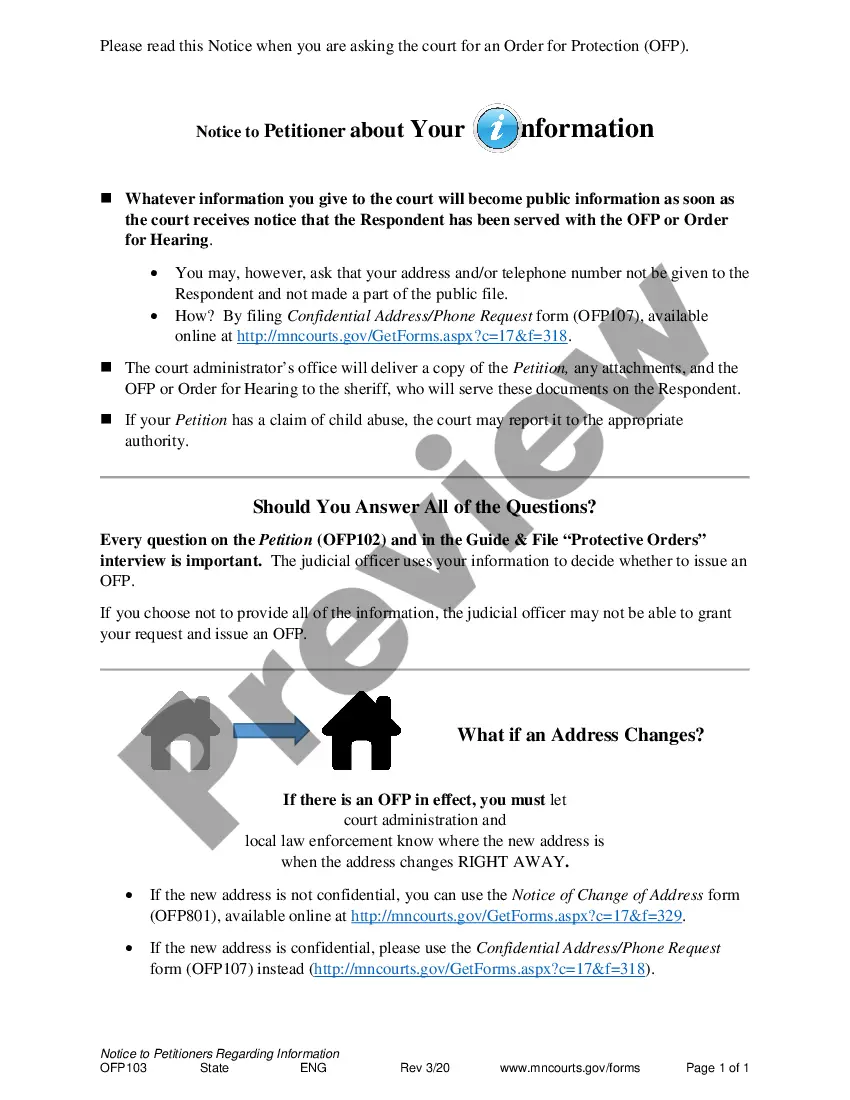
Minnesota Notice to Petitioner Regarding Information Provided in Petition and Affidavit
Overview of this form
The Notice to Petitioner Regarding Information Provided in Petition and Affidavit is an official form used in Minnesota order for protection cases. This form informs the petitioner about the implications of the information they provide in their petition and affidavit. Unlike other forms, it specifically addresses the potential consequences of withholding information, as well as what becomes public once an order is served. This form is essential for petitioners seeking protection in instances of domestic violence or harassment.
Form components explained
- Disclosure of information: Explains how the provided information will be used by the judge.
- Public access: Details what information becomes public once an order for protection is served.
- Notification requirements: Guidance on notifying changes of residence to the court and law enforcement.
- Reporting obligations: Specifies that allegations of child abuse will be reported to authorities.
When to use this form
This form should be used when a petitioner files for an order of protection in Minnesota. It is necessary at the beginning of the legal process to ensure that petitioners understand the importance of the information they provide and how it impacts their case. It is particularly relevant in situations involving domestic violence, harassment, or threats where the petitioner seeks legal protection from the respondent.
Intended users of this form
- Individuals filing for an order of protection in Minnesota.
- Petitioners seeking to understand the implications of the information they provide.
- Victims of domestic violence or harassment needing legal intervention.
How to prepare this document
- Read the instructions carefully to understand the purpose of the notification.
- Provide accurate information in the petition and affidavit sections.
- Note any information you wish to keep confidential from the respondent.
- Notify the court administrator promptly of any changes to your residence.
- Understand that allegations of child abuse may be reported to the relevant authorities.
Notarization guidance
In most cases, this form does not require notarization. However, some jurisdictions or signing circumstances might. US Legal Forms offers online notarization powered by Notarize, accessible 24/7 for a quick, remote process.
Get your form ready online
Our built-in tools help you complete, sign, share, and store your documents in one place.
Make edits, fill in missing information, and update formatting in US Legal Forms—just like you would in MS Word.
Download a copy, print it, send it by email, or mail it via USPS—whatever works best for your next step.
Sign and collect signatures with our SignNow integration. Send to multiple recipients, set reminders, and more. Go Premium to unlock E-Sign.
If this form requires notarization, complete it online through a secure video call—no need to meet a notary in person or wait for an appointment.
We protect your documents and personal data by following strict security and privacy standards.

Make edits, fill in missing information, and update formatting in US Legal Forms—just like you would in MS Word.

Download a copy, print it, send it by email, or mail it via USPS—whatever works best for your next step.

Sign and collect signatures with our SignNow integration. Send to multiple recipients, set reminders, and more. Go Premium to unlock E-Sign.

If this form requires notarization, complete it online through a secure video call—no need to meet a notary in person or wait for an appointment.

We protect your documents and personal data by following strict security and privacy standards.
Avoid these common issues
- Failing to notify the court of a change in residence.
- Omitting critical information from the petition and affidavit.
- Not understanding which information becomes public.
Why complete this form online
- Convenience of downloading and completing the form at your own pace.
- Editability allows for easy corrections and updates.
- Reliability, as the form is drafted by licensed attorneys and regularly updated.
Legal use & context
- The information provided in the petition and affidavit is considered public once served.
- The court has specific duties to report claims of child abuse, ensuring the safety of minors.
- Petitioners have the right to request confidentiality for certain personal information.
What to keep in mind
- Understand the significance of the information you provide in the petition and affidavit.
- Notify the court promptly of any changes to your residence.
- Utilize the confidentiality options available to protect your personal details.
Looking for another form?



Form popularity
FAQ
Yes, in Minnesota, you can be served by mail, but specific rules apply. When serving documents related to the Minnesota Notice to Petitioner Regarding Information Provided in Petition and Affidavit, the recipient must acknowledge receipt of the documents. This process generally involves sending the documents via certified mail and obtaining a return receipt. For guidance on this and to ensure compliance with all legal requirements, you can rely on the resources provided by US Legal Forms.
The notice of right to intervene in Minnesota informs parties that they have the option to join an ongoing legal proceeding. This notice is particularly relevant in cases where additional parties may have an interest in the outcome. Understanding this notice is vital, especially when dealing with the Minnesota Notice to Petitioner Regarding Information Provided in Petition and Affidavit, as it ensures that all interested parties have the opportunity to participate in the proceedings.
An affidavit of service in Minnesota is a legal document that confirms a party has delivered legal papers to another party as required by law. This document details how and when the service was completed, offering proof that all parties were properly notified. In relation to the Minnesota Notice to Petitioner Regarding Information Provided in Petition and Affidavit, having a valid affidavit of service is essential for maintaining the integrity of the legal process.
Yes, in Minnesota, an affidavit must be notarized to be legally binding. Notarization adds a layer of authenticity, as the notary public confirms the identity of the individual signing the affidavit. This process is especially important for documents related to the Minnesota Notice to Petitioner Regarding Information Provided in Petition and Affidavit, ensuring that the information provided is trustworthy and reliable.
In Minnesota, a notary is typically required for an affidavit to ensure its validity. The notary's role is to verify the identity of the signer and witness the signing of the document. This requirement enhances the credibility of the affidavit, particularly in cases related to the Minnesota Notice to Petitioner Regarding Information Provided in Petition and Affidavit, where accurate and authenticated information is crucial.
A notice of filing order is a document that informs all parties involved in a legal case that a certain filing has been officially recorded by the court. This notice ensures transparency and keeps everyone updated on the progress of the case. In the context of the Minnesota Notice to Petitioner Regarding Information Provided in Petition and Affidavit, this document serves as a critical communication tool, confirming that the court has received necessary documents.
The divorce petition is a legal document filed in court by a spouse who seeks a divorce. Also called the "complaint" in some states, the petition informs the court of the filing spouse's (called the "petitioner") desire to end the marriage, and its filing with the court signifies the initiation of the divorce process.
The Petitioner is a person making a request of the government. In the context of immigration, this is a person (the petitioner) who files an immigration form to request benefits on behalf of another person (the beneficiary).
Any time before a judge issues a final divorce decree, the petitioner may petition the court to withdraw a divorce request by filing a motion to dismiss without prejudice.If the defendant has filed no documents other than a notice of appearance, the petitioner may unilaterally withdraw the divorce petition.
As nouns the difference between petitioner and applicant is that petitioner is (legal) someone who presents a petition to a court while applicant is one who applies for something; one who makes request; a petitioner.