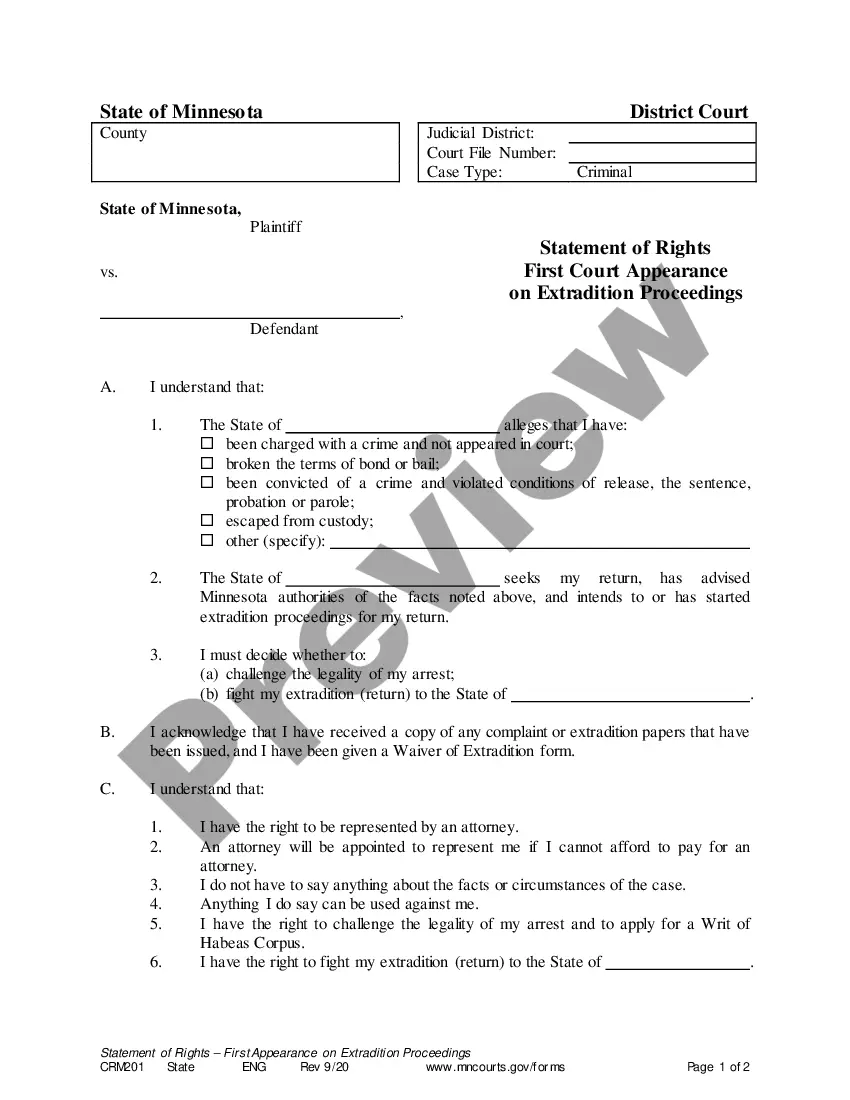
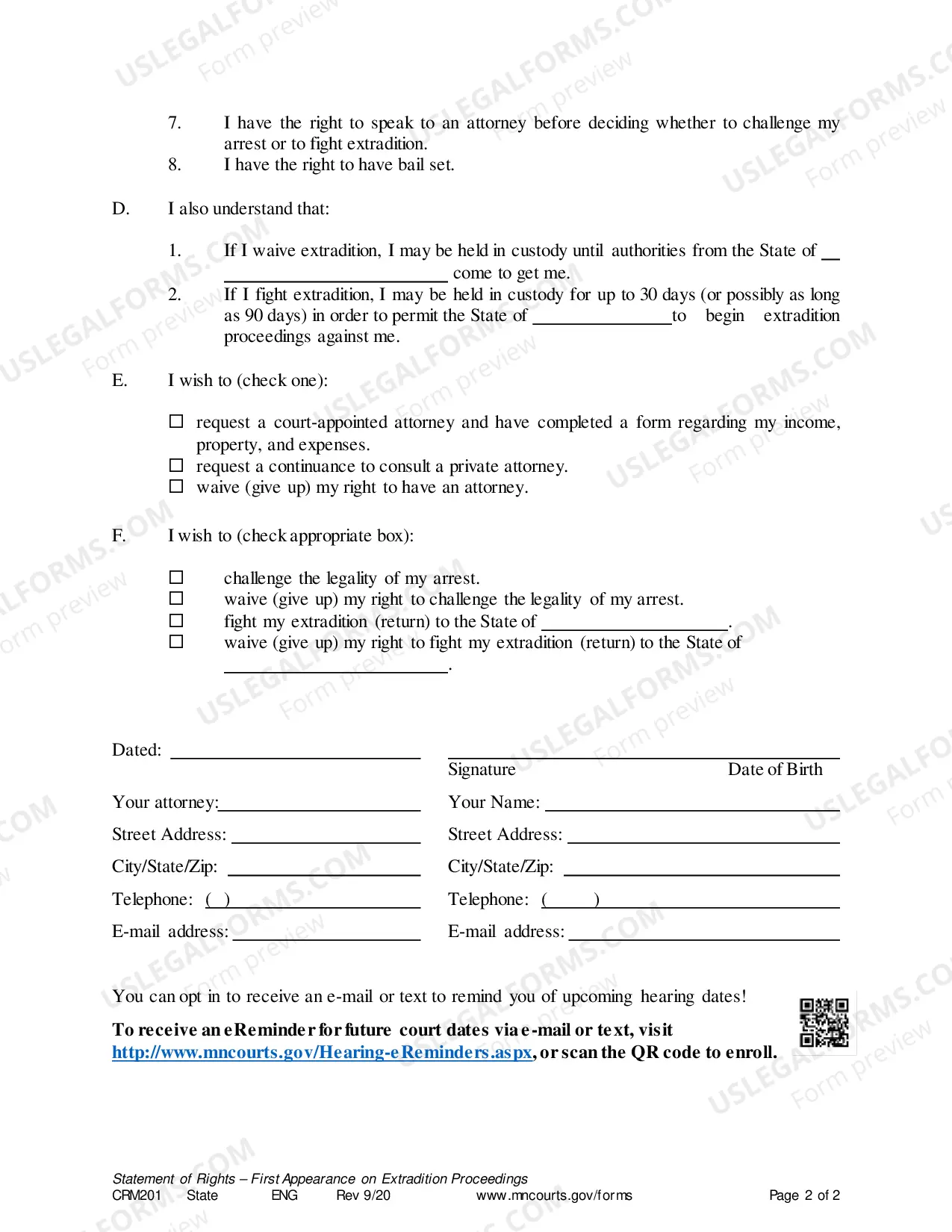
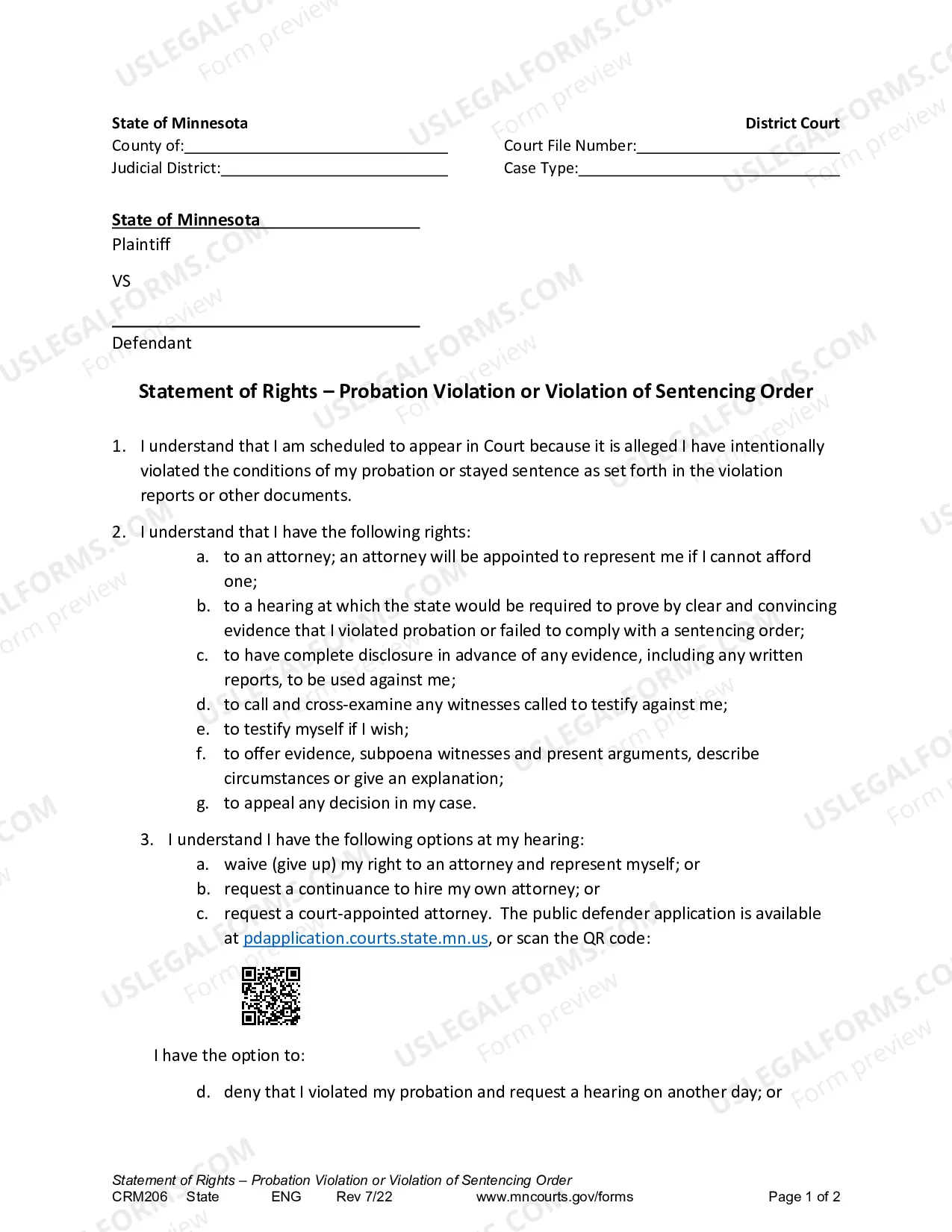
This is an official Minnesota court form for use in a criminal case, a Extradition Statement of Rights. USLF amends and updates these forms as is required by Minnesota Statutes and Law.
Minnesota Extradition Statement of Rights
State:
Minnesota
Control #:
MN-CRM201
Format:
PDF
Instant download
This website is not affiliated with any governmental entity
Public form
Description
Free preview
Get your form ready online
Our built-in tools help you complete, sign, share, and store your documents in one place.
Built-in online Word editor
Make edits, fill in missing information, and update formatting in US Legal Forms—just like you would in MS Word.
Export easily
Download a copy, print it, send it by email, or mail it via USPS—whatever works best for your next step.
E-sign your document
Sign and collect signatures with our SignNow integration. Send to multiple recipients, set reminders, and more. Go Premium to unlock E-Sign.
Notarize online 24/7
If this form requires notarization, complete it online through a secure video call—no need to meet a notary in person or wait for an appointment.
Store your document securely
We protect your documents and personal data by following strict security and privacy standards.

Make edits, fill in missing information, and update formatting in US Legal Forms—just like you would in MS Word.

Download a copy, print it, send it by email, or mail it via USPS—whatever works best for your next step.

Sign and collect signatures with our SignNow integration. Send to multiple recipients, set reminders, and more. Go Premium to unlock E-Sign.

If this form requires notarization, complete it online through a secure video call—no need to meet a notary in person or wait for an appointment.

We protect your documents and personal data by following strict security and privacy standards.
Looking for another form?
How to fill out Minnesota Extradition Statement Of Rights?
Access any type from 85,000 legal documents like the Minnesota Extradition Statement of Rights online with US Legal Forms. Each template is crafted and refreshed by state-certified attorneys.
If you already possess a subscription, Log In. Once you’re on the form’s page, tap the Download button and navigate to My documents to retrieve it.
If you have yet to subscribe, adhere to the following guidelines.
With US Legal Forms, you’ll consistently have swift access to the appropriate downloadable template. The platform offers you access to forms and organizes them into categories to make your search easier. Utilize US Legal Forms to acquire your Minnesota Extradition Statement of Rights quickly and effortlessly.
- Verify the state-specific criteria for the Minnesota Extradition Statement of Rights you intend to utilize.
- Browse the description and preview the example.
- When you are confident the example is what you require, click Buy Now.
- Choose a subscription plan that fits your finances.
- Establish a personal account.
- Make a payment in one of two convenient methods: by credit card or through PayPal.
- Select a format to download the document in; two options are available (PDF or Word).
- Download the document to the My documents section.
- Once your reusable form is prepared, print it out or save it to your device.
Form popularity
FAQ
In an extradition process, one sovereign jurisdiction typically makes a formal request to another sovereign jurisdiction ("the requested state"). If the fugitive is found within the territory of the requested state, then the requested state may arrest the fugitive and subject him or her to its extradition process.
What is a Rule 8 hearing in a Minnesota criminal case? (a) The purpose of this hearing is to again advise defendants of their rights, to allow defendants to plead guilty, or if the defendant does not plead guilty, to request or waive an Omnibus Hearing under Rule 11.
Yes, Minnesota CAN extradite you back from Wisconsin. Typically warrants will state whether they are for execution within state boundaries or in all 50 states.
FBI data from Central Minnesota counties show that Stearns, Benton and Sherburne counties won't extradite the subjects of felony warrants 51 percent to 57 percent of the time when the subject is apprehended in another state.
The purpose of the Omnibus Hearing is to avoid a multiplicity of court appearances on these issues with a duplication of evidence and to combine all of the issues that can be disposed of without trial into one appearance.
As of 2010, in practice, Florida, Alaska, and Hawaii typically do not request extradition if the crime in question is not a felony because of the associated costs of transporting the suspect and the housing fees that must be paid to the jurisdiction in which the accused is held until transported.
Within the U.S., extradition between states is governed by federal law. The Extradition Clause of the U.S. Constitution (Article Iv Section 2) requires that:Not all states have adopted the UCEA, however, states that have not adopted it have their own extradition laws that comply with the federal law.
Some crimes which may be subject to extradition include murder, kidnapping, drug trafficking, terrorism, rape, sexual assault, burglary, embezzlement, arson, or espionage.