Minnesota Client Acknowledgment of Attorney's Disapproval of Settlement Agreement
Understanding this form
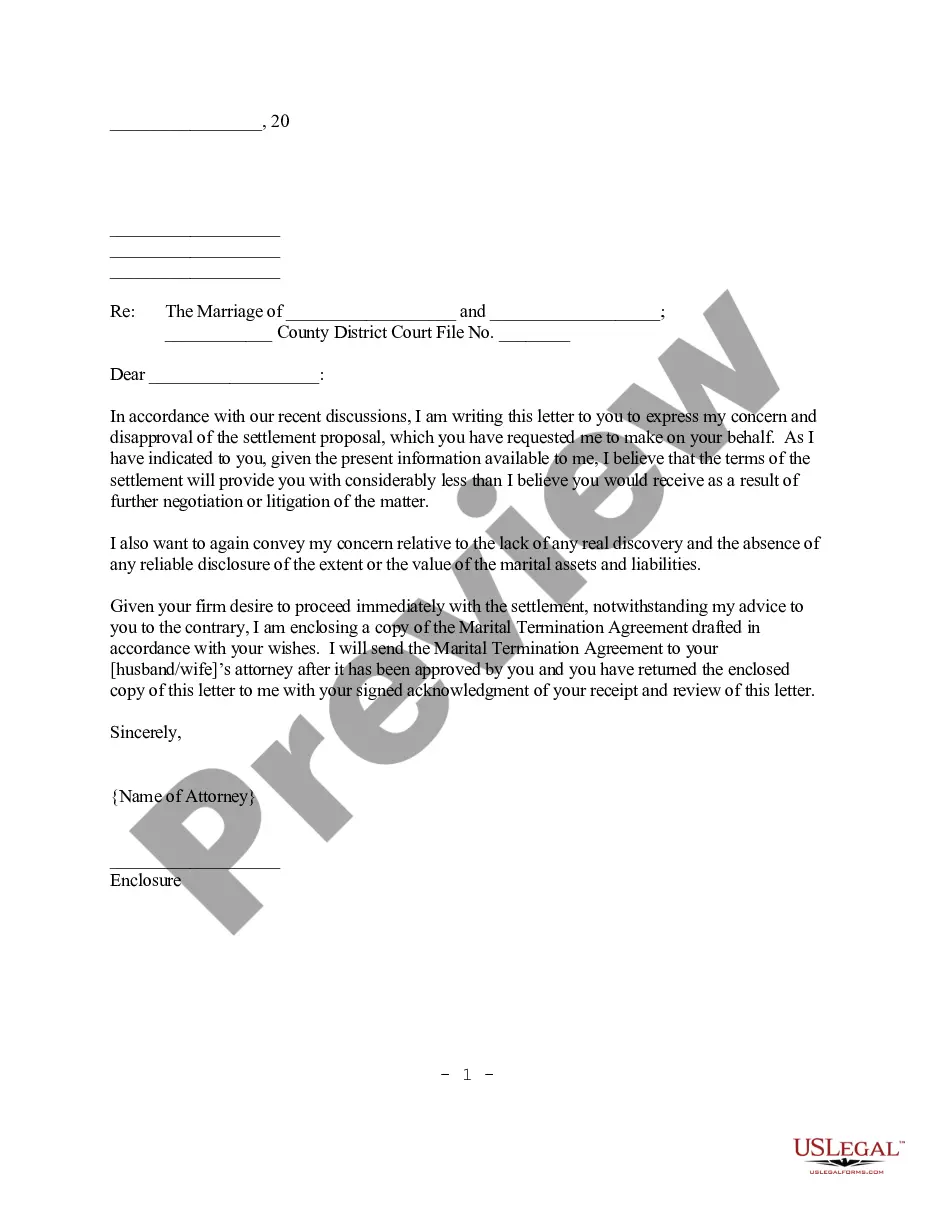
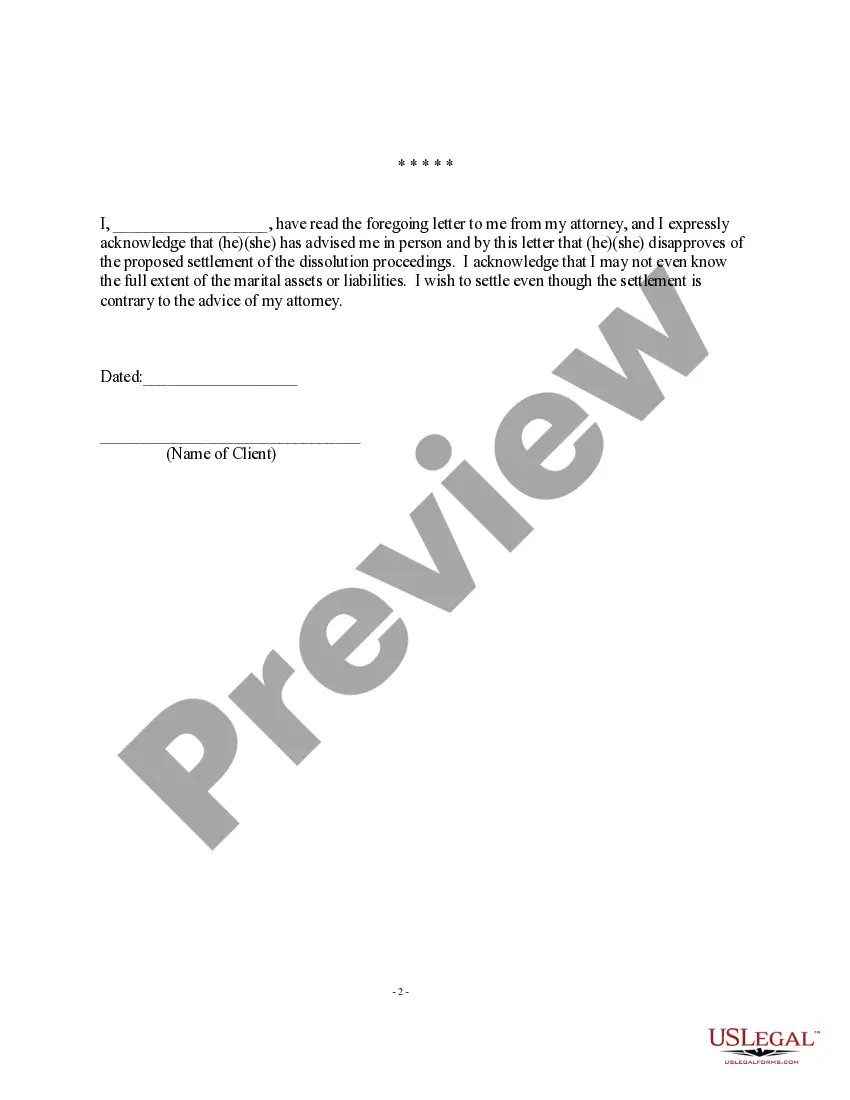
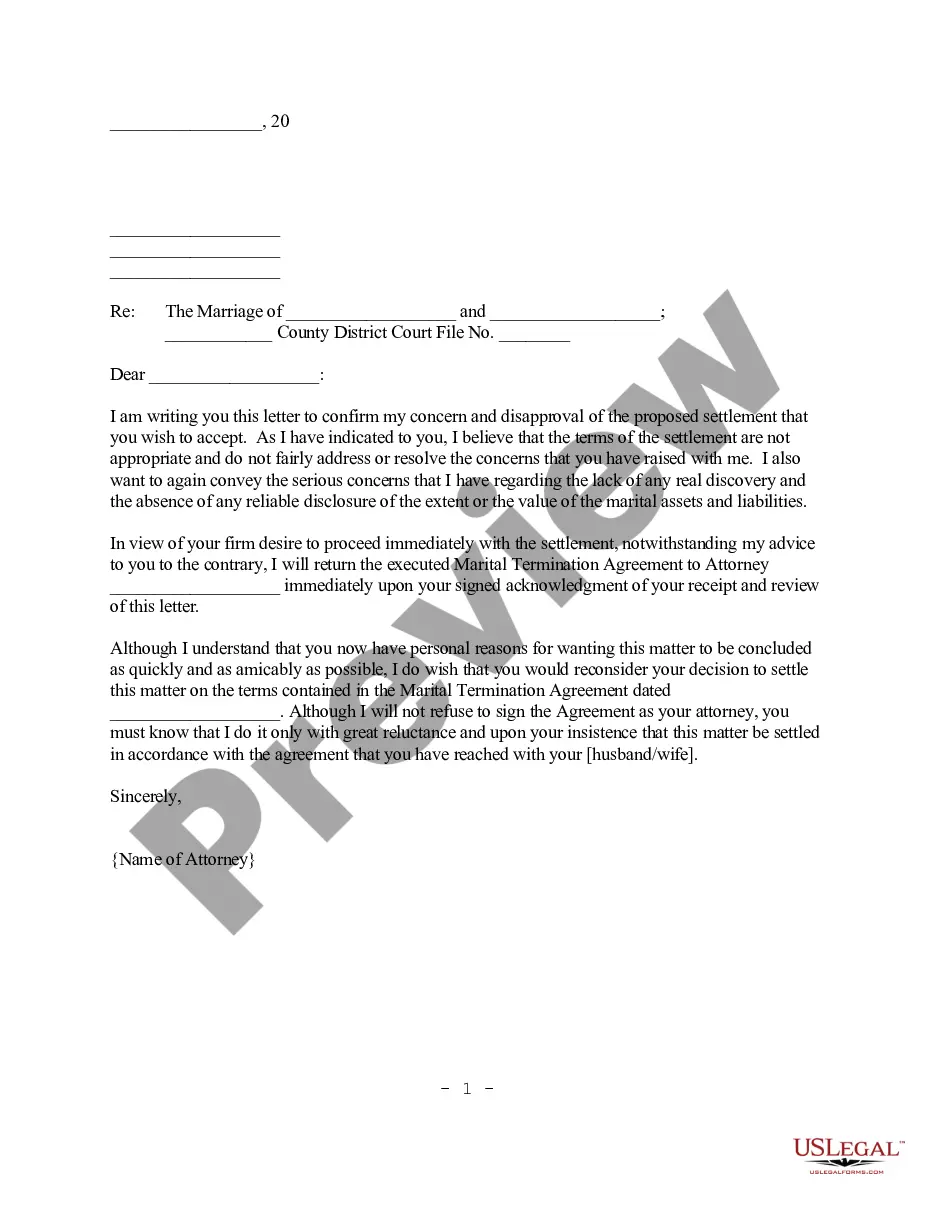
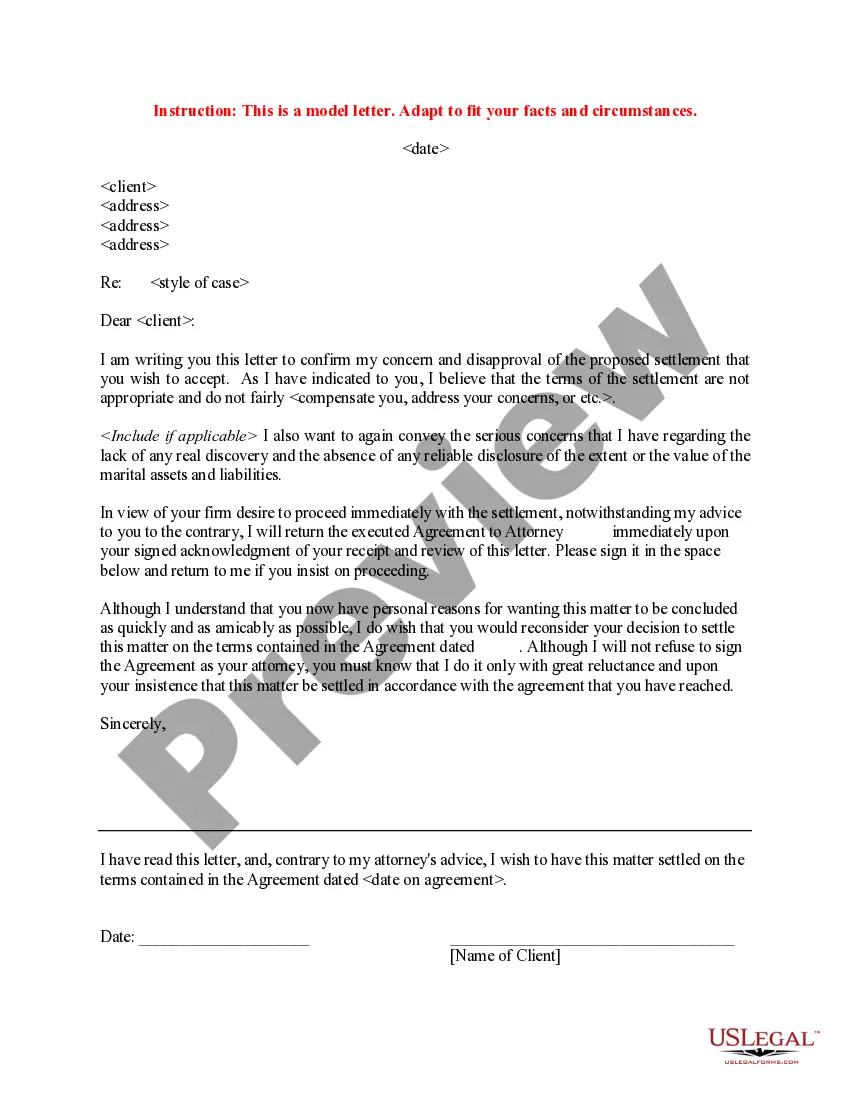
The Client Acknowledgment of Attorney's Disapproval of Settlement Agreement is a formal letter from an attorney expressing their disagreement with a client's decision to settle a legal matter. This crucial document underscores the attorney's professional advice against the settlement while respecting the client's wishes to proceed. It differs from other legal forms by including a release that the client must sign, acknowledging that they are choosing to settle despite the attorney's disapproval.
Key parts of this document
- Attorneyâs disapproval statement regarding the proposed settlement.
- Clientâs acknowledgment of the attorney's advice and their intent to proceed with the settlement.
- Information on the lack of complete disclosure of marital assets and liabilities.
- Enclosure of the Marital Termination Agreement for the clientâs review and signature.
- Space for the attorney's name and the client's signature with the date.
Situations where this form applies
This form should be used when a client wishes to settle a legal matter against the advice of their attorney. It is particularly applicable in divorce or marital dissolution proceedings where the attorney believes that the settlement terms are not in the client's best interest. The form is essential for documenting the attorney's disapproval and ensuring the client understands the consequences of their decision.
Intended users of this form
- Clients involved in a legal dispute who intend to settle despite their attorney's advice.
- Individuals undergoing divorce or marital dissolution proceedings.
- Attorneys who need to formally document their disapproval of a client's settlement decision.
Completing this form step by step
- Fill in the county and district court file number at the top of the letter.
- Address the letter to the appropriate recipient, usually the client or opposing counsel.
- Clearly state your disapproval of the proposed settlement in the body of the letter.
- Include the marital termination agreement as an enclosure for review and signature.
- Request the client to sign and date the acknowledgment section at the bottom of the form.
Notarization guidance
This form does not typically require notarization unless specified by local law. Clients should verify specific requirements in their jurisdiction to ensure the validity of their acknowledgment.
Get your form ready online
Our built-in tools help you complete, sign, share, and store your documents in one place.
Make edits, fill in missing information, and update formatting in US Legal Forms—just like you would in MS Word.
Download a copy, print it, send it by email, or mail it via USPS—whatever works best for your next step.
Sign and collect signatures with our SignNow integration. Send to multiple recipients, set reminders, and more. Go Premium to unlock E-Sign.
If this form requires notarization, complete it online through a secure video call—no need to meet a notary in person or wait for an appointment.
We protect your documents and personal data by following strict security and privacy standards.

Make edits, fill in missing information, and update formatting in US Legal Forms—just like you would in MS Word.

Download a copy, print it, send it by email, or mail it via USPS—whatever works best for your next step.

Sign and collect signatures with our SignNow integration. Send to multiple recipients, set reminders, and more. Go Premium to unlock E-Sign.

If this form requires notarization, complete it online through a secure video call—no need to meet a notary in person or wait for an appointment.

We protect your documents and personal data by following strict security and privacy standards.
Mistakes to watch out for
- Failing to include the court file number or proper addressing of the letter.
- Not ensuring the client thoroughly understands the implications of settling against advice.
- Neglecting to obtain the clientâs signature on the acknowledgment portion.
- Not enclosing the marital termination agreement for the client to review.
Why use this form online
- Convenient access to professionally drafted templates anytime and from anywhere.
- Easy customization for specific needs and circumstances.
- Reliable, up-to-date legal forms prepared by licensed attorneys.
Legal use & context
- This form serves to document the attorney's disapproval of a settlement, providing legal protection for both the attorney and the client.
- It helps prevent potential disputes regarding the clientâs decision to settle against legal advice.
- Adhering to proper procedures can enhance the enforceability of the settlement agreement.
Key takeaways
- The form captures both the client's decision and the attorney's professional recommendation.
- It's a critical document for clients considering a settlement against legal advice.
- Ensure clarity and correctness in the completion of the form to mitigate future risks.
Looking for another form?
Form popularity
FAQ
Common expenses of an estate include executors fees, attorneys fees, accounting fees, court fees, appraisal costs, and surety bonds. These typically add up to 2% to 7% of the total estate value. Most estates are settled though probate in about 9 to 18 months, assuming there is no litigation involved.
Get death certificates. find and file the will with the local probate court. notify the Social Security Administration of the death. notify the state Department of Health. identify the trust beneficiaries. notify the beneficiaries. inventory trust assets. protect trust property.
When they pass away, the assets are distributed to beneficiaries, or the individuals they have chosen to receive their assets. A settlor can change or terminate a revocable trust during their lifetime. Generally, once they die, it becomes irrevocable and is no longer modifiable.
Before closing or dissolving a trust, the trustee must complete all steps in the trust administration process. This includes paying all financial obligations, distributing trust property to beneficiaries, filing final tax returns, and providing a final Trust Accounting.
The process of funding your living trust by transferring your assets to the trustee is an important part of what helps your loved ones avoid probate court in the event of your death or incapacity. Qualified retirement accounts such as 401(k)s, 403(b)s, IRAs, and annuities, should not be put in a living trust.
The Bottom Line After adding up all these fees and costs, you can probably count on settling your trust for anywhere from less than 1% to as much as 5% of the value of your assets. This doesn't include estate or income taxes that may be due and payable during the course of the trust administration.
However, a person with a large or complex estate or a unique situation may want to consult with an estate planning attorney for help with setting up a trust. Regardless of the size of estate, it might be a good idea to talk to an estate planning attorney if you have questions or concerns about setting up a trust.
How Long to Distribute Trust Assets? Most Trusts take 12 months to 18 months to settle and distribute assets to the beneficiaries and heirs.
Q: How Long Does an Executor Have to Distribute Assets From a Will? A: Dear Waiting: In most states, a will must be executed within three years of a person's death.