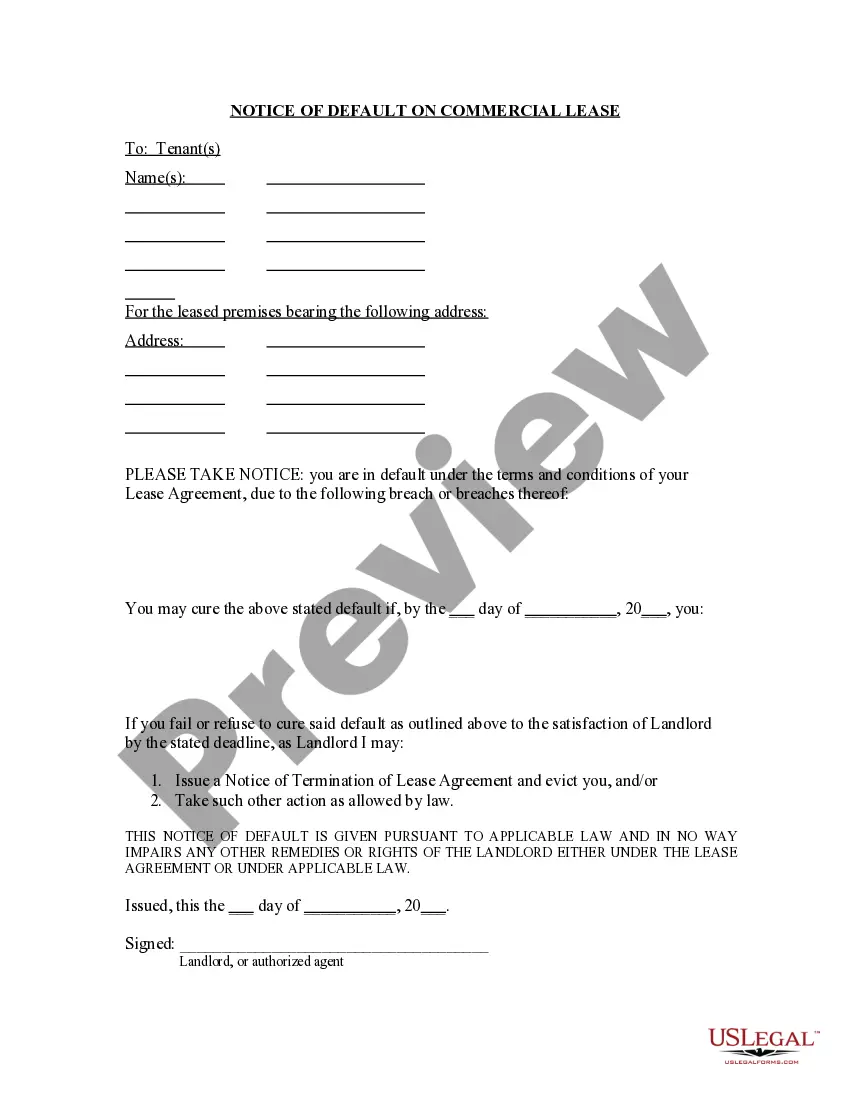
In landlord-tenant law, default refers to the failure of a tenant to timely pay rent due. In anticipation of such an occurence, landlords commonly require a new tenant to pay a security deposit, which may be used to remedy defaults in payment of rent and other monetary obligations under the rental agreement. In general, the landlord is required to give the tenant notice of the default before bringing eviction proceedings or applying security deposit proceeds to the payment in default. The fixing of a definite default date for payment of rent can be critical if it becomes necessary to evict a tenant for a default in the payment of rent. Landlords often require a background and/or reference check on prospective tenants in an attempt to minimize defaults in rent payments.
Minnesota Letter from Landlord to Tenant as Notice of Default on Commercial Lease
Description
How to fill out Minnesota Letter From Landlord To Tenant As Notice Of Default On Commercial Lease?
Have any template from 85,000 legal documents such as Minnesota Letter from Landlord to Tenant as Notice of Default on Commercial Lease online with US Legal Forms. Every template is prepared and updated by state-licensed attorneys.
If you have already a subscription, log in. Once you’re on the form’s page, click on the Download button and go to My Forms to access it.
In case you haven’t subscribed yet, follow the steps below:
- Check the state-specific requirements for the Minnesota Letter from Landlord to Tenant as Notice of Default on Commercial Lease you need to use.
- Look through description and preview the template.
- When you are sure the template is what you need, click on Buy Now.
- Select a subscription plan that works for your budget.
- Create a personal account.
- Pay out in one of two appropriate ways: by bank card or via PayPal.
- Select a format to download the document in; two options are available (PDF or Word).
- Download the file to the My Forms tab.
- After your reusable template is ready, print it out or save it to your gadget.
With US Legal Forms, you’ll always have quick access to the right downloadable template. The platform gives you access to documents and divides them into categories to simplify your search. Use US Legal Forms to get your Minnesota Letter from Landlord to Tenant as Notice of Default on Commercial Lease easy and fast.
Form popularity
FAQ
Before selling the tenant's property, the landlord must give the tenant five days' notice. Unless the lease requires the landlord to give the tenant notice, the landlord may be able to terminate the lease and evict the tenant if the tenant does not pay the rent on time.
If you're an assured tenant or a protected tenant Your landlord will have to give you notice if they want you to leave. They have to give the reasons why they want to evict you - for example, if you have rent arrears or you've damaged the property. Your landlord will have to go to court and get a court order.
For example, the lease may provide that in case of default, the landlord can recover late fees and interest. If the lease is a net lease, it may provide for the landlord to recover such things as property taxes, insurance, utilities, maintenance and repairs.
So a tenant is likely to have to give between 3 and 4 months notice if rent is paid monthly, and 3 and 6 months notice if rent is paid quarterly.
Landlords can try and forfeit a lease if a tenant is in breach of their obligations (this assumes that the lease document includes a right to forfeit).If a commercial lease contains a break clause, either or both parties to the agreement may seek to terminate the lease before its fixed period has ended.
Break rights can only be exercised on reasonable prior written notice and usually a minimum of 6 months' notice is required.It is therefore prudent for a landlord or tenant to ask its professional advisors to serve a break notice on its behalf and to review the validity of any such notice served by the other party.
A break-early fee is a lump sum payment. The amount of the break-early fee will vary greatly depending upon the commercial tenant's specific circumstances. In exchange for the break-early fee, the landlord will agree to release the commercial tenant from all of its obligations under the commercial lease.
Paying the remainder of the rent still owed on the lease in full; Paying a specified amount of liquidated damages as outlined in the contract terms; Paying an additional amount of punitive damages, dependent on local state laws; and/or.