Michigan Recommendation Order
About this form
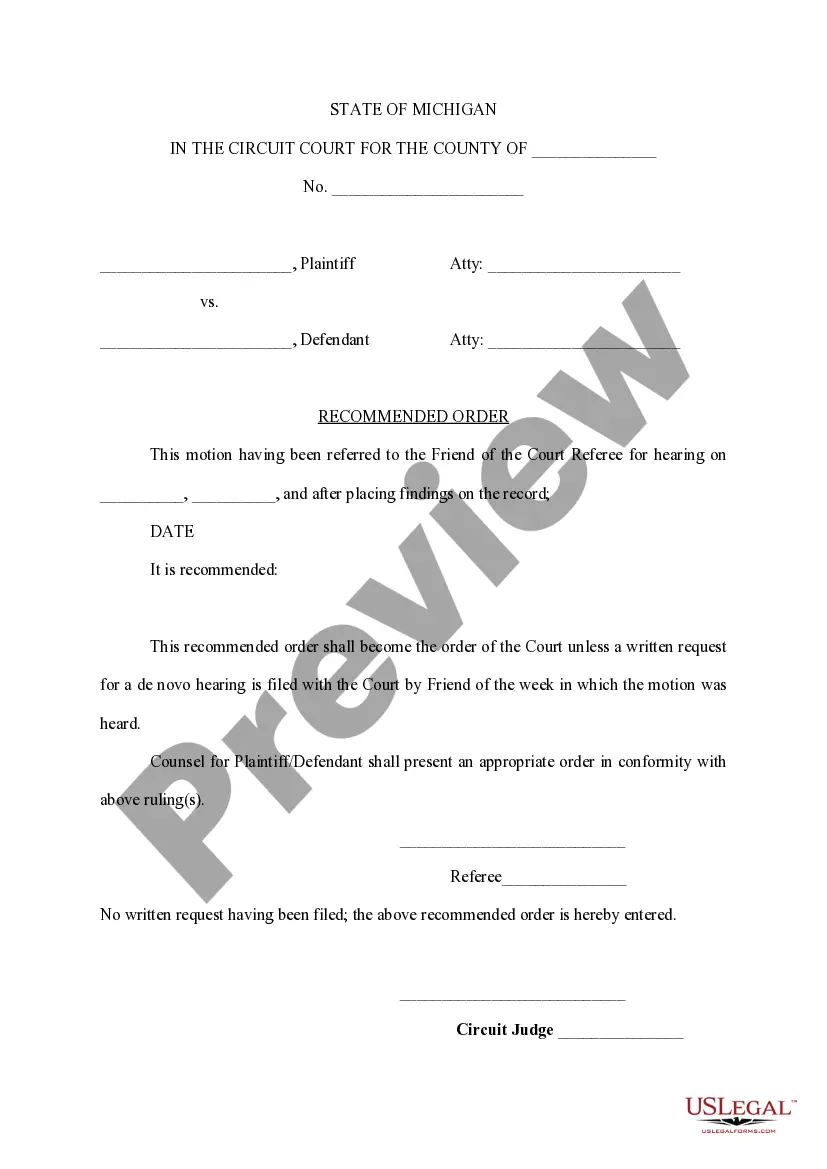
The Recommendation Order is a document issued by a Friend of the Court Referee that outlines suggested rulings following a hearing. It serves as a formal recommendation that will become the Court's order unless a written request for a hearing is submitted. This form is crucial for individuals involved in legal disputes, as it clarifies the recommended outcomes and facilitates the next steps in the judicial process.
Key components of this form
- Header section with the court details and case number
- Identification of the parties involved (plaintiff and defendant)
- Details about the hearing date and findings
- The refereeâs recommendations for the court order
- Instructions on how to contest the recommendation
- Signature fields for the referee and circuit judge


When to use this form
This form is typically used after a court hearing involving custody, support, or other family law issues. If you are involved in a case where a referee has made recommendations, this form is necessary to formalize those suggestions into court orders. It can be utilized when you want to provide feedback or contest the recommended order by requesting a hearing.
Intended users of this form
This form is intended for:
- Parties involved in family law cases, including parents and guardians.
- Attorneys representing plaintiffs or defendants in court proceedings.
- Individuals who wish to contest a magistrate's recommendations.
How to prepare this document
- Fill in the case number, court location, and parties involved in the header.
- Enter the date of the hearing along with a summary of findings.
- List the refereeâs recommendations clearly under the designated section.
- Indicate the process to contest the recommendations, including how to file for a de novo hearing.
- Sign and date the form where indicated by both the referee and the circuit judge.
Notarization requirements for this form
This form does not typically require notarization unless specified by local law. Always check state-specific regulations to ensure compliance.
Get your form ready online
Our built-in tools help you complete, sign, share, and store your documents in one place.
Make edits, fill in missing information, and update formatting in US Legal Forms—just like you would in MS Word.
Download a copy, print it, send it by email, or mail it via USPS—whatever works best for your next step.
Sign and collect signatures with our SignNow integration. Send to multiple recipients, set reminders, and more. Go Premium to unlock E-Sign.
If this form requires notarization, complete it online through a secure video call—no need to meet a notary in person or wait for an appointment.
We protect your documents and personal data by following strict security and privacy standards.

Make edits, fill in missing information, and update formatting in US Legal Forms—just like you would in MS Word.

Download a copy, print it, send it by email, or mail it via USPS—whatever works best for your next step.

Sign and collect signatures with our SignNow integration. Send to multiple recipients, set reminders, and more. Go Premium to unlock E-Sign.

If this form requires notarization, complete it online through a secure video call—no need to meet a notary in person or wait for an appointment.

We protect your documents and personal data by following strict security and privacy standards.
Common mistakes to avoid
- Failing to submit a written request for a hearing within the appropriate time frame.
- Omitting signatures from the referee or judge, which could nullify the form.
- Not including the correct case number or partiesâ names, leading to confusion in court records.
Why use this form online
- Convenience of downloading and completing the form from home.
- Editability allows for easy modifications as needed.
- Reliable, attorney-drafted templates ensure compliance with local laws.
Main things to remember
- The Recommendation Order communicates the refereeâs suggested rulings to the court.
- It can be contested through a written request for a hearing if necessary.
- Ensure all sections of the form are filled correctly to avoid delays in the legal process.
Looking for another form?


Form popularity
FAQ
Proof of service refers to the documentation that confirms that legal papers have been delivered to a party involved in a lawsuit. It serves as critical evidence that all parties have been informed and is required for the court to proceed with cases, including those involving a Michigan Recommendation Order. Understanding proof of service helps ensure proper legal protocols are followed.
To legally serve someone in Michigan, you must deliver the legal documents to the individual directly or use an approved method like mail or electronic communication. It's important to follow the state's specific laws regarding service to avoid complications. Utilizing platforms like uslegalforms can help streamline this process by providing the necessary forms and guidance for serving documents effectively.
Proof of service in Michigan is a formal declaration that confirms a party has served legal documents to another party. This declaration can include various methods of service such as personal delivery, mailing, or electronic service. It is crucial in legal proceedings, including situations involving a Michigan Recommendation Order, as it substantiates that all parties have been appropriately informed.
A proof of service document in Michigan is a legal form that verifies that a summons or complaint has been properly delivered to the intended recipient. This document acts as essential evidence in court, demonstrating that the involved parties were notified about legal proceedings. When you file a Michigan Recommendation Order, including a proof of service ensures that the process is valid and recognized by the court.
The 7 day rule in Michigan refers to the requirement that certain court orders take effect seven days after they are issued. This period allows parties time to respond or appeal if they choose. It is crucial to be aware of this timeline when dealing with a Michigan Recommendation Order, as it may impact your ability to take action. For those unfamiliar with the process, consulting with professionals or platforms like USLegalForms can provide clarity and support.
Filing a motion with the court in Michigan requires completing the necessary forms and submitting them to the appropriate court. You need to include a clear description of your request, along with any supporting documents. Use the guidelines provided by the Michigan court system to ensure accuracy and compliance. Additionally, utilizing resources like USLegalForms can streamline the process of preparing your motion and ensure that it meets all legal requirements.
In Michigan, a debt typically becomes uncollectible after six years from the date of the last payment or written acknowledgment. This period is referred to as the statute of limitations. After this time, creditors can no longer sue you to collect the debt. Understanding the implications of a Michigan Recommendation Order can help you respond effectively to any collection attempts.
The order of heirs in Michigan defines the sequence in which family members inherit an estate when a person passes away without a will. Generally, spouses and children have priority, followed by parents, siblings, and other relatives. Understanding the Michigan Recommendation Order plays a significant role in estate planning and ensuring that your wishes are fulfilled. For clarity and structuring your estate, you may find USLegalForms helpful in preparing the necessary documentation.
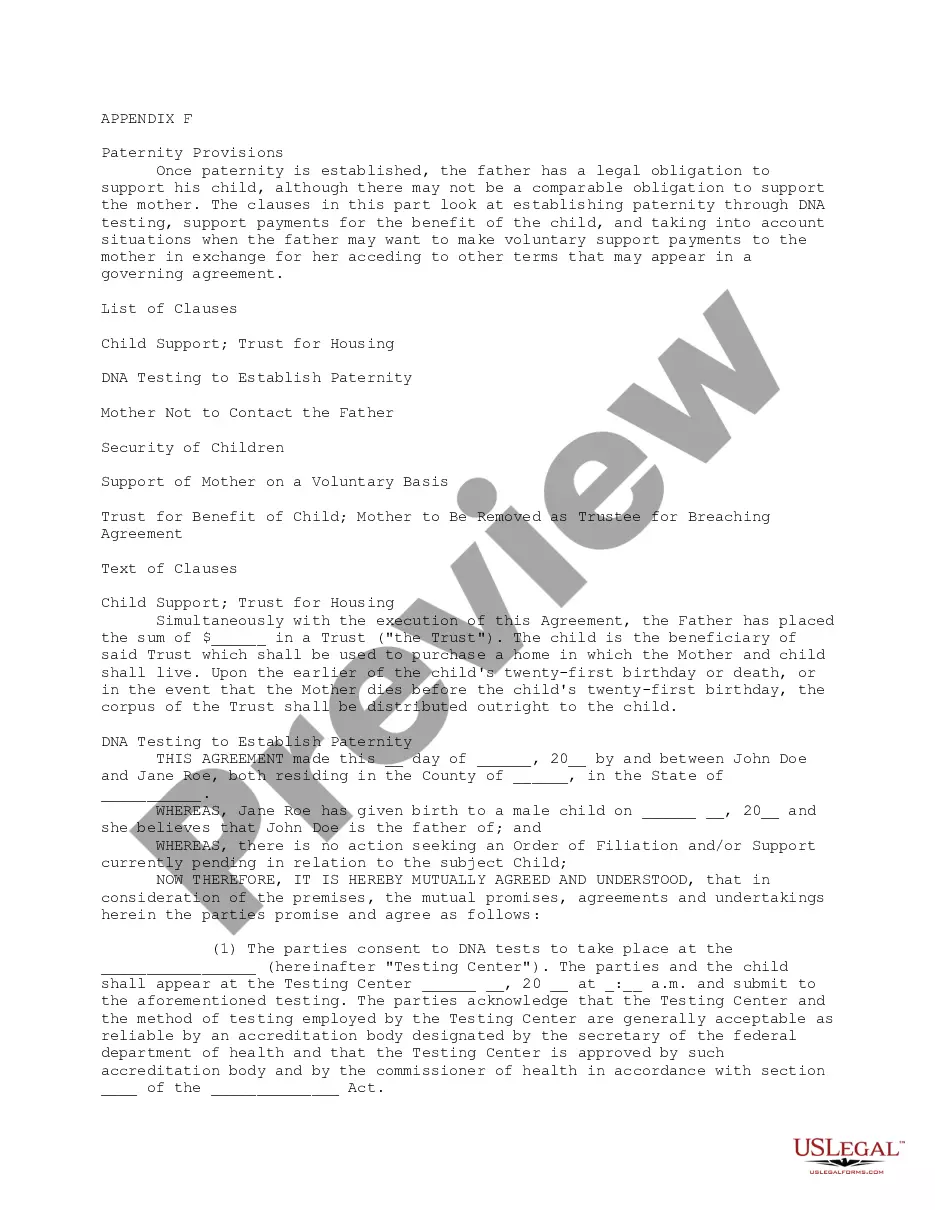
The filiation process involves filing a legal action to determine a child's parentage in Michigan. Typically, this process begins with a petition to the court, followed by potential DNA testing to establish paternity. Once confirmed, a Michigan Recommendation Order is issued, ensuring the child receives their rightful benefits. To ease the complexities of this process, utilizing resources from USLegalForms can be highly beneficial.
An order of filiation in Michigan is a legal determination confirming the identity of a child’s parents. It solidifies the rights of the child related to support, custody, and inheritance. This order becomes crucial in disputes regarding paternity and helps establish parental responsibilities. For individuals needing assistance in obtaining a Michigan Recommendation Order, USLegalForms provides essential forms and support.