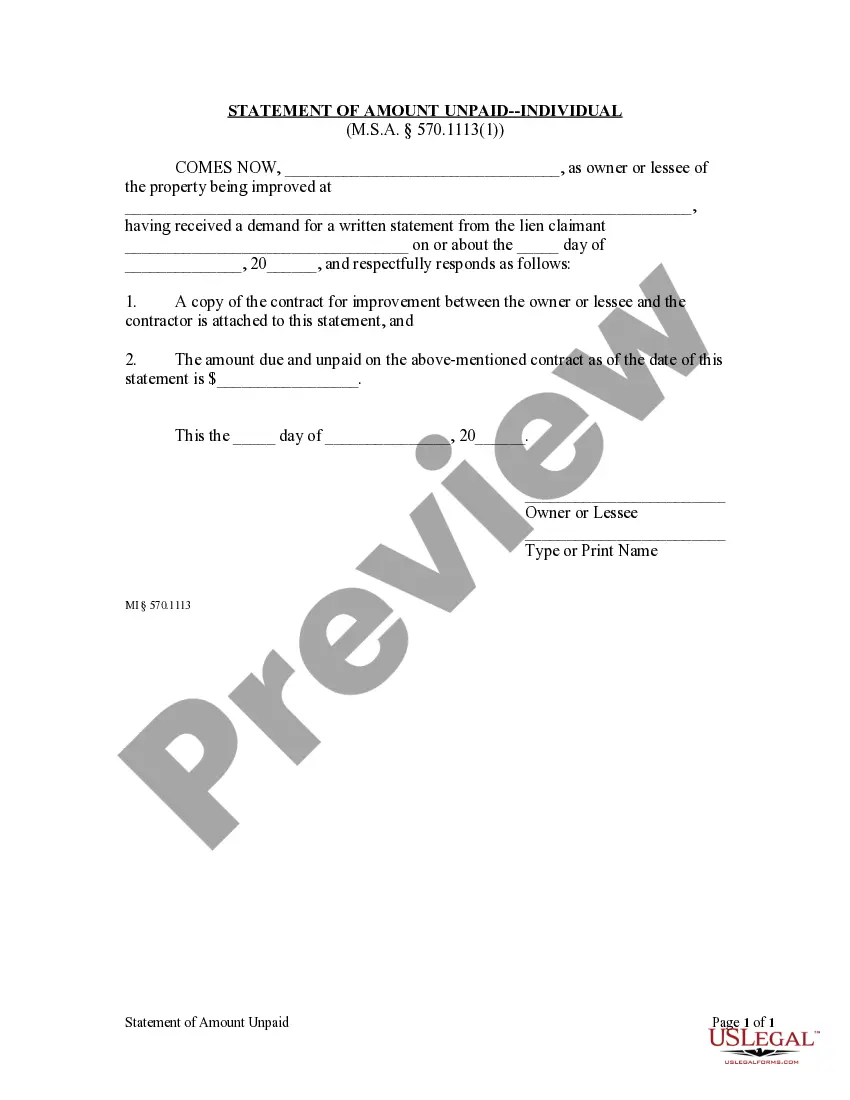
Michigan Statement of Amount Unpaid - Individual
Understanding this form
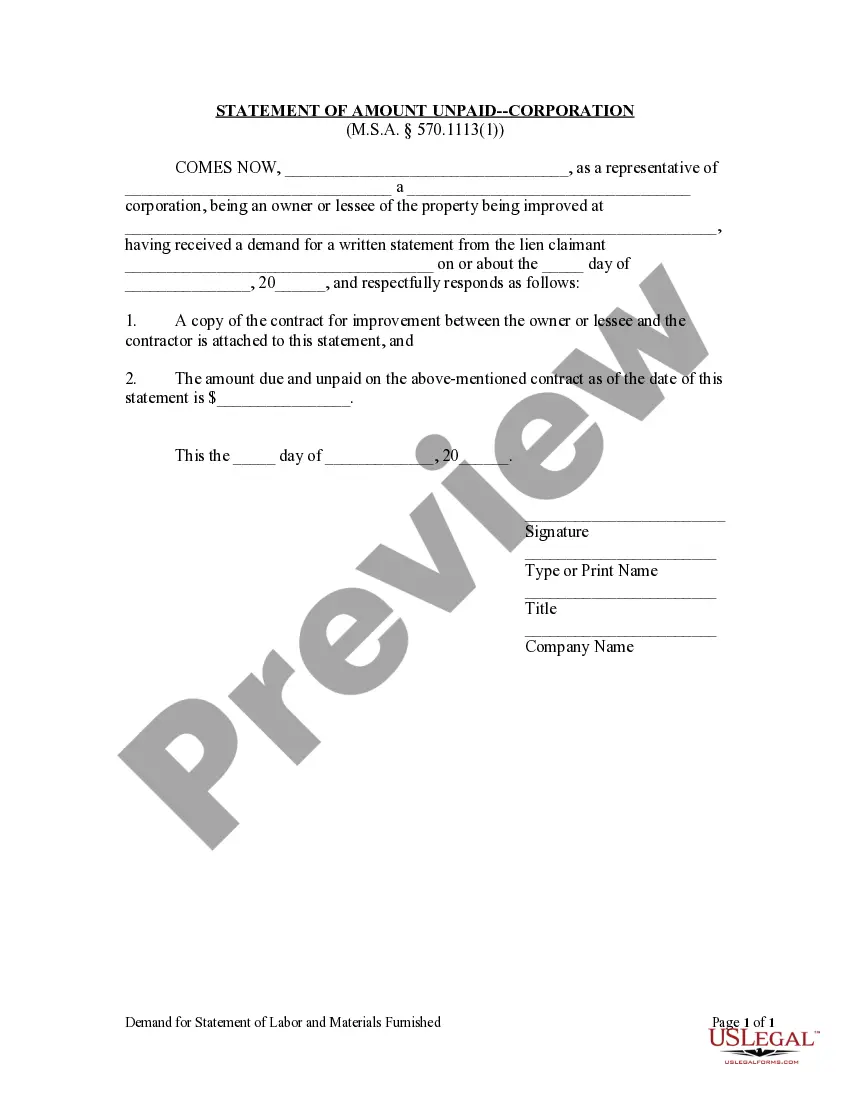
The Statement of Amount Unpaid - Individual is a legal document used by property owners in Michigan to respond to requests from lien claimants. This form allows owners to formally disclose the amount owed on a contractor's agreement while also providing a copy of the contract. It differs from other legal forms by specifically addressing the financial transparency between property owners and contractors regarding unpaid amounts related to property improvements.
What’s included in this form
- Identification of the property owner or lessee.
- Details of the property being improved, including its address.
- Name of the lien claimant making the demand.
- Date of the demand for information.
- Attached copy of the contract between the owner and the contractor.
- Statement of the amount due and unpaid as of the date of completion.
- Date of response and signature of the owner or lessee.
Common use cases
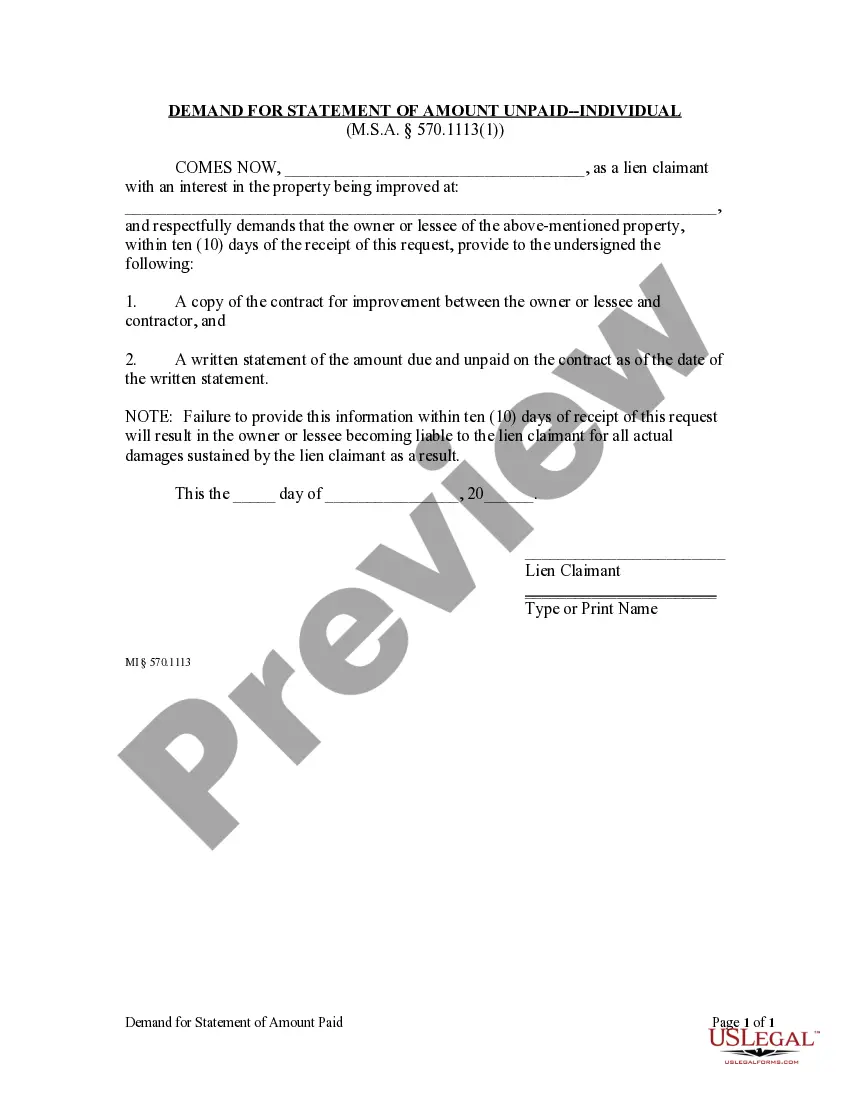
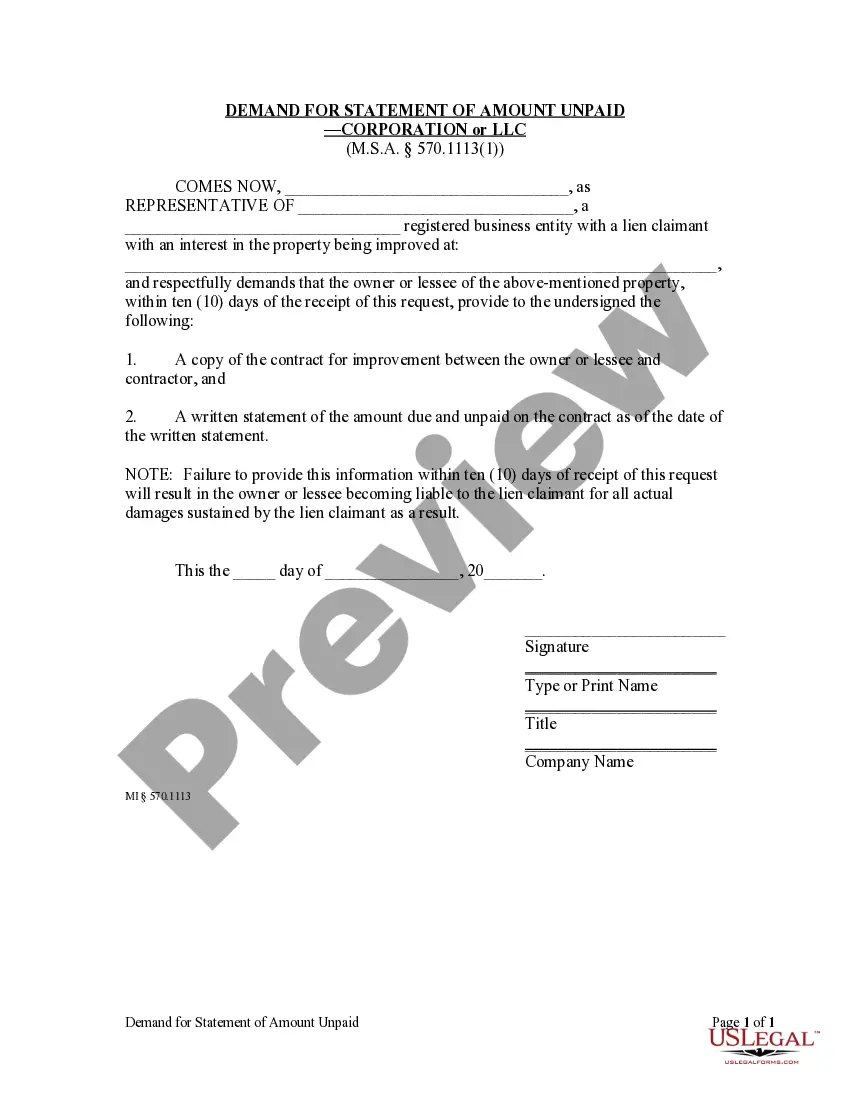
This form is necessary when a property owner receives a demand from a lien claimant to provide information about an outstanding payment regarding a property improvement. It is typically used in construction or renovation projects to clarify financial obligations and maintain legal compliance.
Who should use this form
- Property owners who have hired contractors for improvements.
- Lessee of properties who are managing improvement projects.
- Anyone receiving a written demand for information from a lien claimant regarding an unpaid contract.
How to prepare this document
- Identify yourself as the owner or lessee of the property involved.
- Specify the address of the property being improved.
- Include the name of the lien claimant and the date you received their demand.
- Attach a copy of the contract with the contractor for the improvements.
- Clearly state the amount due and unpaid as of the date of your response.
- Sign and date the document to finalize your response.
Is notarization required?
This form does not typically require notarization to be legally valid. However, some jurisdictions or document types may still require it. US Legal Forms provides secure online notarization powered by Notarize, available 24/7 for added convenience.
Get your form ready online
Our built-in tools help you complete, sign, share, and store your documents in one place.
Make edits, fill in missing information, and update formatting in US Legal Forms—just like you would in MS Word.
Download a copy, print it, send it by email, or mail it via USPS—whatever works best for your next step.
Sign and collect signatures with our SignNow integration. Send to multiple recipients, set reminders, and more. Go Premium to unlock E-Sign.
If this form requires notarization, complete it online through a secure video call—no need to meet a notary in person or wait for an appointment.
We protect your documents and personal data by following strict security and privacy standards.

Make edits, fill in missing information, and update formatting in US Legal Forms—just like you would in MS Word.

Download a copy, print it, send it by email, or mail it via USPS—whatever works best for your next step.

Sign and collect signatures with our SignNow integration. Send to multiple recipients, set reminders, and more. Go Premium to unlock E-Sign.

If this form requires notarization, complete it online through a secure video call—no need to meet a notary in person or wait for an appointment.

We protect your documents and personal data by following strict security and privacy standards.
Typical mistakes to avoid
- Failing to attach the contract to the statement.
- Not including the correct name of the lien claimant.
- Leaving the amount unpaid section blank or inaccurately filled out.
- Missing the date of the demand from the lien claimant.
- Not signing the form or forgetting to date it.
Benefits of using this form online
- Easy access to a legally vetted form tailored for Michigan residents.
- Convenient download option, allowing quick completion and submission.
- Editable format ensures you can customize the form before printing.
- Reliable resource created by licensed attorneys for legal clarity.
Looking for another form?
Form popularity
FAQ
Your tax return amount is, in general, based on line 24 (total tax owed) and line 33 (total tax paid). Subtract line 24 from line 33.
We will send a letter/notice if: You are due a larger or smaller refund. We have a question about your tax return. We need to verify your identity.
If you don't understand why you received your bill, please contact the appropriate Tax Division at the number below: To pay your debt or other questions about your delinquent account, call Treasury Collection Services Bureau at 517-636-5265.
Michigan Department of Treasury is now accepting electronic payments for estimated taxes by using the Michigan Individual Income Tax e-Payments system.You may receive estimated payment vouchers in the mail even if you have not filed estimated payments in the past.
To start, it is important to point out that not all letters and notices that you receive from the IRS are necessarily bad.In certain limited circumstances, the IRS may send you a letter or notice communicating the fact that you made an and error and the agency has corrected it in your favor.
The Michigan Unclaimed Property website is available at www.michigan.gov/unclaimedproperty. Claimants may also call Michigan Unclaimed Property at (517) 636-5320 between 9 a.m. and 4 p.m. on weekdays.
In Michigan, the state generally has 6 years to collect a tax debt.
Don't ignore it. Most IRS letters and notices are about federal tax returns or tax accounts. Don't panic. Do take timely action. Do review the information. Don't reply unless instructed to do so. Do respond to a disputed notice. Do remember that there is usually no need to call the IRS. Do avoid scams.
Generally speaking, the IRS sent you certified mail to show it attempted to give you notice of whatever issue the IRS wants to address with you.If the IRS fails to give you notice and an opportunity for a hearing then in certain cases the IRS brings up Constitutional issues regarding your right to Due Process.