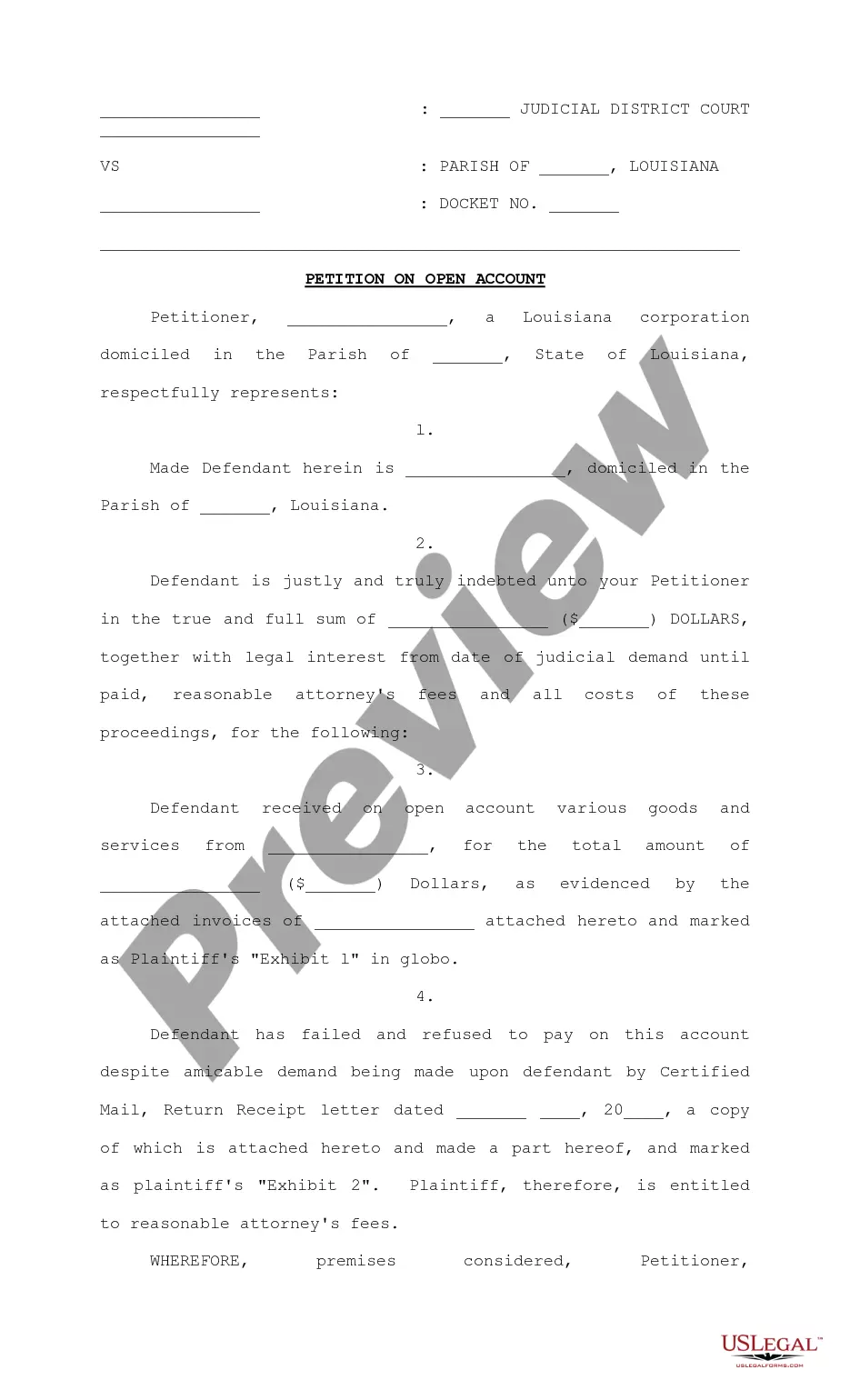
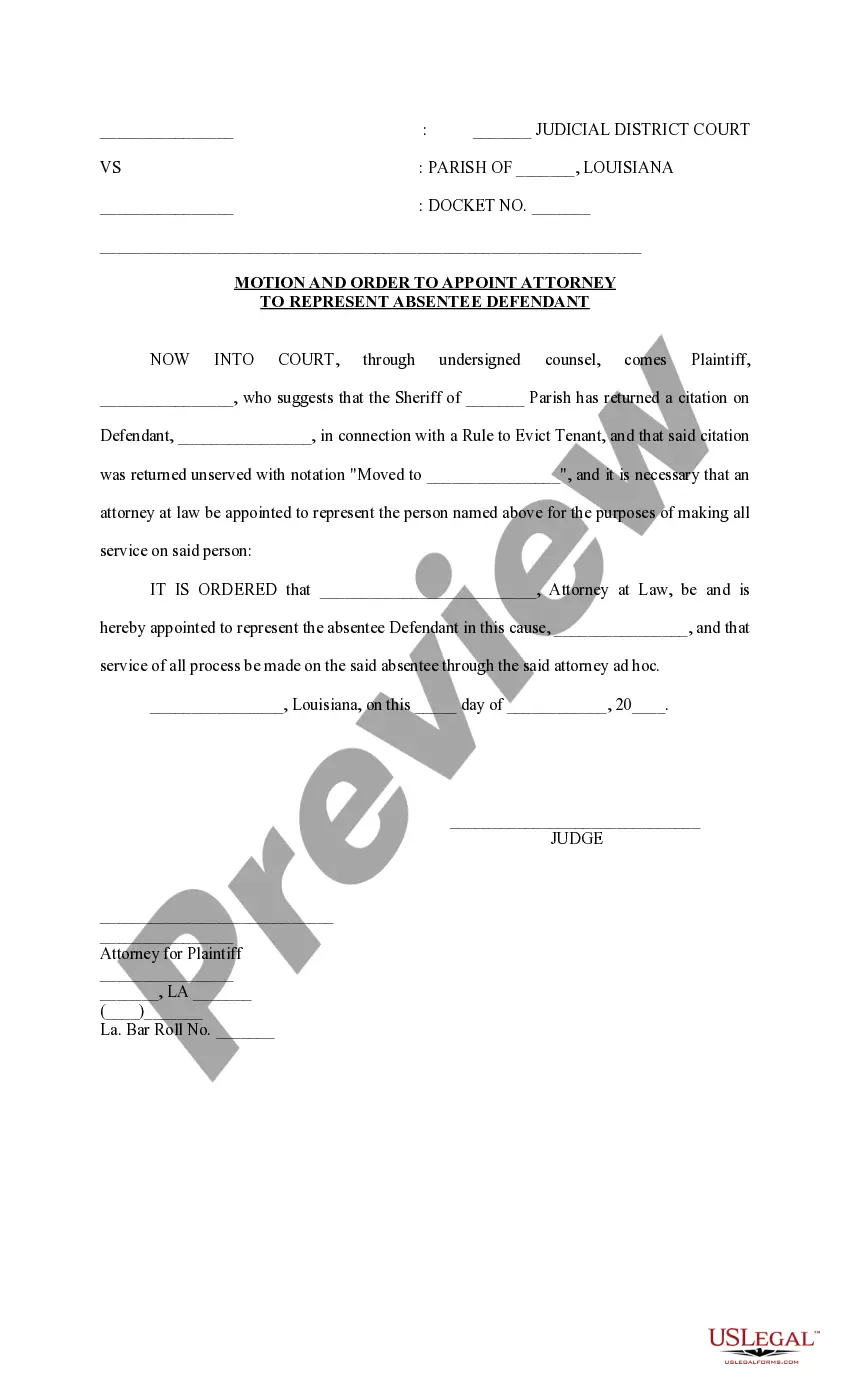
Agreement to Arbitrate a Disputed Open Account
Understanding this form
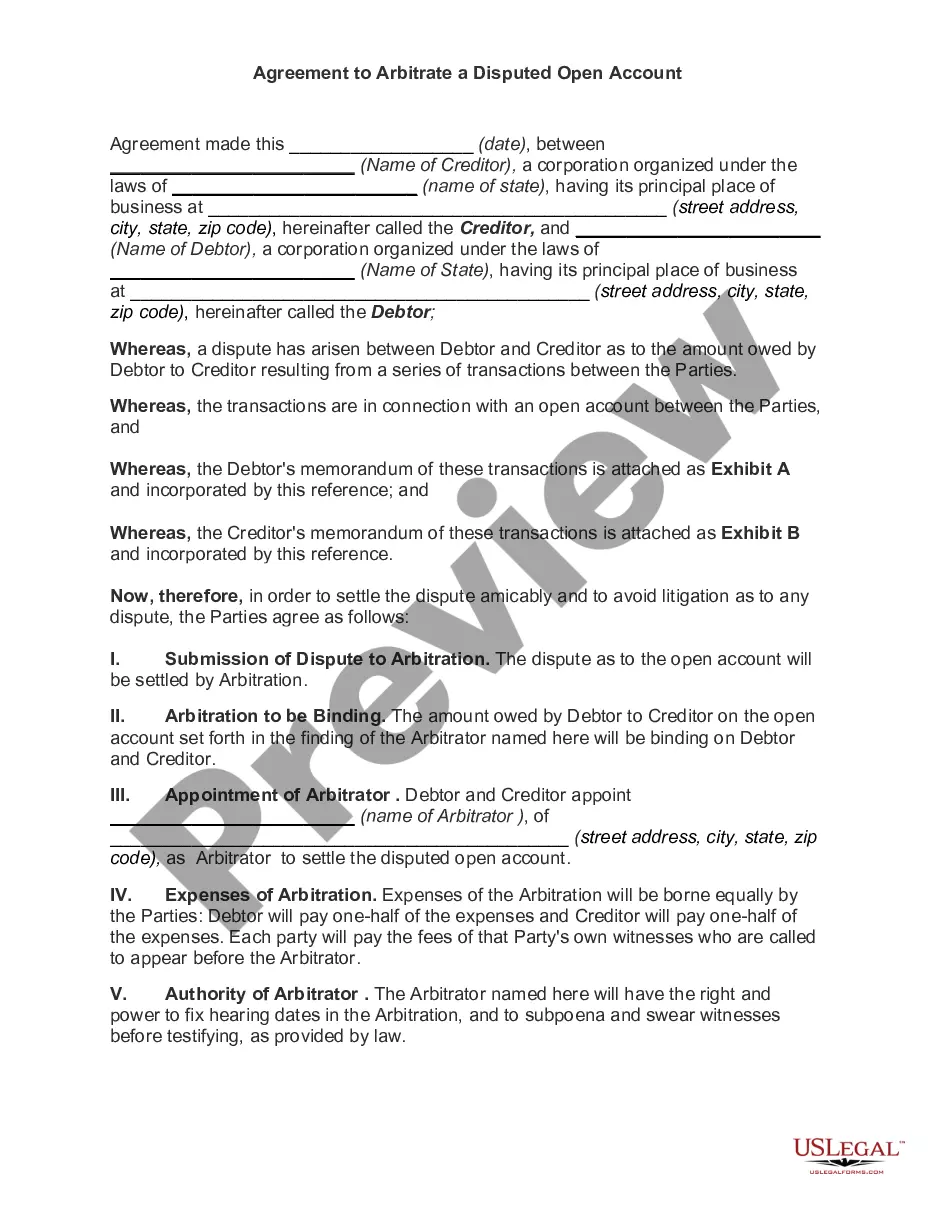
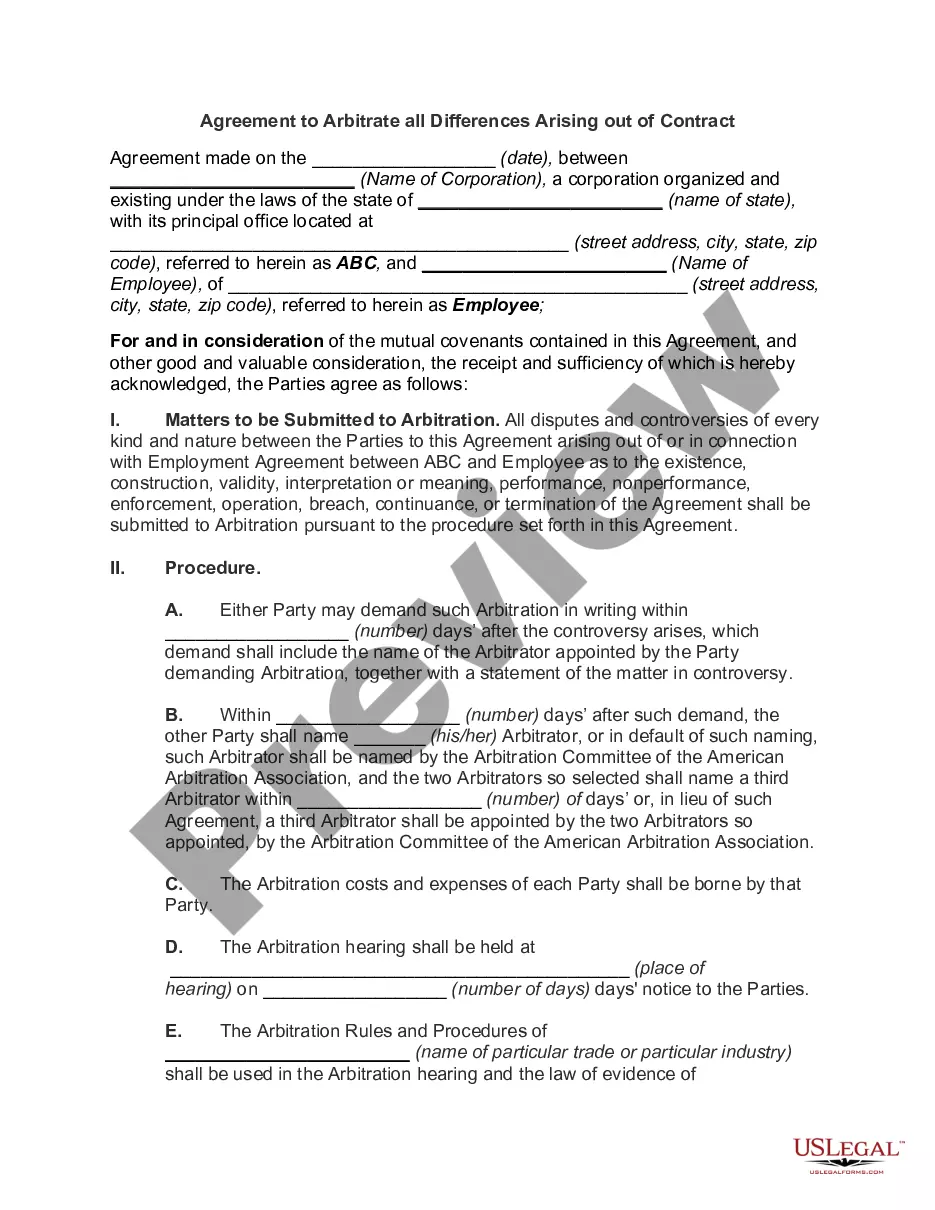
The Agreement to Arbitrate a Disputed Open Account is a legal document that outlines the terms under which two parties agree to resolve disputes over an outstanding balance without going to court. This form serves to streamline conflict resolution by involving an impartial arbitrator, making the process typically faster and less costly than traditional litigation. Unlike formal court proceedings, arbitration offers simplified rules and a confidential setting for both parties.
What’s included in this form
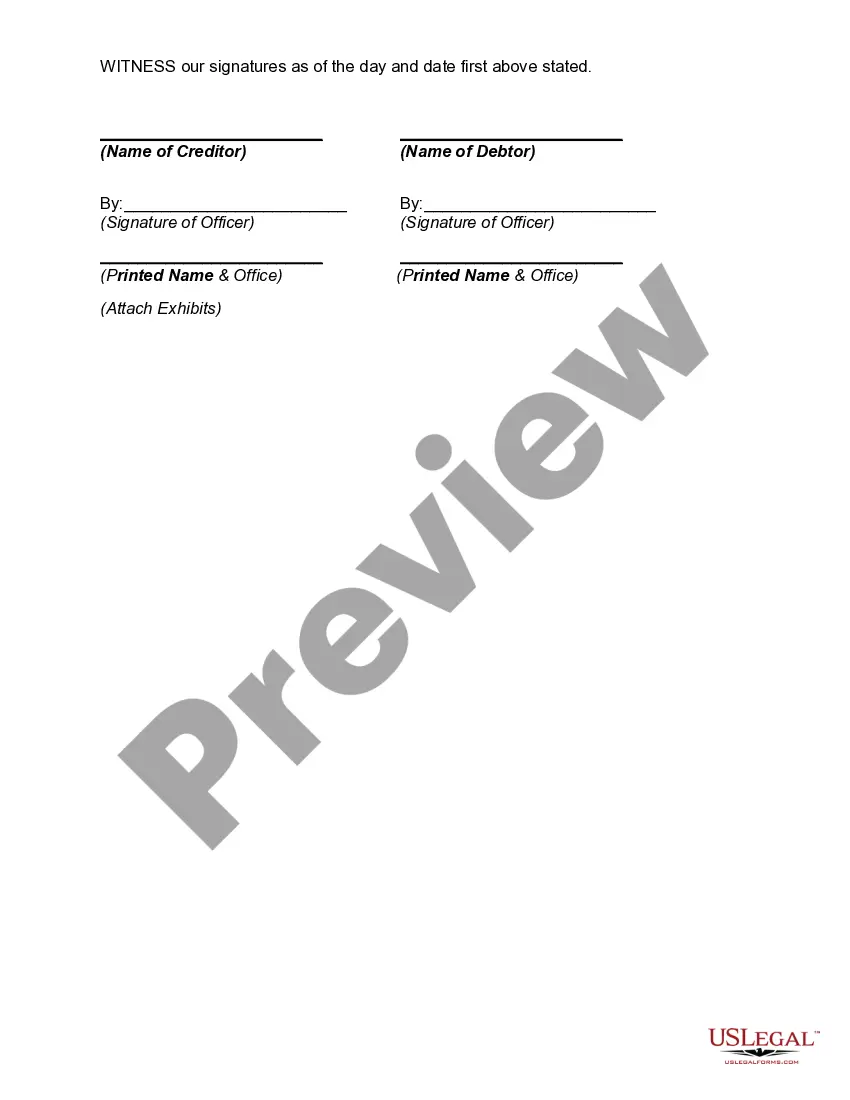
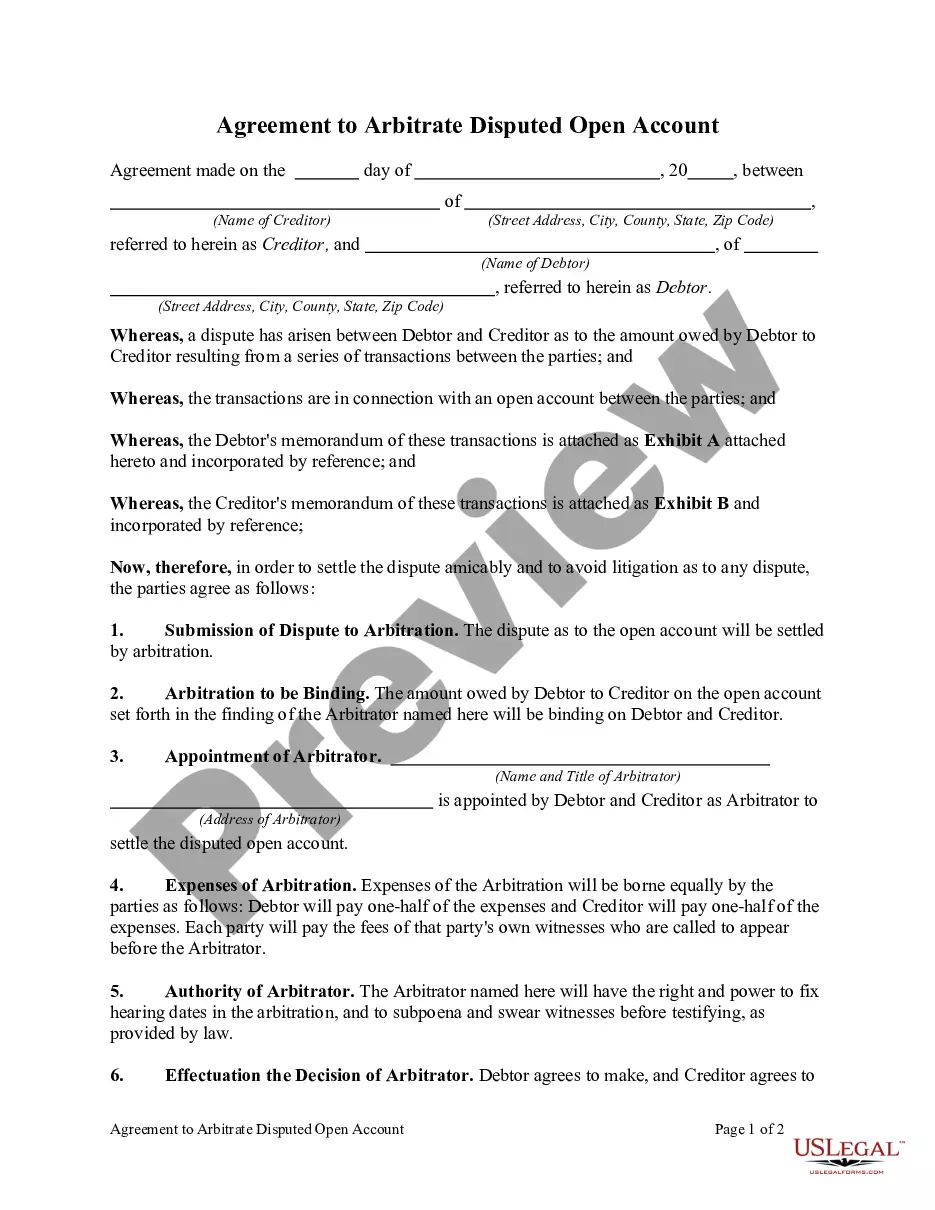
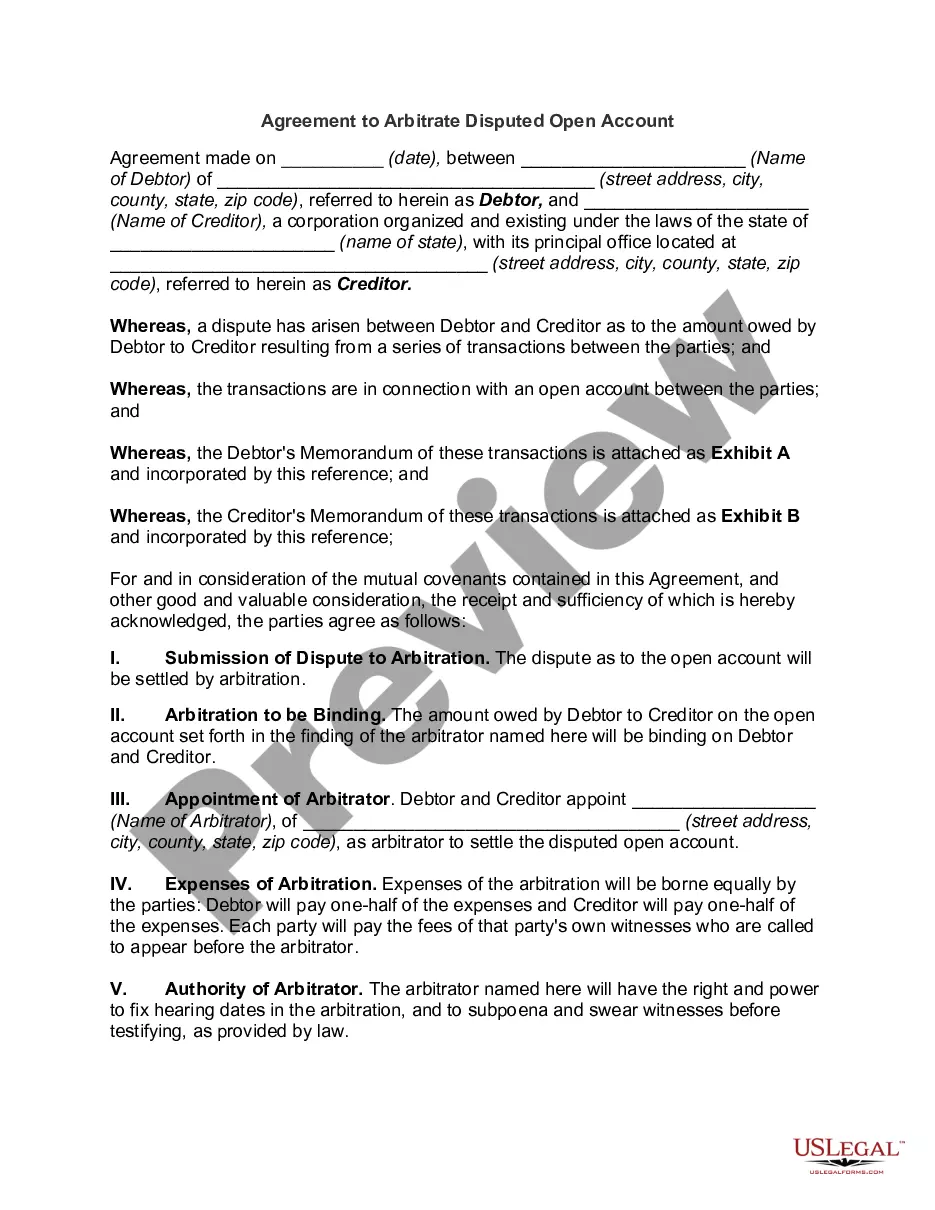
- Submission of dispute: The parties agree to submit their dispute regarding the open account to arbitration.
- Binding arbitration: The arbitrator's decision regarding the amount owed will be final and binding on both parties.
- Appointment of arbitrator: The form includes provisions for appointing an arbitrator to handle the case.
- Expenses of arbitration: It outlines how the costs of arbitration will be shared between the parties.
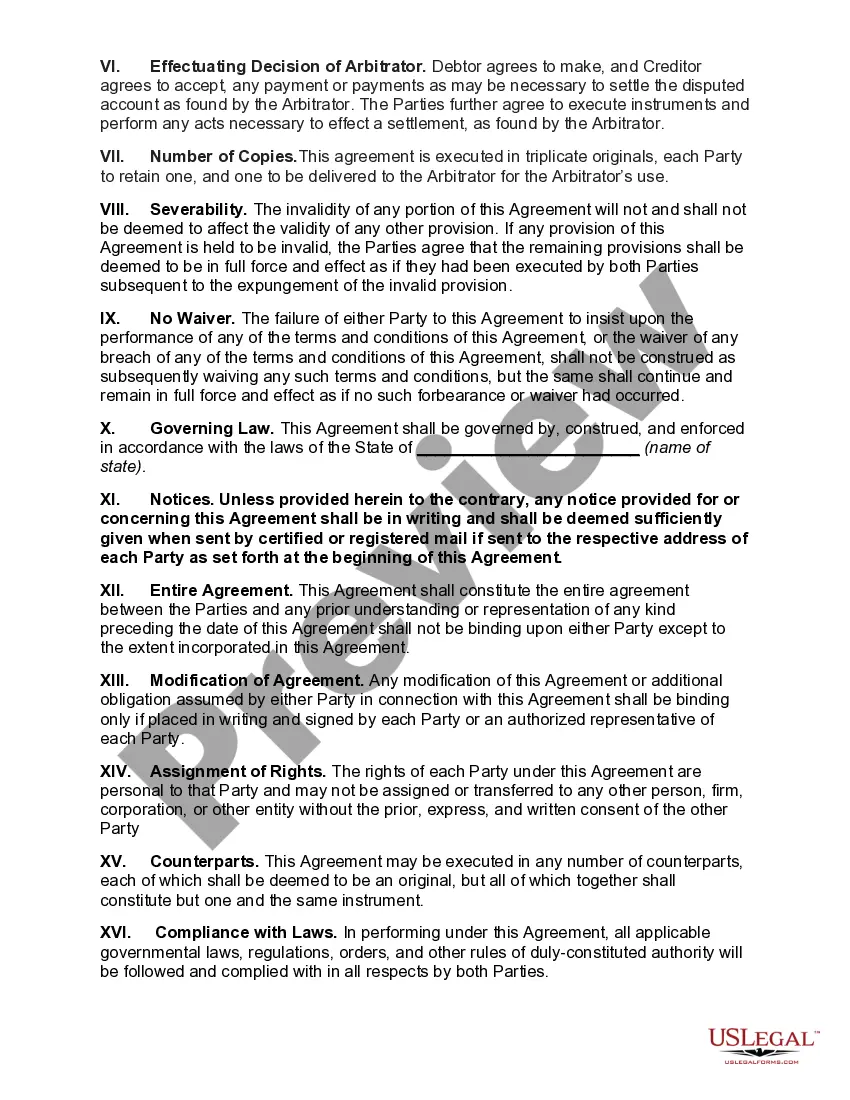
- Severability clause: Affirms that invalid provisions do not affect the validity of the remaining clauses in the agreement.

When this form is needed
This form is ideal when there is a dispute between a creditor and debtor over an outstanding balance. It is commonly used in business transactions where an open account exists and helps to facilitate a resolution without entering the court system. If both parties wish to settle the matter efficiently and amicably, employing this arbitration agreement can save time and resources.
Who needs this form
This form is suitable for:
- Businesses acting as creditors seeking to resolve payment disputes.
- Debtors who want to address claims over unpaid accounts with their creditors.
- Both parties who wish to avoid the costs and time associated with litigation.
How to complete this form
- Identify the parties involved by entering the names of the creditor and debtor, along with their respective addresses.
- Attach supporting documents, such as Exhibits A and B, which detail the transactions leading to the dispute.
- Choose and enter the name of an arbitrator who will oversee the arbitration process.
- Fill in the date of the agreement and have both parties sign to formalize the agreement.
- Ensure that you understand and agree to share the arbitration expenses before finalizing the document.
Does this document require notarization?
This form does not typically require notarization unless specified by local law. Notarization can provide additional legal recognition but is not a standard requirement for this arbitration agreement.
Get your form ready online
Our built-in tools help you complete, sign, share, and store your documents in one place.
Make edits, fill in missing information, and update formatting in US Legal Forms—just like you would in MS Word.
Download a copy, print it, send it by email, or mail it via USPS—whatever works best for your next step.
Sign and collect signatures with our SignNow integration. Send to multiple recipients, set reminders, and more. Go Premium to unlock E-Sign.
If this form requires notarization, complete it online through a secure video call—no need to meet a notary in person or wait for an appointment.
We protect your documents and personal data by following strict security and privacy standards.

Make edits, fill in missing information, and update formatting in US Legal Forms—just like you would in MS Word.

Download a copy, print it, send it by email, or mail it via USPS—whatever works best for your next step.

Sign and collect signatures with our SignNow integration. Send to multiple recipients, set reminders, and more. Go Premium to unlock E-Sign.

If this form requires notarization, complete it online through a secure video call—no need to meet a notary in person or wait for an appointment.

We protect your documents and personal data by following strict security and privacy standards.
Typical mistakes to avoid
- Failing to attach necessary documentation that supports the open account claim.
- Not clearly specifying the arbitrator, which could lead to disputes over the selected individual.
- Leaving out the signatures of both parties, rendering the agreement incomplete.
Why complete this form online
- Convenient access to a professionally drafted document that can be downloaded instantly.
- Editability allows users to customize the form based on specific circumstances or agreements.
- Reliability, as all forms are created by licensed attorneys to ensure legal validity.
What to keep in mind
- The Agreement to Arbitrate provides a structured approach to resolving disputes over open accounts out of court.
- This form can help both parties avoid litigation costs and expedite dispute resolution.
- Properly completing the form and adhering to the outlined processes is crucial for enforceability.
Looking for another form?


Form popularity
FAQ
Because arbitration prevents your claims taken seriously, there's no upside to remaining in a mandatory arbitration agreement. Even if you opt out, you can still choose arbitration to settle a dispute, so there's no downside to opting out.
In other words, it is legal for your employer to rescind a job offer if you refuse to sign an arbitration agreement. And, if you are employed at will?as the vast majority of employees are?your employer may fire you for refusing to sign. So, you may be putting your job in jeopardy if you don't sign the agreement.
What is an arbitration agreement? Arbitration agreements require that persons who signed them resolve any disputes by binding arbitration, rather than in court before a judge and/or jury.
This type of agreement is not enforceable unless you sign it. If you refuse to sign, it is possible that your employer will do nothing in response. The decision about whether to sign an arbitration agreement can be a difficult one, and often is made after talking with coworkers about what others plan to do.
Arbitration agreements do not favor employees. While the process of arbitration is not necessarily a bad thing for employees, forced arbitration is. It namely deprives them of their rights to the civil justice system. Employees under forced arbitration file claims rarely.
As a general matter, it is not a particularly good idea for employees to sign an arbitration agreement with their employer. As described in more detail above, employers prefer arbitration because it tends to benefit them. However, these benefits come at a cost: your rights as an employee.
There are also some disadvantages of arbitration to consider: No Appeals: The arbitration decision is final. There is no formal appeals process available. Even if one party feels that the outcome was unfair, unjust, or biased, they cannot appeal it.
The obvious advantage of including an arbitration clause in your contract before the dispute arises is that once the dispute does arise, you can force the dispute out of the court system, and you can force the other side to arbitrate. But the good news can also be the bad news, if you're not careful.