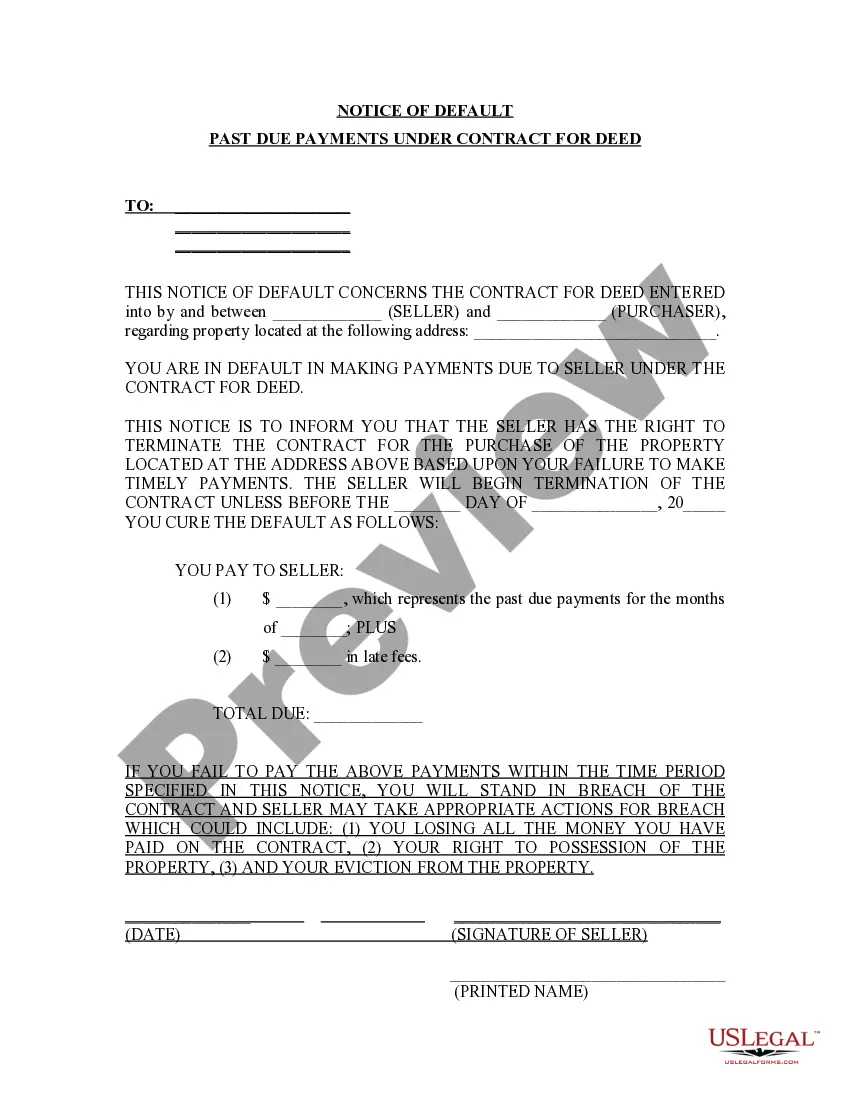
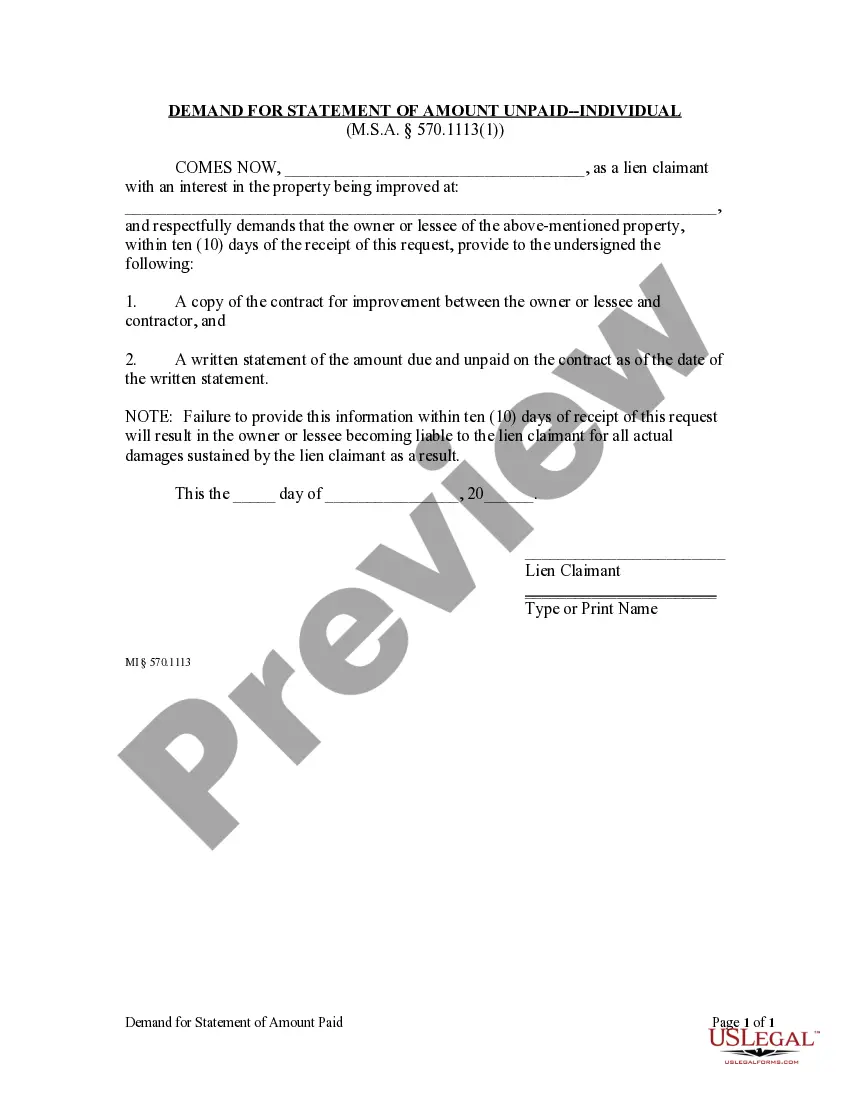
Michigan Demand for Statement of Amount Unpaid - Individual
What this document covers
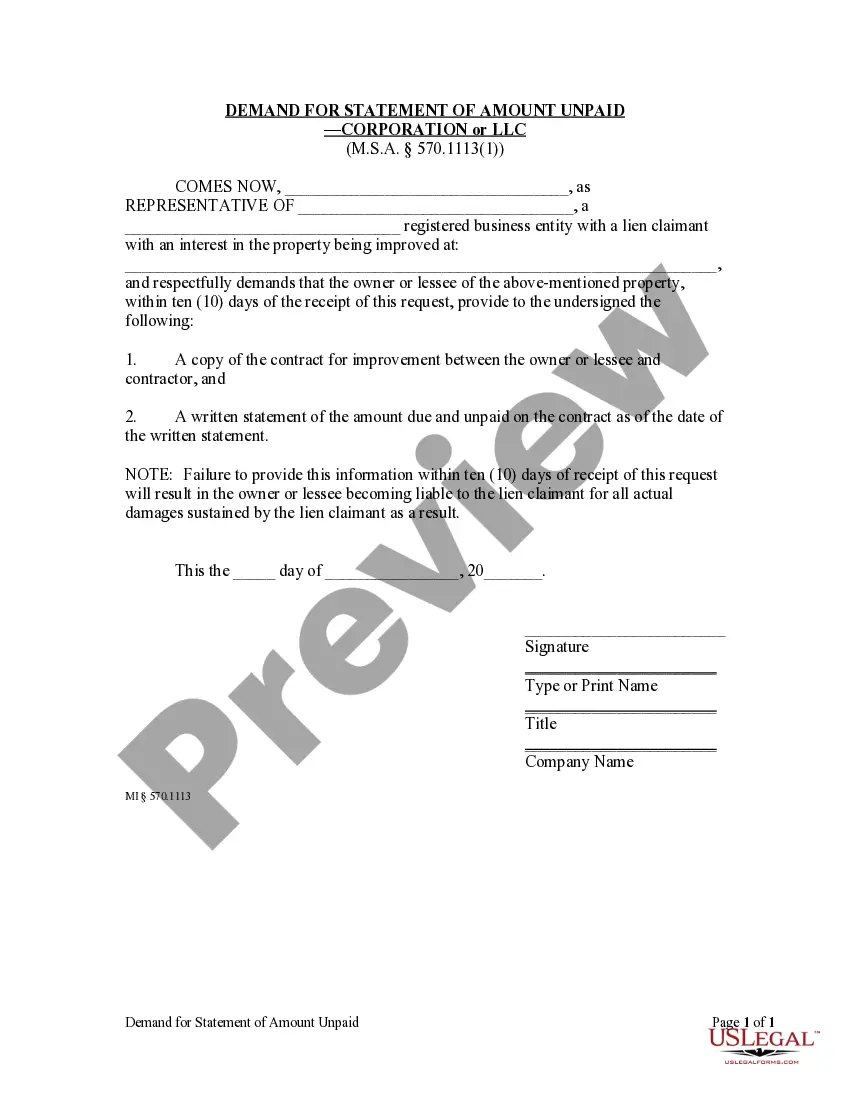
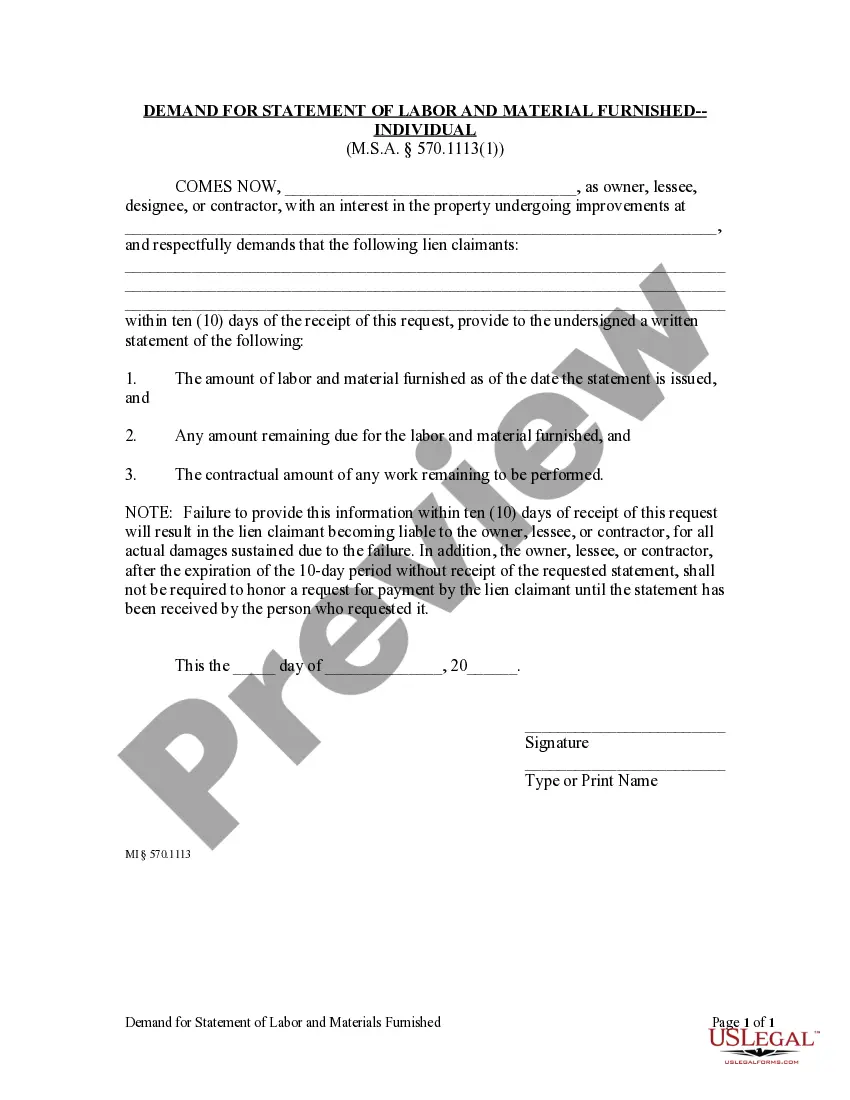
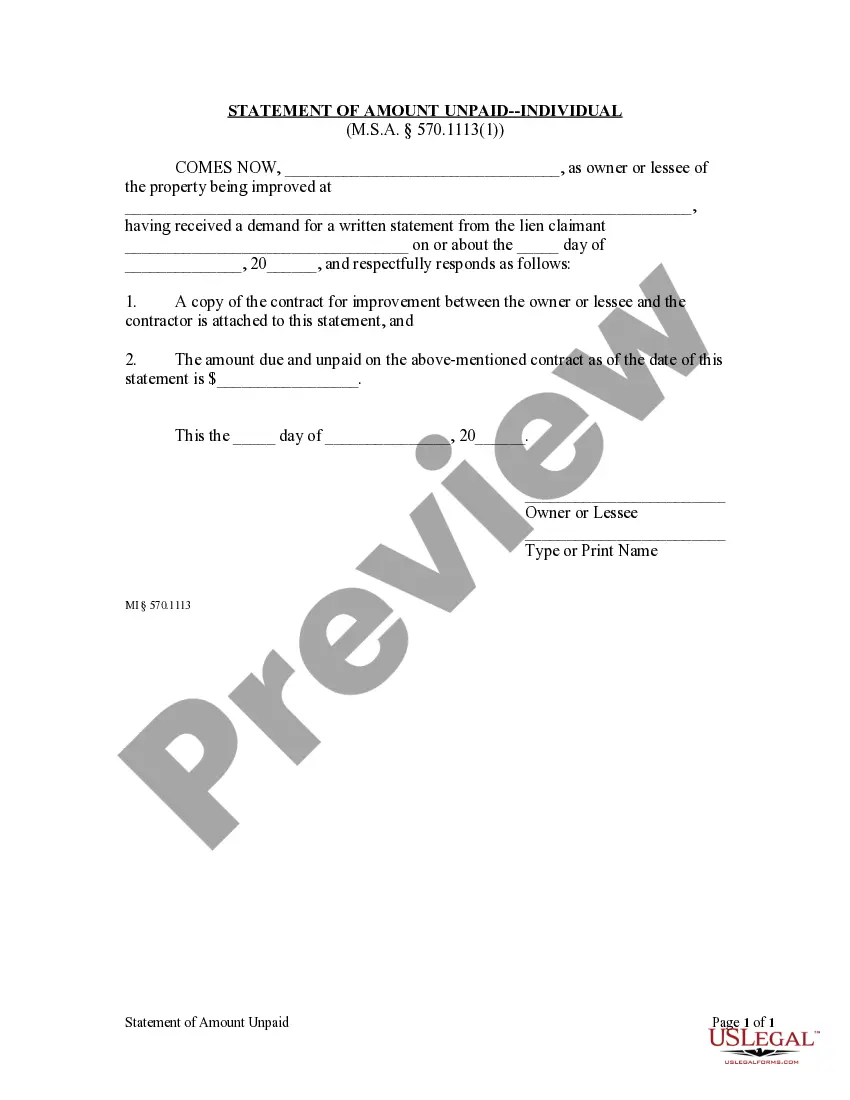
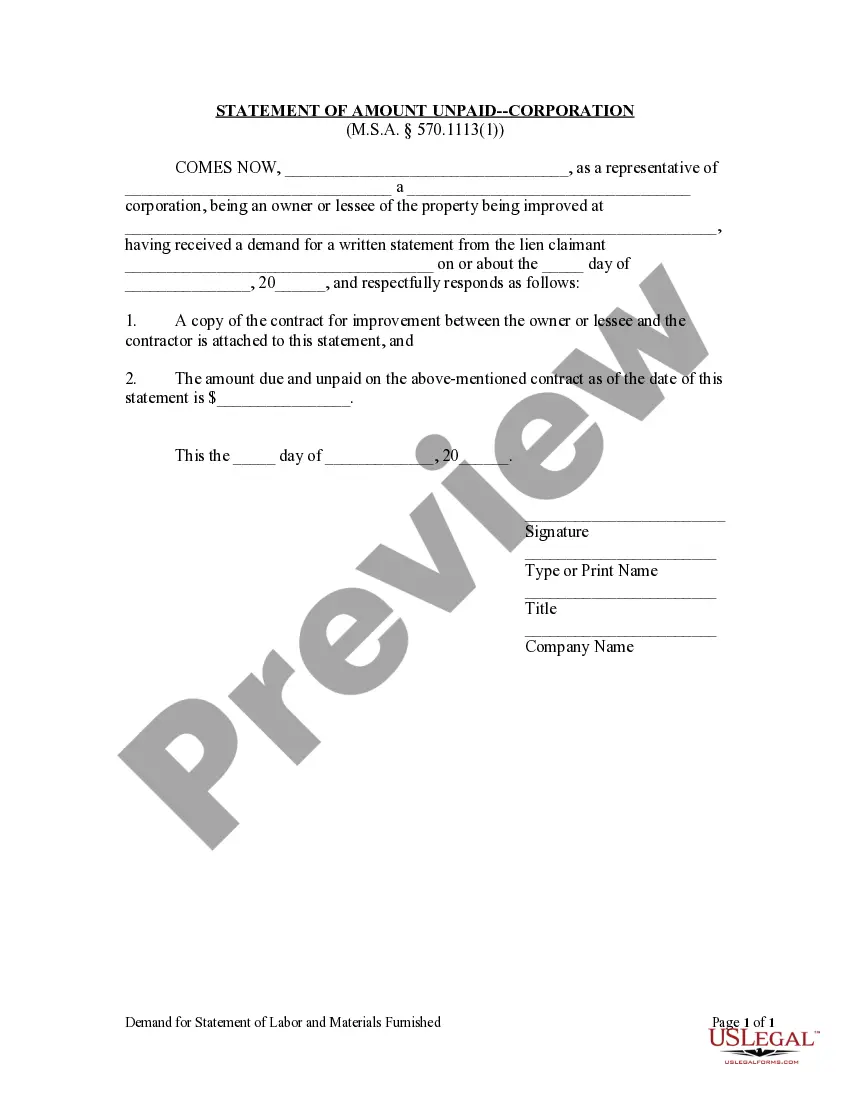
The Demand for Statement of Amount Unpaid - Individual is a legal document used by lien claimants to request information from property owners or lessees. This form specifically demands a copy of the improvement contract and a written statement of the amount due from the contractor. It serves to protect the lien claimant's interests under Michigan statutes, ensuring transparency in financial matters related to property improvement contracts.
Main sections of this form
- Identification of the lien claimant and the property involved.
- Request for a copy of the improvement contract.
- Demand for a written statement of the unpaid amount as of the requested date.
- Notice of potential liability for failure to respond within ten days.
- Signature and date lines for the lien claimant.
When this form is needed
This form is necessary when a lien claimant needs to formally request financial information related to an improvement project on a property. It is particularly important in scenarios where a contractor's payment is overdue, and the lien claimant needs confirmation of the agreed contract terms and outstanding amounts.
Who this form is for
- Individuals or businesses acting as lien claimants on construction projects.
- Property owners or lessees who have not received payment or wish to clarify payment statuses.
- Contractors seeking formal records of contracts and payment status.
Instructions for completing this form
- Enter the name of the lien claimant and their interest in the property.
- Specify the address of the property being improved.
- Detail the contract terms you are requesting from the owner or lessee.
- Indicate the date and complete the signature section of the form.
- Ensure that all information is accurate and clear before delivery to the recipient.
Notarization guidance
Notarization is generally not required for this form. However, certain states or situations might demand it. You can complete notarization online through US Legal Forms, powered by Notarize, using a verified video call available anytime.
Get your form ready online
Our built-in tools help you complete, sign, share, and store your documents in one place.
Make edits, fill in missing information, and update formatting in US Legal Forms—just like you would in MS Word.
Download a copy, print it, send it by email, or mail it via USPS—whatever works best for your next step.
Sign and collect signatures with our SignNow integration. Send to multiple recipients, set reminders, and more. Go Premium to unlock E-Sign.
If this form requires notarization, complete it online through a secure video call—no need to meet a notary in person or wait for an appointment.
We protect your documents and personal data by following strict security and privacy standards.

Make edits, fill in missing information, and update formatting in US Legal Forms—just like you would in MS Word.

Download a copy, print it, send it by email, or mail it via USPS—whatever works best for your next step.

Sign and collect signatures with our SignNow integration. Send to multiple recipients, set reminders, and more. Go Premium to unlock E-Sign.

If this form requires notarization, complete it online through a secure video call—no need to meet a notary in person or wait for an appointment.

We protect your documents and personal data by following strict security and privacy standards.
Typical mistakes to avoid
- Failing to provide accurate property address details.
- Not specifying the exact information requested from the owner or lessee.
- Missing the deadline for sending the request or following up.
- Omitting the date or signature on the form.
Advantages of online completion
- Convenient access to legal forms without the need for physical paperwork.
- Editable templates that allow customization to fit individual needs.
- Reliability of legally drafted forms by licensed attorneys.
Looking for another form?

Form popularity
FAQ
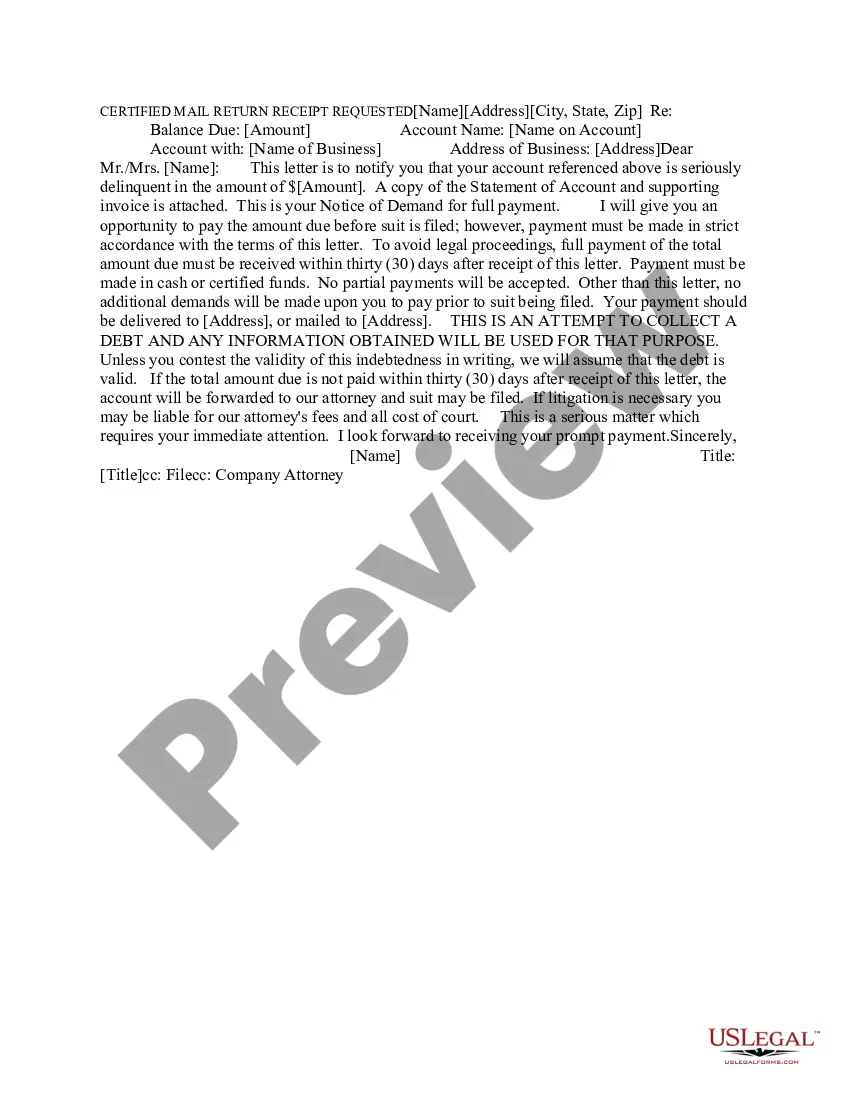
Type your letter. Concisely review the main facts. Be polite. Write with your goal in mind. Ask for exactly what you want. Set a deadline. End the letter by stating you will promptly pursue legal remedies if the other party does not meet your demand. Make and keep copies.
No, a demand letter is not necessary prior to filing a superior court limited/unlimited jurisdiction lawsuit in California.
Although an attorney often writes the demand letter, you can also do it yourself in several cases:If you have a fairly simple legal issue and you want to go through the process yourself, without an attorney. If you want to clarify your thoughts on what happened and what you want.
An attorney is usually not necessary at this point and you can write a demand letter on your own. To write one, gather necessary documents, draft your letter, and send the letter to your opposing party.
You can ask them what use they have put the money to. This is obviously going to remind them that they owe you money, and in case it genuinely simply skipped their mind, the best case scenario will be that they return it right then and there. Ask them to cover for you someplace. Give them a polite reminder.
1Type your letter.2Concisely review the main facts.3Be polite.4Write with your goal in mind.5Ask for exactly what you want.6Set a deadline.7End the letter by stating you will promptly pursue legal remedies if the other party does not meet your demand.8Make and keep copies.How to Write a Demand Letter WashingtonLawHelp.org Helpful\nwww.washingtonlawhelp.org > resource > how-to-write-a-demand-letter
Establish facts. Don't assume everyone knows the facts. Refer to evidence. If there's evidence (like a contract), you don't need to include it, but you should refer to it. Make a demand. Be specific as to what you want. Set a deadline and establish method of payment. Offer a consequence.
Be Organized. Submit the Letter in a Timely Manner. Reference Pertinent Claim Information on All Communication. Use Appropriate Professional Language and Tone. Use Subheadings. Be Specific. Set Forth Demand Amount Clearly. Provide Deadline for Response.