Maine Release of Mortgage
What this document covers
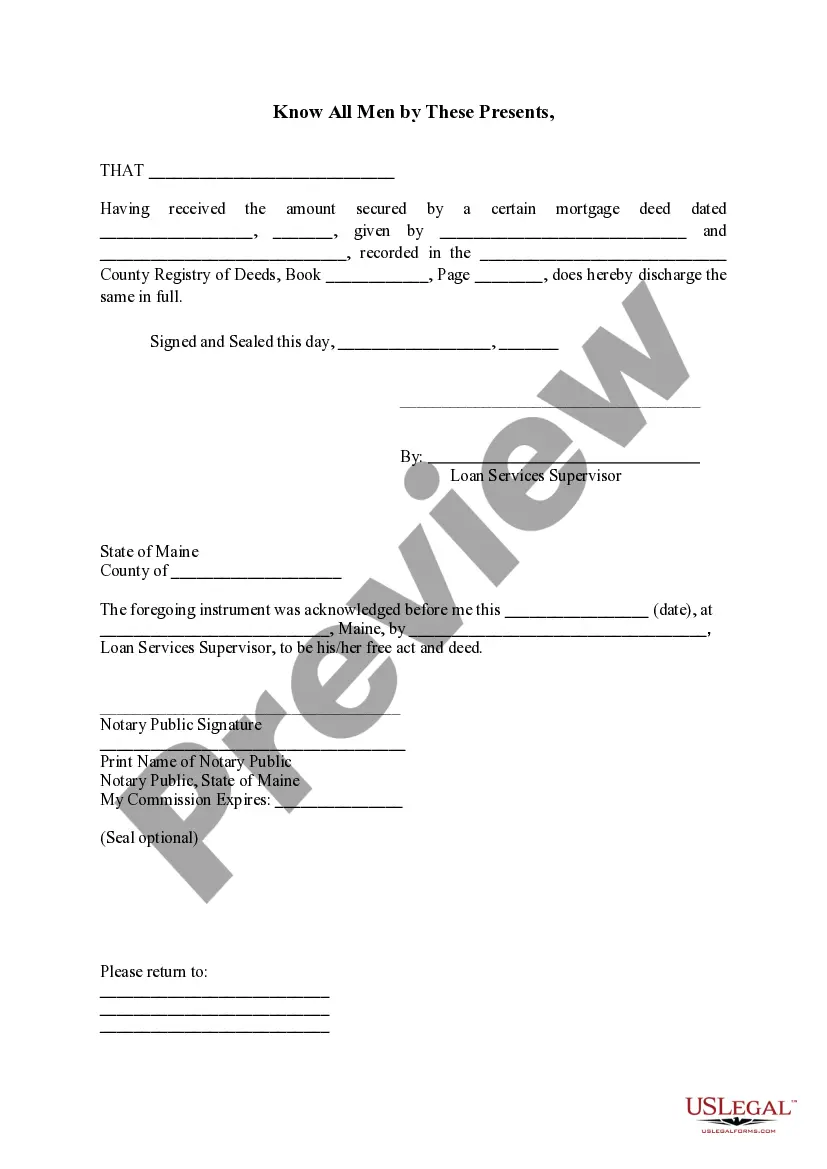
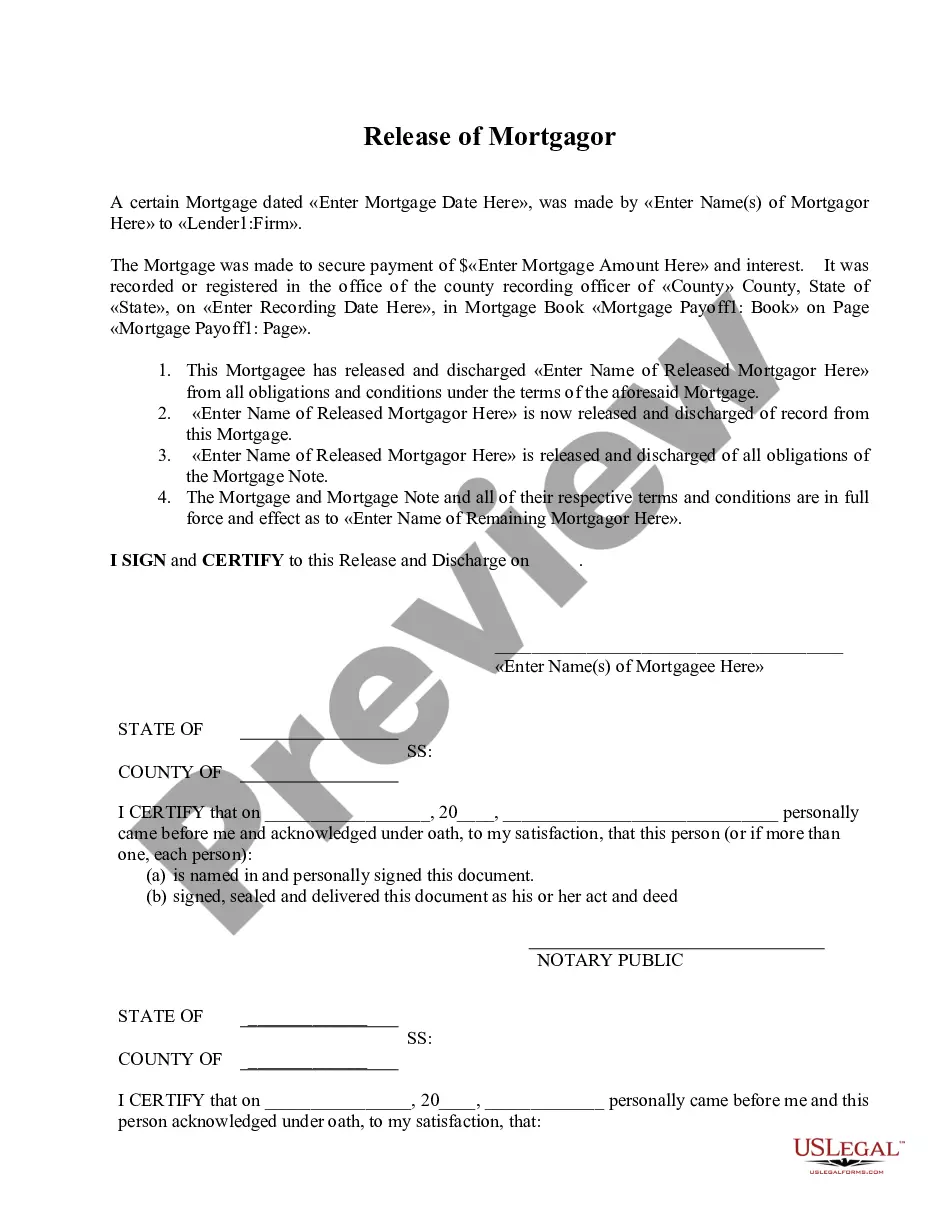
The Release of Mortgage is a legal document used to officially release a mortgage lien on a property once the mortgage debt has been paid in full. This form is essential for homeowners who have completed their mortgage payments and want to confirm that the lender has relinquished any claim over the property. By using this form, you ensure that the mortgage holder formally discharges the mortgage, which is crucial for property ownership clarity and future transactions.
Key parts of this document
- Identification of the mortgage holder and the borrower(s).
- Details of the original mortgage, including date and recording information.
- Statement of discharge, confirming the mortgage has been paid in full.
- Date and signature lines for the mortgage holder and notary public.
When to use this form
This form is needed when a mortgage has been completely paid off, and the borrower wants to ensure there is no remaining debt on the property. It is particularly important during property sales or refinances, as a clear title without encumbrances provides confidence to potential buyers and lenders.
Who should use this form
This form is suitable for:
- Homeowners who have satisfied their mortgage obligations.
- Lenders or mortgage holders completing the discharge process.
- Real estate professionals assisting clients in property transactions.
Steps to complete this form
- Identify the mortgage holder and the borrower(s) involved.
- Enter the details of the original mortgage, including the date and recording information.
- Clearly state that the mortgage is being discharged as it has been paid in full.
- Sign and date the form in the presence of a notary public.
- Complete the notary section to validate the signature.
Does this form need to be notarized?
Yes, this form must be notarized to be legally valid. Using US Legal Forms' integrated online notarization service makes this process simple and secure, allowing you to complete your notarization via a video call without the need for travel.
Get your form ready online
Our built-in tools help you complete, sign, share, and store your documents in one place.
Make edits, fill in missing information, and update formatting in US Legal Forms—just like you would in MS Word.
Download a copy, print it, send it by email, or mail it via USPS—whatever works best for your next step.
Sign and collect signatures with our SignNow integration. Send to multiple recipients, set reminders, and more. Go Premium to unlock E-Sign.
If this form requires notarization, complete it online through a secure video call—no need to meet a notary in person or wait for an appointment.
We protect your documents and personal data by following strict security and privacy standards.

Make edits, fill in missing information, and update formatting in US Legal Forms—just like you would in MS Word.

Download a copy, print it, send it by email, or mail it via USPS—whatever works best for your next step.

Sign and collect signatures with our SignNow integration. Send to multiple recipients, set reminders, and more. Go Premium to unlock E-Sign.

If this form requires notarization, complete it online through a secure video call—no need to meet a notary in person or wait for an appointment.

We protect your documents and personal data by following strict security and privacy standards.
Avoid these common issues
- Failing to complete all required fields, including the mortgage details.
- Not having the form signed in front of a notary.
- Submitting the form without confirming that the mortgage is fully paid.
- Not recording the form with the appropriate county office.
Benefits of completing this form online
- Convenience of downloading and completing the form from anywhere.
- Editable fields allow users to personalize the document as needed.
- Reliability of attorney-drafted templates ensures legal compliance.
Looking for another form?
Form popularity
FAQ
To release someone from a mortgage, you usually need to refinance the mortgage or obtain a formal release from the lender. This process may involve ensuring that the mortgage is either transferred or restructured to reflect the change in obligation. If you need assistance with the documentation, US Legal Forms offers resources to help you draft the required release agreements and navigate the necessary steps.
Give your lender reasonable time, possibly two to three weeks, to release its lien. Then call or visit your lender. Advise the lender that you have yet to receive its "release of lien" document.
A Mortgage Release is where you, the homeowner, voluntarily transfer the ownership of your property to the owner of your mortgage in exchange for a release from your mortgage loan and payments.Depending on your situation, you may be required to make a financial contribution to receive a mortgage release.
People can just let the home go to foreclosure, and this will affect their scores for seven years. Or they can do a deed in lieu of foreclosure. With a deed in lieu, you voluntarily give your home to the lender in exchange for the cancellation of your loan. This, too, can create a negative mark on your credit history.
The discharge of a mortgage means that the borrower no longer is obligated to make further payments on the loan. A discharge can be the result of the mortgage being paid in full or refinanced by the borrower. A mortgage also can be discharged if the borrower files for bankruptcy.
What is Satisfaction of Mortgage? A Satisfaction of Mortgage, also known as a Mortgage Lien Release, is a legal document provided by the mortgagee (financial institution) advising that the mortgage has been paid in full, all terms of the loan have been satisfied and there will no longer be a lien on the property.
When you pay off your loan and you have a mortgage, the lender will send you or the local recorder of deeds or office that handles the filing of real estate documents a release of mortgage.On the other hand, when you have a trust deed or deed of trust, the lender files a release deed.
The charge can also be called a termination or settlement fee. A recorded mortgage discharge certifies that the mortgage has been satisfied and legally releases the interest of the lender in the property and thereby clears the title.
When discharging your mortgage, you are paying your current loan in full. The mortgage we have registered on the title of your property is removed, and we will no longer hold it as security.